Prevod
Once upon a time there was a man who had a hay meadow far up on a hillside, and in the meadow stood a barn where he stored his fodder. But there cannot have been much in that barn these last few years, I should think; for every Midsummer Night, when the grass was at its finest and lushest, the meadow was grazed quite bare, as though a whole herd had been there feeding in the night. This happened once, and it happened twice, and then the man grew tired of it. He told his sons—he had three, and the third was Askepot, as you may well guess—that one of them must spend Midsummer Night in the outlying hay barn, for it would never do to have every last blade of grass eaten up again, as it had been the two previous years. Whoever went must keep a sharp lookout, the man said. Well, the eldest was willing to go and guard the meadow; he would look after the grass, he said, so that neither man nor beast nor the Devil himself should get any of it. Towards evening he went off to the barn and lay down to sleep, but a little way into the night there came such a rumbling and such an earthquake that the walls and roof shook. The lad leapt up and took to his heels as fast as ever he could, not daring even to look behind him; and that night the hay was eaten up just as it had been in the years before.
The next Midsummer Eve the man said again that they could not go on losing all the grass in the outlying meadow year after year. One of his sons must go and watch over it, and watch over it properly, too;
and so the second son was willing to try his luck that evening. He went off to the hay barn and lay down to sleep, just as his brother had done; but during the night there came a rumbling and an earthquake even worse than on the previous Midsummer Night. When the lad heard it, he took fright and ran as fast as though he were being paid for it.
The following year it was Askeladden’s turn; but as he made ready to go, the other two laughed and mocked him. “Yes, you’re just the one to look after the hay, you who have never learnt anything but how to sit in the ashes and roast yourself,” they said. But Askeladden paid no heed to their talk, and towards evening he sauntered off to the outlying meadow. There he went into the hay barn and lay down, but after a while such a dreadful rumbling and crashing began that it was fearsome to hear. Oh, if it gets no worse than this, I can stand it, thought Askeladden. A little later there came another crash and an earthquake that sent the wisps of hay flying about the lad.
Oh, if it gets no worse than this, I can stand it, thought Askeladden. But just then there came a third rumbling and an earthquake so great that the lad thought the walls and roof had come tumbling down;
but when it was over, all at once everything around him grew perfectly still. I wonder if it will come again? thought Askeladden. But no, it did not come again; all was quiet and stayed quiet, and after he had lain there a little while, he heard what sounded like a horse standing just outside the barn door, chewing. He crept over to the crack in the doorway to see what it was. There stood a horse, cropping the grass, and never in his life had Askeladden seen a horse so big and sleek and fine. It wore a saddle and bridle and carried a full suit of armour for a knight, all of copper, polished till it shone. Aha! So you’re the one who eats up our hay, thought the lad. I’ll soon put a stop to that. He quickly took out his fire steel and tossed it over the horse, and then it had no power to stir from the spot. It grew so tame that the lad could do whatever he liked with it. So he mounted it and rode away to a place no one knew about, and there he kept it. When he came home again, his brothers laughed and asked how he had fared. “You can’t have stayed long in the hay barn, if you ever got as far as the meadow at all,” they said. “I lay in the hay barn till the sun rose, but I neither heard nor saw a thing,” said the lad. “Heaven knows what frightened you so.” “Well, we’ll see how well you’ve guarded the meadow,” answered his brothers; but when they got there, the grass stood just as tall and thick as it had the evening before.
The next Midsummer Night it was just the same: neither of the two brothers dared go to the outlying meadow to guard the hay, but Askeladden dared. And exactly the same thing happened as on the previous Midsummer Night: first there came a rumbling and an earthquake, then another a little later, and then yet another, but all three earthquakes were far, far stronger this time. Then all at once everything grew perfectly still again, and the lad heard something chewing outside the barn door;
so he crept as softly as he could to the crack in the doorway—and sure enough, there stood another horse close against the wall, munching and cropping the grass. It was much bigger and sleeker even than the first, and it had a saddle on its back, a bridle on its head, and a full suit of armour for a knight—all of shining silver, and as splendid as anyone could wish to see. Aha! So you’re the one who’s eating up our hay tonight, thought the lad. I’ll soon put a stop to that. He took out his fire steel and tossed it over the horse’s mane, and there it stood, as meek as a lamb. So the lad rode this horse, too, to the place where he kept the other, and then went home again. “The hay meadow must look a pretty sight today,” said his brothers. “Oh, indeed it does!” said Askeladden.
They went off to see it again, and there stood the grass, as thick and tall as before, but that did nothing to make them any kinder to Askeladden. When the third Midsummer Night came, neither of the two elder brothers dared sleep in the outlying barn and guard the grass, for they had been so frightened on the nights they had spent there that they never forgot it. But Askeladden dared; and exactly the same thing happened as on the two previous nights. There came three earthquakes, each more dreadful than the last, and at the third the lad was tossed from one wall of the barn to the other; but then all at once everything grew perfectly still. When he had lain there a little while, he heard something chewing outside the barn door. Once more he crept to the crack in the doorway—and there stood a horse just outside, far, far bigger and sleeker than the other two he had caught. Aha!
So you’re the one who’s eating up our hay this time, thought the lad. I’ll soon put a stop to that. He snatched out his fire steel and tossed it over the horse, and there it stood as though nailed to the ground, and the lad could do whatever he liked with it. He rode off to the place where he kept the other two, and afterwards he went home again. There his two brothers mocked him just as they had before. He must have kept a fine watch over the grass in the meadow that night, they said, for he looked as though he were still walking in his sleep. But Askeladden paid no heed; he only told them to go and look. So they did, and this time too the grass stood just as fine and thick as ever.
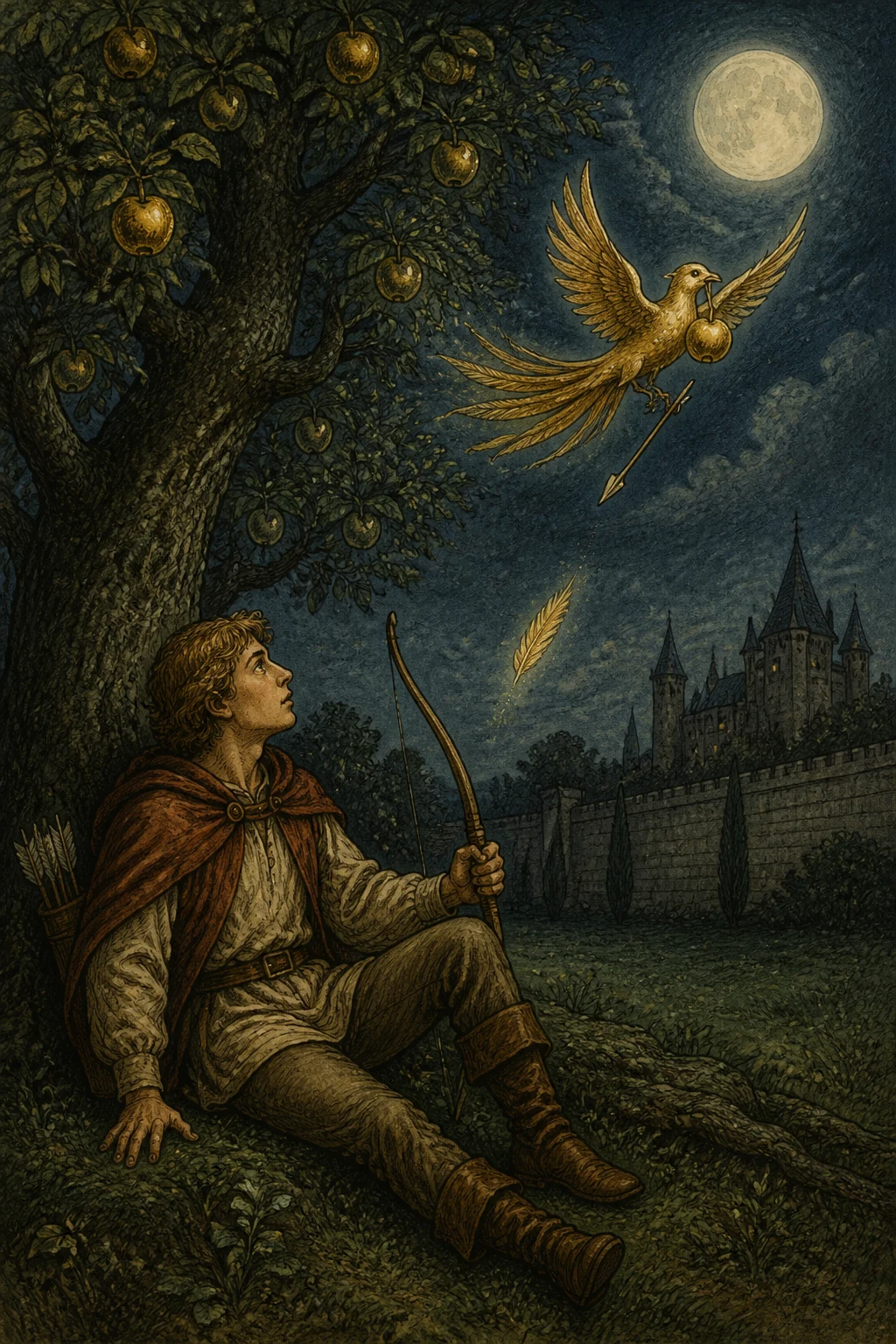
The king of the country where Askeladden’s father lived had a daughter whom he would give to no one but the man who could ride to the top of the glass mountain—for close by the royal palace stood a very, very high mountain of glass, smooth as ice. The princess was to sit at its very summit with three golden apples in her lap, and whoever could ride up and take the three golden apples should have her and half the kingdom. The king had this proclaimed outside every church in the land, and in many other kingdoms too. The princess was so beautiful that everyone who saw her fell in love with her, whether he wished to or not—and so you may well imagine that all the princes and knights were eager to win her, with half the kingdom into the bargain. They came riding from every corner of the world, so splendid that they shone, and on horses that fairly pranced along; and every one of them thought he would be the one to win the princess.
When the day appointed by the king arrived, the foot of the glass mountain was so thick with knights and princes that it teemed with them. Everyone who could crawl or walk wanted to go and see who would win the princess, and Askeladden’s two brothers were going too;
but they would not have him with them on any account. If they went about with such a changeling, so filthy and black from lying and poking in the ashes, people would only make fun of them, they said. “Well, I can go just as well alone as by myself,” said Askeladden. When the two brothers reached the glass mountain, all the princes and knights were riding at it till their horses foamed; but little good it did them, I should think, for the moment the horses set a hoof on the mountain, they slipped, and not one of them got so much as a few feet up. Nor was that any wonder, for the mountain was as smooth as a windowpane and as steep as the wall of a house. But they all longed to have the princess and half the kingdom, and they rode and they slid, and that was all that came of it.
At last all the horses were so tired that they could do no more, and so drenched with sweat that the foam streamed down their sides, and the knights had to give up. The king was already thinking of having it proclaimed that the riding would begin again the next day, to see whether things might go better then; but just at that moment a knight came riding on a horse so fine that no one had ever seen its like. He had copper armour and a copper bridle, all so bright that it gleamed. The others called out that he might as well spare himself the trouble of trying to ride up the glass mountain, for it was no use anyway; but he turned a deaf ear to them. He rode straight towards the glass mountain and up it as though it were nothing at all, and a good way too—about a third of the way, it must have been;
but when he got there, he turned his horse and rode down again. The princess thought she had never seen so handsome a knight, and as he rode she sat thinking, Heaven grant that he comes all the way up! When she saw him turn his horse, she threw one of the golden apples after him, and it rolled into his shoe. But no sooner had he reached the foot of the mountain than he rode away so fast that no one knew what had become of him. That evening all the princes and knights had to appear before the king, so that the one who had ridden so far up the glass mountain could show the golden apple the princess had thrown. But none of them had it; they came one after another, and not one could produce the apple.
That evening Askepot’s brothers came home too, and told him at great length about the riding up the glass mountain. At first no one had managed to get so much as a single step up. “But then someone came in copper armour, with a copper bridle, so bright that you could see him shining a long way off,” they said. “And there was a fellow who could ride! He rode more than a third of the way up the glass mountain, and he could have ridden right to the top if he had wanted; but he turned there, for he must have thought that was enough for one day.” “Oh, I should have liked to see him too,” said Askeladden—he was sitting in the hearth, poking about as usual. “You, indeed!” said his brothers. “You look just the thing to be among such fine gentlemen, you ugly wretch, sitting there!” The next day the brothers were going off again, and once more Askepot asked whether he might go with them and watch the riders. But no, he certainly might not; he was far too ugly and filthy, they said. “Well, well, I’m just as happy to go alone as by myself,” said Askepot.
When the brothers reached the glass mountain, all the princes and knights began riding again, and you may be sure they had seen to their horses’ shoes this time. But it did no good: they rode and they slid, just as they had the day before, and no one got so much as a yard up;
and when they had worn their horses out so that they could do no more, they all had to stop again. Then the king thought he had better proclaim that the riding would take place for the last time on the following day, in case things might go better then. But he thought again: he had better wait a little longer, he decided, in case the knight in copper armour should come that day too. They saw nothing of him, but all at once someone came riding on a horse far, far finer than the one the knight in copper armour had ridden. This knight had silver armour, a silver saddle, and a silver bridle, all so bright that they glittered and shone from far away. Again the others called out to him, saying that he might as well not attempt to ride up the glass mountain, for it would never be any use; but the knight paid no heed. He rode straight to the glass mountain and up it, even farther than the knight in copper armour; but when he had gone two-thirds of the way, he turned his horse and rode down again. The princess liked him even better, and sat wishing he would only come all the way up; but when she saw him turn, she threw the second apple after him, and it rolled into his shoe. The moment he reached the foot of the glass mountain, he rode away so fast that no one could see what had become of him.
That evening, when everyone had to appear before the king and the princess so that whoever had the golden apple could show it, they came one after another, but no one had a golden apple. Just as on the previous day, the two brothers came home that evening and told how things had gone: everyone had ridden, and no one could get up. “But at long last someone came in silver armour, and he had a silver bridle and a silver saddle too,” they said. “And he could ride! He went about two-thirds of the way up, but then he turned back. There was a fellow for you, and the princess threw the second golden apple to him,” said the brothers.
“Oh, I should have liked to see him too,” said Askeladden. “Oh yes, he was surely as bright as the ashes you sit poking in, you ugly black wretch!” said his brothers.
On the third day everything went just as it had on the days before. Askeladden wanted to go along and watch the riding, and the other two would not have him with them; and when they reached the glass mountain, no one could get so much as a yard up. Everyone was waiting for the knight in silver armour, but there was neither sight nor sound of him. At long last, however, someone came riding on a horse so fine that no one had ever seen its equal. He had golden armour, a golden saddle, and a golden bridle, so bright, so very bright that they glittered and shone from a long way off. The other knights and princes did not even get as far as calling out to tell him it was no use trying, so astonished were they at his splendour. He rode straight towards the glass mountain and flew up it as though it were nothing at all, so that the princess did not even have time to wish he would come right to the top. The moment he reached her, he took the third golden apple from her lap, then turned his horse and rode down again; and before anyone knew it, he had vanished from their sight.
When the two brothers came home that evening, they talked long and eagerly about how the riding had gone that day, and at last they told him about the knight in golden armour.
“There was a fellow for you! There isn’t so splendid a knight in all the world!” said his brothers. “Oh, I should have liked to see him too!” said Askeladden. “Yes, there’s rather less of a gleam in that heap of coals you lie grubbing in, you ugly black wretch!” said his brothers.
The next day all the knights and princes had to appear before the king and his daughter—it must have grown too late the evening before, I suppose—so that whoever had the golden apple could show it. But they came one after another, first the princes and then the knights, and no one had a golden apple. “But someone must have it,” said the king, “for we all saw someone ride up and take it.” So he ordered everyone in the kingdom to come to the palace and see whether they could produce the golden apple. They came one after another, but no one had the golden apple, and at long last Askeladden’s two brothers came too. They were the last, and the king asked whether there was no one else left in the kingdom. “Oh yes, we have a brother,” the two said, “but he certainly hasn’t taken the golden apple. He hasn’t been out of the ash heap on any of these days.” “Well, that makes no difference,” said the king. “If everyone else has come to the palace, he may come too.” And so Askeladden had to go to the royal palace as well.
“Have you got the golden apple?” asked the king. “Yes, here’s the first, and here’s the second, and here’s the third as well,” said Askeladden, taking all three golden apples out of his pocket. At the same moment he threw off his sooty rags, and there he stood in the golden armour, so splendid that he shone. “Yes, you shall have my daughter and half my kingdom; you have well earned them both,” said the king. So there was a wedding, and Askelad won the princess, and you may be sure there was merry feasting at that wedding, for they could all make merry, even if they could not ride up the glass mountain; and if they have not finished making merry, they are at it still.