Prevod
_A peasant woman of Miano gives birth to a myrtle. A Prince falls in love with it, and from it comes a most beautiful Fairy. Going away, he leaves her inside the myrtle, with a little bell attached. Some wicked women, jealous of his love, enter the Prince’s chamber and touch the myrtle; the Fairy comes out, and they kill her. The Prince returns, discovers the havoc, and wishes to die of grief; but, recovering the Fairy through a strange turn of fortune, he puts the courtesans to death and takes the Fairy for his wife._ Not a soul was heard to breathe while Zeza continued her tale; but scarcely had she finished speaking when a great uproar broke out, and no one could stop laughing over the Ass’s droppings and the enchanted cudgel. Someone remarked that if only there were a whole grove of such cudgels, more than a few rogues would cease playing the fool, and more than a few others would acquire some sense, and nowadays there would not be more asses than grains of flour. After they had talked a little on this subject, however, the lord bade Cecca take up the thread of the tales, and she began as follows:
If men considered how much harm, how much ruin, how many households are brought to destruction by the world’s accursed women, they would be more careful to shun the tracks of a dishonest woman than the sight of a venomous snake. They would not squander their honor on the dregs of a brothel, their lives on a hospital of diseases, or their entire income on a common whore not worth three farthings, since she gives them nothing to swallow but compounded pills of vexation and rage, as you shall hear happened to a Prince who had fallen into the hands of this wicked breed.
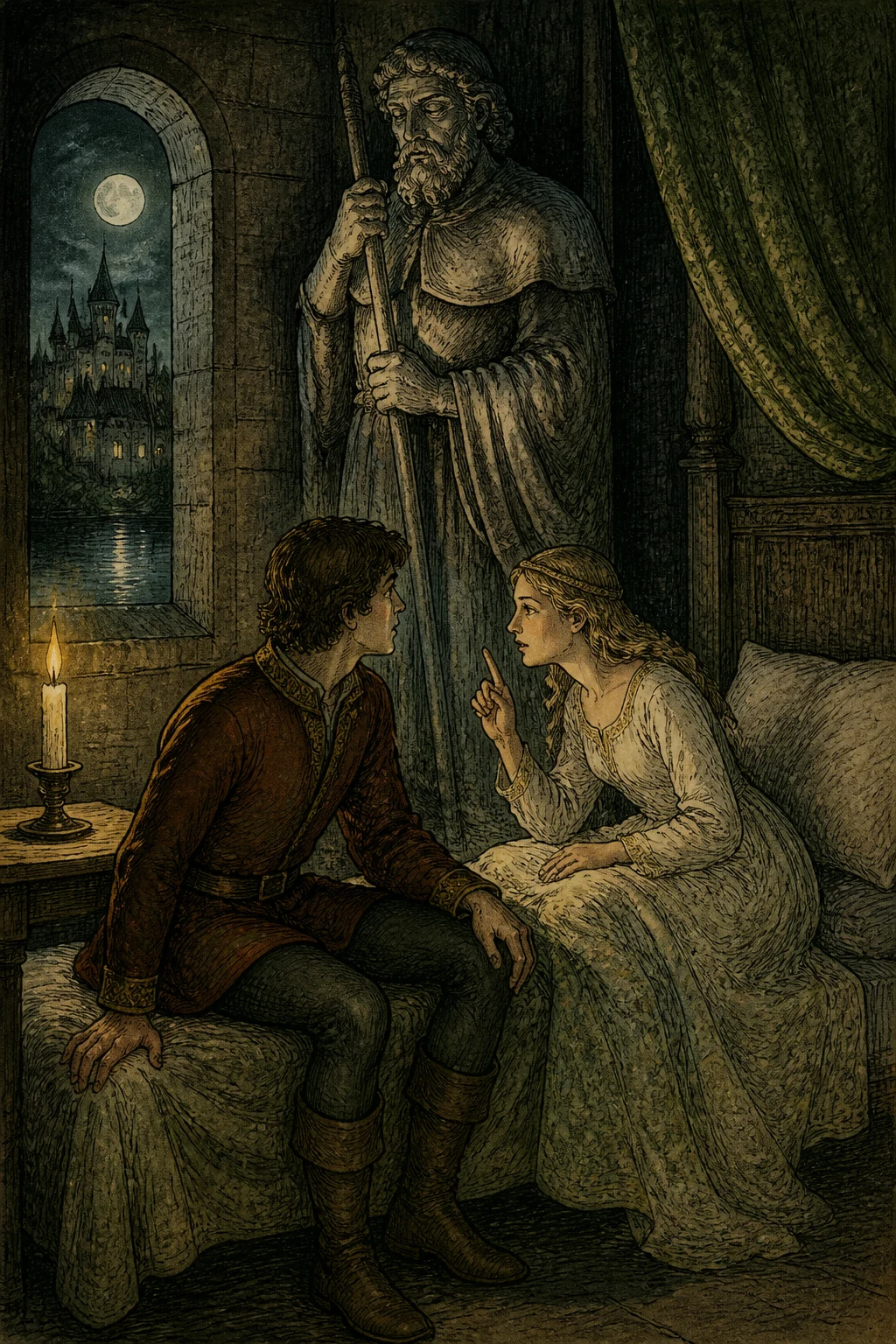
In the village of Miano there lived a husband and wife who, having not so much as a scrap of a child, longed desperately for an heir. The wife, above all, was forever saying, “Oh God, if only I could bring something into the world! I would not care if it were a sprig of myrtle.” She sang this song so often, and pestered Heaven so persistently with these words, that her belly swelled, her womb grew round, and at the end of nine months, instead of delivering a little boy or girl into the midwife’s arms, she brought forth from the Elysian fields of her womb a beautiful sprig of myrtle. Delighted beyond measure, she planted it in an earthenware pot adorned with handsome grotesque faces and set it at a window, tending it morning and evening more diligently than a tenant farmer tends a patch of cabbages from which he hopes to pay the garden’s rent. Now the King’s son happened to pass that way on a hunting expedition, and took such an extraordinary fancy to this lovely sprig that he sent word to its mistress to sell it to him: he would pay her an eye out of his head. After a thousand refusals and objections, she was finally tempted by his offers, hooked by his promises, frightened by his threats, and overcome by his entreaties, and gave him the pot. She begged him to cherish it, for she loved it more than a daughter and valued it as though it had sprung from her own loins. The Prince, in the greatest delight imaginable, had the pot carried to his own chamber and placed on a balcony, where he hoed and watered it with his own hands. Now it happened one evening that the Prince went to bed and put out the candles. When the world had grown quiet and everyone was in their first sleep, he heard someone shuffling through the room and groping their way toward the bed. He supposed it must be either some chamber boy coming to lighten his purse or some household sprite coming to pull off his blankets. But being a bold fellow, whom not even the hideous Devil could frighten, he played dead and waited to see how the business would end. When he felt the visitor settle beside him, however, and discovered by touch how smooth the workmanship was, finding, where he had expected porcupine quills, a little creature softer and silkier than Barbary wool, more supple and tender than a marten’s tail, more delicate and downy than a goldfinch’s feathers, he plunged straight in. Taking her for a Fairy—as indeed she was—he clung to her like an octopus, and, playing at the silent sparrow, they ground their stones to the finest powder. But before the Sun came forth like a chief physician to visit the sick and languishing flowers, his visitor rose and slipped away, leaving the Prince filled with sweetness, brimming with curiosity, and laden with wonder. When this traffic had continued for seven days, he began to waste and melt with longing to know what blessing this was that rained upon him from the stars, and what ship, freighted with the sweetness of love, came to anchor in his bed. So one night, while the lovely girl lay asleep, he tied one of her braids to his arm so that she could not slip away, called a servant, and had the candles lit. Then he beheld the flower of beauties, the wonder of women, Venus’s mirror and darling, love’s own masterpiece. He saw a little doll, a painted dove, a fairy Morgana, a glorious banner, a golden morsel; he saw a huntress, a falcon’s eye, a moon in its fullness, a young pigeon’s bill, a king’s dainty, a jewel. In short, he saw a spectacle to strike a man senseless. Gazing at her, he said, “Go bake yourself in an oven, goddess of Cyprus! Put a rope about your neck, Helen! Away with you, Ciosa and Fiorella, for your beauties are mere trifles beside this beauty of double gold: beauty complete, whole, ripe, substantial, solidly planted; graces that whistle, that dance, that thunder, that flourish, that carry all before them, in which there is not a flaw to be found or a blemish to be discovered. O sleep, sweet sleep, heap poppies upon the eyes of this lovely jewel! Do not spoil my pleasure in gazing as long as I desire upon this triumph of beauty! O lovely braid that binds me! O lovely eyes that kindle me! O lovely lips that refresh me! O lovely breast that comforts me! O lovely hand that pierces me through! Where, in what workshop of nature’s wonders, was this living statue fashioned? What India supplied the gold to make this hair? What Ethiopia the ivory to build this brow? What shore the carbuncles to compose these eyes? What Tyre the purple to tint these cheeks? What Orient the pearls to string these teeth? And from what mountains was the snow gathered to scatter over this breast?
“Snow contrary to nature, which preserves flowers and warms hearts!” So saying, he twined his arms about her like vines, to give new life to his own life; and as he clasped her neck she was released from sleep, answering the enamored Prince’s sigh with a charming yawn. Seeing her awake, he said, “O my beloved, if I was nearly undone at the sight of this Temple of Love without candles, what will become of my life now that you have lit two lamps within it? O lovely eyes, with your little triumph of light you drive the stars into bankruptcy! You alone, you have pierced this heart; you alone can poultice it like fresh eggs. And you, my lovely physician, be moved, be moved to pity for a man sick with love, who, by changing his air from the darkness of night to the brightness of your beauty, has caught a fever. Lay your hand upon my breast, feel my pulse, prescribe a remedy. But why do I ask for a prescription, my soul? Apply five cupping glasses to these lips with your lovely mouth! I want no other purge for this life of mine than a handful of this sweet herb. I am certain that with the cordial water of your lovely grace, and the root of your tongue, I shall be cured and well.” At these words her lovely face turned as red as a flame, and she replied, “Not so much praise, my lord Prince. I am your servant, and to serve that royal face I would cast aside even the bare necessities. I count it great good fortune that this sprig of myrtle, planted in a pot of clay, should have become a bough of laurel hung at the tavern of a heart of flesh—and a heart containing such greatness and such virtue.” At these words the Prince melted like a tallow candle. Embracing her again and sealing this letter with a kiss, he gave her his hand and said, “Here is my pledge: you shall be my wife, you shall command my scepter, you shall hold the key to this heart, just as you hold the rudder of this life.” After these and a hundred other courtesies and conversations, they rose from bed, made sure their innards were in good working order, and continued in the same arrangement for a number of days. But Fortune, who spoils games and parts married couples, is forever a black dog shitting in the midst of lovers’ pleasures. It happened that the Prince was summoned to hunt a great wild boar that was ravaging the country, and so was obliged to leave his wife—or rather, to leave two thirds of his heart behind. Now, because he loved her more than life, and saw her as fairer than all fair things, from this love and this beauty there sprang that third thing which is a storm upon the sea of lovers’ contentment, a downpour upon the washing of love’s joys, soot falling into the rich stew of lovers’ pleasures: that thing, I say, which is a serpent that bites, a woodworm that gnaws, a gall that poisons, a frost that stiffens; that thing which keeps life forever hanging by a thread, the mind unsettled, and the heart suspicious. And so he called the Fairy and said:
“I am obliged, my heart, to spend two or three nights away from home. God knows with what sorrow I tear myself from you, who are my very soul; Heaven knows whether I shall breathe my last before I set off at a trot. But since I cannot avoid going, if I am to please my father, I must leave you. Therefore I beg you, by all the love you bear me, to go inside the pot and not come out until I return, which shall be as soon as possible.” “So I shall,” said the Fairy, “for I do not know how, nor wish, nor have the power to swerve from what pleases you. Go, then, with good fortune’s blessing, for I am yours to command. Only do me the favor of leaving a silken thread tied to the top of the myrtle, with a little bell upon it. When you return, pull the thread and ring, and I shall come out at once and say, ‘Here I am.’” The Prince did so, and also called a servant and told him, “Come here, come here, you! Open your ears and listen well. Make this bed every evening, just as though I were to sleep in it myself. Keep this pot watered, and mind what you are about, for I have counted the leaves, and if I find a single one missing, I shall deprive you of your daily bread.” With this he mounted his horse and went off like a sheep being led to slaughter, to pursue a pig. Meanwhile, seven women of loose life whom the Prince kept, seeing that his love had grown lukewarm and cold, and that he had ceased to till their fields, began to suspect that some new attachment had made him forget his old friendships. Eager to reconnoiter the ground, they called a mason and paid him handsomely to dig a tunnel beneath their house that came out in the Prince’s chamber. These pox-ridden wenches went in, keen to discover whether some new visitor, some other hussy, had taken their turn and bewitched their lover. Finding no one, they opened the balcony door, and, seeing the beautiful myrtle, each plucked a leaf. Only the youngest took the whole topmost sprig, to which the little bell was attached. Scarcely had she touched it when it rang, and the Fairy, believing it was the Prince, came out at once. The moment those mangy harlots saw this painted beauty, they laid their claws upon her, saying, “So you are the one who turns the waters of our hopes to your own mill? You are the one who has won such a handsome handful of the Prince’s favor at our expense? You are the grand lady who has taken possession of our bit of flesh? Welcome indeed! You have come to the strainer now! Oh, that your mother had never shat you out! There, you are done for! You have drawn a blank; this time you have choked on it! May I never have been born after nine months if you get away!” So saying, they struck her a terrible blow on the head and at once divided her into five pieces, each taking her share. Only the youngest would have no part in this cruelty, and when her sisters urged her to do as they did, she would take nothing but a lock of golden hair.
Having done this, they slunk away through the same tunnel. Meanwhile the servant arrived to make the bed and water the pot, as his master had ordered. Finding this dreadful scene, he nearly died of fright. Biting his hands, he gathered up the scraps of flesh and bone that remained, scraped the blood from the floor, and piled it all into the pot. Then he watered it, made the bed, locked the door, slipped the key beneath it, and took to his heels out of the country. When the Prince returned from the hunt, he pulled the silken thread and rang the little bell. But ring away and catch your quails, ring away and let the Bishop pass! He might have rung the alarm, but the Fairy played deaf. So he went straight to his chamber and, having no patience to call the servant and ask for the key, kicked the lock, flung the door wide, went inside, and opened the balcony door. Seeing the pot stripped of its leaves, he began a furious lament, shouting, shrieking, and howling, “Oh, wretched me! Oh, miserable me! Oh, black my fate! Who has played me this filthy trick?
“Who has crowned me with this triumph of sorrow? O ruined, shattered, broken Prince! O my myrtle stripped bare! O my lost Fairy! O my blighted life! O my pleasures gone up in smoke, my delights turned to vinegar! What will you do, unfortunate Cola Marchione? What will you do, unhappy man?
“Leap this ditch! Rise from this nest! You have fallen from every happiness, and will you not cut your throat? You have been stripped of every treasure, and will you not bleed yourself dry? You have been cheated of life, and will you not make an end? Where are you, where are you, my myrtle? What soul harder than flint has ruined this lovely pot? O accursed hunt, which has hunted away all my contentment!
“Alas! I am finished, I am undone, I am utterly lost; my days are numbered. I cannot possibly linger in this world as an example of suffering, without my very life. I must stretch out my feet and die, for without my beloved, sleep will be torment, food poison, pleasure constipation, and life bitter.” These and other words, enough to move the stones in the street, the Prince uttered; and after long lamentation and bitter wailing, full of anguish and heartbreak, never closing his eyes to sleep nor opening his mouth to eat, he allowed grief to gain such a foothold that his face, once bright as Eastern vermilion, became yellow as orpiment, and the ham-red of his lips turned to rancid lard. The Fairy, who had sprouted anew from the remnants placed in the pot, saw the poor lover’s misery and despair, and how he had dwindled to a pinch of a man, the color of a sick Spaniard, a worm-eating lizard, leaf juice, sulfur, a yellow pear, a warbler’s backside, and a puffball. Moved to pity, she sprang from the pot like candlelight flashing from a lantern suddenly opened, appeared before Cola Marchione’s eyes, and clasped him in her arms. “Take heart, take heart, my Prince!” she said. “No more! End this mourning, wipe your eyes, put aside your anger, unpucker your mouth. Here I am, alive and beautiful, in spite of those strumpets who split my skull and did to my flesh what Tesone did to his poor brother.” Seeing this when he least expected it, the Prince rose from death to life. Color returned to his cheeks, warmth to his blood, spirit to his breast, and after a thousand caresses, playful embraces, kisses, and endearments, he wished to hear everything that had happened from beginning to end. Learning that the servant was not to blame, he had him summoned; then, with his father’s full consent, he ordered a great banquet and married the Fairy. He invited all the leading people of the kingdom, and insisted above all that the seven witches who had butchered that suckling calf should be present. When they had finished chewing, the Prince asked each guest in turn what punishment anyone would deserve who harmed that lovely girl, pointing to the Fairy, who appeared so beautiful that she struck hearts like lightning, hauled souls like a winch, and dragged desires behind her like a sledge. All those seated at table, beginning with the King, gave their opinions: one said the culprit deserved the gallows, another the wheel, another red-hot pincers, another to be thrown from a height, one this punishment and another that. At last it was the seven hinds’ turn to speak. Though this talk was not at all to their liking, and they dreamed of a bad night ahead, still, since truth is always found where wine is at work, they replied that anyone with the heart to so much as touch this dainty morsel of love’s delights deserved to be buried alive in a sewer. When they had pronounced this sentence with their own mouths, the Prince said, “You yourselves have pleaded your case; you yourselves have settled the judgment. It remains for me to carry out your decree. For you are the ones who, with the heart of Nero and the cruelty of Medea, made an omelet of this lovely head and chopped these lovely limbs like sausage meat. Quick, then! Come along! Let no time be lost! Let them be thrown this instant into a main sewer, there to end their lives in misery.” This was done at once. The Prince married the youngest sister of these wretches to the servant, giving her a handsome dowry, and provided a comfortable living for the myrtle’s mother and father. He himself lived happily with the Fairy, while those daughters of the Devil ended their lives in bitter suffering, proving the truth of the wise old proverb:
_The lame goat goes her way_ _Until someone makes her stay._