Prevod
_Antuono of Maregliano, being the prince of blockheads, is driven out by his mother and enters the service of an ogre. Wishing to visit his home, he receives gifts from his master on several occasions, but is always cheated out of them by an innkeeper. At last the ogre gives him a cudgel, which punishes his stupidity, makes the innkeeper pay for his knavery, and enriches his household._ Whoever said that Fortune is blind knew more than Master Lanza, who knows everything, for she truly strikes like a blind woman, hoisting up to the very pinnacle people you would not employ to chase birds from a beanfield, and flinging flat on their faces others who are the flower of mankind, as you shall now hear.
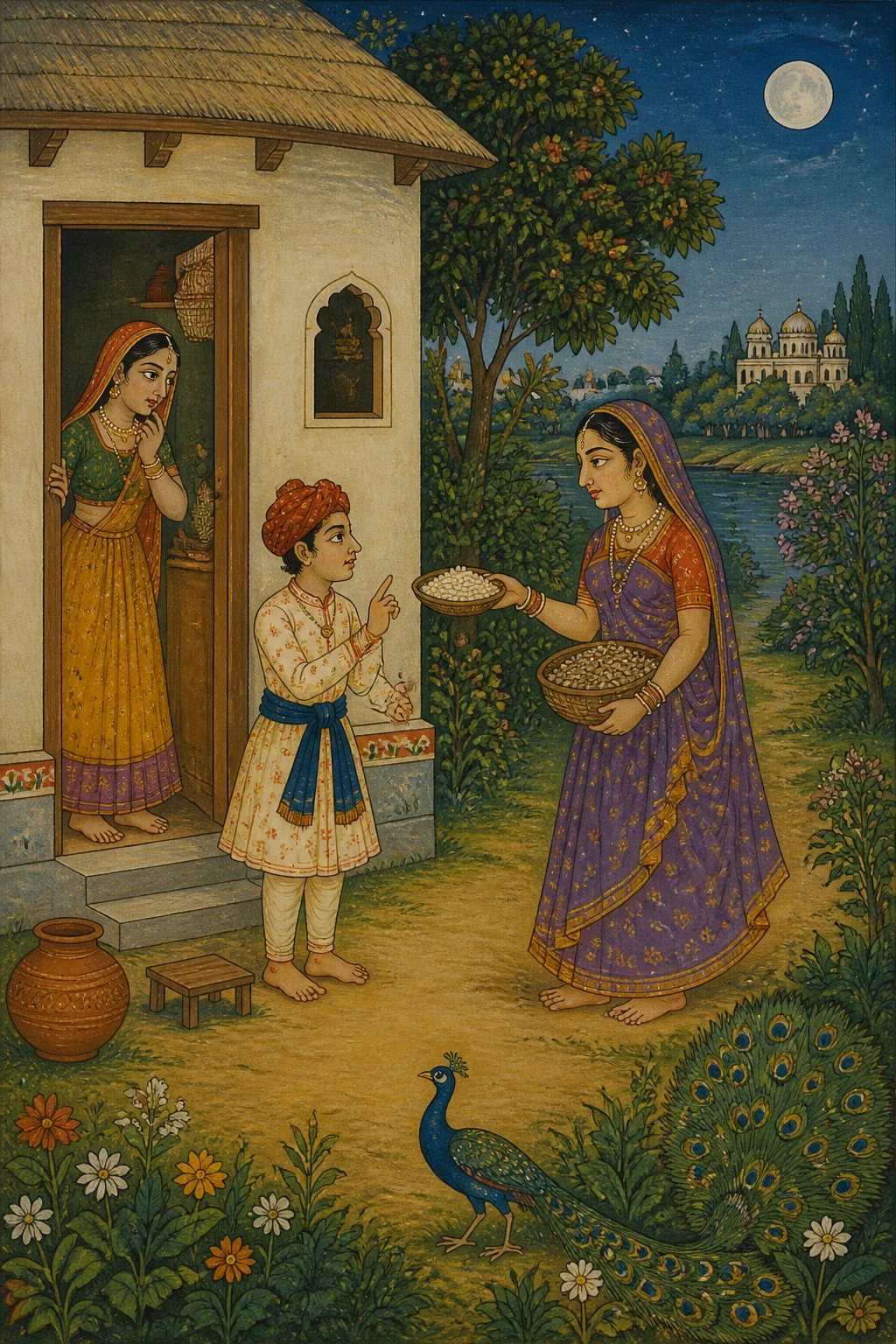
Once upon a time, in the town of Maregliano, there lived an honest woman called Masella, who, besides six great strapping daughters, all unmarried and tall as beanpoles, had a son so lumpish, so utterly fit for putting out to pasture, that he was not worth a snowball in winter. He made her feel like a sow dragging a log about her neck, and not a day went by without her saying to him, “What are you doing in this house, you curse upon our bread?
“Melt away, you lump of lumber! Clear out, you filthy Maccabee! Sink through the earth, you planter of plagues! Get out of my sight, you chestnut-swallower! You must have been changed in your cradle: instead of a lively, quiet, pretty little baby, they put a great lasagna-gobbling hog in your place!” But for all this, Masella talked and he whistled. Seeing there was no hope that Antuono—for that was her son’s name—would ever turn his mind to anything useful, one day, after giving him a thorough head-washing without soap, she seized a rolling pin and began taking the measure of his doublet. Antuono, finding himself belabored, combed, and quilted when he least expected it, slipped out of her hands as best he could, turned his heels toward her, and walked and walked until, toward
the twenty-fourth hour, when the little lamps were beginning to be lit in Cintrella’s shops, he reached the foot of a mountain so high that it butted heads with the clouds. There, sitting on the great root of a poplar beside a grotto fashioned from pumice stone, was an ogre. Oh, mother of mine, what an ugly creature he was! He was a dwarfish stump, a wicker hamper of a fellow, with a head bigger than an Indian pumpkin, a forehead covered in lumps, eyebrows joined together, staring eyes, a flattened nose with two nostrils like great sewers, and a mouth as wide as a winepress, out of which stuck two tusks reaching to his cheekbones. His chest was hairy, his arms were like the reels of a winding machine, his legs bowed like a vaulted ceiling, and his feet flat as a duck’s. In short, he looked like a hobgoblin, a sack-carrying bogeyman, a hideous beggar, the very image of an evil apparition: he would have set an Orlando trembling, terrified a Scannarebecco, and made a swaggering bully faint. But Antuono, who would not have stirred at the crack of a sling, bowed his head and said, “God be with you, sir! What are you doing? How are you?
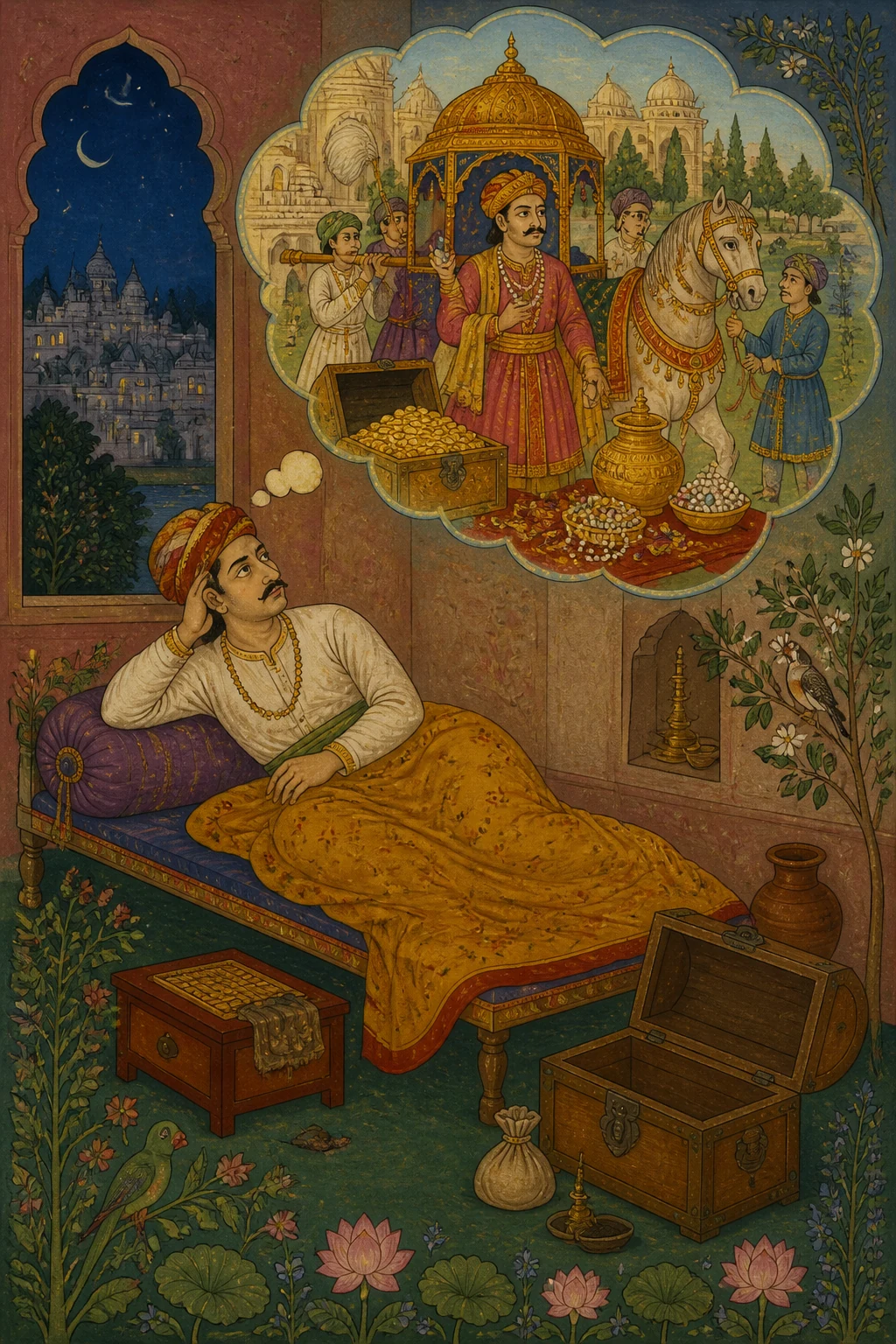
“Do you want anything? How far is it from here to wherever I’m going?” Hearing this rigmarole, which jumped from one thing to another, the ogre burst out laughing; and because the beast’s humor pleased him, he said, “Would you like to take service with me?” Antuono answered, “How much do you want a month?” “Just see that you serve me honestly,” the ogre replied, “and we shall come to terms, and you will do well for yourself.” So, with this bargain struck, Antuono remained in the ogre’s service, where food was flung about in abundance and, as for work, he lived like a loafer. Within four days he had grown fat as a Turk, round as an ox, bold as a cock, red as a lobster, green as garlic, and broad as a whale, so well fed and flourishing that he could scarcely see out of his eyes. But before two years had passed, he grew weary of all this fat living and felt a great longing and itching to take a turn around Pascarola; and thinking of his little home, he had almost gone back to his first foolishness. The ogre, who could see right into his innards and knew by his face what an itch in the backside was making him fidget like a badly served mistress, called him aside and said, “My dear Antuono, I know you are burning to see your own flesh and blood. Since I love you as dearly as the pupils of my eyes, I am willing for you to pay them a visit and have that pleasure. Take this donkey, then, to spare you the weariness of the road. But keep your wits about you, and never say to him, _Gee up, shit-gold_, or, by my grandfather’s soul, you will regret it!” Antuono took the donkey and, without so much as saying good evening, climbed on its back and set off at a trot. But he had not gone a hundred paces before he dismounted and began to say, _“Gee up, shit-gold.”_ He had scarcely opened his mouth when the Sardinian beast began shitting pearls, rubies, emeralds, sapphires, and diamonds, each as big as a walnut. With his mouth hanging a hand’s breadth open, Antuono stared at these handsome bowel movements, these magnificent fluxes, this rich dysentery of the little donkey’s; and, overjoyed, he filled a saddlebag with the jewels, mounted again, and rode briskly on until he reached an inn. Dismounting, the first thing he said to the innkeeper was, “Here, tie this donkey to the manger and give him plenty to eat. But mind you do not say, _‘Gee up, shit-gold,’_ or you will regret it. And put these little things somewhere safe for me.” The innkeeper, who was a master of his trade, a harbor shark, a thoroughbred rogue of the finest assay, heard this unexpected warning and saw the jewels, which were worth a fortune, and grew curious to learn what those words meant. So he gave Antuono plenty to chew on and as much to swill as he could hold, then tucked him between a straw mattress and a coarse woolen blanket. No sooner did he see his eyes heavy with sleep and hear him snoring at full blast than he ran to the stable and said to the donkey, _“Gee up, shit-gold.”_ At the medicine of these words, the beast performed its usual operation, loosening its bowels in golden squirts and jewel-studded spasms. Seeing this precious evacuation, the innkeeper resolved to exchange the donkey and hoodwink that bumpkin Antuono, reckoning it an easy matter to blind, bamboozle, befuddle, deceive, swindle, dupe, entrap, and make bladders pass for lanterns with such a hog, clod, noodle, wether, simpleton as had fallen into his hands. So, next morning, when Dawn came to empty her old husband’s chamber pot, all red sediment, out of the window of the East, Antuono awoke, rubbed his eyes with his hand, stretched for half an hour, and let out some sixty yawns and farts in the form of a dialogue. Then he called the innkeeper, saying, “Come here, comrade: short reckonings make long friendships. Friends we may be, but let our purses fight it out. Make up my bill and pay yourself.” So, having reckoned so much for bread, so much for wine, this for soup, that for meat, five for stabling, ten for the bed, and fifteen for wishing him a good digestion, he shelled out the cash and took the counterfeit donkey, with a little bag of pumice stones in place of his precious stones, and lumbered off toward his village. Before he had even set foot in the house, he began shouting like a man boiled in nettles, “Run, Mother, run! We are rich! Spread out tablecloths, lay out sheets, unfold blankets, and you will see treasures!” His mother, beside herself with joy, opened a chest containing the trousseaux of her marriageable daughters and brought out sheets so fine you could blow them away, tablecloths fragrant from the wash, and coverlets that fairly dazzled your eyes, making a splendid spread upon the floor. Antuono set the donkey upon it and began to chant, _“Gee up, shit-gold.”_ But gee up and shit-gold as much as you please, the donkey paid as much attention to those words as it would to the sound of a lyre. After repeating them three or four times, all to the winds, Antuono seized a handsome cudgel and began belaboring the poor beast. He thrashed and battered and pounded it so hard that at last the wretched animal let go beneath itself and deposited a fine yellow splatter upon the white linen. Poor Masella, seeing this loosening of the bowels, and finding that where she had counted on a fund to enrich her poverty she had instead a fundament so generous that it stank out the whole house, seized a stick and, without giving him time to show her the pumice stones, gave him a sound drubbing. At this he fled straight back to the ogre, who, seeing him approach at more of a trot than a walk, and knowing through his magic everything that had happened, gave him a rich dressing-down for letting an innkeeper cheat him. He called him a ninny, a mother’s darling still needing to be fed by hand, a lump, a jackal, a simpleton, a dolt, a great piece of a donkey, a chestnut-swallower, a blockhead, a bumpkin, and a blunderer, who had exchanged an ass running freely with treasures for a stingy beast that yielded only orange-colored curds. Antuono swallowed this pill and swore that never, never again would he let any living man lead him by the nose or make a fool of him. But another year had scarcely passed before the same headache returned, and he was pining to death to see his family. The ogre, who was ugly of face but beautiful of heart, gave him leave to go and made him a further present of a handsome napkin, saying, “Take this to your mother, but mind you do not play the ass over it as you did over the donkey. Until you reach your own house, do not say, _‘Open and close, little napkin,’_ for if some nasty misfortune befalls you, the loss is yours. Now go your way in peace, and come back soon.” So Antuono departed; but a little way from the grotto he at once spread the napkin on the ground and said, _“Open and close, little napkin.”_ As it opened, there appeared such beauties, such splendors, such fine things that it was past believing. At the sight of them Antuono immediately said, _“Close, little napkin,”_ and when everything had folded itself away inside, he hurried off to the very same inn. Going in, he said to the host, “Here, put this napkin away for me, and mind you do not say, _‘Open and close, little napkin.’”_ The innkeeper, who had been through the mill three times over, said, “Leave it to this old hand.” After giving him plenty down his gullet and getting him drunk as a lord, he sent him off to bed. Then he took the napkin and said, _“Open, little napkin,”_ and the napkin unfolded and brought forth so many precious things that it was a marvel to behold. Finding another napkin like it, he foisted this upon Antuono when he awoke. Antuono made good speed and reached his mother’s house, saying, “Now at last we shall put an end to our rags, patches, and tatters!” With that he spread the napkin on the floor and began to say, _“Open, little napkin.”_ But he could have gone on from today until tomorrow and only wasted his time: not a crumb nor a straw came of it. Seeing that the business was going against the grain, he said to his mother, “Well, bless this year! That innkeeper has taken me in again. But just wait: he and I are two different men. Better for him if he had never been hatched; better if a cartwheel had run over him! May I lose the best piece of furniture in the house if, when I pass that inn, I do not smash his crockery to crumbs in payment for my jewels and the donkey he stole!” His mother, hearing this fresh piece of asinine folly, blazed with rage and said, “Break your neck, you accursed son! Break your shoulder blade! Get out of my sight, for you turn my very guts and I cannot stomach you any longer. My hernia swells and my gorge rises whenever you come under my feet! Have done with it, and quickly! Treat this house as though it were on fire, for I shake you out of my clothes and shall reckon I never shat you into the world!” Poor Antuono, seeing the lightning, had no wish to wait for the thunder. Like a man who had stolen the washing, he lowered his head, lifted his heels, and scuttled back to the ogre. Seeing him come creeping in, limp and crestfallen, the ogre played him another fine tune on the cymbals, saying, “I do not know what keeps me from punching your eye out, you great gullet, you little guzzler, you farting mouth, rotten throat, hen’s backside, chatterbox, trumpet of the Vicaria! You proclaim everything to the world, vomit up everything inside you, and cannot keep a chickpea in your belly! If you had held your tongue at the inn, what happened to you would never have happened. But by making your tongue a mill-clapper, you have ground to pieces the good fortune these hands gave you.” Wretched Antuono tucked his tail between his legs and swallowed this music. He remained quietly in the ogre’s service for another three years, thinking no more of home than of becoming a count. Yet, after that time, the fever returned, and he again took it into his head to visit his house. He therefore asked the ogre’s leave; and the ogre, to rid himself of this thorn in his flesh, agreed to let him go, giving him a handsome carved cudgel and saying, “Take this cudgel as a remembrance of me. But take care not to say RISE, CUDGEL, or LIE DOWN, CUDGEL, for I shall have no share in what happens to you.” Taking it, Antuono answered, “Come now, I have cut my wisdom teeth, and I know how many pairs three oxen make. I am no longer a little child. Whoever means to cheat Antuono might as well try kissing his own elbow!” The ogre replied, “The work praises the master. Words are female, deeds are male. We shall see.
“You have heard me better than a deaf man would. A man forewarned is half saved.” While the ogre was still speaking, Antuono slipped away toward home; but he had not gone half a mile before he said, RISE, CUDGEL. These were no mere words, but an enchantment, for at once the cudgel, as though a goblin had got inside its very marrow, began working like a lathe upon poor Antuono’s shoulders. The blows rained down out of a clear sky, one coming hard upon another.
The poor fellow, finding himself pounded and tanned into cordovan leather, promptly said, _“Lie down, cudgel,”_ and the cudgel stopped playing counterpoint upon the score of his back. Having learned at his own expense, he said, “Let whoever runs away be lame! By my faith, I shall not leave the matter here. The man who is to have a bad evening has not gone to bed yet!” So saying, he reached his usual inn, where he was received with the warmest welcome in the world, for the innkeeper knew what rich juice this rind could yield. As soon as Antuono arrived, he said to his host, “Here, put this cudgel away for me. But mind you do not say, _‘Rise, cudgel,’_ for you will be in danger. Understand me well, and do not complain of Antuono afterward, for I give you fair warning and make my position clear beforehand.” The innkeeper, delighted at this third stroke of luck, stuffed him with soup and made him see the bottom of the wine jug. Once he had laid him out upon a little bed, he hurried off to fetch the cudgel and, calling his wife to share in the fine festivities, said, _“Rise, cudgel.”_ The cudgel began testing the measure of the innkeepers’ backs, thump on this side and whack on that, giving them such a thunderous coming and going that, finding themselves hard pressed and in a sorry plight, they ran to wake Antuono, with the cudgel still at their heels, and begged for mercy. Antuono, seeing the business running straight as a plumb line, the macaroni in the cheese and the broccoli in the lard, said, “There is no help for it: you will die beaten to a pulp unless you give me back my things.” The innkeeper, who had been thoroughly pounded, cried, “Take everything I have, only rid me of this torment on my shoulders!” And to make Antuono’s position all the more secure, he had everything he had pilfered brought out. Once Antuono had it all in his hands, he said, _“Lie down, cudgel,”_ and it crouched down and flung itself to one side.
Then, taking the donkey and his other belongings, he went home to his mother. There, having made a royal assay of the donkey’s backside and a sure trial of the napkin, he feathered his nest handsomely; and by marrying off his sisters and making his mother rich, he proved the truth of the saying, _God helps fools and little children._