Prevod
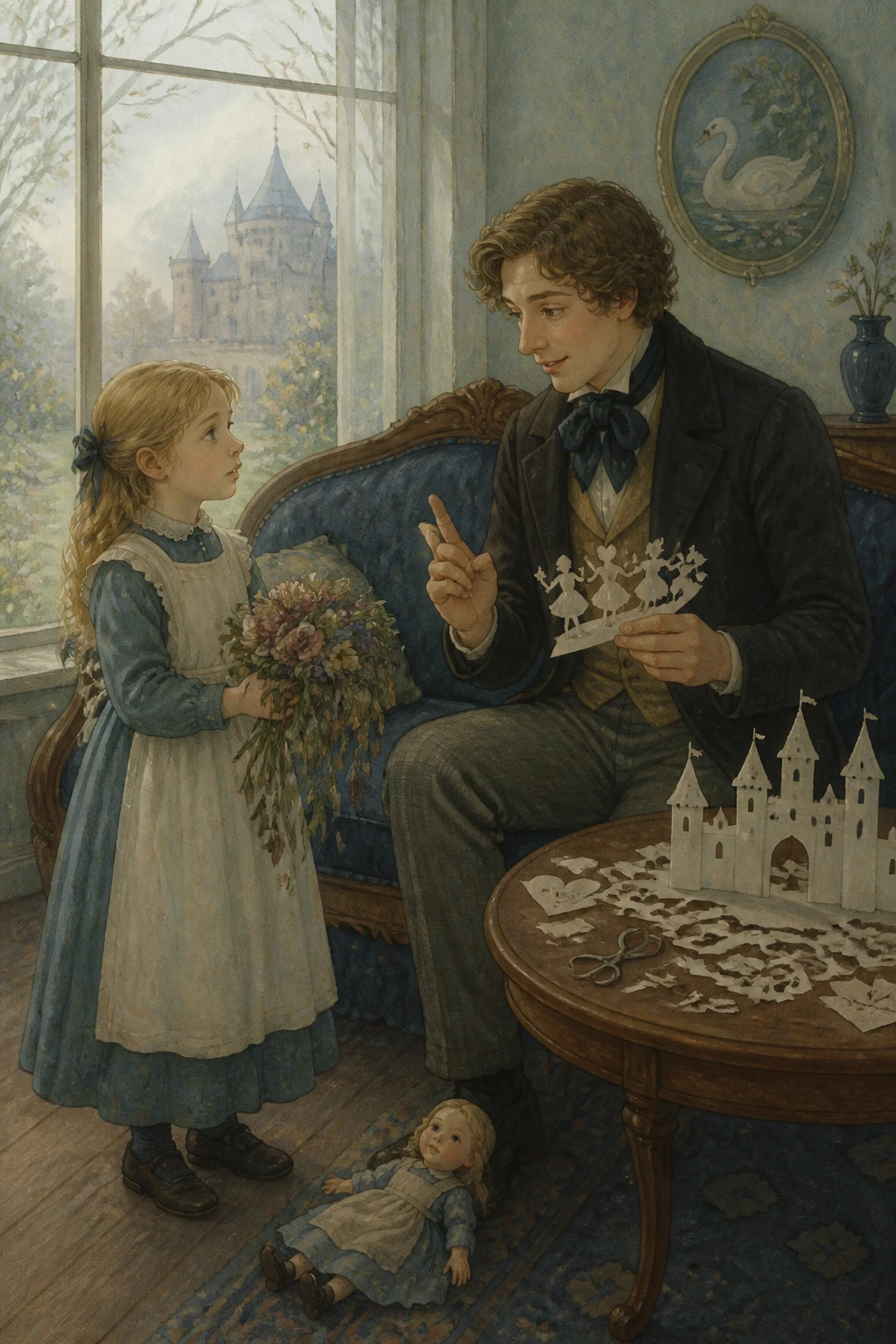
Yes, it was little Tuk. His name was not really Tuk, but when he was too young to speak properly he had called himself Tuk; it was meant to be Carl, and it is just as well to know that. He had to look after his sister Gustave, who was much smaller than he was, and he also had to learn his lesson, but those two things cannot be done at once. The poor boy sat with his little sister on his lap and sang all the songs he knew, while his eyes kept straying to the geography book lying open before him. By tomorrow he had to know by heart all the towns in the diocese of Zealand, and everything there was to know about them.
Now his mother came home, for she had been out, and took little Gustave. Tuk ran to the window and read until he nearly read his eyes out, for it was almost dark, and growing darker, but his mother could not afford to buy candles.
“There goes the old washerwoman from the lane!” said his mother, looking out of the window. “She can scarcely carry herself, and yet she has to carry that bucket from the pump. Run out, little Tuk, and be a dear, good boy! Help the old woman!”
And Tuk ran out at once and helped her. But by the time he came home it was quite dark; there was no question of a candle, and he had to go to bed. His bed was an old settle, and there he lay thinking about his geography lesson: the diocese of Zealand and everything the teacher had told them. He really ought to have studied it, but now, of course, he could not. He slipped the geography book under his pillow, for he had heard that this was a great help in remembering one’s lesson, but that is not to be relied upon.
There he lay, thinking and thinking, and then all at once it was as though someone kissed his eyes and mouth. He was asleep, and yet not asleep; he seemed to see the old washerwoman’s kind eyes looking at him, and she said, “It would be a great shame if you did not know your lesson! You helped me, and now I shall help you, and our Lord will always help you too!”
And all at once the book beneath little Tuk’s head began to wriggle and squirm. “Cock-a-doodle-doo! Cluck! Cluck!” A hen had come along, all the way from the town of Køge. “I am one of Køge’s hens!” Then she told him how many inhabitants there were, and about the battle that had been fought there, though that was really nothing to speak of.
“Wriggle, squirm, bump!” Something came tumbling down. It was a wooden bird, the parrot from the bird-shooting contest in Præstø. It said there were just as many inhabitants as it had nails in its body, and it was rather proud. “Thorvaldsen once lived just round my corner. Bump! How comfortably I lie!”
But little Tuk was not lying down; all at once he was on horseback. Away they went at a gallop, a gallop! A splendidly dressed knight, with a shining helmet and a waving plume, held him in front of him on the horse, and they rode through the forest to the old town of Vordingborg. It was a great, bustling town; tall towers soared above the royal castle, and lights shone far out through its windows. Inside there was singing and dancing; King Valdemar and splendid young ladies of the court were joining in the dance. Morning came, and as the sun rose, the town and the king’s castle dwindled away, one tower after another, until at last only a single tower stood on the hill where the castle had been. The town was so tiny and so poor, and the schoolboys came along with their books under their arms and said, “Two thousand inhabitants,” but that was not true; there were not so many.
And little Tuk lay in his bed, feeling that he was dreaming and yet not dreaming. But someone was close beside him. “Little Tuk! Little Tuk!” said a voice. It was a sailor, a very little fellow, who might have been a naval cadet, but he was not a naval cadet. “I bring you warmest greetings from Korsør. It is a town on the rise! A lively town, with a steamship and a mail coach. Once people were always calling it nasty, but that was an old prejudice.” “I lie beside the sea,” says Korsør. “I have a highway and a pleasure wood, and I have given birth to a poet who was amusing, which is more than can be said of them all. I meant to send a ship round the world; I did not do it, but I could have done it. And I smell so sweet: right beside the town gate the loveliest roses bloom!”
Little Tuk saw them; red and green swam before his eyes, but when the colours settled, there was a whole wooded slope beside the clear fjord, and above it stood a magnificent old church with two tall, pointed towers. Springs gushed from the slope in thick jets of water, splashing as they fell, and close by sat an old king with a golden crown upon his long hair. It was King Hroar beside the springs, at the town now called Roskilde. And over the slope and into the old church went all the kings and queens of Denmark, hand in hand, all wearing golden crowns, while the organ played and the springs murmured. Little Tuk saw everything and heard everything. “Do not forget the Assembly of the Estates!” said King Hroar.
All at once everything was gone again. Why, where had it gone? It was like turning a page in a book. And now an old woman stood there, a weeding woman from Sorø, where grass grows in the market square. She had her grey linen apron over her head and down her back; it was so wet that it must have been raining. “Yes, it has!” she said. Then she recited some amusing bits from Holberg’s comedies, and she knew about Valdemar and Absalon. But all at once she crouched down and bobbed her head, as though she were about to leap. “Croak!” she said. “It is wet, it is wet, it is peaceful as the grave—in Sorø!” Suddenly she was a frog. “Croak!” And then she was the old woman again. “One must dress for the weather!” she said. “It is wet, it is wet! My town is like a bottle: you go in through the cork, and you must come out the same way! I used to have catfish, and now I have fresh, rosy-cheeked boys at the bottom of the bottle, learning wisdom: Greek! Greek! Hebrew, croak!” It sounded just like frogs singing, or someone walking through marsh water in heavy boots. Always the same sound, so unchanging, so dull, so dull, that little Tuk fell into a proper sleep, and that could only do him good.
But even in this sleep there came a dream, or whatever it was. His little sister Gustave, with her blue eyes and golden curls, was suddenly a lovely grown-up girl, and though she had no wings, she could fly. Together they flew over Zealand, over the green forests and the blue waters.
“Do you hear the cock crowing, little Tuk? Cock-a-doodle-doo! The hens are flying up from Køge town! You shall have a poultry yard so big, so big; you shall never suffer hunger or want! You shall shoot the parrot, as the saying goes; you shall be a rich and happy man! Your house shall rise as proudly as King Valdemar’s tower, and it shall be richly built, with marble statues like those from the Præstø corner—you know what I mean. Your name shall travel far and wide through the world with honour, like the ship that was to have sailed from Korsør, and in Roskilde town—‘Remember the Assembly of the Estates!’ King Hroar said—you shall speak well and wisely there, little Tuk. And when at last you come to your grave, you shall sleep as peacefully—”
“—As though I were lying in Sorø!” said Tuk, and then he woke. It was bright morning. He could not remember the least thing about his dream, nor was he meant to, for we must not know what is to come.
And he sprang out of bed and read his book, and knew his lesson straight away. Then the old washerwoman put her head round the door, nodded to him, and said:
“Thank you for yesterday, you blessed child! May our Lord make your loveliest dream come true!” Little Tuk had no idea what he had dreamed, but you see, our Lord knew!