Prevod
In a certain town there lived two men who had exactly the same name: they were both called Claus. But one owned four horses, while the other had only a single horse; so, to tell them apart, people called the man with four horses Big Claus, and the man with only one horse Little Claus. Now we shall hear what happened to the two of them, for this is a true story!
All through the week Little Claus had to plough for Big Claus and lend him his one horse. In return, Big Claus helped him with all four of his own, but only once a week, and that was on Sundays. Hurrah! How Little Claus cracked his whip over all five horses! For that one day they were as good as his. The sun shone so beautifully, and all the bells in the church tower were ringing for church. People in their Sunday best, with hymnbooks under their arms, were going to hear the parson preach, and they looked at Little Claus ploughing with five horses. He was so pleased that he cracked his whip again and cried, "Gee up, all my horses!"
"You mustn't say that," said Big Claus. "Only one of those horses is yours!" But when more people passed on their way to church, Little Claus forgot that he mustn't say it, and cried, "Gee up, all my horses!"
"Now, I'll ask you to stop that!" said Big Claus. "For if you say it once more, I'll strike your horse on the forehead and kill it on the spot. That will be the end of it!"
"Indeed I won't say it again!" said Little Claus. But when people came past and nodded good day to him, he felt so pleased, and thought how splendid it looked to have five horses ploughing his field, that he cracked his whip and cried, "Gee up, all my horses!"
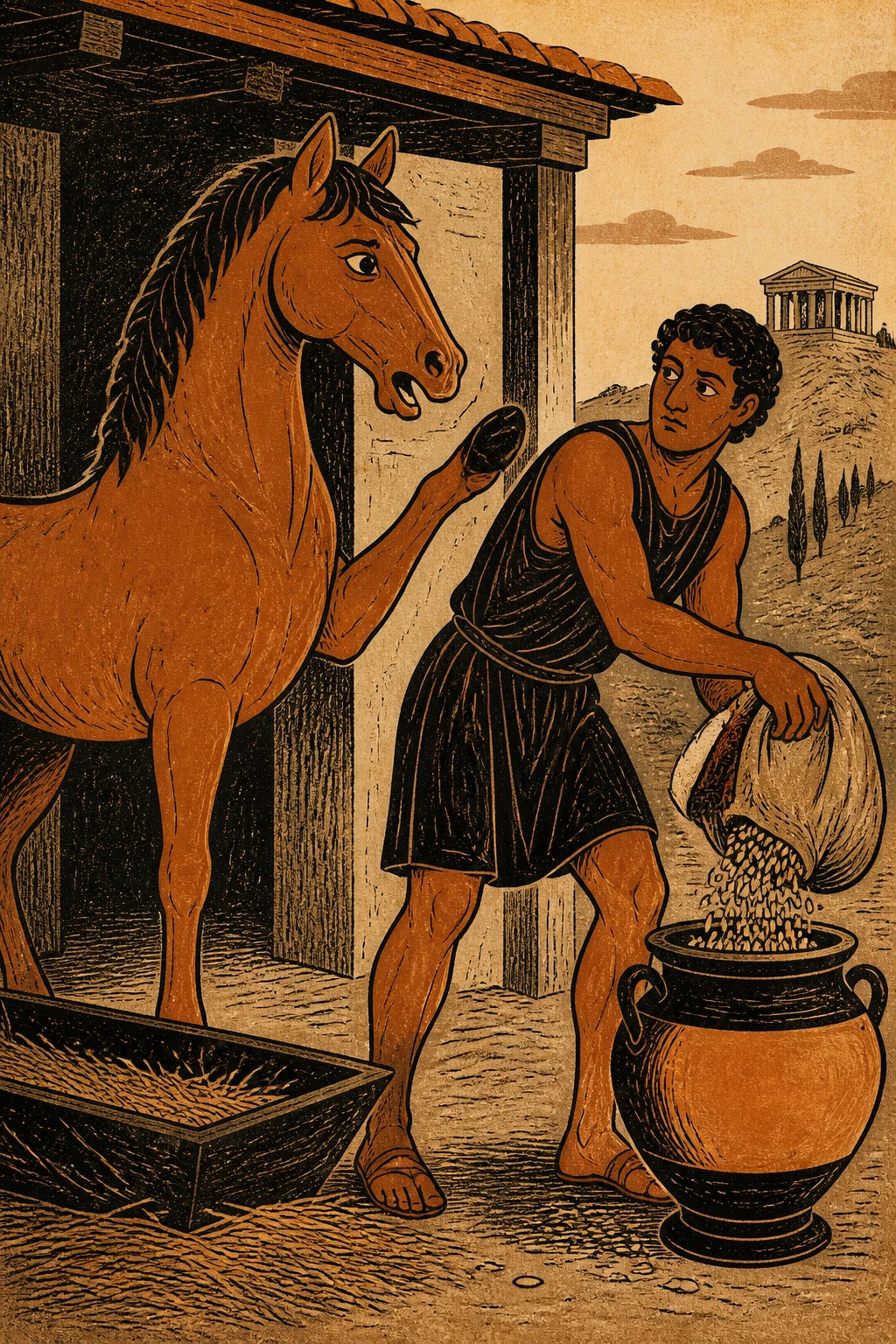
"I'll gee up your horses for you!" said Big Claus. He took the tethering mallet and struck Little Claus's only horse on the forehead, so that it fell down stone dead.
"Oh, now I haven't a single horse left!" said Little Claus, and he began to cry. Afterwards he skinned the horse and let the hide dry thoroughly in the wind. Then he put it in a sack, slung it over his shoulder, and set off for town to sell his horsehide.
He had such a long way to go, and had to pass through a great dark forest. Now the weather turned frightfully bad. He lost his way completely, and before he found the right road it was evening, and much too far either to reach the town or to get home again before nightfall.
Close beside the road stood a large farmhouse. The shutters had been closed over the windows, but light still shone out above them. Surely they'll let me stay the night here, thought Little Claus, and he went up and knocked.
The farmer's wife opened the door, but when she heard what he wanted, she told him to go away. Her husband was not at home, and she would take in no strangers.
"Well, then I shall have to sleep outside," said Little Claus, and the farmer's wife shut the door in his face. Close by stood a great haystack, and between it and the house a little shed had been built, with a flat thatched roof.
"I can sleep up there!" said Little Claus when he saw the roof. "What a lovely bed! Surely the stork won't fly down and bite my legs." For there was a real live stork standing on the roof of the house, where it had its nest.
Little Claus climbed onto the shed and lay there, turning this way and that to make himself comfortable. The wooden shutters did not quite meet the tops of the windows, so he could see straight into the room.
A large table was laid with wine and roast meat and a most delicious fish. The farmer's wife and the sexton were sitting at the table, with no one else there at all. She poured him wine, and he helped himself to the fish, for that was something he was fond of.
"If only I could have some too!" said Little Claus, stretching his head towards the window. Good heavens, what a lovely cake he could see in there! Yes, this was a feast indeed!
Now he heard someone riding along the road towards the house. It was the farmer's wife's husband coming home. He was a very good man, but he suffered from the strange affliction of never being able to bear the sight of sextons. If a sexton came before his eyes, he flew into a rage. That was why the sexton had come to say good day to the wife when he knew the husband was away, and why the good wife had set all her finest food before him. When they heard the husband coming, they were terribly frightened, and the wife begged the sexton to crawl into a large empty chest standing in the corner. He did so, for he knew very well that the poor man could not bear the sight of sextons. The wife quickly hid all the lovely food and wine in her baking oven, for if her husband had seen it, he would surely have asked what it all meant.
"Oh dear!" sighed Little Claus on top of the shed, when he saw all the food disappear. "Is someone up there?" asked the farmer, looking up at Little Claus. "Why are you lying there? Come inside instead!"
Little Claus told him how he had lost his way, and asked whether he might stay the night. "Of course!" said the farmer. "But first we must have something to eat!"
The wife welcomed them both very kindly, laid a long table, and gave them a large dish of porridge. The farmer was hungry and ate with a hearty appetite, but Little Claus could not help thinking of the delicious roast meat, fish, and cake that he knew were in the oven.
Under the table, at his feet, he had laid his sack with the horsehide inside, for, as we know, that was what he had left home with, meaning to sell it in town. He had no taste at all for the porridge, and he trod on his sack, making the dry hide inside creak quite loudly.
"Hush!" Little Claus said to his sack, but at the same moment he trod on it again, and it creaked much louder than before. "Why, what have you got in that sack?" asked the farmer.
"Oh, it's a wizard!" said Little Claus. "He says we're not to eat porridge. He's conjured up a whole ovenful of roast meat and fish and cake."
"What's that?" said the farmer, and quickly opened the oven. There he saw all the lovely food his wife had hidden, but now he believed the wizard in the sack had conjured it up for them. The wife dared not say a word, but at once put the food on the table, and they ate the fish and the roast meat and the cake. Then Little Claus trod on his sack again, making the hide creak.
"What does he say now?" asked the farmer. "He says," answered Little Claus, "that he's conjured up three bottles of wine for us as well. They're over in the corner beside the oven!" Now the wife had to fetch the wine she had hidden, and the farmer drank and grew very merry. How dearly he would have liked to own a wizard like the one Little Claus had in his sack!
"Can he conjure up the devil too?" asked the farmer. "I'd like to see him, now that I'm feeling merry!" "Yes," said Little Claus, "my wizard can do anything I ask. Can't you?" he asked, treading on the sack so that it creaked. "Do you hear? He says yes. But the devil looks so dreadful, he's not worth seeing!"
"Oh, I'm not afraid at all. What can he look like?" "Well, he'll appear in the very likeness of a sexton!" "Ugh!" said the farmer. "That's dreadful! You must know I can't bear the sight of sextons! Still, never mind; since I know it's the devil, I suppose I can put up with it better. I've got courage now! But he mustn't come too close."
"I'll ask my wizard," said Little Claus. He trod on the sack and bent his ear to it. "What does he say?" "He says you can go and open the chest in the corner, and you'll see the devil crouching inside. But you must hold the lid down so he can't get out."
"Will you help me hold it?" said the farmer, going over to the chest where his wife had hidden the real sexton, who sat inside in a terrible fright.
The farmer raised the lid a little and peeped underneath. "Ugh!" he cried, springing back. "Yes, I saw him! He looked exactly like our sexton! Oh, that was frightful!"
They had to have a drink after that, and they went on drinking far into the night. "You must sell me that wizard," said the farmer. "Ask whatever you like for him! Why, I'll give you a whole bushel of money this very minute!"
"No, I can't do that!" said Little Claus. "Just think how much use this wizard can be to me!" "Oh, I'd so dearly like to have him," said the farmer, and he went on begging.
"Well," Little Claus said at last, "since you've been so kind as to give me shelter tonight, so be it: you shall have the wizard for a bushel of money. But I want the bushel filled to the brim."
"You shall have it," said the farmer. "But you must take that chest away with you. I won't have it in the house another hour. There's no knowing whether he's still sitting in it."
Little Claus gave the farmer his sack with the dry hide inside and received a whole bushel of money for it, heaped to overflowing. The farmer even gave him a large wheelbarrow to carry away the money and the chest.
"Goodbye!" said Little Claus, and off he went with his money and the great chest, in which the sexton was still sitting. On the other side of the forest was a broad, deep river, where the water rushed so swiftly that one could scarcely swim against the current. A large new bridge had been built across it. Little Claus stopped in the middle and said very loudly, so that the sexton inside the chest could hear:
"Now, what am I to do with this silly chest? It's as heavy as though it were full of stones! I'm quite tired of wheeling it any farther, so I'll throw it into the river. If it floats home to me, well and good; and if it doesn't, that doesn't matter either."
He took hold of the chest with one hand and lifted it a little, as though he meant to tip it into the water. "No, don't!" cried the sexton inside the chest. "Just let me out!"
"Oh!" said Little Claus, pretending to be frightened. "He's still in there! Then I'd better throw it into the river at once and drown him!" "Oh no, oh no!" cried the sexton. "I'll give you a whole bushel of money if you'll leave it alone!"
"Well, that's another matter!" said Little Claus, and he opened the chest. The sexton crawled out at once, pushed the empty chest into the water, and went home, where Little Claus was given a whole bushel of money. He had already received one from the farmer, so now his whole wheelbarrow was full of money!
"Well, I got a very good price for that horse!" he said to himself when he reached his own room and tipped all the money into a great heap in the middle of the floor. "How annoyed Big Claus will be when he finds out how rich I've become through my one horse! But I won't tell him outright."
He sent a boy to Big Claus to borrow a bushel measure. "Whatever can he want it for?" thought Big Claus, and he smeared tar underneath the bottom so that a little of whatever was measured would stick to it. And so it did, for when he got the measure back, three new silver eight-skilling pieces were stuck to it.
"What's this?" said Big Claus, and he ran straight over to Little Claus. "Where did you get all that money?" "Oh, it was for my horsehide. I sold it last night!"
"That was a fine price indeed!" said Big Claus. He hurried home, took an axe, struck all four of his horses on the forehead, stripped off their hides, and drove into town with them.
"Hides! Hides! Who'll buy hides?" he cried through the streets. All the shoemakers and tanners came running and asked what he wanted for them.
"A bushel of money for each," said Big Claus. "Are you mad?" they all said. "Do you think we have money by the bushel?" "Hides! Hides! Who'll buy hides?" he cried again. But to everyone who asked what the hides cost, he answered, "A bushel of money."
"He's making fools of us," they all said. The shoemakers took up their leather straps and the tanners their leather aprons, and began beating Big Claus.
"Hides! Hides!" they mocked him. "Yes, we'll give you a hide that spurts red piglets! Out of town with him!" they shouted, and Big Claus had to hurry away as fast as he could. Never in his life had he had such a beating.
"Well!" he said when he got home. "Little Claus shall pay for this. I'll kill him!" But at Little Claus's house, his old grandmother had died. She had been very cross and unkind to him, it was true, but he was still quite sorrowful. He took the dead woman and laid her in his warm bed to see whether she might come back to life. She was to lie there all night, while he himself would sit in the corner and sleep in a chair, as he had done before.
As he sat there that night, the door opened and Big Claus came in with his axe. He knew very well where Little Claus's bed was, went straight up to it, and struck the dead grandmother on the forehead, thinking it was Little Claus.
"There!" he said. "You won't fool me again!" And then he went home. "What a wicked, wicked man!" said Little Claus. "He meant to kill me! It was lucky for the old woman that she was dead already, or he'd have taken her life!"
He dressed his old grandmother in her Sunday clothes, borrowed a horse from his neighbour, harnessed it to the cart, and placed his grandmother on the back seat so that she could not fall out as he drove. Then they rolled away through the forest. As the sun rose, they came to a large inn, where Little Claus stopped and went inside to get something to eat.
The innkeeper had a great deal of money. He was a very good man too, but as hot-tempered as though he were full of pepper and tobacco. "Good morning!" he said to Little Claus. "You're in your best clothes early today!"
"Yes," said Little Claus. "I'm taking my old grandmother into town. She's sitting out there in the cart; I can't persuade her to come inside. Would you take her a glass of mead? But you'll have to speak very loudly, for she's hard of hearing."
"Of course I will!" said the innkeeper. He poured a large glass of mead and carried it out to the dead grandmother, who had been propped up in the cart.
"Here's a glass of mead from your son!" said the innkeeper. But the dead woman did not say a word; she sat perfectly still. "Can't you hear?" shouted the innkeeper as loudly as he could. "Here's a glass of mead from your son!"
He shouted the same thing once more, and then yet again. But when she did not stir at all, he grew angry and threw the glass straight into her face. The mead ran down over her nose, and she fell backwards into the cart, for she had only been propped up, not tied in place.
"Now then!" cried Little Claus, rushing out of the door and seizing the innkeeper by the front of his coat. "You've killed my grandmother! Just look—there's a great hole in her forehead!"
"Oh, what a dreadful accident!" cried the innkeeper, clasping his hands. "It's all because of my temper! Dear Little Claus, I'll give you a whole bushel of money and bury your grandmother as though she were my own. Only hold your tongue, for otherwise they'll chop my head off, and that's so horrible!"
So Little Claus received a whole bushel of money, and the innkeeper buried the old grandmother as though she had been his own. When Little Claus came home again with all that money, he immediately sent his boy over to Big Claus to ask whether he might borrow a bushel measure.
"What's this?" said Big Claus. "Didn't I kill him? I must go and see for myself!" And he took the measure over to Little Claus in person.
"Why, where did you get all that money?" he asked, opening his eyes wide at the sight of all the money that had been added to the heap. "It was my grandmother you killed, not me!" said Little Claus. "I've sold her now and got a bushel of money for her!"
"That was a fine price indeed!" said Big Claus. He hurried home, took an axe, and killed his old grandmother on the spot. Then he put her in his cart, drove into town, where the apothecary lived, and asked him whether he wanted to buy a dead person.
"Who is it, and where did you get it?" asked the apothecary. "It's my grandmother!" said Big Claus. "I've killed her for a bushel of money!"
"Heaven preserve us!" said the apothecary. "You're talking nonsense! Don't say such things, or you could lose your head!" Then he told him plainly what a dreadful, wicked thing he had done, what an evil man he was, and how he ought to be punished. Big Claus was so frightened that he sprang straight out of the apothecary's shop into his cart, whipped up the horses, and raced home. But the apothecary and everyone else thought he was mad, and so they let him drive wherever he pleased.
"You'll pay for this!" said Big Claus when he was out on the road. "Yes, you'll pay for this, Little Claus!" As soon as he got home, he took the largest sack he could find, went over to Little Claus, and said, "You've fooled me again! First I killed my horses, and then my old grandmother! It's all your fault, but you'll never fool me again!" He seized Little Claus around the waist and put him into the sack, hoisted him onto his shoulder, and shouted to him, "Now I'm going to drown you!"
It was a long way to the river, and Little Claus was not so light to carry. The road led close past the church, where the organ was playing and people were singing beautifully inside. Big Claus set his sack, with Little Claus in it, beside the church door, thinking it might be a good thing to go in and hear a hymn before going any farther. Little Claus could not get out, after all, and everyone was in church. So in he went.
"Oh dear! Oh dear!" sighed Little Claus inside the sack. He twisted and turned, but he could not possibly undo the cord. Just then a very, very old cattle drover came along, with snow-white hair and a stout staff in his hand. He was driving a whole herd of cows and bulls before him, and they bumped into the sack Little Claus was sitting in and knocked it over.
"Oh dear!" sighed Little Claus. "I'm so young, and already I must go to heaven!" "And poor me!" said the drover. "I'm so old, and I still can't get there!"
"Open the sack!" cried Little Claus. "Crawl inside in my place, and you'll go straight to heaven!" "Yes, I'd dearly like that," said the drover, and he untied the sack for Little Claus, who sprang out at once.
"You'll look after the cattle, won't you?" said the old man, and he crawled into the sack. Little Claus tied it shut and went on his way with all the cows and bulls.
A little later Big Claus came out of the church and hoisted the sack onto his shoulder again. He thought it had become very light indeed, for the old drover weighed less than half as much as Little Claus. "How light he's become to carry! It must be because I've heard a hymn!" He went on to the river, which was broad and deep, threw the sack with the old drover into the water, and shouted after him, thinking all the while that it was Little Claus, "There! You won't fool me again!"
Then he set off home, but when he reached the crossroads, he met Little Claus driving all his cattle. "What's this?" said Big Claus. "Didn't I drown you?"
"Yes!" said Little Claus. "You threw me into the river not half an hour ago!" "But where did you get all those splendid cattle?" asked Big Claus.
"They're sea cattle!" said Little Claus. "I'll tell you the whole story, and I must thank you for drowning me too. I've come out on top now—I'm truly rich, I can tell you! I was so frightened, lying inside the sack, with the wind whistling about my ears as you threw me off the bridge into the cold water. I sank straight to the bottom, but I didn't hurt myself, for the loveliest soft grass grows down there. I landed on it, and at once the sack was opened. The loveliest maiden, dressed in snow-white clothes, with a green wreath around her wet hair, took me by the hand and said, 'Is that you, Little Claus? Here are some cattle for you to begin with! A mile farther up the road there's another whole herd I'll give you!' Then I saw that the river was a great highway for the sea folk. Down on the bottom they walked and drove from the sea far inland, all the way to where the river ends. It was so beautiful there, with flowers and the freshest grass, and the fish swimming in the water darted about my ears just as the birds do in the air up here. What fine people there were, and what cattle, grazing along the ditches and hedges!"
"But why have you come straight back up here to us?" asked Big Claus. "I wouldn't have done that if it was so lovely down there!" "Well," said Little Claus, "that's just where I've been clever! You heard what I told you: the sea maiden said there was another whole herd of cattle for me a mile farther up the road. And by the road she means the river, of course, for she can't go anywhere else. But I know how the river winds, first this way, then that. It's a great roundabout way to go! So you make the journey shorter, if you can, by coming up here onto dry land and driving straight across to the river again. That saves me nearly half a mile, and gets me to my sea cattle all the sooner!"
"Oh, you're a lucky man!" said Big Claus. "Do you think I'll get sea cattle too when I reach the bottom of the river?" "Yes, I should think so," said Little Claus. "But I can't carry you to the river in the sack; you're too heavy for me. If you'll walk there yourself and then crawl into the sack, I'll throw you in with the greatest pleasure."
"Thank you!" said Big Claus. "But if I don't get any sea cattle when I get down there, I'll give you a beating, you may be sure!" "Oh no! Don't be so unkind!" And off they went to the river. When the cattle, who were thirsty, saw the water, they ran as fast as they could to get down and drink.
"Look how they're hurrying!" said Little Claus. "They're longing to get back to the bottom again!" "Yes, but help me first!" said Big Claus. "Or you'll get a beating!" And he crawled into the great sack, which had been lying across the back of one of the bulls. "Put a stone in, or I'm afraid I won't sink," said Big Claus.
"It'll be all right!" said Little Claus, but he put a large stone in the sack all the same, tied the cord tightly, and gave it a push. Splash! There was Big Claus out in the river, and he sank straight to the bottom.
"I'm afraid he won't find the cattle!" said Little Claus, and he drove home with the herd he had.