O besedilu
Terej, Prokna in Filomela
- Vir
- Ovidove preobrazbe
- Avtor
- Ovid
- Jezik branja
- English
- Jezik izvirnika
- Latin
- Čas branja
- 15 min branja
- Obseg
- 12 strani
- Naslov izvirnika
- Tereus, Procne, and Philomela
O izvirniku
Ovidove preobrazbe
Pesniški tok antičnih preobrazb, kjer bogovi, ljudje in narava stalno menjavajo obliko. Bralni jezik je English, izvirnik pa prihaja iz vira Ovidove preobrazbe v jeziku Latin.
Besedilo
Terej, Prokna in Filomela
At these words the people at once returned to the sorrows before them and mourned Amphion, dead with all his children. The mother was hated. Yet even then, they say, one man, Pelops, wept for her; drawing his robes away from his breast, he revealed the ivory of his left shoulder. At birth that shoulder had been flesh, the same color as the right. Later, they say, the gods pieced together the limbs his father’s hands had butchered. All the rest were found, but the part between the throat and the top of the arm was missing. Ivory was fitted in place of the lost flesh, and by that means Pelops was made whole.
The neighboring princes gathered, and the nearby cities urged their kings to go and offer comfort: Argos and Sparta and Mycenae, the city of Pelops, and Calydon, not yet hated by fierce Diana, fertile Orchomenos and Corinth, famed for bronze, proud Messene, Patrae, and low-lying Cleonae, Neleus’ Pylos, and Troezen, not yet ruled by Pittheus, and all the other cities enclosed by the Isthmus between two seas, and those beyond it, visible from that same Isthmus.
Who could believe it? You alone, Athens, stayed away. War prevented that duty: barbarian forces, brought across the sea, were threatening the walls of Mopsops’ city. Tereus of Thrace had routed them with troops sent to its aid, and his victory had won him a glorious name. Pandion therefore bound him to himself by giving him Procne in marriage: he was powerful in wealth and men, and happened to trace his descent from mighty Gradivus. But Juno, guardian of brides, was absent; Hymenaeus was absent; no Grace blessed that bed.
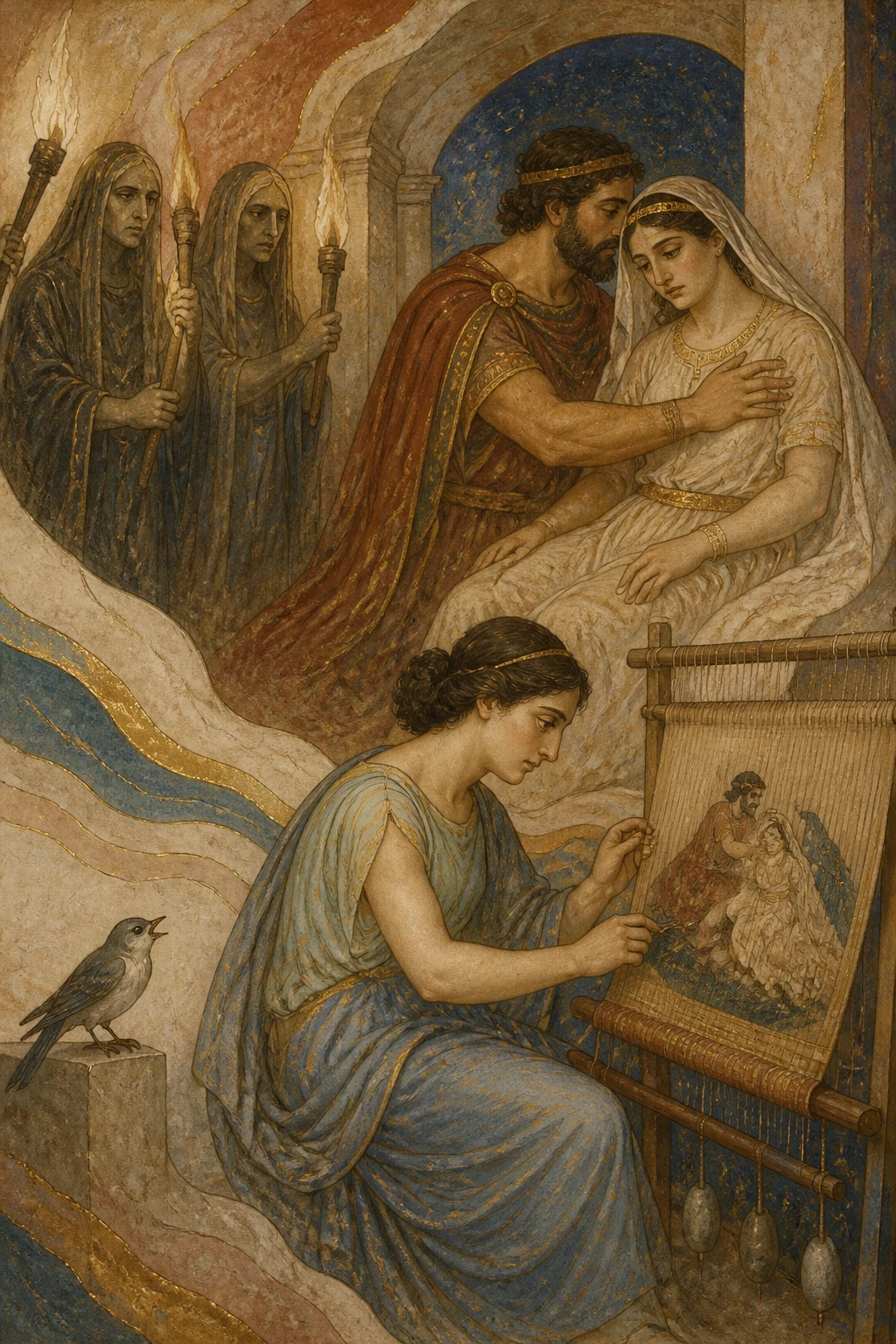
The Furies held torches snatched from a funeral; the Furies spread the marriage bed, and an ill-omened owl brooded over the house and perched on the bridal chamber’s roof. Under that omen Procne and Tereus were married; under that omen they became parents. Thrace, of course, rejoiced with them, and they themselves thanked the gods, decreeing festivals for the day when illustrious Pandion’s daughter was given to the king, and for the day when Itys was born.
So deeply hidden is our true good. Already the Sun had led the returning year through five autumns, when Procne coaxed her husband: “If I have any favor with you, either send me to visit my sister, or let my sister come here! You can promise your father-in-law that she will soon return. To let me see my sister would be a precious gift.” He ordered his ships launched upon the sea, and under sail and oar entered the harbors of Cecrops’ city and reached the shores of Piraeus.
As soon as he was admitted to his father-in-law, they clasped right hands, and their conversation began with words of good omen. He had begun explaining why he had come, conveying his wife’s request and promising a swift return if her sister were sent, when Philomela appeared, splendid in her rich attire, but richer still in beauty: such, we are told, are the naiads and dryads who walk deep in the woods, if only you dress them in such finery.
At the sight of the maiden Tereus blazed up, as when someone sets fire to the pale ears of grain, or burns dry leaves and the grass stored in a hayloft. Her beauty deserved admiration; but his own inborn lust spurred him on as well, and the people of that country are prone to passion: his nation’s vice and his own set him aflame. He longed to bribe her watchful attendants, to corrupt her nurse’s loyalty, to tempt the girl herself with immense gifts, to lavish his entire kingdom on her, or to seize her and defend his prize in savage war.
There was nothing he would not dare, possessed by unbridled lust, and his breast could not contain its hidden fires. Already he could scarcely endure delay, and eagerly returned to Procne’s request, pursuing his own desires under her name. Passion made him eloquent, and whenever his pleas grew too insistent, he said that Procne wished it so. He even added tears, as though she had commissioned those as well.
Gods above, how much blind night fills the human heart! In the very act of plotting his crime, Tereus was thought devoted, and won praise through his wickedness. And Philomela wanted the same thing. Winding her arms fondly about her father’s shoulders, she begged to visit her sister, pleading by her own welfare for what would destroy it. Tereus watched her, and in looking already touched her; her kisses and the arms he saw encircling her father’s neck were all spurs and torches and fuel for his frenzy. Whenever she embraced her father, he wished he were that father—nor would he have been any less wicked.
The father yielded to the pleas of both his daughters. Philomela rejoiced and thanked him, thinking, poor girl, that she and her sister had gained a blessing that would bring grief to them both. Little of his day’s labor now remained for Phoebus, and his horses were beating with their hooves the downward slope of heaven. A royal feast was laid upon the tables, and wine in golden cups; then they gave their bodies to peaceful sleep.
But the Odrysian king, though he had retired, still burned for her. Recalling her face, her movements, her hands, he imagined what he had not yet seen just as he wished it, feeding his own fires, while desire drove sleep away. Day came, and Pandion, clasping his departing son-in-law’s right hand, entrusted his companion to him through rising tears: “Dear son-in-law, since a loving purpose has prevailed, and both my daughters wish it, and you too, Tereus, wish it, I give her into your keeping. By your pledged faith, by our bond of kinship, by the gods above, I beg you: protect her with a father’s love, and send her back as soon as you can, the sweet comfort of my anxious old age—every delay will seem long to me.
You too, Philomela, if you have any love for me, return as soon as you can: it is enough that your sister is far away.” As he gave these charges, he kissed his daughter, and gentle tears fell between his words. As a pledge of faith he asked for their right hands and joined them together, begging them to remember to greet his absent daughter and grandson in his name.
His voice choked with sobs, he could scarcely say a last farewell, and feared the forebodings in his heart. Once Philomela was aboard the painted ship, and the oars drew the sea toward them and drove the land away, “I have won!” he cried. “My heart’s desire sails with me!” The barbarian exulted, scarcely able to postpone his joy, and never turned his eyes from her, like the predatory bird of Jove when its hooked talons have set a hare in its lofty nest: the captive has no escape, and the robber gazes at his prize.
The voyage was over, and they had left their weary ships on their native shore, when the king dragged Pandion’s daughter to a secluded lodge, hidden deep in ancient woods. There he shut her in, pale and trembling, afraid of everything, already asking through her tears where her sister was. Then, revealing his wicked purpose, he overpowered her, a virgin and alone, while she cried out in vain, again and again, for her father, her sister, and above all the great gods.
She trembled like a frightened lamb that, wounded, has escaped a gray wolf’s jaws and still cannot believe itself safe, or like a dove, its feathers wet with its own blood, still shuddering in fear of the greedy claws that held it. When her senses returned, she tore her loosened hair like a woman in mourning, beat and bruised her arms, and stretched out her hands. “You barbarian, with your monstrous deeds!
You cruel man!” she cried. “Did my father’s loving charges and his tears not move you? Nor your concern for my sister, nor my virginity, nor the sacred bonds of marriage? You have thrown everything into confusion. I have become my sister’s rival; you are husband to us both, and Procne must now be my enemy. Why not take my life as well, traitor, so no crime remains for you to commit? If only you had done so before this foul union, my shade would have been free of guilt.
Yet if the gods above see this, if their divine power means anything, if all has not perished with me, one day you will pay for this. I myself will cast aside my shame and tell what you have done. Given the chance, I will go among the people; if I am kept shut in these woods, I will fill the woods with my cries and move the stones that share my knowledge. Heaven will hear this, and any god who dwells there!”
These words roused the savage tyrant’s anger and a fear no less fierce. Spurred by both, he drew the sword he wore from its sheath, seized her by the hair, twisted her arms behind her back, and forced her into bonds. Philomela offered her throat, for the sight of the sword had given her hope of death. But as she cried out in outrage, still calling her father’s name and struggling to speak, he gripped her tongue with pincers and cut it out with his cruel blade. Its severed root quivered; the tongue itself lay trembling on the dark earth, murmuring.
As the tail of a mutilated snake will leap, it writhed, and dying sought its mistress’s feet. Even after this crime, they say—I scarcely dare believe it— he repeatedly assailed her mutilated body with his lust. After such deeds he could still bring himself to return to Procne. At the sight of her husband she asked for her sister. He gave a feigned groan and told an invented tale of death, and his tears made it credible. Procne tore from her shoulders her robes gleaming with broad bands of gold, put on black garments, raised an empty tomb, and brought offerings to a spirit not among the dead, mourning her sister’s fate, though not as it deserved to be mourned.
The god of the sun had passed through all twelve signs, completing a year. What could Philomela do? Guards barred her escape; the lodge’s walls stood firm, built of solid stone; her mouth was mute, with no tongue to tell the deed. But grief has great inventive power, and misery breeds cunning. Skillfully she stretched the warp upon a Thracian loom and wove purple signs into the white threads, a record of the crime. When it was finished, she gave it to a woman, gesturing for her to take it to the queen. The woman carried it to Procne, not knowing what message it held.
The savage tyrant’s wife unrolled the cloth and read the lamentable story of her own misfortune. And—marvelous that she could—she said nothing. Grief sealed her lips; her tongue sought words indignant enough and found none. There was no time for tears: she rushed ahead, ready to confound right and wrong, wholly absorbed in visions of revenge. It was the season when the women of Thrace celebrated the rites of Bacchus held every third year: night shared their mysteries.
By night Rhodope rang with the sharp clash of bronze; by night the queen left her house, equipped herself for the god’s rites, and took up the weapons of frenzy. Vine leaves covered her head, a deerskin hung at her left side, and a light spear rested on her shoulder. Wildly she sped through the woods, a crowd of her women following, terrible Procne, driven by the frenzy of grief, mimicking yours, Bacchus. At last she reached the lonely lodge, howled aloud, cried “Euhoe!” and broke down the doors.
She snatched her sister away, dressed her in the emblems of Bacchus, hid her face with ivy leaves, and led the bewildered girl inside her own walls. When Philomela realized she had entered that accursed house, the unhappy girl shuddered, and all the color left her face. Finding a private place, Procne removed the trappings of the rites, uncovered her wretched sister’s shame-stricken face, and sought to embrace her. But Philomela could not bear to raise her eyes to meet hers, believing herself her sister’s rival.
With her gaze cast down, she longed to swear, calling the gods as witnesses, that this dishonor had been forced upon her; her hands served her for a voice. Procne burned, unable to contain her rage. Rebuking her sister’s tears, she said, “This is no work for weeping, but for steel—or anything you have that can surpass the power of steel. Sister, I am ready for any crime.
Either I will set fire to the royal palace and fling Tereus, the author of this, into the flames, or with my blade tear out his tongue, his eyes, and the parts that robbed you of your honor; or drive out his guilty soul through a thousand wounds. I am planning something terrible, though what it is, I do not yet know.” While Procne spoke, Itys came to his mother. The sight of him suggested what she could do. Looking at him with merciless eyes, she said, “Ah, how like your father you are!” Without another word she prepared a dreadful crime, seething with silent rage.
Yet when her son approached and greeted his mother, drew her neck down with his little arms, and kissed her with childish endearments, the mother in her was moved. Her anger faltered and stood still, and tears, forced from her unwilling eyes, made them wet. But as soon as she felt her resolve wavering under too much tenderness, she turned again to her sister’s face.
Looking from one to the other, she said, “Why can one offer me his endearments, while the other is silent, her tongue torn out? Why, when he calls me mother, can she not call me sister? Consider the husband you have married, daughter of Pandion! You betray your birth: love for Tereus is a crime.” Without delay she dragged Itys away, like a tigress of the Ganges hauling a suckling fawn through shadowy woods.
When they reached a remote part of the lofty house, as he stretched out his hands, already seeing his fate, crying “Mother! Mother!” and reaching for her neck, Procne struck him with a sword where breast and side meet, and did not turn her face away. That single wound would have killed him; Philomela slit his throat with the blade. They tore apart his limbs while they were still alive, still holding something of his spirit. Some pieces seethed in hollow cauldrons, others hissed on spits; the inner rooms streamed with gore.
To this feast the wife invited the unsuspecting Tereus. Pretending it was a sacred rite of her native land that only one man might attend, she sent away his companions and servants. Tereus himself, seated high upon his ancestral throne, ate, and heaped his own flesh into his belly. So dark was his understanding that he said, “Bring Itys here.” Procne could not hide her cruel joy.
Eager now to announce the ruin she had wrought, she said, “You have within you the one you ask for.” He looked around and asked where the boy was. As he asked and called again, Philomela sprang forward just as she was, her hair disheveled and spattered with the frenzied slaughter, and hurled Itys’ bloody head into his father’s face. Never had she wished more keenly for the power of speech, to proclaim her joy in words.
The Thracian overturned the tables with a mighty cry and called the serpent-haired sisters from the valley of Styx. Now he longed, if only he could, to tear open his breast and cast out that dreadful feast, the flesh entombed within him; now he wept and called himself his son’s miserable tomb; now, with drawn sword, he pursued the daughters of Pandion. You would have thought their bodies were poised on wings: on wings they were. One sought the woods, the other flew beneath the eaves. Even now the marks of slaughter have not left her breast, and her feathers are stained with blood.
He, made swift by grief and the desire for vengeance, changed into a bird with a crest rising from its head and an enormous beak jutting out like a long spearpoint. The bird is called the hoopoe; it looks as though it is armed for war.
Izvirnik
Tereus, Procne, and Philomela
Naslednje strani prikazujejo izvirno besedilo za primerjavo.
Source ID: ovid_metamorphoses_story_043 Citation: Ovid, Metamorphoses 6.401-6.674 Original language: Latin Source: PerseusDL canonical-latinLit Source URL: https://github.com/PerseusDL/canonical-latinLit/blob/master/data/phi0959/phi006/phi0959.phi006.perseus-lat2.xml Segmentation certainty: medium 401: Talibus extemplo redit ad praesentia dictis 402: vulgus et exstinctum cum stirpe Amphiona luget.
403: Mater in invidia est. Hanc tunc quoque dicitur unus 404: flesse Pelops, umeroque, suas a pectore postquam 405: deduxit vestes ebur ostendisse sinistro. 406: Concolor hic umerus nascendi tempore dextro 407: corporeusque fuit: manibus mox caesa paternis 408: membra ferunt iunxisse deos; aliisque repertis, 409: qui locus est iuguli medius summique lacerti, 410: defuit. Impositum est non comparentis in usum 411: partis ebur, factoque Pelops fuit integer illo.
412: Finitimi proceres coeunt, urbesque propinquae 413: oravere suos ire ad solacia reges, 414: Argosque et Sparte Pelopeiadesque Mycenae 415: et nondum torvae Calydon invisa Dianae 416: Orchomenosque ferax et nobilis aere Corinthus 417: Messeneque ferox Patraeque humilesque Cleonae 418: et Nelea Pylos, neque adhuc Pittheia Troezen, 419: quaeque urbes aliae bimari clauduntur ab Isthmo 420: exteriusque sitae bimari spectantur ab Isthmo.
421: Credere quis posset? solae cessastis Athenae. 422: Obstitit officio bellum, subvectaque ponto 423: barbara Mopsopios terrebant agmina muros. 424: Threicius Tereus haec auxiliaribus armis 425: fuderat et clarum vincendo nomen habebat. 426: Quem sibi Pandion opibusque virisque potentem 427: et genus a magno ducentem forte Gradivo 428: conubio Procnes iunxit. Non pronuba Iuno, 429: non Hymenaeus adest, non illi Gratia lecto.
430: Eumenides tenuere faces de funere raptas, 431: Eumenides stravere torum, tectoque profanus 432: incubuit bubo thalamique in culmine sedit. 433: Hac ave coniuncti Procne Tereusque, parentes 434: hac ave sunt facti. Gratata est scilicet illis 435: Thracia, disque ipsi grates egere diemque, 436: quaque data est claro Pandione nata tyranno, 437: quaque erat ortus Itys, festum iussere vocari.
438: Usque adeo latet utilitas. Iam tempora Titan 439: quinque per autumnos repetiti duxerat anni, 440: cum blandita viro Procne “si gratia” dixit 441: “ulla mea est, vel me visendam mitte sorori, 442: vel soror huc veniat! redituram tempore parvo 443: promittes socero: magni mihi muneris instar 444: germanam vidisse dabis.” Iubet ille carinas 445: in freta deduci veloque et remige portus 446: Cecropios intrat Piraeaque litora tangit.
447: Ut primum soceri data copia, dextera dextrae 448: iungitur, et fausto committitur omine sermo. 449: Coeperat adventus causam, mandata referre 450: coniugis et celeres missae spondere recursus: 451: ecce venit magno dives Philomela paratu, 452: divitior forma: quales audire solemus 453: naidas et dryadas mediis incedere silvis, 454: si modo des illis cultus similesque paratus.
455: Non secus exarsit conspecta virgine Tereus, 456: quam siquis canis ignem supponat aristis, 457: aut frondem positasque cremet faenilibus herbas. 458: Digna quidem facies: sed et hunc innata libido 459: exstimulat, pronumque genus regionibus illis 460: in venerem est: flagrat vitio gentisque suoque. 461: Impetus est illi comitum corrumpere curam 462: nutricisque fidem, nec non ingentibus ipsam 463: sollicitare datis totumque impendere regnum, 464: aut rapere et saevo raptam defendere bello—, 465: et nihil est quod non effreno captus amore 466: ausit nec capiunt inclusas pectora flammas.
467: Iamque moras male fert cupidoque revertitur ore 468: ad mandata Procnes, et agit sua vota sub illa. 469: Facundum faciebat amor: quotiensque rogabat 470: ulterius iusto Procnen ita velle ferebat. 471: Addidit et lacrimas, tamquam mandasset et illas. 472: Pro superi, quantum mortalia pectora caecae 473: noctis habent! ipso sceleris molimine Tereus 474: creditur esse pius laudemque a crimine sumit.
475: Quid quod idem Philomela cupit patriosque lacertis 476: blanda tenens umeros, ut eat visura sororem, 477: perque suam contraque suam petit ipsa salutem. 478: Spectat eam Tereus praecontrectatque videndo 479: osculaque et collo circumdata bracchia cernens 480: omnia pro stimulis facibusque ciboque furoris 481: accipit; et quotiens amplectitur illa parentem, 482: esse parens vellet: neque enim minus impius esset.
483: Vincitur ambarum genitor prece. Gaudet agitque 484: illa patri grates et successisse duabus 485: id putat infelix, quod erit lugubre duabus. 486: Iam labor exiguus Phoebo restabat, equique 487: pulsabant pedibus spatium declivis Olympi: 488: regales epulae mensis et Bacchus in auro 489: ponitur; hinc placido dantur sua corpora somno. 490: At rex Odrysius, quamvis secessit, in illa 491: aestuat, et, repetens faciem motusque manusque, 492: qualia vult fingit quae nondum vidit, et ignes 493: ipse suos nutrit, cura removente soporem.
494: Lux erat, et generi dextram complexus euntis 495: Pandion comitem lacrimis commendat obortis: 496: “Hanc ego, care gener, quoniam pia causa coegit 497: et voluere ambae, voluisti tu quoque, Tereu, 498: do tibi, perque fidem cognataque pectora supplex, 499: per superos oro, patrio ut tuearis amore 500: et mihi sollicitae lenimen dulce senectae 501: quam primum (omnis erit nobis mora longa) remittas.
502: Tu quoque quam primum (satis est procul esse sororem) 503: si pietas ulla est, ad me, Philomela, redito.” 504: Mandabat pariterque suae dabat oscula natae, 505: et lacrimae mites inter mandata cadebant. 506: Utque fide pignus dextras utriusque poposcit 507: inter seque datas iunxit natamque nepotemque 508: absentes pro se memori rogat ore salutent; 509: supremumque vale pleno singultibus ore 510: vix dixit timuitque suae praesagia mentis.
511: Ut semel imposita est pictae Philomela carinae, 512: admotumque fretum remis tellusque repulsa est, 513: “vicimus” exclamat, “mecum mea vota feruntur” 514: exsultatque et vix animo sua gaudia differt 515: barbarus et nusquam lumen detorquet ab illa, 516: non aliter, quam cum pedibus praedator obuncis 517: deposuit nido leporem Iovis ales in alto: 518: nulla fuga est capto, spectat sua praemia raptor.
519: Iamque iter effectum, iamque in sua litora fessis 520: puppibus exierant, cum rex Pandione natam 521: in stabula alta trahit, silvis obscura vetustis, 522: atque ibi pallentem trepidamque et cuncta timentem 523: et iam cum lacrimis, ubi sit germana, rogantem 524: includit: fassusque nefas et virginem et unam 525: vi superat frustra clamato saepe parente, 526: saepe sorore sua, magnis super omnia divis.
527: Illa tremit velut agna pavens, quae saucia cani 528: ore excussa lupi nondum sibi tuta videtur, 529: utque columba suo madefactis sanguine plumis 530: horret adhuc avidosque timet, quibus haeserat, ungues. 531: Mox ubi mens rediit, passos laniata capillos, 532: lugenti similis, caesis plangore lacertis, 533: intendens palmas “o diris barbare factis, 534: o crudelis” ait “nec te mandata parentis 535: cum lacrimis movere piis nec cura sororis 536: nec mea virginitas nec coniugialia iura!
537: Omnia turbasti: paelex ego facta sororis, 538: tu geminus coniunx, hostis mihi debita Procne. 539: Quin animam hanc, ne quod facinus tibi, perfide, restet, 540: eripis? atque utinam fecisses ante nefandos 541: concubitus vacuas habuissem criminis umbras. 542: Si tamen haec superi cernunt, si numina divum 543: sunt aliquid, si non perierunt omnia mecum, 544: quandocumque mihi poenas dabis. Ipsa pudore 545: proiecto tua facta loquar. Si copia detur, 546: in populos veniam; si silvis clausa tenebor, 547: implebo silvas et conscia saxa movebo: 548: audiet haec aether, et si deus ullus in illo est.”
549: Talibus ira feri postquam commota tyranni 550: nec minor hac metus est, causa stimulatus utraque 551: quo fuit accinctus, vagina liberat ensem 552: arreptamque coma flexis post terga lacertis 553: vincla pati cogit. Iugulum Philomela parabat 554: spemque suae mortis viso conceperat ense: 555: ille indignantem et nomen patris usque vocantem 556: luctantemque loqui comprensam forcipe linguam 557: abstulit ense fero. Radix micat ultima linguae, 558: ipsa iacet terraeque tremens inmurmurat atrae; 559: utque salire solet mutilatae cauda colubrae, 560: palpitat et moriens dominae vestigia quaerit.
561: Hoc quoque post facinus (vix ausim credere) fertur 562: saepe sua lacerum repetisse libidine corpus. 563: Sustinet ad Procnen post talia facta reverti. 564: Coniuge quae viso germanam quaerit: at ille 565: dat gemitus fictos commentaque funera narrat, 566: et lacrimae fecere fidem. Velamima Procne 567: deripit ex umeris auro fulgentia lato 568: induiturque atras vestes et inane sepulcrum 569: constituit falsisque piacula manibus infert 570: et luget non sic lugendae fata sororis.
571: Signa deus bis sex acto lustraverat anno. 572: Quid faciat Philomela? fugam custodia claudit, 573: structa rigent solido stabulorum moenia saxo, 574: os mutum facti caret indice. Grande doloris 575: ingenium est, miserisque venit sollertia rebus. 576: Stamina barbarica suspendit callida tela 577: purpureasque notas filis intexuit albis, 578: indicium sceleris; perfectaque tradidit uni, 579: utque ferat dominae gestu rogat: illa rogata 580: pertulit ad Procnen, nec scit, quid tradat in illis.
581: Evolvit vestes saevi matrona tyranni 582: fortunaeque suae carmen miserabile legit 583: et (mirum potuisse) silet. Dolor ora repressit, 584: verbaque quaerenti satis indignantia linguae 585: defuerunt; nec flere vacat, sed fasque nefasque 586: confusura ruit, poenaeque in imagine tota est. 587: Tempus erat, quo sacra solent trieterica Bacchi 588: Sithoniae celebrare nurus: nox conscia sacris.
589: Nocte sonat Rhodope tinnitibus aeris acuti, 590: nocte sua est egressa domo regina deique 591: ritibus instruitur furialiaque accipit arma. 592: Vite caput tegitur, lateri cervina sinistro 593: vellera dependent, umero levis incubat hasta. 594: Concita per silvas turba comitante suarum 595: terribilis Procne furiisque agitata doloris, 596: Bacche, tuas simulat. Venit ad stabula avia tandem 597: exululatque euhoeque sonat portasque refringit 598: germanamque rapit; raptaeque insignia Bacchi 599: induit et vultus hederarum frondibus abdit 600: attonitamque trahens intra sua moenia ducit.
601: Ut sensit tetigisse domum Philomela nefandam, 602: horruit infelix totoque expalluit ore. 603: Nacta locum Procne sacrorum pignera demit 604: oraque develat miserae pudibunda sororis 605: amplexumque petit. Sed non attollere contra 606: sustinet haec oculos, paelex sibi visa sororis, 607: deiectoque in humum vultu iurare volenti 608: testarique deos, per vim sibi dedecus illud 609: illatum, pro voce manus fuit. Ardet et iram 610: non capit ipsa suam Procne; fletumque sororis 611: corripiens “non est lacrimis hoc” inquit “agendum, 612: sed ferro, sed si quid habes, quod vincere ferrum
613: possit. In omne nefas ego me, germana, paravi. 614: Aut ego, cum facibus regalia tecta cremabo, 615: artificem mediis inmittam Terea flammis, 616: aut linguam, aut oculos et quae tibi membra pudorem 617: abstulerunt, ferro rapiam, aut per vulnera mille 618: sontem animam expellam. Magnum quodcumque paravi: 619: quid sit, adhuc dubito.” Peragit dum talia Procne, 620: ad matrem veniebat Itys. Quid possit, ab illo 621: admonita est: oculisque tuens inmitibus “a quam 622: es similis patri” dixit. Nec plura locuta 623: triste parat facinus tacitaque exaestuat ira.
624: Ut tamen accessit natus matrique salutem 625: attulit et parvis adduxit colla lacertis 626: mixtaque blanditiis puerilibus oscula iunxit, 627: mota quidem est genetrix infractaque constitit ira 628: invitique oculi lacrimis maduere coactis: 629: sed simul ex nimia mentem pietate labare 630: sensit, ab hoc iterum est ad vultus versa sororis 631: inque vicem spectans ambos “cur admovet” inquit 632: “alter blanditias, rapta silet altera lingua?
633: Quam vocat hic matrem, cur non vocat illa sororem? 634: Cui sis nupta, vide, Pandione nata, marito. 635: Degeneras: scelus est pietas in coniuge Tereo.” 636: Nec mora, traxit Ityn, veluti Gangetica cervae 637: lactentem fetum per silvas tigris opacas. 638: Utque domus altae partem tenuere remotam, 639: tendentemque manus et iam sua fata videntem 640: et “mater, mater” clamantem et colla petentem 641: ense ferit Procne, lateri qua pectus adhaeret, 642: nec vultum vertit. Satis illi ad fata vel unum 643: vulnus erat: iugulum ferro Philomela resolvit.
644: Vivaque adhuc animaeque aliquid retinentia membra 645: dilaniant. Pars inde cavis exsultat aenis, 646: pars veribus stridunt: manant penetralia tabo. 647: His adhibet coniunx ignarum Terea mensis 648: et patrii moris sacrum mentita, quod uni 649: fas sit adire viro, comites famulosque removit. 650: Ipse sedens solio Tereus sublimis avito 651: vescitur inque suam sua viscera congerit alvum.
652: Tantaque nox animi est, “Ityn huc accersite” dixit. 653: Dissimulare nequit crudelia gaudia Procne, 654: iamque suae cupiens exsistere nuntia cladis, 655: “intus habes, quem poscis” ait. Circumspicit ille 656: atque ubi sit quaerit. Quaerenti iterumque vocanti, 657: sicut erat sparsis furiali caede capillis, 658: prosiluit Ityosque caput Philomela cruentum 659: misit in ora patris: nec tempore maluit ullo 660: posse loqui et mentis testari gaudia dictis.
661: Thracius ingenti mensas clamore repellit 662: vipereasque ciet Stygia de valle sorores; 663: et modo, si posset reserato pectore diras 664: egerere inde dapes inmersaque viscera gestit, 665: flet modo seque vocat bustum miserabile nati, 666: nunc sequitur nudo genitas Pandione ferro. 667: Corpora Cecropidum pennis pendere putares: 668: pendebant pennis. Quarum petit altera silvas, 669: altera tecta subit; neque adhuc de pectore caedis 670: excessere notae, signataque sanguine pluma est.
671: Ille dolore suo poenaeque cupidine velox 672: vertitur in volucrem, cui stant in vertice cristae; 673: prominet inmodicum pro longa cuspide rostrum: 674: nomen epops volucri, facies armata videtur.
Nadaljuj z branjem