O besedilu
Likijski kmetje
- Vir
- Ovidove preobrazbe
- Avtor
- Ovid
- Jezik branja
- English
- Jezik izvirnika
- Latin
- Čas branja
- 4 min branja
- Obseg
- 4 strani
- Naslov izvirnika
- The Lycian Peasants
O izvirniku
Ovidove preobrazbe
Pesniški tok antičnih preobrazb, kjer bogovi, ljudje in narava stalno menjavajo obliko. Bralni jezik je English, izvirnik pa prihaja iz vira Ovidove preobrazbe v jeziku Latin.
Besedilo
Likijski kmetje
Then all alike, women and men, feared the manifest wrath of heaven, and with still greater devotion revered the mighty power of the goddess who bore the twins, and, as happens, this recent deed brought older tales to mind. One among them said: “In the fields of fertile Lycia, too, the country folk of old did not scorn the goddess unpunished. The story is little known, for its people were obscure, yet it is marvellous. I myself have seen the pool and the place made famous by the wonder. For my father, then advanced in years and no longer able to endure the journey, had ordered me to bring home some chosen cattle from that country, and as I set out had given me a man of that people as my guide. As I roamed the pastures with him,
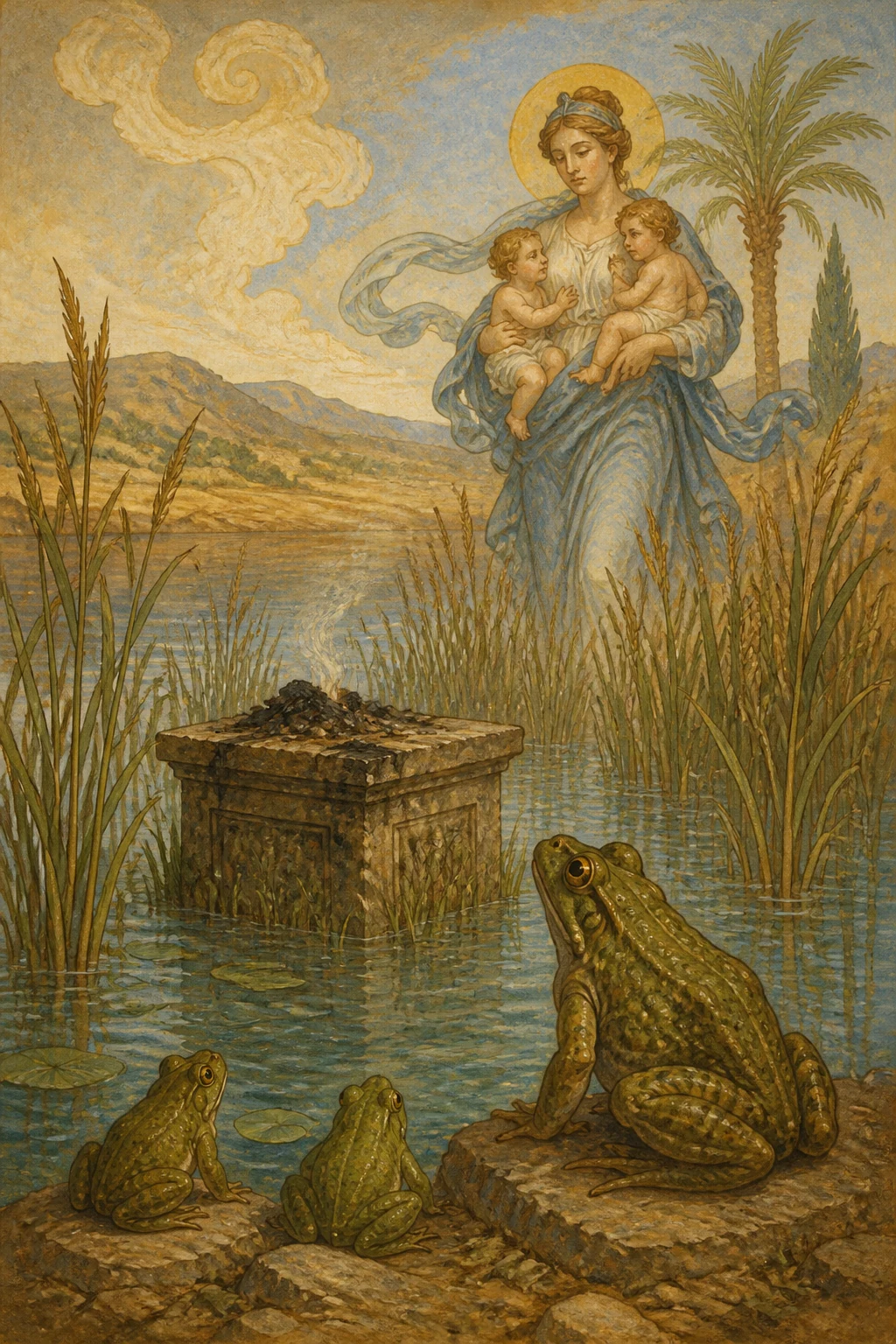
there in the middle of a lake stood an ancient altar, black with sacrificial ashes, surrounded by trembling reeds. My guide stopped and murmured fearfully, ‘Be gracious to me’; and in just such a murmur I too said, ‘Be gracious.’ Yet I asked whether the altar belonged to the Naiads, to Faunus, or to some native god, and my companion answered: ‘Young man, no mountain deity dwells at this altar: she claims it as her own whom heaven’s royal consort once barred from all the earth, whom wandering Delos scarcely dared receive despite her prayers, when that light island still floated on the sea.
There, leaning against a palm and the tree of Pallas, Latona bore her twins, against their stepmother’s will. From there too, they say, the new-made mother fled from Juno, carrying in her arms her children, both divine. And now, in the land of Lycia, home of the Chimaera, as the fierce sun scorched the fields, the goddess, weary from her long ordeal, grew thirsty, parched by the blazing heat from heaven, and her hungry children had drained her milk-filled breasts.
By chance she caught sight of a pool of modest size deep in a valley; country folk were gathering bushy willow shoots there, along with rushes and the sedge that thrives in marshes. The Titan’s daughter approached and knelt upon the earth, meaning to scoop up the cool water and drink. The rustic crowd forbade her. The goddess addressed those who denied her: “Why do you keep me from the water? Water is for everyone to use.
Nature has made neither sunlight nor air the property of anyone, nor the flowing waters: I have come for a gift that belongs to all. Yet I beg you humbly to grant it. I did not intend to bathe my body here, or wash my weary limbs, but to relieve my thirst. My mouth is dry as I speak, my throat is parched, and scarcely lets my voice pass through. A draught of water will be nectar to me, and I shall acknowledge that with it I have received life: in giving water, you will have given life.
Let these children move you too, who stretch their little arms from my embrace”—and by chance the children were stretching out their arms. Who could have failed to be moved by the goddess’s gentle words? Yet they persisted in denying her pleas, adding threats unless she went far away, and insults besides. Nor was that enough: with their hands and feet they even stirred up the pool itself, and with spiteful leaps churned the soft mud this way and that from the bottom of the water.
Anger made her forget her thirst: the daughter of Coeus no longer begged favours of the unworthy, nor could she bear to speak words beneath a goddess any longer. Raising her hands to the stars, she said, “May you live for ever in that pool!” The goddess’s wish came true: they delight in being beneath the water, now plunging their whole bodies into the depths of the marsh, now putting out their heads, now swimming on the surface, often resting on the bank of the pool, often leaping back into the cold water. Yet even now they ply their ugly tongues in quarrels, and, casting off all shame, though they are beneath the water, beneath the water they still try to curse.
Their voices too are hoarse now, their puffed-up throats swell, and their very insults stretch their gaping mouths wide. Their heads touch their backs, their necks seem to have vanished, their backs are green, their bellies—the largest part of their bodies—white, and they leap about the muddy pool, newly fashioned frogs.’”
Izvirnik
The Lycian Peasants
Naslednje strani prikazujejo izvirno besedilo za primerjavo.
Source ID: ovid_metamorphoses_story_041 Citation: Ovid, Metamorphoses 6.313-6.381 Original language: Latin Source: PerseusDL canonical-latinLit Source URL: https://github.com/PerseusDL/canonical-latinLit/blob/master/data/phi0959/phi006/phi0959.phi006.perseus-lat2.xml Segmentation certainty: medium 313: Tum vero cuncti manifestam numinis iram 314: femina virque timent cultuque impensius omnes 315: magna gemelliparae venerantur numina divae, 316: utque fit, a facto propiore priora renarrant.
317: E quibus unus ait: “Lyciae quoque fertilis agris 318: non impune deam veteres sprevere coloni. 319: Res obscura quidem est ignobilitate virorum, 320: mira tamen. Vidi praesens stagnumque locumque 321: prodigio notum. Nam me iam grandior aevo 322: impatiensque viae genitor deducere lectos 323: iusserat inde boves gentisque illius eunti 324: ipse ducem dederat. Cum quo dum pascua lustro, 325: ecce lacu medio sacrorum nigra favilla 326: ara vetus stabat tremulis circumdata cannis.
327: Restitit et pavido “faveas mihi” murmure dixit 328: dux meus; et simili “faveas” ego murmure dixi. 329: Naiadum Faunine foret tamen ara rogabam 330: indigenaeve dei, cum talia rettulit hospes: 331: “Non hac, o iuvenis, montanum numen in ara est: 332: illa suam vocat hanc, cui quondam regia coniunx 333: orbem interdixit, quam vix erratica Delos 334: orantem accepit, tum cum levis insula nabat.
335: Illic incumbens cum Palladis arbore palmae 336: edidit invita geminos Latona noverca. 337: Hinc quoque Iunonem fugisse puerpera fertur 338: inque suo portasse sinu, duo numina, natos. 339: Iamque Chimaeriferae, cum sol gravis ureret arva, 340: finibus in Lyciae longo dea fessa labore 341: sidereo siccata sitim conlegit ab aestu, 342: uberaque ebiberant avidi lactantia nati.
343: Forte lacum mediocris aquae prospexit in imis 344: vallibus; agrestes illic fruticosa legebant 345: vimina cum iuncis gratamque paludibus ulvam. 346: Accessit positoque genu Titania terram 347: pressit, ut hauriret gelidos potura liquores. 348: Rustica turba vetat. Dea sic adfata vetantes: 349: “Quid prohibetis aquis? usus communis aquarum est. 350: Nec solem proprium natura nec aera fecit 351: nec tenues undas: ad publica munera veni.
352: Quae tamen ut detis, supplex peto. Non ego nostros 353: abluere hic artus lassataque membra parabam, 354: sed relevare sitim. Caret os umore loquentis 355: et fauces arent, vixque est via vocis in illis. 356: Haustus aquae mihi nectar erit, vitamque fatebor 357: accepisse simul: vitam dederitis in unda. 358: Hi quoque vos moveant, qui nostro bracchia tendunt 359: parva sinu:” et casu tendebant bracchia nati.
360: Quem non blanda deae potuissent verba movere? 361: Hi tamen orantem perstant prohibere minasque, 362: ni procul abscedat, conviciaque insuper addunt. 363: Nec satis est, ipsos etiam pedibusque manuque 364: turbavere lacus imoque e gurgite mollem 365: huc illuc limum saltu movere maligno. 366: Distulit ira sitim: neque enim iam filia Coei 367: supplicat indignis nec dicere sustinet ultra 368: verba minora dea, tollensque ad sidera palmas 369: “aeternum stagno” dixit “vivatis in isto.”
370: Eveniunt optata deae: iuvat esse sub undis 371: et modo tota cava submergere membra palude, 372: nunc proferre caput, summo modo gurgite nare, 373: saepe super ripam stagni consistere, saepe 374: in gelidos resilire lacus. Sed nunc quoque turpes 375: litibus exercent linguas pulsoque pudore, 376: quamvis sint sub aqua, sub aqua maledicere temptant. 377: Vox quoque iam rauca est, inflataque colla tumescunt, 378: ipsaque dilatant patulos convicia rictus.
379: Terga caput tangunt, colla intercepta videntur, 380: spina viret, venter, pars maxima corporis, albet, 381: limosoque novae saliunt in gurgite ranae.””
Nadaljuj z branjem