Prevod
There was a hill, and on its summit lay a level stretch of open ground, made green by grassy growth. The place had no shade; but when the god-born bard sat down there and set his strings resounding, shade came to the place. The oak of Chaonia was there, the grove of the Heliads, the oak with its lofty foliage, soft lindens, beeches, and the virgin laurel, the brittle hazel and the ash, useful for spears, the knotless fir, the holm oak bowed beneath its acorns, the cheerful plane, the maple with its varied hues, and with them river-dwelling willows and the watery lotus, the ever-green box and slender tamarisks,
the two-toned myrtle and the laurustinus with blue berries. You too came, ivy with your twining feet, and with you leafy vines and elms arrayed in vines, manna ashes, spruces, the strawberry tree laden with red fruit, and pliant palms, the victor’s prize, and the pine, its foliage gathered high into a shaggy crown, dear to the Mother of the Gods; for Cybele’s Attis shed his human form in this and hardened into its trunk.
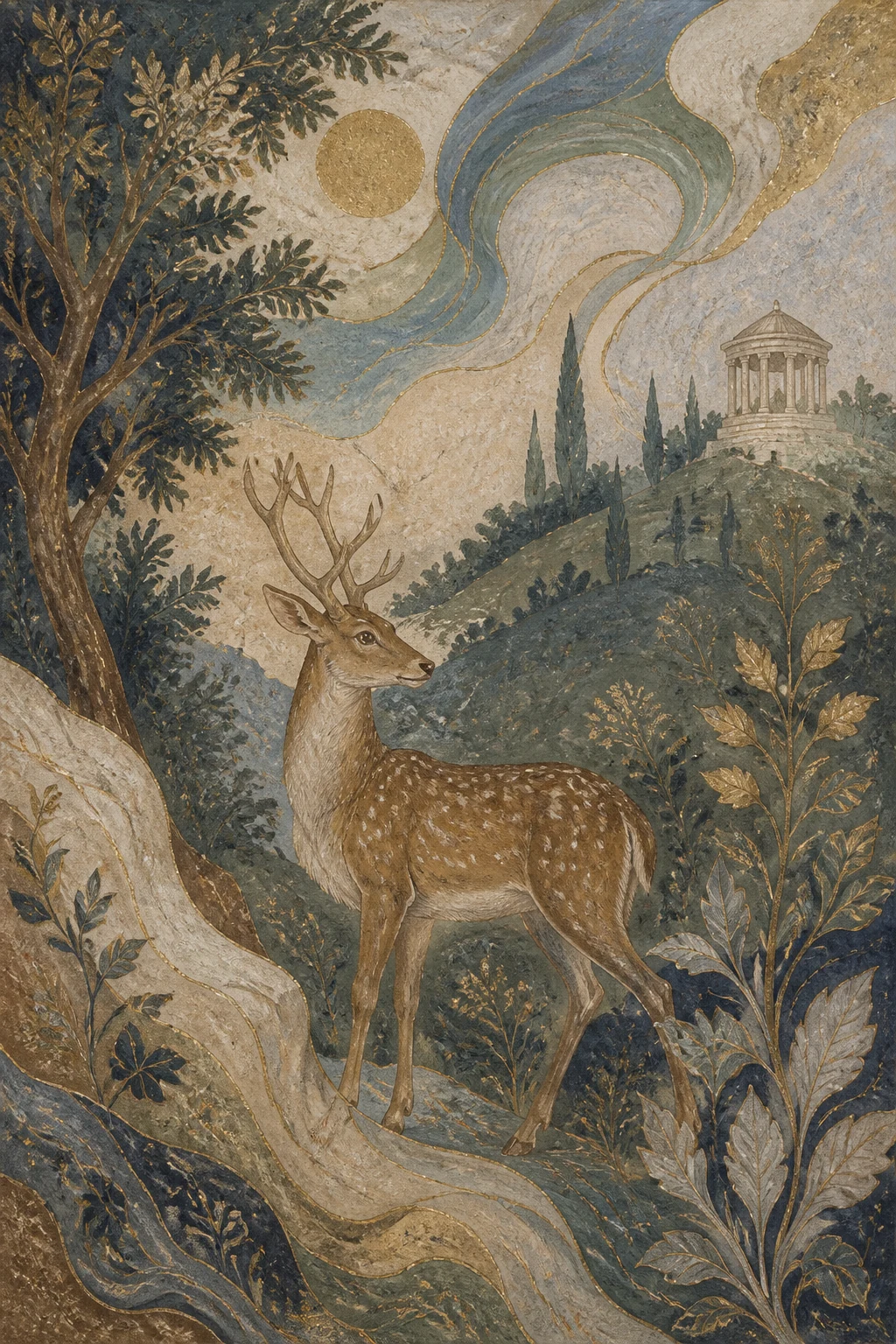
Among this throng came the cypress, shaped like a turning post, a tree now, but once a boy beloved by the god who tunes the lyre’s strings and strings his bow. For there was a great stag, sacred to the nymphs who dwell in the fields of Carthaea, whose spreading antlers cast deep shade above his own head. His antlers gleamed with gold, and down upon his shoulders hung jeweled necklaces about his rounded neck.
Above his brow a silver amulet, fastened with slender straps, swayed; and matching pearls shone from both his ears, beside his hollow temples. Free of fear, having laid aside his natural timidity, he would often visit houses and offer his neck to be stroked by any hand, however strange. Yet above all others, Cyparissus, fairest of the Cean people, he was dear to you. You led the stag to fresh pastures and the waters of a clear spring; now you wove flowers of many colors through his antlers, now, sitting on his back, you rode joyfully here and there, guiding his gentle mouth with purple reins.
It was hot and noon, and beneath the blazing sun the curving claws of shore-dwelling Cancer seethed: weary, the stag laid his body on the grassy earth and drew coolness from the shade of trees. Unwittingly, the boy Cyparissus pierced him with a sharp javelin; and when he saw him dying of the cruel wound, he resolved to die himself. What words of comfort Phoebus offered him, urging him to temper his grief and keep it in proportion to his loss! Yet still the boy lamented, and begged this final gift of the gods: to mourn forever.
And now, his blood drained away by endless weeping, his limbs began to turn green, and the hair that lately hung above his snow-white brow became a bristling crown; stiffening, it rose in a slender peak toward the starry heavens. The god groaned and said in sorrow, “I shall mourn for you, and you shall mourn for others and stand beside the grieving.” Such was the grove the bard had drawn to him; and he sat amid a gathering of beasts and a throng of birds.
When he had tested the strings enough with his thumb and heard their different notes, though diverse in sound, blend in harmony, he raised his voice in this song:
Izvirnik
Source ID: ovid_metamorphoses_story_068 Citation: Ovid, Metamorphoses 10.86-10.147 Original language: Latin Source: PerseusDL canonical-latinLit Source URL: https://github.com/PerseusDL/canonical-latinLit/blob/master/data/phi0959/phi006/phi0959.phi006.perseus-lat2.xml Segmentation certainty: medium 86: Collis erat collemque super planissima campi 87: area, quam viridem faciebant graminis herbae.
88: Umbra loco deerat: qua postquam parte resedit 89: dis genitus vates et fila sonantia movit, 90: umbra loco venit. Non Chaonis afuit arbor. 91: non nemus Heliadum, non frondibus aesculus altis, 92: nec tiliae molles, nec fagus et innuba laurus, 93: et coryli fragiles et fraxinus utilis hastis 94: enodisque abies curvataque glandibus ilex 95: et platanus genialis acerque coloribus impar 96: amnicolaeque simul salices et aquatica lotos 97: perpetuoque virens buxum tenuesque myricae 98: et bicolor myrtus et bacis caerula tinus.
99: Vos quoque, flexipedes hederae, venistis et una 100: pampineae vites et amictae vitibus ulmi, 101: ornique et piceae pomoque onerata rubenti 102: arbutus et lentae, victoris praemia, palmae 103: et succincta comas hirsutaque vertice pinus, 104: grata deum matri; siquidem Cybeleius Attis 105: exuit hac hominem truncoque induruit illo. 106: Adfuit huic turbae metas imitata cupressus, 107: nunc arbor, puer ante deo dilectus ab illo, 108: qui citharam nervis et nervis temperat arcum.
109: Namque sacer nymphis Carthaea tenentibus arva 110: ingens cervus erat, lateque patentibus altas 111: ipse suo capiti praebebat cornibus umbras. 112: Cornua fulgebant auro, demissaque in armos 113: pendebant tereti gemmata monilia collo. 114: Bulla super frontem parvis argentea loris 115: vincta movebatur parilique aetate: nitebant 116: auribus e geminis circum cava tempora bacae.
117: Isque metu vacuus naturalique pavore 118: deposito celebrare domos mulcendaque colla 119: quamlibet ignotis manibus praebere solebat. 120: Sed tamen ante alios, Ceae pulcherrime gentis, 121: gratus erat, Cyparisse, tibi. Tu pabula cervum 122: ad nova, tu liquidi ducebas fontis ad undam, 123: tu modo nectebas varios per cornua flores, 124: nunc eques in tergo residens huc laetus et illuc 125: mollia purpureis frenabas ora capistris.
126: Aestus erat mediusque dies, solisque vapore 127: concava litorei fervebant bracchia cancri: 128: fessus in herbosa posuit sua corpora terra 129: cervus et arborea frigus ducebat ab umbra. 130: Hunc puer imprudens iaculo Cyparissus acuto 131: fixit; et ut saevo morientem vulnere vidit, 132: velle mori statuit. Quae non solacia Phoebus 133: dixit et ut leviter pro materiaque doleret, 134: admonuit! Gemit ille tamen munusque supremum 135: hoc petit a superis, ut tempore lugeat omni.
136: Iamque per inmensos egesto sanguine fletus 137: in viridem verti coeperunt membra colorem, 138: et modo qui nivea pendebant fronte capilli, 139: horrida caesaries fieri sumptoque rigore 140: sidereum gracili spectare cacumine caelum. 141: Ingemuit tristisque deus “lugebere nobis 142: lugebisque alios aderisque dolentibus” inquit. 143: Tale nemus vates attraxerat inque ferarum 144: concilio medius turba volucrumque sedebat.
145: Ut satis impulsas temptavit pollice chordas 146: et sensit varios, quamvis diversa sonarent, 147: concordare modos, hoc vocem carmine movit: