Prevod
There was a hill, and on its summit lay a level stretch of open ground, made green by grassy growth. The place had no shade; but when the god-born bard sat down there and set his strings resounding, shade came to the place. The oak of Chaonia was there, the grove of the Heliads, the oak with its lofty foliage, soft lindens, beeches, and the virgin laurel, the brittle hazel and the ash, useful for spears, the knotless fir, the holm oak bowed beneath its acorns, the cheerful plane, the maple with its varied hues, and with them river-dwelling willows and the watery lotus, the ever-green box and slender tamarisks,
the two-toned myrtle and the laurustinus with blue berries. You too came, ivy with your twining feet, and with you leafy vines and elms arrayed in vines, manna ashes, spruces, the strawberry tree laden with red fruit, and pliant palms, the victor’s prize, and the pine, its foliage gathered high into a shaggy crown, dear to the Mother of the Gods; for Cybele’s Attis shed his human form in this and hardened into its trunk.
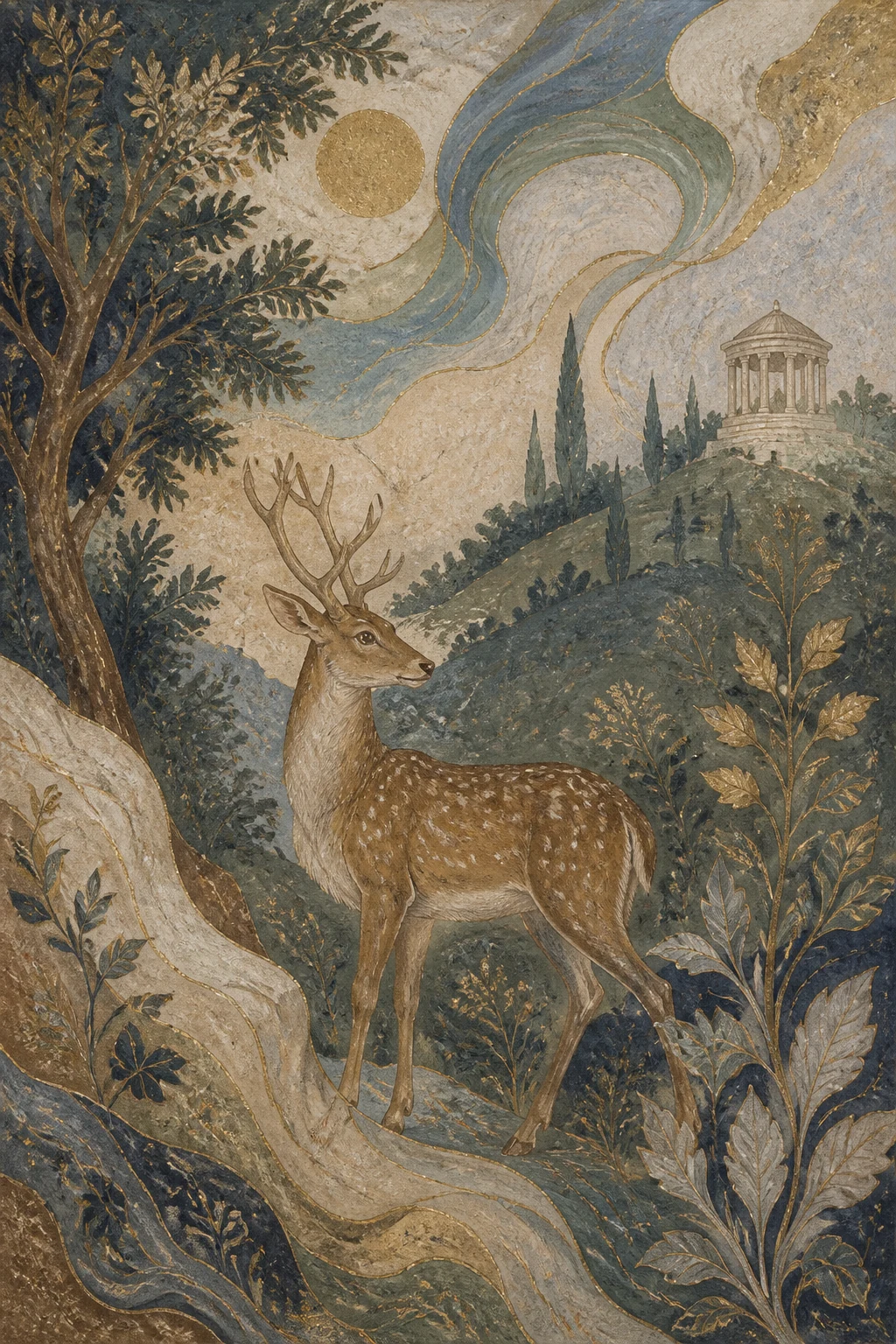
Among this throng came the cypress, shaped like a turning post, a tree now, but once a boy beloved by the god who tunes the lyre’s strings and strings his bow. For there was a great stag, sacred to the nymphs who dwell in the fields of Carthaea, whose spreading antlers cast deep shade above his own head. His antlers gleamed with gold, and down upon his shoulders hung jeweled necklaces about his rounded neck.
Above his brow a silver amulet, fastened with slender straps, swayed; and matching pearls shone from both his ears, beside his hollow temples. Free of fear, having laid aside his natural timidity, he would often visit houses and offer his neck to be stroked by any hand, however strange. Yet above all others, Cyparissus, fairest of the Cean people, he was dear to you. You led the stag to fresh pastures and the waters of a clear spring; now you wove flowers of many colors through his antlers, now, sitting on his back, you rode joyfully here and there, guiding his gentle mouth with purple reins.
It was hot and noon, and beneath the blazing sun the curving claws of shore-dwelling Cancer seethed: weary, the stag laid his body on the grassy earth and drew coolness from the shade of trees. Unwittingly, the boy Cyparissus pierced him with a sharp javelin; and when he saw him dying of the cruel wound, he resolved to die himself. What words of comfort Phoebus offered him, urging him to temper his grief and keep it in proportion to his loss! Yet still the boy lamented, and begged this final gift of the gods: to mourn forever.
And now, his blood drained away by endless weeping, his limbs began to turn green, and the hair that lately hung above his snow-white brow became a bristling crown; stiffening, it rose in a slender peak toward the starry heavens. The god groaned and said in sorrow, “I shall mourn for you, and you shall mourn for others and stand beside the grieving.” Such was the grove the bard had drawn to him; and he sat amid a gathering of beasts and a throng of birds.
When he had tested the strings enough with his thumb and heard their different notes, though diverse in sound, blend in harmony, he raised his voice in this song: