Prevod
The son of Agenor does not know that his daughter and little grandson are gods of the sea. Overcome by grief, by a succession of sorrows, and by the many portents he has seen, the founder leaves his own city, as though the place’s fortune, not his own, weighed upon him. Driven through long wanderings, he reaches the borders of Illyria with his exiled wife. Now, burdened by sorrow and years, as they recall the earliest fortunes of their house and recount their sufferings to each other, “Was that serpent I pierced with my spear a sacred creature,” Cadmus asks, “when, after leaving Sidon, I scattered its viper’s teeth upon the earth, a strange new seed?
If the gods cherish it and avenge it with such unerring wrath, I pray that I myself may stretch into a serpent’s length.” He speaks, and stretches into a serpent’s length, and feels scales growing over his hardened skin, his black body mottled with blue spots. He falls forward upon his breast. His legs, joined together, gradually narrow to a smooth, tapering point.
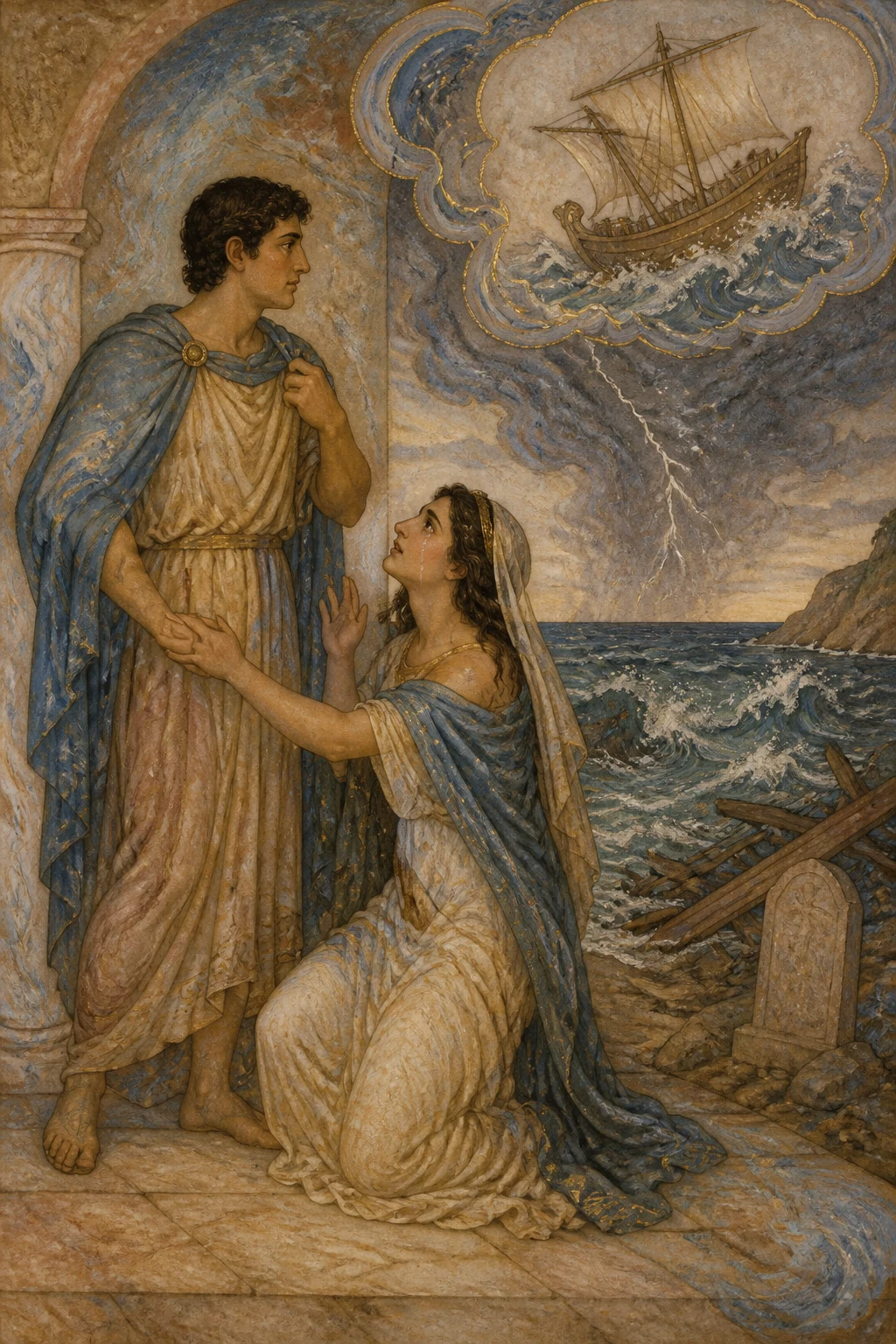
His arms alone remain: those arms he stretches out, and, tears streaming down his still-human face, he says, “Come close, my wife, come close, most wretched woman, and while something of me remains, touch me, take my hand while it is still a hand, before the serpent claims me wholly!” He longs to say more, but suddenly his tongue is split in two. Though he wishes to speak, words fail him, and whenever he tries to utter a lament, he hisses: this is the only voice nature has left him.
His wife strikes her bare breast and cries, “Cadmus, stay! Unhappy man, cast off this monstrous shape! Cadmus, what is this? Where are your feet, your shoulders, your hands, your complexion, your face—and, even as I speak, everything? Why, gods of heaven, do you not turn me too into such a serpent?” She had spoken. He licked his wife’s face and slipped into her dear embrace, as though he knew her, coiling about her and seeking the neck he knew so well.
All who are there—for their companions are present—are terrified; but she strokes the crested serpent’s slippery neck. And suddenly there are two, and they glide with coils entwined, until they find shelter in a nearby grove. Even now they neither flee from people nor wound them: gentle serpents, they remember what they once were.
Izvirnik
Source ID: ovid_metamorphoses_story_029 Citation: Ovid, Metamorphoses 4.563-4.603 Original language: Latin Source: PerseusDL canonical-latinLit Source URL: https://github.com/PerseusDL/canonical-latinLit/blob/master/data/phi0959/phi006/phi0959.phi006.perseus-lat2.xml Segmentation certainty: medium 563: Nescit Agenorides natam parvumque nepotem 564: aequoris esse deos: luctu serieque malorum 565: victus et ostentis, quae plurima viderat, exit 566: conditor urbe sua, tamquam fortuna locorum, 567: non sua se premeret; longisque erroribus actus 568: contigit Illyricos profuga cum coniuge fines.
569: Iamque malis annisque graves, dum prima retractant 570: fata domus releguntque suos sermone labores, 571: “num sacer ille mea traiectus cuspide serpens” 572: Cadmus ait “fuerat, tum, cum Sidone profectus 573: vipereos sparsi per humum, nova semina, dentes? 574: Quem si cura deum tam certa vindicat ira, 575: ipse precor serpens in longam porrigar alvum.” 576: Dixit, et ut serpens in longam tenditur alvum 577: durataeque cuti squamas increscere sentit 578: nigraque caeruleis variari corpora guttis.
579: In pectusque cadit pronus. Commissaque in unum 580: paulatim tereti tenuantur acumine crura. 581: Bracchia iam restant: quae restant bracchia tendit 582: et lacrimis per adhuc humana fluentibus ora 583: “accede, o coniunx, accede, miserrima,” dixit 584: “dumque aliquid superest de me, me tange manumque 585: accipe, dum manus est, dum non totum occupat anguis!”
586: Ille quidem vult plura loqui, sed lingua repente 587: in partes est fissa duas: nec verba volenti 588: sufficiunt, quotiensque aliquos parat edere questus, 589: sibilat: hanc illi vocem natura reliquit. 590: Nuda manu feriens exclamat pectora coniunx 591: “Cadme, mane, teque, infelix, his exue monstris! 592: Cadme, quid hoc? ubi pes, ubi sunt umerique manusque 593: et color et facies et, dum loquor, omnia? cur non 594: me quoque, caelestes, in eandem vertitis anguem?”
595: Dixerat: ille suae lambebat coniugis ora 596: inque sinus caros, veluti cognosceret, ibat 597: et dabat amplexus adsuetaque colla petebat. 598: Quisquis adest (aderant comites), terretur: at illa 599: lubrica permulcet cristati colla draconis. 600: Et subito duo sunt iunctoque volumine serpunt, 601: donec in adpositi nemoris subiere latebras. 602: Nunc quoque nec fugiunt hominem nec vulnere laedunt 603: quidque prius fuerint, placidi meminere dracones.