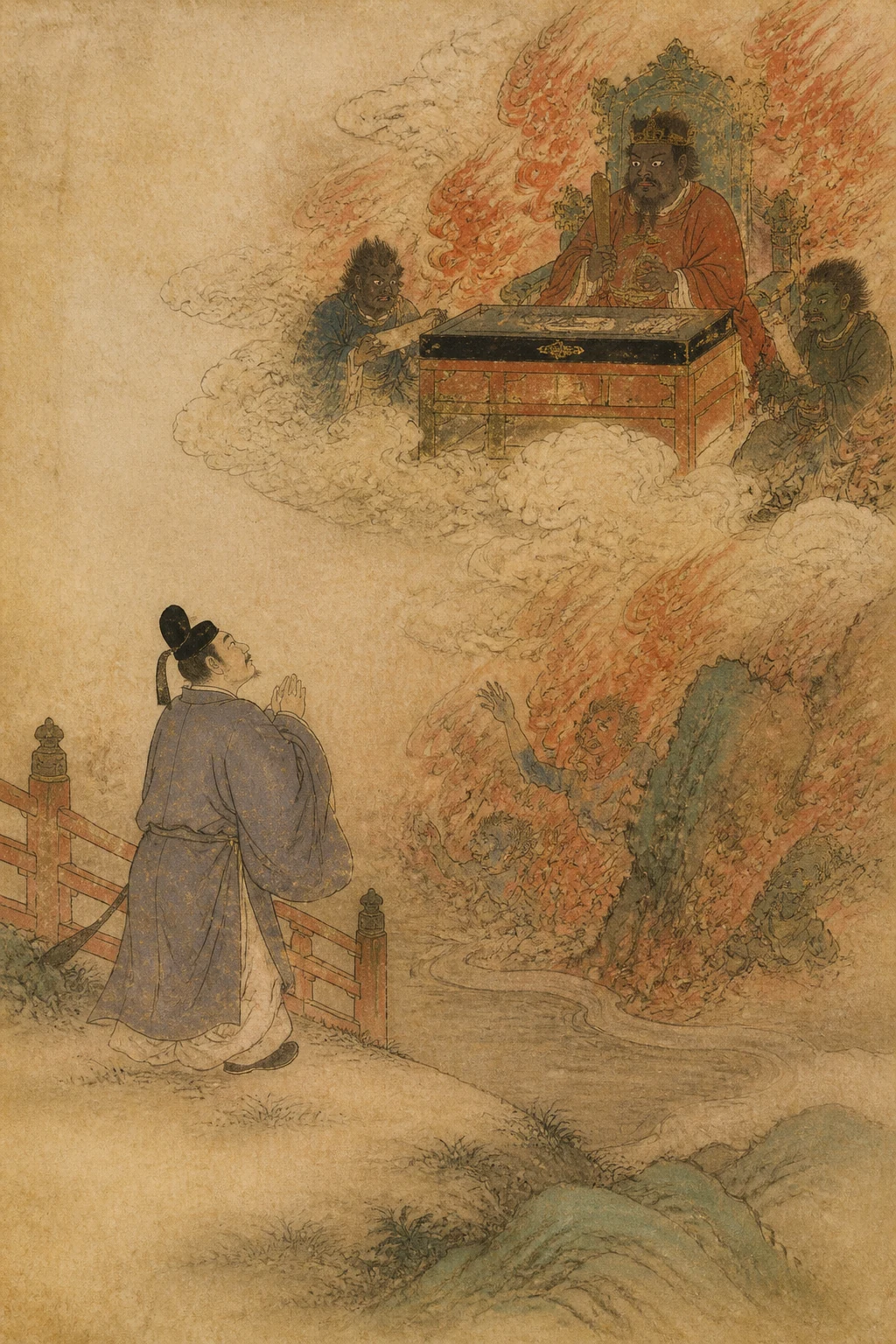
Waltey
Hirotaka pred kraljem Enmo zaradi ženine tožbe
Uji Shūi Monogatari · anonimna srednjeveška zbirkaO besedilu
Hirotaka pred kraljem Enmo zaradi ženine tožbe
- Vir
- Uji Shūi Monogatari
- Avtor
- anonimna srednjeveška zbirka
- Jezik branja
- English
- Jezik izvirnika
- 日本語
- Čas branja
- 3 min branja
- Obseg
- 3 strani
- Naslov izvirnika
- 083 広貴依妻訴炎魔宮ヘ被召事
O izvirniku
Uji Shūi Monogatari
Srednjeveške japonske pripovedi o menihih, duhovih, čudežih, prevarah in vsakdanjih presenečenjih. Bralni jezik je English, izvirnik pa prihaja iz vira Uji Shūi Monogatari v jeziku 日本語.
Besedilo
Hirotaka pred kraljem Enmo zaradi ženine tožbe
This too took place long ago. There was a man named Fujiwara no Hirotaka who died and was summoned to the court of King Enma. When he came before what seemed to be the king’s seat, the king said, “A woman who conceived your child died in childbirth. She fell into hell and now suffers its torments. Because she has brought a complaint before this court, I have summoned you. First, is it true that such a thing happened?” Hirotaka replied, “It is true.” The king said, “Your wife’s complaint is this: ‘I lived with my husband, and together we committed sins. Yet I died giving birth to his child and fell into hell, where I suffer these unbearable torments, while he has done nothing at all for the repose of my soul. There is no reason why I alone should suffer. Summon Hirotaka here, so that he may share my torments.’ That is why you have been summoned.” Hirotaka answered, “Her complaint is entirely just. Amid the duties of public and private life, though I have thought of her, I have done nothing for her soul, and the months and days have slipped vainly by. Yet if I am summoned here now to suffer beside her, that will do nothing to relieve her pain. I beg you, therefore, to grant me leave this once to return to the world of the living. I will set all else aside, have images of the Buddha made and sutras copied, and hold services dedicating their merit to my wife.” “Wait here a while,” said the king. He summoned Hirotaka’s wife and asked what she thought of her husband’s proposal. “If he truly promises to have even images made and sutras copied, and to hold services for me,” she said, “please release him at once.” The king then called Hirotaka before him again, told him what she had said, and declared, “Then return this once. Be sure to have images of the Buddha made and sutras copied, and hold services for your wife’s repose.” With that, he sent him back. Yet Hirotaka still did not know where he was or who had spoken to him. Released, he rose from the courtyard and set off, but on his way he thought, “Who can it be who sits behind that jeweled curtain, passes judgment in this way, and sends me home?” So deeply did this uncertainty trouble him that he went back and knelt once more in the courtyard. From behind the curtain came a voice: “Was that Hirotaka not sent back? Why has he returned?” Hirotaka replied, “Through your unexpected mercy, I have been allowed to return to my homeland, a place I could scarcely have hoped to see again. Yet I do not even know who has commanded that I be sent back. To return without knowing would leave me deeply troubled and full of regret. Though I fear to presume, I have come again to ask.” “You are a foolish man,” came the reply. “In Jambudvipa, the human world, I am called the Bodhisattva Jizō.” Hearing this, Hirotaka thought, “So the one called King Enma is none other than Jizō! If I devote myself to this bodhisattva, surely I may escape the torments of hell.” On the third day he returned to life. Thereafter, he had images of the Buddha made and sutras copied, and held services for his wife. So it is recorded in the Nihon Hokke Genki.
Izvirnik
083 広貴依妻訴炎魔宮ヘ被召事
Naslednje strani prikazujejo izvirno besedilo za primerjavo.
これも今はむかし藤原広貴と云物ありけり死て閻魔の庁にめされて王の御前とおほしき所に参たるに王の給やう汝か子を孕て産をしそこなひたる女死たり地獄に落て苦をうくるにこれへ申事のあるによりて汝をはめしたる也まつさる事あるかととはるれはひろたかさる事さふらひきと申王の給はく妻のうたへ申心はわれ男にくしてともに罪をつくりてしかもかれか子を産そこなひて死して地獄に落てかかるたへかたき苦をうけ候へともいささかも我後世をもとふらひさふらはすされは我一人苦をうけさふらふへきやうなし広貴を諸共に
めしておなしやうにこそ苦をうけさふらはめと申によりてめしたるなりとの給へは広貴か申やう此うたへ申事尤ことはりに候大やけわたくし世をいとなみ候あひた思なから後世をはとふらひ候はて月日はかなく過さふらふ也たたし今にをき候てはともにめされて苦をうけ候ともかれかために苦のたすかるへきに候はすされはこのたひはいとまを給はりて娑婆に罷帰て妻のためによろつをすてて仏経を書供養してとふらひ候はんと申せは王しはしさふらへとの給てかれか妻をめし出て汝か夫ひろたかか申やうを問給へは実々経仏をたに書供養せんと申候ははとくゆるし給へと申時に又広貴をめし出て申ままの事を仰きかせてさらはこのたひはまかり帰れたしかに妻のために仏経を書供養してとふらふへき也とてかへしつかはす広貴かかれとも是はいつくたれかの給そともしらすゆるされて庭を立
て帰る道にておもふやう此玉の簾のうちにゐさせ給てかやうに物のさたして我をかへさるる人はたれにかおはしますらんといみしくおほつかなくおほえけれは又まいりて庭にゐたれは簾の内よりあの広貴は返しつかはしたるにはあらすやいかにして又まいりたるそととはるれはひろたか申やうはからさるに御恩をかうふりて帰かたき本国へかへり候事をいかにおはします人の仰ともえしり候はんまかり帰候はん事のきはめていふせく口惜候へは恐なからこれをうけ給はりに又まいりて候なりと申せは汝ふかくなり閻浮提にしてはわれを地蔵菩薩と称すとの給をききてさは炎魔王と申は地蔵にこそおはしましけれ此菩薩に仕らは地獄の苦をはまぬかるへきにこそあんめれと思ふ程に三日といふに生帰てそののち妻のために仏経かき供養してけりとそ日本法花験記にみえたるとなん
Nadaljuj z branjem