Prevod
The tale was ended. But still the daughters of Minyas pressed on with their work, spurning the god and profaning his feast, when suddenly unseen drums broke out in raucous thunder; a pipe with a curved horn and ringing bronze resounded; myrrh and saffron filled the air, and, a wonder past belief, their weaving began to grow green, and the hanging cloth put forth leaves in the shape of ivy.
Part turned to vines, and what had just been threads changed into tendrils; vine leaves sprang from the warp; the purple lent its brilliance to the patterned grapes. Now the day was done, and the hour drew near that you could call neither darkness nor light, but the borderland of uncertain night, still touched with day: suddenly the roof seemed to shake, rich oil lamps to blaze, the house to glow with ruddy fires, and phantom shapes of savage beasts to howl.
For some time the sisters had been hiding in the smoke-filled house, in separate places, shunning the flames and light; and as they sought the darkness, a membrane spread along their shrunken limbs, enclosing their arms in slender wings. The darkness kept them from knowing how they lost their former shape. No feathers lifted them, yet they held themselves aloft on translucent wings; and when they tried to speak, they uttered tiny voices suited to their bodies, making their faint complaints in squeaks.
They haunt houses, not woods, and, hating the light, fly by night, taking their name from the late evening. Then indeed throughout all Thebes the divinity of Bacchus was renowned, and his aunt told everywhere of the new god’s mighty powers; of all the sisters, she alone knew no grief, except what her sisters caused her. Juno saw her, proud of her children, her marriage to Athamas, and the god she had fostered, and could not bear it. “Could a rival’s son,” she said to herself, “transform the Maeonian sailors and plunge them into the sea, give a son’s flesh to his own mother to tear apart, and cloak
the three daughters of Minyas in strange new wings, while Juno can do nothing but weep for unavenged wrongs? Is that enough for me? Is this the whole extent of my power? He himself teaches me what to do—we may learn even from an enemy— and in the slaughter of Pentheus he has shown, enough and more than enough, what madness can accomplish. Why should Ino not be goaded to madness, following her kindred’s example?”
There is a downward path, darkened by deathly yew, that leads through speechless silence to the realms below. The sluggish Styx breathes out mist, and newly arrived shades descend that way, phantoms whose bodies have received burial. Pallor and cold hold those desolate regions far and wide, and the new spirits do not know where the road lies, where it leads to the Stygian city, or where black Dis has his grim palace.
The spacious city has a thousand entrances and gates open on every side; and as the sea receives rivers from all the earth, so that place receives all souls, yet is never too small for any multitude, nor feels the swelling crowd. Bloodless shades wander, without bodies or bones; some throng the forum, some the palace of the king below, while others practise various crafts, imitations of their former life.
Others are confined by the punishment they endure. Leaving her heavenly home, Juno, Saturn’s daughter, deigned to go there—so much she yielded to hatred and anger. As soon as she entered, and the threshold groaned beneath her sacred weight, Cerberus raised his three heads and gave three barks at once. She summoned the sisters born of Night, those stern, implacable powers.
They sat before the prison gates, barred with adamant, combing black snakes out of their hair. As soon as they recognized her amid the murky shadows, the goddesses rose. The place is called the Abode of the Accursed: Tityos lay stretched across nine acres, offering his entrails to be torn; you, Tantalus, can catch no water, and the tree hanging above you slips away; you, Sisyphus, either chase or push the rock that must roll back; Ixion spins, pursuing and fleeing himself; and the daughters of Belus, who dared plot their cousins’ deaths, unceasingly fetch water only to lose it.
When Saturn’s daughter had surveyed them all with a grim gaze, and Ixion above all, she turned her eyes from him to Sisyphus again. “Why,” she said, “of these brothers does this one suffer endless punishment, while proud Athamas dwells in a wealthy palace, though he and his wife have always scorned me?” She explained the reasons for her hatred and her journey, and what she wished. Her wish was that the house of Cadmus should fall, and that the sisters should drive Athamas to crime.
She mingled commands, promises, and prayers, urging the goddesses. When Juno had spoken, Tisiphone shook her disordered grey hair, flinging back the snakes that blocked her face, and said, “There is no need for lengthy explanations: consider all you command already done. Leave this hateful realm and return to the sweeter air of heaven.” Juno returned rejoicing, and as she prepared to enter heaven, Iris, daughter of Thaumas, cleansed her with sprinkled water.
Without delay, savage Tisiphone took up a torch soaked in blood, put on a robe red with streaming gore, girded herself with a coiling snake, and left her home. Grief accompanied her, with Dread and Terror, and Madness with her trembling face. She stood upon the threshold: they say the doorposts of Aeolus’s son shook, pallor stained the maple doors, and the sun fled the place. His wife was terrified by these portents, and Athamas was terrified too. They made to leave the house, but the baleful Fury stood in their way, blocking the entrance; stretching out her arms, entwined with knotted vipers, she shook her hair. The snakes stirred and hissed;
some lay upon her shoulders, some slid down around her breast, hissing, vomiting venom, and flickering their tongues. Then she tore two snakes from the midst of her hair and hurled them with her pestilential hand. They roamed over Ino’s breast and Athamas’s, breathing their poisonous breath. They inflicted no wounds upon their bodies: it was the mind that felt their dreadful blows.
She had also brought a monstrous liquid poison: foam from Cerberus’s mouth, the venom of Echidna, wandering delusions, the forgetfulness of a blinded mind, crime and tears, frenzy and the love of slaughter, all ground together. Mixed with fresh blood, she had boiled them in a hollow bronze vessel, stirring with green hemlock. As they stood trembling, she poured the maddening poison into both their breasts, stirring the very depths of their hearts.
Then she swung her torch again and again in the same circle, so swiftly that the moving flames overtook one another. Thus victorious, her command fulfilled, she returned to the ghostly realms of mighty Dis and unbound the snake she wore. At once the son of Aeolus, raging in the middle of the hall, cried, “Ho, comrades, spread your nets in these woods! I have just seen a lioness here with her two cubs.”
Madly he hunted his wife as though tracking a wild beast, snatched Learchus from his mother’s arms as he smiled and stretched out his little hands, whirled him twice and thrice through the air like a sling, and savagely dashed the infant’s face against a hard rock. Then at last the mother, maddened— whether grief had caused it or the poison coursing through her— howled and fled, distraught, with streaming hair, carrying you, little Melicerta, in her bare arms, and crying, “Euhoe, Bacchus!” At Bacchus’s name Juno laughed. “May your foster-child always serve you so,” she said.
A cliff overhangs the sea: its base is hollowed by the waves, sheltering the waters beneath from rain; its summit stands sheer, jutting out over the open sea. Ino climbed it—madness had given her strength— and, checked by no fear, flung herself and her burden into the deep; the stricken water whitened with foam. But Venus, pitying her granddaughter’s undeserved suffering, coaxed her uncle with these words: “O god of the waters, Neptune, to whom fell power second only to heaven’s, great indeed is my request, but pity my kin, whom you see tossed upon the boundless Ionian Sea, and add them to your gods. I too have some claim upon the sea,
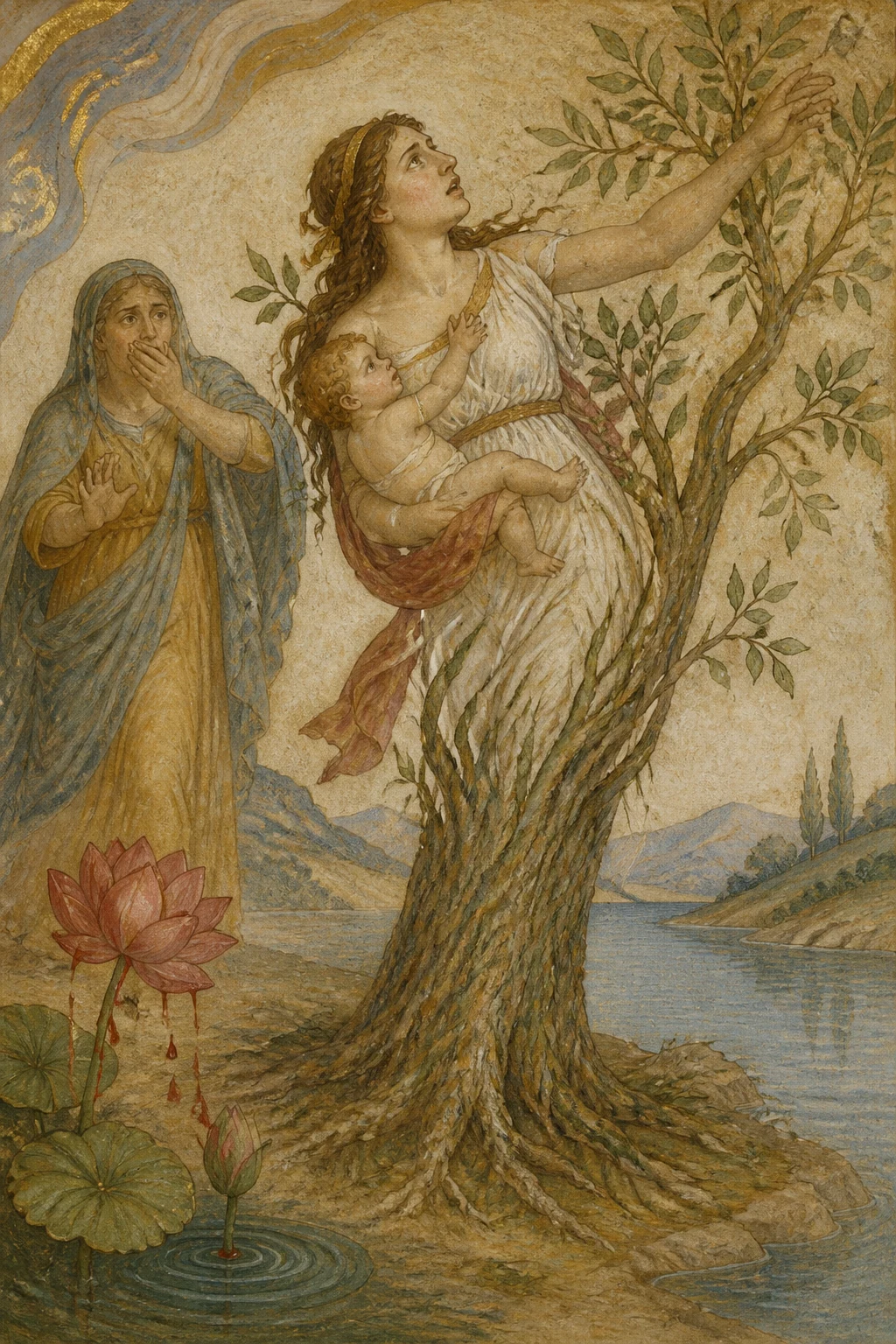
if once I was foam that took shape in the midst of the deep, and still keep the Greek name I took from it.” Neptune granted her prayer and stripped away all that was mortal in them, clothing them in awe-inspiring majesty, changing their names and forms together, and naming the god Palaemon and his mother Leucothoe. Her Sidonian attendants had followed her footprints as far as they could, and saw their last traces at the cliff’s edge; certain that she was dead, they beat their breasts in mourning for the house of Cadmus, tearing their hair and clothes, and bitterly reproached the goddess as unjust and too cruel toward her rival. Juno could not endure
their insults. “I shall make you yourselves,” she said, “the greatest memorials of my cruelty.” Deeds followed words. For the most devoted of them said, “I shall follow my queen into the sea,” but, as she prepared to leap, could not move at all, and clung fast to the cliff. Another, trying to beat her breast in the customary gesture of grief, felt her arms grow stiff; another, who happened to have stretched her hands toward the sea, became stone, her hands still reaching toward those same waters; another had seized her hair to tear it from her head, and her fingers could be seen suddenly hardened among the locks: each remained fixed in the gesture in which she was caught.
Some became birds; even now those daughters of Ismenus skim the surface of those waters with their wingtips.