Prevod
Once upon a time, as never before, and so on. There were once an old woman and an old man. They had reached old age without ever having a child. What had they not tried? What had they left undone, hoping to have even one little child of their own? They went to women who worked charms, to skilled sorcerers, to readers of the stars, but there was still no sign of the old woman falling with child. Now that they were growing old, they began to worry. “What shall we do, wife,” said the old man one day, “if we fall upon days of sickness or hardship? You know I have done everything in my power, yet God has not seen fit to grant us a little child to be the staff of our old age.” “Ah, husband, who is to blame? You know I have gone far and wide, to wise women and healers, and done whatever anyone told me, but to have some comfort in this wretched old age of ours—and a heavy burden it is!—has proved beyond us.” “Come, let us each go a different way, wherever God may guide us, for there is no use in our staying together, two poor souls in want.” “Let us part, husband, if you think it best. But tell me, who will close your eyes at your last hour?” “You are right, wife. Wait, then: take the kerchief I wore on our wedding day, and I shall take the striped towel you brought me as part of your dowry. Let us look at them every day, and when we see three drops of blood upon them, let us return home. That shall be the sign that death has drawn near to one of us.” “So let us do, husband.” No sooner said than done. They made ready for the road and each took a bag over one shoulder. At the bottom of hers the old woman put her husband’s kerchief, while the old man put his wife’s striped towel in his, and one set off eastward and the other westward. For nine days and nine nights they travelled on and on, and on again, asking good folk and bad, great and small, what they might do to have a child. Whatever people told them to try, they answered that they had tried it already, all in vain. They hoped someone might tell them something they did not yet know, but they found no such person. On the tenth day, the old man rose and went outside to wash before setting out once more. When he took up the towel to dry his face, what should he see? Three drops of blood upon it. “I must go home,” he said to himself, “for God knows what may have happened to my old wife.” He hurried off down the road, giving no thought to food or rest, and made his way home again. “What has happened to you, wife?” he asked as soon as he saw his other half. “What should have happened to me, husband? I went on my way, asking here and there, begging everyone to teach me something that might help us have a child. But my questions and pleas were all in vain; I was only wasting my breath. As I went on, I came to a great, vast forest, such as I had never seen, and lost myself in its thick woods until I no longer knew how to find my way back to other folk. Then, all at once, I saw an old man before me, withered with age, forgotten by death and God alike. I told him what I was seeking and how I had lost my way. Old and laden with years as he was, he sat down and talked with me, and in a gentle voice showed me the road home and told me to return, for God had heard our heart’s desire.”
“And was that what the sign on my towel meant?” “It seems it was.” Then they resolved never to part again, but to stay and bear their sorrows together. Not long afterward, the old woman told her husband that she felt herself with child. Oh, if only God could have seen the old man’s joy when he heard such glad news! He bustled to and fro in his delight, no longer knowing what to put his hand to or what to do. So the days passed, one after another, until nine months were up, when, with the help of the Mother of God, the old woman gave birth to a darling, plump little boy, with a book in his hand. On the third evening, when the Fates came, the old man happened to be awake. You see, he could scarcely sleep for joy, and for three days he had not closed his eyes, forever bustling about his wife, nursing her and tending her as she lay abed. So when the Fates arrived, he was not asleep, but sat huddled in a corner, as though he were Mătrăcuca, the lady’s sister. When the Fates began to pronounce their blessings, he was all ears and heard everything. The eldest Fate said, “This child shall be a Făt-Frumos, a handsome hero, and he shall become rich.” The middle one said, “When this child is twelve years old, the evil spirits shall carry him away.” The youngest said, “If he escapes the evil spirits, this child shall become an emperor.” That was all the old man needed to hear for it to feel as though a sharp knife had pierced his heart. You see, he could not reconcile himself to what the second Fate had said. A great dread seized him, and from that very moment he began devising ways to save his little boy from such a calamity and keep the spirits from carrying him away:
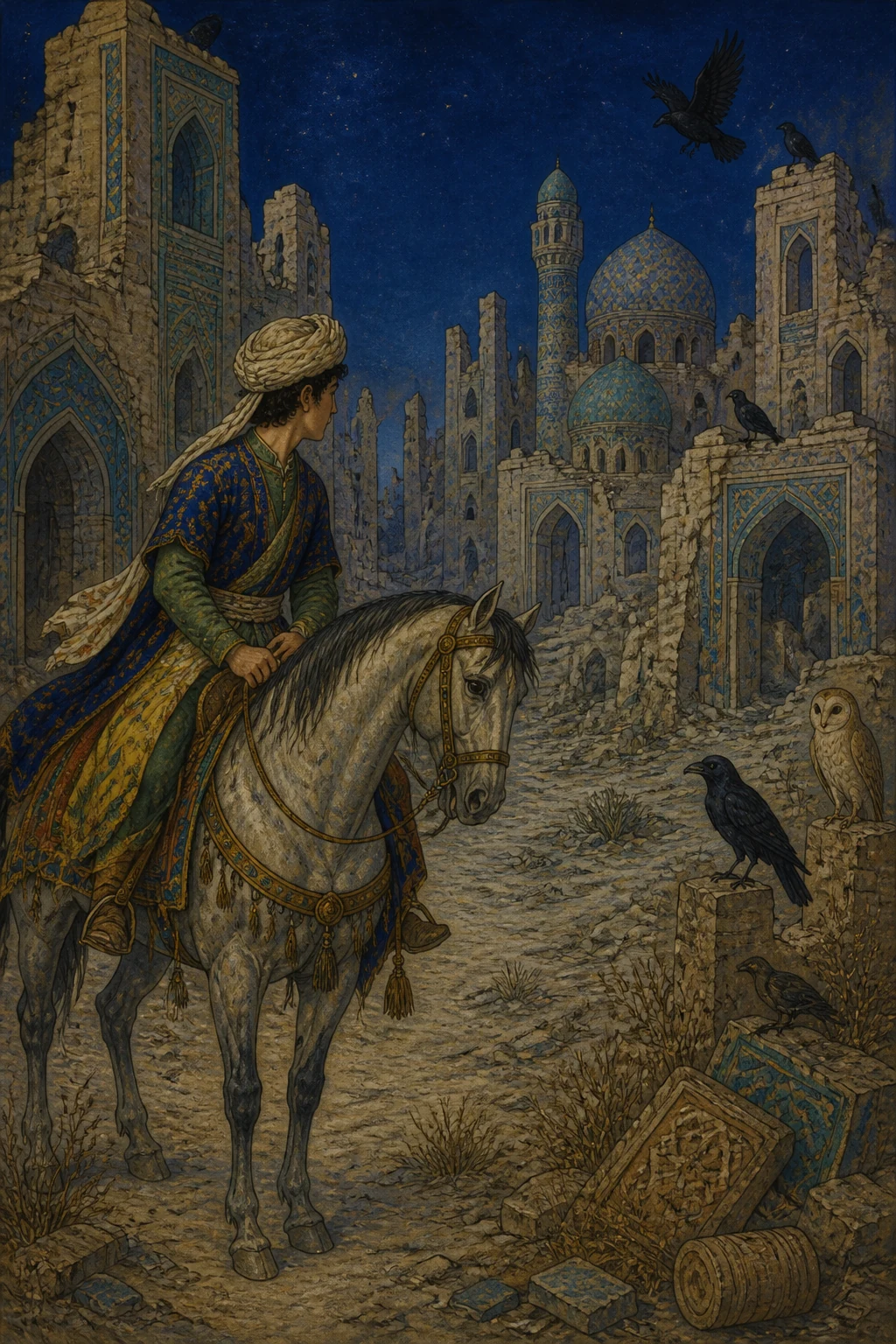
Meanwhile, the child grew, obeyed his parents, and never let go of the book with which he had been born. He read and read, and learned so much that everyone marvelled at his diligence and his knowledge. By the time he was nine, there was nothing he did not know. He had become a living book himself, and all the neighbours came to ask his advice about their troubles. Whether the old man rejoiced in his son or not was hard to say, but the old woman was beside herself with joy to see him so handsome and so accomplished. The old man, you see, had a thorn in his heart; he knew what he knew, but told no one. The older the boy grew, the handsomer and more learned he became. The whole village honoured him and heeded his words as though he were some great personage; but as time went by, the old man grew ever sadder. When the boy was nearly twelve, the old man could contain himself no longer and had to unburden his heart. He thought it best to tell his family what was to happen to their son. And so, one evening, as they all sat by the fire, talking of this and that to pass the time, the old man told them everything he had heard from the Fates. The old woman, the boy’s mother, very nearly died of grief when she heard such tidings; but the old man and his son sprang up, sprinkled her with water, and only with great difficulty brought her round. The boy, meanwhile, fell deep in thought. He pondered and planned until, after a few days, he told his father what he had devised. His father, who listened to his words as though reading a book of wisdom, went through the village and sent word to all the neighbours that on a certain evening, the very evening when his son was to turn twelve, they should gather at the church to pray for the boy and save him from the evil spirits. He spoke to the old priest as well, and every one of them promised to grant his request. And so they did. On the evening when the old man’s son was to turn twelve, all the villagers, men, women, and children, gathered at the church with the old priest to pray. When the old man arrived with his wife and son, the boy still holding his book, the neighbours placed them in their midst, and the prayers began. They prayed and prayed, when all at once they found the church filling with a thick mist. Then they all fell to their knees and offered up such fervent prayers that they would have softened the heart of the wickedest spirit. The mist dispersed, and they were left unharmed. The next evening, while they were praying, at just the same hour, they suddenly found the church full of mice, bats, and owls, which began flitting and scurrying about, climbing over people and nipping them wherever they could. Everyone was frightened, even the old priest himself. Then the boy, his book in his hand, fell to his knees and began to pray with all his heart. The old man, the priest, and all the neighbours in the church did the same. The mice and all those other creatures vanished. On the third evening they gathered again and began their prayers. They prayed and prayed until, towards midnight, the church suddenly began to shake, and terrible cracks and crashes, booms and rumblings like thunder were heard. Once more they fell to their knees, and once more they prayed with all their faith in God. But what should happen, right in the midst of their prayers? A monk came down from the church tower, seized the old man’s son beneath the arms, snatched him from among them, and rose into the air with him. Before the people could make sense of it, the two had vanished from their sight like a phantom. Perhaps he was still up in the tower; perhaps he was behind the church; perhaps he was here, perhaps there. But no: the monk had carried him away, and away he was. Everyone was utterly stunned with fright, and the old man and his wife most of all. Once they had recovered a little from their terror and quiet had returned to the church, the people went out and each returned home. Though the monk had carried him off, the old man’s son would not let go of his book. He kept reading, loudly and steadily; and when he reached the middle of the book, the monk could scarcely hold him any longer. He tried to wrench the book from the boy’s hand, but the boy held it fast. As they struggled in the air over the book, the monk lost his grip, and the old man’s son fell into a deep ravine. God alone knows how long he lay there before he recovered from the stupor into which the fall had plunged him. When he came to himself, the book was still in his hand. He thanked the Lord for delivering him from the evil spirits and keeping him alive; but now he had another trouble: he did not know where he was. He rose and set off. On and on he went, until at last he managed to climb out of the ravine. Then he took whatever road the Lord’s mercy might lead him along. Heading towards the setting sun, he walked and walked from morning until evening, without coming upon a village or seeing a single soul. At last he reached a tree and stayed beneath it for the night. Having neither eaten nor drunk, he could not sleep. As he struggled with hunger, thirst, and weariness, he wondered which way to go to find people. The next day he set off westward again, as he had planned, until he came upon heaps of human skulls and bones. A cold shiver of fear ran through him, and he began reading from his little book, which helped drive away the horror threatening to overwhelm him. Taking his courage in both hands, he went on; but the farther he went, the more numerous the heaps of human bones became. He pretended not to notice them and kept going until he reached a great city of which nothing remained but ruins. Very few walls were still standing. He walked a little farther and came upon a magnificent palace. When he reached it, he knocked at the gate. He meant to ask for something to eat, for he no longer knew how many days he had gone without food, and for leave to sleep there, since it had been so long since he had rested properly. But no one answered. He knocked again. Still not a soul replied. At last he knocked a third time, a little harder. This time a thin, piping voice called from within, “Who is there?” He answered that he was a man like any other, and asked for shelter. When the little gate opened, what do you think he saw? The mere shadow of a man: an old fellow with a beard down to his knees, lean, wizened, and hunched, as though he ate only once a week. He crossed himself at the sight of Făt-Frumos and said that he had not seen a human being since he was a young lad. This old man was the palace gatekeeper, left there to guard it until someone should be found who could break the spell upon that place. Once Făt-Frumos was inside, the old man set a clean table for him and laid upon it bread as white as snow and a dish of vegetables, good to eat though prepared without much art. The boy ate like a wolf, for he himself could no longer remember when he had last eaten. When he had eaten his fill, he began talking to the old man. “Tell me, father, how is it that in all the days I have been travelling I have not met a single living soul in these parts, but only heaps upon heaps of human bones scattered here and there? And here in this palace I find only you with any life left in your bones, while all around it seems like the kingdom of death.” “Ah, my dear boy, the story of this kingdom is a long one. I shall tell you a little of it. You see, my child, this kingdom too was once great and powerful. The emperor and empress of this land had no children. Instead of praying to God to grant them an heir, they took to dabbling in enchantments. They searched far and wide until they found a sorcerer. What he did and how he did it I cannot tell, but sure enough, the empress conceived, and after nine months she bore a daughter more beautiful than any fairy in heaven. She is still alive today. So beautiful is she that, once you have seen her, you could never forget her as long as you lived. When the Fates came on the third day, they decreed that she could not marry until someone was found who could spend a night in her chamber and come out unharmed. It seems God was punishing the child for her parents’ sin. And that was not all: the Fates extended the punishment to the whole kingdom. They said that from the day the first suitor came and failed to escape alive, all the towns and villages would crumble, as you have seen, and all the people would rot away until only their bones remained. This was to frighten young men away from coming to woo her. You see, the sorcerer who enabled the empress to bear a child was punished too, for it is he who comes at night to torment and torture the poor young men who dare remain in the princess’s chamber. Many young men have ventured to make the attempt, and all have perished.” On hearing this, Făt-Frumos told the gatekeeper that he too would like to see the emperor’s daughter. “Put it out of your mind, my dear boy; do not put your soul in jeopardy. Cross yourself and leave this place, lest you lose your life. What a pity it would be, with all your youth before you!” “So be it!” the boy said to himself, thinking of all he had suffered. “What have I to live for, alone in these wildernesses?” And he insisted on being taken to the princess’s chamber. When the gatekeeper saw that there was no way to dissuade him, he took him to the emperor’s daughter. The moment they saw each other, they were drawn to one another. Plainly they had been made for each other. And why should it not have been so? The poor princess would gladly have had the boy remain in her chamber that night, but her heart ached for his youth: how could so fine a young man be allowed to perish? Together with the gatekeeper, she tried once more to persuade him not to stay. But it was no use, for Făt-Frumos was one of those who, once they have made up their minds to do something, cannot be turned from it by the devil himself. And so, when evening came, he went in with his little book in his hand and kept watch. Whatever he did that night, he lived to see daylight. The next morning they found him still holding his book, wan and as yellow as beeswax, as though he had laboured at heaven knows what heavy tasks for heaven knows how many nights, without food or drink. The princess awoke from her sleep, and when she saw him there alive and whole, she said, “You shall be my husband.” Then all at once, as if out of the clear sky, the people in the towns and villages began coming back to life, as did the servants about the palace; everything that had been alive on the day the first suitor came began to stir and rise as though from a deep sleep. People returned to their work, the army began beating drums and blowing trumpets, and came to the imperial court to pay homage and offer its service. Where until then there had been silence and death, now the shouts and bustle of the crowds of people and animals going about their business were deafening. The gatekeeper was bewildered by what he saw. He did not know which way to look or what to marvel at first. Făt-Frumos and the princess came out and showed themselves to the people. The multitude shouted for joy so loudly that their cries reached heaven, and from every mouth came the words, “Long live our emperor and empress!” Once Făt-Frumos had married the princess, he took his seat upon the imperial throne and set the army, the nobles, and the common people in order according to his own understanding. Everyone was pleased with his arrangements. They lived happily together as husband and wife, until one day he remembered his father and mother and grew sad, for he knew nothing of what had become of them. The empress noticed his sadness, and loving him dearly, could not bear to see him downcast even for an instant. She began to question him. When he told her, she urged him to go and bring them back, so that they might all live together in perfect contentment. That was just what Făt-Frumos wished. Yet he could not bear to leave his wife alone. The poor fellow knew well enough what loneliness meant. But as his longing for his parents grew stronger, he resolved to go. Before he left, the empress, his wife, gave him a ring which, she said, had been handed down to her from her ancestors. She told him that it had the power, whenever he took it from his finger, looked at it, and made a wish, to raise a palace whose like could not be found anywhere in the world. She also gave him the palace coachman, an old, faithful servant, swift to do his duty, who was not to leave his master’s side for so much as the time it takes to strike a spark. Thus supplied and ready for the road, he set out for the village where his parents lived, after taking leave of the empress, the nobles, and the soldiers. His route led through the realm of Emperor Sefer, through the land of the fairies, and God knows where else. His journey lasted three years, three months, and three days before he reached his parents’ village. As he passed through Emperor Sefer’s realm, the officers of the court welcomed him and sent him on his way with affection. And as he passed through the land of the fairies, they vied with one another to show him honour and escort him on his journey. When he reached his parents’ village, he drew up his coach before their humble hut. His father and mother did not recognise him. Seeing this, he asked them to give him lodging. The old people welcomed him, begging his pardon that they could offer him no more than they had, which was their poor hut. He agreed and stayed there. During the night he rose and slipped quietly outside. Looking at the ring, he wished for a splendid palace to stand in place of that hut. Scarcely had he finished the thought when a magnificent palace rose before him, adorned with every beauty, with splendid gardens and clear springs, so lovely that you could have gazed at them for ever without having your fill. And as for the inside—ah, that was something indeed! The chambers, the benches, the bedding: nothing but the costliest things. When the old man and his wife awoke the next morning and found themselves surrounded by gold, they were frightened. They rubbed their eyes and looked all around, scarcely able to believe what they saw. They thought they must be dreaming. Then Făt-Frumos came in, roused them from their bewilderment, and made himself known, telling them that he was their son who had been carried away, and that he had become an emperor. When they heard this, the old man and his wife all but died and came to life again for joy. They embraced him and kissed him on either cheek, while he kissed their hands. Word soon spread through the village that the old man and his wife had become rich beyond belief, and people came flocking to see the wonder with their own eyes. When the news reached the lord of the estate, he too went to see the palace and was left staring. This man was envious and evil-hearted. He could not bear, you see, to be outdone by anyone, whether in wealth or worldly success. So he went there to see the wonder for himself, and when he saw Făt-Frumos, he would dearly have liked him for a son-in-law, for he had three daughters. He invited Făt-Frumos to visit his own house, so that they might become friends. Făt-Frumos, pure-hearted and suspecting no harm, went out of politeness. Once he was there, the lord of the estate brought up the subject of marriage and said he would gladly give him whichever of his daughters he wished to take. Făt-Frumos told them plainly that he was already married and meant to return to his wife before long. Indeed, when they asked him, he even told them by what power he had raised that beautiful palace. The envious lord of the estate then plotted with his daughters how they might steal the ring from Făt-Frumos’s finger. A few days later, they invited him to dine with them, so that they might make merry and enjoy one another’s company; for, as they said, who knew whether they would ever meet again? Făt-Frumos, never dreaming of their plot, went. After they had feasted and drunk to their hearts’ content, just as they were about to rise from the table, the spiteful landowner called for one more glass apiece—a stirrup cup, as the saying goes. Into the glass he gave Făt-Frumos he secretly mixed some sleep-inducing herbs. No sooner had he drunk it than the devil had him. He fell into a stupor akin to death. His head lolled from side to side as though his neck were broken. They lifted him gently and laid him in a bed, where he remained until the following day. While he slept soundly, they slipped the ring from his finger and hid it. When Făt-Frumos awoke the next morning, he was ashamed of what he had done. He reproached himself bitterly for having behaved as he had never behaved in his life before, drinking away his very senses. He thought, you see, that he had drunk like a wretch, and that was why he had become so drunk. As soon as he awoke, he went home, without noticing that the ring was missing from his finger. But when he reached home, where was the palace? Nowhere to be found. It had vanished as though it had never existed, and in its place stood his parents’ hut once more. He reproached himself again for his foolishness, but now, as the saying goes, he might as well have tried to pluck out a blind man’s eyes. So he resolved to return to his own kingdom and have no more dealings with such evil-hearted people. He urged his parents to come with him and live as though in paradise. But they were content to let their bones remain in the little corner of the world where they had been born, and wished their son a good life, free of devilish troubles. Poor Făt-Frumos, saddened by the loss of his ring and saddened that his parents would not come to live with him, sat with his head resting on his hand, wondering how he might make everything turn out well. All at once the coachman the empress had given him appeared before him. “What troubles you, master, that you are so sad and cannot be comforted? Have you perhaps received bad news from the kingdom?” “No bad news has come from the kingdom, my good fellow. But this and this and this has happened to me.” And he told him everything from beginning to end. “Come now, master, do not grieve so much over such a trifle.” “What are you saying, man? A trifle? Do you call it a trifle that I have lost the ring, so precious a treasure? And do you think it a small matter for me to part from my parents without any hope of seeing them again?” “No, master; but let us understand one another. If Your Majesty’s parents do not wish to come and live beside you, you can still make their lives comfortable here by leaving them a handsome sum of money, of which, thank the Lord, you have plenty. As for the ring, our lady the empress took care of that too. When we left, she gave me this ring, with strict orders to hand it to you only when I saw that sorrow was about to overcome you. And now, it seems to me, the time has come. Here it is!” At once he drew from his breast a ring like the one Făt-Frumos had lost and handed it to him, adding that this ring had the power, whenever he looked at it and wished, to summon two black men before him, who would carry out whatever he commanded. Just then the very lord of the estate who had caused all the trouble happened to be passing, going about his business in a carriage drawn by four fine horses. As soon as Făt-Frumos took the ring in his hand, he looked at it and wished for the two black men to appear. Instantly there stood before him two men as black as the bottom of a cauldron, nimble and swift as leopards. “What is your command, master?” they asked. “Seize that fine gentleman passing in his carriage, and do not let him go until he produces the ring he treacherously slipped from my finger.” He had realised, you see, that there had been something unclean about his drunkenness that day; but as he had not known what to do about it, he had held his tongue. And off those two went, my friend, like dragons, like raging lions, so swiftly that you could not have caught them with a slingstone. In an instant they were there: one seized the horses by the reins and brought them to a dead stop, while the other caught the envious lord of the estate by the chest and, in the twinkling of an eye, hauled him down to the ground.
And how they began to twist his arms and pummel him, until you could not help pitying him! When the Moors demanded the ring, he denied having it, like the scoundrel he was. The devil had taken possession of his heart and would not let him bring the ring to light for anything. But do you think the Moors let him off so easily? Not a bit of it. They set about him afresh. He passed from one pair of hands to another like a ball. They battered and tormented him until you would have thought he must perish in their hands, yet still he would not breathe a word. When the Moors saw that he had set his mind against giving up the ring, they laid him on the ground. One held him down while another drew a knife from his belt, sharpened it on his boot, and made as if to skin him alive. Seeing that this was no jest, and that his life hung by a thread, he confessed, to save himself from death, that the ring was in his keeping. He took it out and handed it to the Moors. His men, the coachman and the hired hand, would have liked to leap to their master’s rescue. But who could get near them? The Moors had only to give them a shove, and they went head over heels, scarcely able to get up again. Făt-Frumos watched, swelling with satisfaction to see the wretched miser getting the thrashing he deserved. Făt-Frumos slipped the ring onto his finger beside the other and resolved to return to his own kingdom. He gave his parents some three purses of gold, for they would not go with him, made ready for the journey, climbed into his carriage, and set off. But their parting! Even the wood and stones might have wept at the grief of the old man and his wife. For they understood that they would never see one another again. Perhaps in heaven, but here on earth, certainly not. And Făt-Frumos travelled on and on, along a long and distant road—for what lies ahead makes the tale finer still—until he reached a lovely glade, with a little stream running along its edge. There he chose to rest. And a fine spot he had found, for it was so beautiful that you could scarcely bear to leave it. But that vermin of an estate owner had set his heart on having Făt-Frumos’s ring for himself, and nothing else would satisfy him. He followed him, thinking that by cunning, guile, and pretence he might deceive Făt-Frumos and leave him empty-handed. When he saw that Făt-Frumos meant to rest, he too stopped a little way off, behind a thicket, and waited for him to fall asleep. Făt-Frumos, never dreaming of such villainy, spread some costly rugs he had with him upon the grass, sat down on them, ate, and lay down to sleep. His faithful coachman kept watch for a good while; but when he saw that not so much as a ripple stirred upon the water, and being weary himself from the journey, he too laid down his head and was soon overcome by sleep. When the fellow saw that both were fast asleep, he came out of the bushes and, softly, softly, like a cat stalking mice, crept up to Făt-Frumos, slipped the rings from his finger, and made off. When Făt-Frumos awoke and found his rings missing, he thought the coachman must have taken them for safekeeping, lest he lose them in his sleep, and asked him about them. The coachman answered that, heaven forbid, he had done no such thing. Then Făt-Frumos understood that some thief had stolen them, and he was bitterly distressed. In this unhappy state he ordered the horses harnessed to the carriage and set off. He had no idea who could have taken the rings, nor anyone he could call to account for them. As he travelled on, fretting and grieving, he wondered what he would tell the empress when she asked him about the rings. For he could not bear the thought of anyone taking him for a useless, blundering sleepyhead. Just as his regret was tormenting him more fiercely than ever, they were passing through a great, dense forest. Suddenly he heard some marvellous fiddlers playing as though they were eating fire, and drawing nearer all the while. Before long the musicians came past his carriage and, still playing, bade Făt-Frumos good day. He returned their greeting and began to question them. “Well now, my good fellows, where have you come from, and where are you going?” The fiddlers answered, “We are going to play at your empress’s wedding.” “What do you mean, play at my empress’s wedding?” asked Făt-Frumos, his heart leaping with fear. “Well, you see, a neighbouring emperor, finding that you had been gone so long without returning, marched upon your kingdom with an army, to force the empress to marry his son. The empress resisted stoutly, and twice the armies met in battle, and twice that emperor was victorious. In the end, the empress gave up hope that you would ever return. And rather than see the towns and villages laid waste, and so many soldiers perish, she consented to the emperor’s demand. The wedding is tomorrow.” “How can such a thing be?” “It can be, and it is. But since you are on your way home, if you wish to arrive before the wedding, let the carriage follow and come along with us.” Făt-Frumos did not wait to be told twice. He climbed down from the carriage and set off with the fiddlers. One of them took him on his back, gathered himself, and sprang straight into the high heavens, travelling like a whirlwind. He would have gone as swiftly as thought, but feared that Făt-Frumos might burst with fright. All at once Făt-Frumos began to shout, “Stop, fellow! Let me fetch my cap—it has fallen off my head!” “What is this talk of stopping? Let the wretched cap be! By now it is a six-month journey on foot from here to the place where it fell.” They travelled on a little farther, then came down at the steps of his own palace. As soon as he arrived, the empress, all the nobles, and the whole army came out to meet him. When they had exchanged greetings and welcomed him home, they told him how the neighbouring emperor had risen against them, how his army had twice defeated the army of their kingdom, and how they were preparing for a third battle. Then the empress told him that she had contrived the business with the fiddlers to bring him home more quickly, and that she knew how he had lost the rings and all that had befallen him. While they were still speaking, a messenger appeared before them and handed the rings in question to the empress, and to the emperor the cap that had fallen from his head. She told him that two of the fiddlers he had seen in the forest had been given orders: one to bring him home, the other to fetch the rings. The emperor was overjoyed, yet deeply angered that their neighbour should have dared to make war upon his empress. When the people heard that Făt-Frumos had returned, they came flocking to enlist. Young and old rose up, and he gathered an army as countless as the leaves and blades of grass. Făt-Frumos put them in order and taught them how to go into battle. The people obeyed him and loved him dearly. And the nobles? They were not to be outdone. For he was just, merciful, and brave. Marching to war with so great and terrible a force, he overran the kingdom of their insolent neighbour. In battle he captured the enemy emperor together with his son and brought them before the empress. Then, extending his rule over that kingdom too, and setting everything in order so that his subjects might live happily, he settled down to enjoy life. And they lived out their days, troubled by no one. And I mounted a saddle, and so on.