Prevod
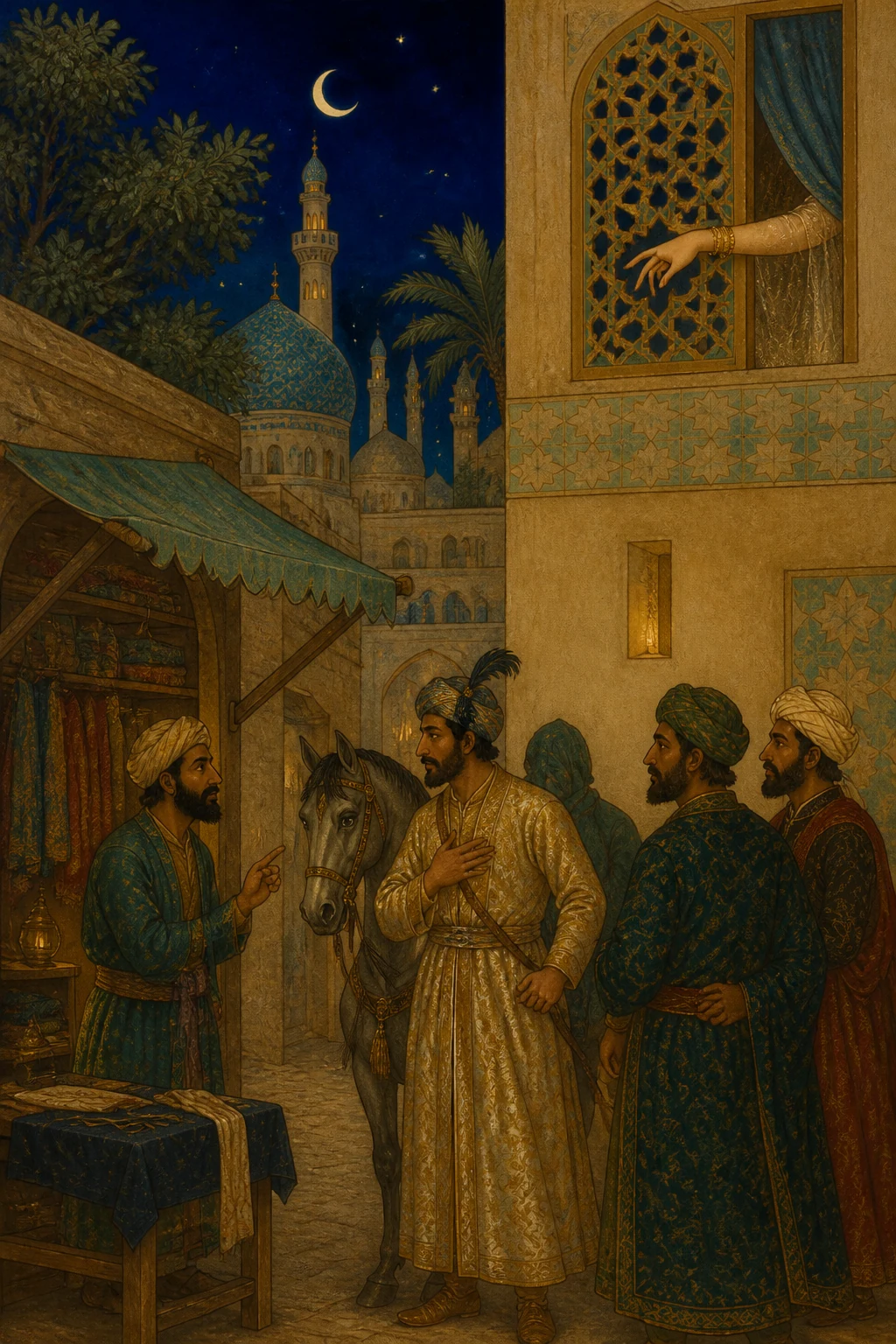
It is also related, O King, that Ishaq ibn Ibrahim al-Mawsili said: One winter evening I was at home, with clouds spread thick across the sky and rain pouring as though from the mouths of waterskins. No one could venture along the streets, so deep were they in water and mud. I was heavyhearted, for none of my friends had come to see me, and the mire and clay prevented me from going to them. So I said to my servant, “Bring me something to divert me.” He brought food and wine, but I took no pleasure in them, having no companion to keep me company. I kept peering out through the windows and watching the streets until night fell. Then I remembered a slave girl belonging to one of al-Mahdi’s sons, with whom I was in love. She was skilled in singing and playing musical instruments, and I said to myself, “If only she were here tonight, my happiness would be complete, and her presence would shorten this night of brooding and unease.” Just then someone knocked at the door, saying, “May a beloved enter who stands at the door?” I thought, “Perhaps the tree of wishes has borne fruit.” I rose and went to the door, and there stood my beloved, wrapped in a green mantle, with a covering of brocade over her head to shield her from the rain. She had sunk knee-deep in mud, and water pouring from the gutters had drenched her clothes. A remarkable sight she was! “My lady,” I said, “what has brought you out in such mire?” She replied, “Your messenger came to me and described your passion and longing, so I could do nothing but answer your summons and hasten to you.” I marvelled at this. But morning overtook Shahrazad, and she fell silent, leaving her tale untold.
Then, when it was the six hundred and ninety-sixth night,
She said: It has reached me, O fortunate King, that when the girl came and knocked at Ishaq’s door, he went out to her and said, “My lady, what has brought you out in such mire?” She replied, “Your messenger came to me and described your passion and longing, so I could do nothing but answer your summons and hasten to you.” I marvelled at this, but was unwilling to tell her that I had sent no one. Instead I said, “Praise be to God, who has reunited us after all the pain I have endured in waiting! Had you delayed another hour, it would have been for me to make my way to you, so greatly do I yearn for you, and so ardent is my love.” Then I told my servant, “Bring water.” He brought a vessel of hot water so that she might put herself to rights. I ordered him to pour it over her feet, and washed them with my own hands. Then I called for a suit of the finest clothes and dressed her in them after she had taken off what she was wearing. We sat down, and I called for food, but she declined it. “Would you care for wine?” I asked. “Yes,” she said. I drank a few cups, and then she asked, “Who will sing?” “I will, my lady,” I replied. “I should not like that,” she said. “Then one of my slave girls.” “I do not want that.” “Sing yourself, then.” “Nor will I.” “Who is to sing for you, then?” I asked. She replied, “Go out and find someone to sing for me.” I went out to obey her, though without hope, certain that I should find no one at such an hour. I walked on until I reached the street, where I came upon a blind man tapping the ground with his staff and saying, “May God grant no good to those people I have just left! If I sang, they would not listen, and if I fell silent, they treated me with contempt.” “Are you a singer?” I asked. “Yes,” he replied. “Would you like to spend the rest of the night with us and keep us company?” “Take my hand, if you wish,” he said. I took his hand and led him home, then said to her, “My lady, I have brought a blind singer whom we may enjoy without his seeing us.” “Bring him in,” she said. I brought him in and pressed him to eat. He ate daintily and washed his hands, and I offered him wine. He drank three cups, then asked, “Who are you?” “Ishaq ibn Ibrahim al-Mawsili,” I replied. “I have often heard of you,” he said, “and now I am delighted to be your drinking companion.” “Sir,” I answered, “your delight is mine.” Then he said, “Sing for me, Ishaq.” In a playful spirit I took up the lute and said, “I hear and obey.” When I had sung and the song was ended, he said, “Ishaq, you have almost become a singer.” I felt humbled in my own eyes and laid the lute aside. “Have you no one who can sing well?” he asked. “I have a slave girl,” I said. “Tell her to sing.” I asked, “Will you sing, then, if you approve of her singing?” “Yes,” he replied. So she sang, but he said, “No, she has accomplished nothing.” Angrily she flung the lute from her hand and said, “We have generously given what we possess. If you have anything, bestow it on us as alms.” He said, “Bring me a lute that no hand has touched.” I ordered the servant to fetch one, and he brought a new lute. The blind man felt it over, then played in a mode unknown to me and burst into song with these two verses:
A beloved came through the darkness while night still lingered, knowing well the hour for a visit. Nothing startled us but her greeting and her words: “May a beloved enter who stands at the door?”
He continued: The girl gave me a sidelong glare and said, “A secret between you and me, and you could not keep it in your breast for a single hour, but must entrust it to this man!” I swore to her that I had not and pleaded with her, then began kissing her hands, tickling her breasts, and nibbling her cheeks until she laughed. Then I turned to the blind man and said, “Sing, sir.” He took up the lute and sang these two verses:
How often have I visited fair women, and with my own hands touched their henna-dyed fingers! I have tickled the pomegranates of their breasts, and lingered, nibbling the rounded apples of their cheeks. I said to her, “My lady, who could have told him what we have been doing?” “You are right,” she replied. Then we drew away from him, and he said, “I need to relieve myself.” “Boy,” I said, “take the candle and lead the way for him.” He went out, but was so long in returning that we went to look for him and could not find him. The doors were locked, and the keys were in the cupboard. We could not tell whether he had ascended into heaven or sunk into the earth. Then I knew that he was Iblis, and that he had acted as my procurer. I turned back, recalling these two verses of Abu Nuwas:
I marvel at Iblis in his pride, and at the malice he harbours in his heart: too haughty to bow once before Adam, he has become a pimp to Adam’s offspring.