Prevod
It is also related that Ibrahim ibn Ishaq said: I was devoted to the service of the Barmakids. One day, as I sat at home, there came a knock at my door. My servant went out, then returned and said, “There is a handsome young man at the door asking leave to enter.” I admitted him, and a youth came in bearing the marks of illness. “For some time,” he said, “I have been trying to meet you, for I have a favor to ask.” “What is it?” I asked. He took out three hundred dinars, laid them before me, and said, “I beg you to accept these and compose a melody for two verses I have written.” “Recite them to me,” I said. So he began to recite … But morning overtook Shahrazad, and she fell silent, leaving her tale untold.
Then, when it was the six hundred and ninety-seventh night,
She said: It has reached me, O fortunate king, that when the young man came to Ibrahim ibn Ishaq and laid the dinars before him, he said, “I beg you to accept these and compose a melody for two verses I have written.” “Recite them to me,” said Ibrahim. So he recited:
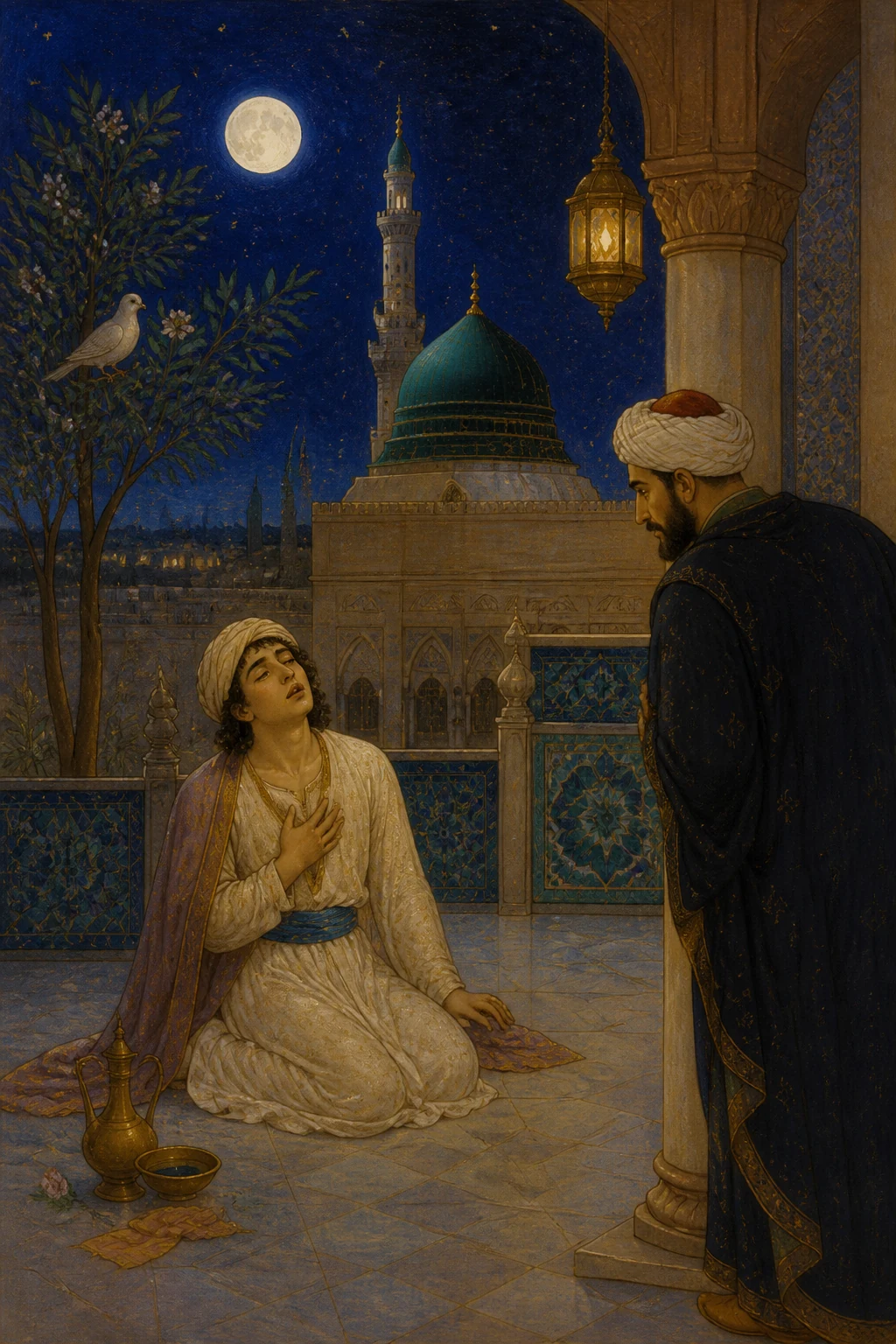
“By God, O eyes that have wounded my heart, quench with my tears the burning pain of sorrow! Fate itself is among those who reproach me for my love: it will not let me see my beloved, even if I am wrapped in my shroud.” Ibrahim continued: I composed for him a melody like a lament, then sang it to him. He swooned, and I thought he had died. At last he revived and said, “Sing it again.” I implored him by God, saying, “I fear you will die.” “Would that I might!” he replied. He went on pleading and beseeching me until I took pity on him and sang it again. This time he fell into a swoon deeper than the first, and I had no doubt that he was dead. I kept sprinkling rose water over him until he revived and sat up. I praised God for his recovery, set his dinars before him, and said, “Take your money and leave me.” “I have no need of it,” he said, “and you shall have as much again if you repeat the melody.” The prospect of the money cheered my heart, and I said, “I will repeat it, but on three conditions. First, you must stay with me and eat my food until you regain your strength. Second, you must drink enough wine to fortify your heart. Third, you must tell me your story.” He did as I asked, then said: “I am a man of Medina. Once I went out for pleasure with my brothers along the road to al-Aqiq. There I saw a maiden among a group of girls, like a bough bedecked with dew. Her eyes had only to glance at a man to carry off his soul. They remained there until the day was spent, then departed, leaving wounds in my heart that were slow to heal. I returned to seek news of her, but found no one. Then I began searching for her in the markets, yet could learn nothing of her. I fell ill with grief and told my story to a kinsman, who said, ‘Do not despair. The spring days are not yet over, and rain will fall. Then you can go out, and I will go with you and bring about your desire.’ This comforted me until al-Aqiq began to flow and overflow its banks. I went out with my brothers and my kinsfolk, and we sat in the very place where we had sat before. Before long the women came toward us, racing like horses at the course. I said to a girl among my relatives, ‘Tell that maiden that this man says to her: How well the poet spoke who said:
“‘She shot me with an arrow that pierced my heart, then turned away, reopening its wounds and scars.’ The girl went to her and delivered the message. The maiden replied, ‘Tell him: How well the poet answered who said:
“‘We suffer even as you complain of suffering; have patience—perhaps we shall soon find relief to heal our hearts.’ Then she said no more, for fear of scandal. I rose to leave, and she rose when I did. I followed her, and she saw me following until I had learned where she lived. After that she would come toward me, and I toward her, until we met. This happened so often that word of it spread and her father came to know. Still I strove to meet her, and at last I complained of my plight to my father. He gathered our kinsfolk and went to her father to ask for her hand on my behalf. But her father said, ‘Had the notion come to me before he brought shame upon her, I would have agreed. But now the affair is common knowledge, and I will not confirm what people are saying.’”
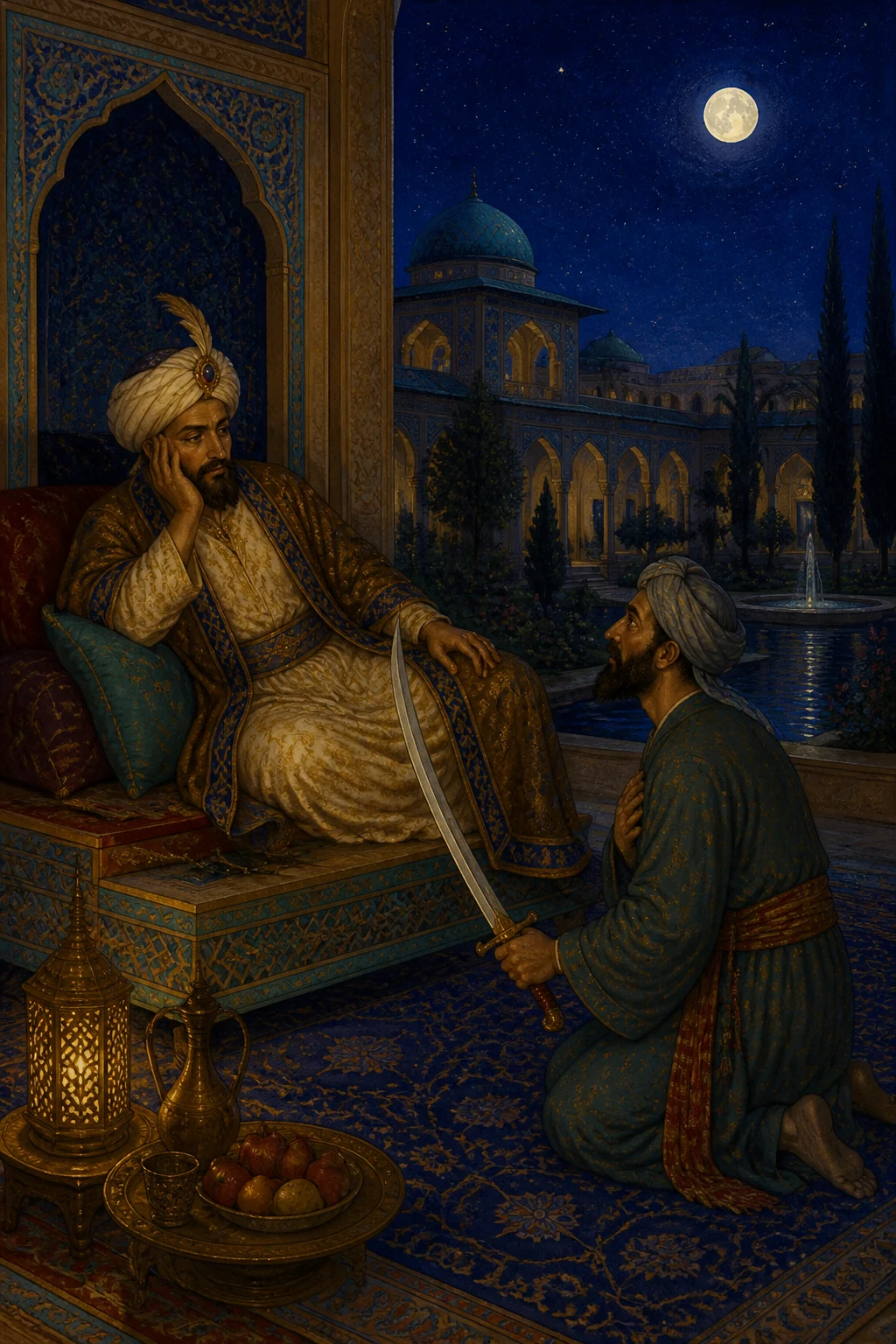
Ibrahim continued: I sang the song to him again, and he told me where he lived and took his leave. Thereafter we became friends. One day Ja‘far ibn Yahya held a gathering, and I attended as usual. I sang him the young man’s verses, and he was so moved that he drank several cups and said, “Confound you! Whose song is this?” I told him the young man’s story, and he bade me ride to him and assure him that his desire would be fulfilled. I went and brought him back. Ja‘far asked him to tell his story once more, and when he had done so, said, “You are under my protection until I marry you to her.” The youth’s heart was comforted, and he stayed with us. When morning came, Ja‘far rode to al-Rashid and told him the tale. The caliph found it delightful and ordered us all to be brought before him. He asked to hear the song again and drank as he listened. Then he ordered a letter to be written to the governor of the Hijaz, commanding him to send the woman’s father and family to his court with all honor, and to provide generously for their expenses. Before long they arrived. Al-Rashid summoned the father into his presence, ordered him to marry his daughter to the youth, and gave him a hundred thousand dinars. Then the man returned to his family. The young man remained one of Ja‘far’s boon companions until the calamity befell him; then he returned with his wife to Medina. May God Most High have mercy upon all their souls.