Prevod
It is also related, O happy King, that Harun al-Rashid lay sleepless one night and sent for al-Asma‘i and Husayn al-Khali‘. When they were brought before him, he said, “Tell me a story, and you begin, Husayn.” He replied, “Yes, Commander of the Faithful. One year I journeyed down to Basra, bearing a poem in praise of Muhammad ibn Sulayman al-Rabi‘i. He received it graciously and bade me remain with him. One day I went out toward al-Murid, taking my way through al-Mahaliyya. The heat was fierce, and I approached a great doorway to ask for water. There I beheld a girl as supple as a swaying bough, with languorous eyes, finely arched brows, and smooth cheeks. She wore a pomegranate-red shift and a mantle from Sana‘a, and the dazzling whiteness of her hands outshone the red of her shift. Beneath it gleamed two breasts like pomegranates, and a belly like folded Coptic linen, its curves like rolls of shining white parchment stuffed with musk. About her neck, Commander of the Faithful, she wore beads of red gold that hung between her breasts, and across her broad forehead lay a fringe as black as jet. Her brows met above great dark eyes; her cheeks were smooth, her nose finely aquiline, and beneath it was a mouth like a pearl, with teeth like precious gems. Fragrance enveloped her. Distraught and bewildered, she paced to and fro in the entrance passage, treading, as she swayed, upon the very hearts of those who loved her. Her full ankles stifled the jingling of her anklets. She was as the poet described her:
‘Each lovely part of her proclaims Its own example of perfection.’ I stood in awe of her, Commander of the Faithful, then drew near to greet her. The house, the passage, and the street were all fragrant with musk. I saluted her, and she answered in a subdued voice, from a sorrowing heart consumed by the flames of longing. I said, ‘My lady, I am an old man and a stranger, and thirst has overcome me. Will you order me a drink of water and earn your reward for it?’ She replied, ‘Leave me, old man. I am too troubled to think of food or water.’” And morning overtook Shahrazad, and she fell silent, leaving her tale untold.
When it was the six hundred and ninety-fourth night
She said, “It has reached me, O happy King, that the girl said, ‘I am too troubled to think of food or water.’ I asked, ‘Why is that, my lady?’ She replied, ‘I love one who treats me unjustly, and desire one who does not desire me. Besides all this, I am tormented by the watchfulness of spies.’ I said, ‘Can there be anyone upon the face of the earth, my lady, whom you desire and who does not desire you?’ ‘Yes,’ she answered, ‘for he has been endowed with surpassing beauty, perfection, and grace.’ I asked, ‘And why do you stand here in this passage?’ She said, ‘His way lies here, and this is the hour when he passes.’ I said, ‘My lady, have you ever met and spoken together in a way that gave rise to this longing?’ She heaved a deep sigh, and tears ran down her cheeks like dew falling upon roses. Then she recited these two verses:
‘We were two branches of a willow above a garden, Breathing the fruits of pleasure in a life of ease. Then came one who severed this branch from its fellow: Who has seen one lonely thing yearn so for another?’ I said, ‘Tell me, how far has your love for this youth carried you?’ She answered, ‘When I see sunlight upon the walls of his family’s house, I imagine it is he. Sometimes I catch sight of him unexpectedly and am struck senseless: blood and spirit flee my body, and I remain out of my wits for a week or two.’ I said, ‘Forgive me, for I suffer from the same yearning as you: love engrosses my thoughts, wastes my body, and saps my strength. I see in your pallor and the delicacy of your skin the signs of love’s torments. And how could love fail to touch you, dwelling as you do in Basra?’ She replied, ‘By Allah, before I loved this youth I was all charm, radiant in beauty and perfection. I had bewitched all the lords of Basra, until this youth himself became enamored of me.’ I asked, ‘What parted you?’ She replied, ‘The calamities of fate. His story and mine is a strange one. On the day of Nawruz I held a gathering and invited several of the slave girls of Basra. Among them was Sayran’s slave girl, whom he had bought from Oman for eighty thousand dirhams. She loved me and was passionately devoted to me. When I entered, she threw herself upon me and nearly tore me to pieces with her pinches and bites. Then we withdrew to enjoy our wine while our meal was being prepared and our pleasure made complete. She sported with me and I with her, now I above her and now she above me. In her drunkenness she reached for my waistband and untied it, though there was nothing improper between us, and in our play my trousers slipped down. While we were thus engaged, he suddenly came in and saw us. Enraged at the sight, he turned away from me like an Arab filly that hears the clatter of its bridle, and rushed out.’” And morning overtook Shahrazad, and she fell silent, leaving her tale untold.
When it was the six hundred and ninety-fifth night
She said, “It has reached me, O happy King, that the girl said to Husayn al-Khali‘, ‘When my beloved saw what I have told you of my sport with Sayran’s slave girl, he went away in anger. For three years now, old man, I have done nothing but offer him excuses, coax him, and appeal to his compassion. Yet he will not grant me a glance, write me a single word, speak to a messenger of mine, or hear the least thing from me.’ I asked her, ‘Is he an Arab or a Persian?’ She replied, ‘Woe to you! He is one of the lords of Basra.’ I asked, ‘Is he old or young?’ She gave me a scornful look and said, ‘You are a fool! He is like the moon on the night of its fullness, smooth of body and beardless, with no fault save his aversion to me.’ I said, ‘What is his name?’ ‘What would you do with it?’ she asked. I replied, ‘I would endeavor to meet him and bring about a reunion between you.’ She said, ‘On condition that you carry a letter to him.’ I answered, ‘I have no objection.’ She said, ‘His name is Damra ibn al-Mughira, and he is called Abu al-Sakha. His mansion is in al-Murid.’ Then she called to those within the house, ‘Bring ink and paper!’ She bared two forearms like bands of silver, and, after invoking the name of Allah, wrote: ‘My lord, the absence of a prayer at the head of my letter reveals my failure. Know that, were my prayers answered, you would never have left me, for I often prayed that you would not leave me, yet you have left. Had my anguish not passed all bounds, your servant’s effort in writing this letter would have sufficed her, despite her despair of you, knowing as she does that you will leave it unanswered. Her utmost wish, my lord, is a glimpse of you as you pass along the street by this entrance, that you may restore a dead soul to life. Dearer still would it be if you wrote her a letter with your own hand—may Allah extend it in every virtuous deed—to take the place of those hours we spent alone together in nights gone by, which you remember, my lord. Am I not your loving, languishing woman? If you grant my request, I shall give thanks to you and praise to Allah. Peace be upon you.’
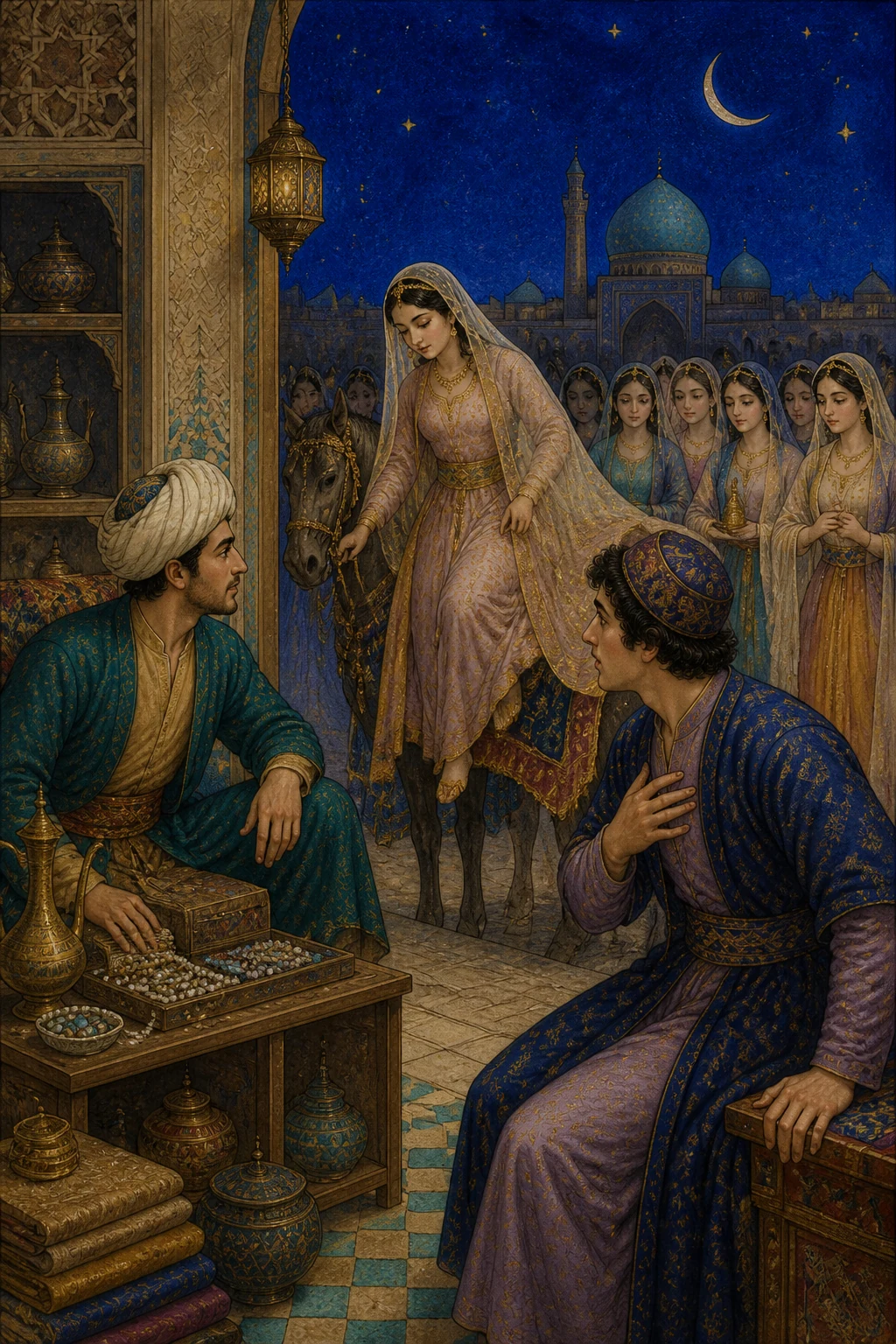
“I took the letter and departed. The next morning I went to the gate of Muhammad ibn Sulayman and found his assembly crowded with great lords. There I saw a youth who adorned the gathering, surpassing all present in beauty and radiance, and whom the emir had seated above himself. I asked who he was and learned that he was Damra ibn al-Mughira. I said to myself, ‘Truly, it is no wonder the poor girl has come to such a pass.’ Then I rose and made my way to al-Murid, where I stood at the gate of his house. Presently he arrived with his retinue. I sprang forward, greeted him with abundant blessings, and handed him the letter. When he had read it and understood its meaning, he said to me, ‘Old man, we have found another in her place. Would you like to see her replacement?’ ‘Yes,’ I replied. He called for a young woman, and there appeared a girl whose beauty put sun and moon to shame, with high, firm breasts, walking with the quick step of one in haste, yet without fear. He handed her the letter and said, ‘Answer it.’ When she had read it and understood its contents, her face turned pale, and she said, ‘Old man, ask Allah’s forgiveness for the errand you have undertaken.’ I went away, Commander of the Faithful, dragging my feet until I reached the first girl’s house. I asked leave to enter and went in. ‘What news?’ she asked. ‘Misery and despair,’ I replied. ‘Never mind him,’ she said. ‘Is Allah not there, and His power?’ Then she ordered five hundred dinars to be given to me, and I departed. Some days later I passed that place again and found servants and horsemen there. I entered, and behold, they were Damra’s companions, begging her to return to him, while she said, ‘No, by Allah, I will never look him in the face!’ I prostrated myself in thanks to Allah, Commander of the Faithful, rejoicing in Damra’s discomfiture. Then I drew near the girl, and she showed me a letter in which, after the invocation of Allah’s name, was written: ‘My lady, were it not for my wish to spare you—may Allah prolong your life—I would set down some part of what you have done, and state fully my defense against your accusation that I wronged you. For it was you who wronged both yourself and me, showing how little you valued your pledge and how scant your faithfulness was, preferring another to me and acting against my wishes. Allah’s help is sought against the choice you made. Peace be upon you.’ She also showed me the gifts and rarities he had sent her, worth thirty thousand dinars. Later I saw her again, and Damra had married her.” Then al-Rashid said, “Had Damra not forestalled me, I should have had a tale of my own with her.”