Waltey
Zgodba o Nimi in Niam
Tisoč in ena noč · arabska pripovedna tradicijaO besedilu
Zgodba o Nimi in Niam
- Vir
- Tisoč in ena noč
- Avtor
- arabska pripovedna tradicija
- Jezik branja
- English
- Jezik izvirnika
- Arabic
- Čas branja
- 52 min branja
- Obseg
- 42 strani
- Naslov izvirnika
- حكاية نعمة ونِعَم - الليالي ٢٣٧ إلى ٢٤٨
O izvirniku
Tisoč in ena noč
Zgodbe v zgodbah, polne trgovcev, dvorov, preoblek in nočnih zapletov. Bralni jezik je English, izvirnik pa prihaja iz vira Tisoč in ena noč v jeziku Arabic.
Besedilo
Zgodba o Nimi in Niam
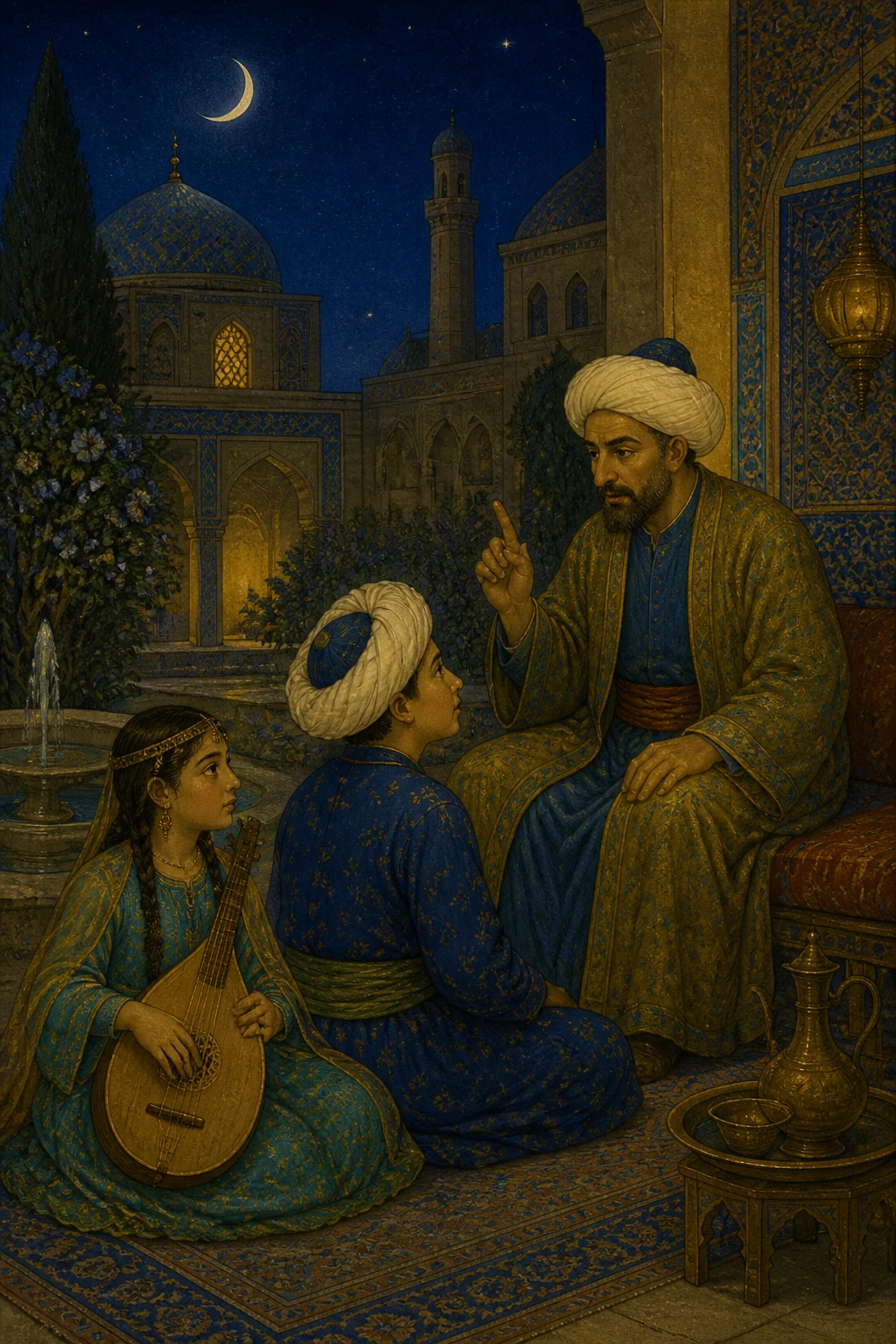
Bahram said: They relate—and God knows best—that in the city of Kufa there lived a man of standing named al-Rabi‘ ibn Hatim, who possessed great wealth and lived in ease. He had been blessed with a son, whom he named Ni‘mat Allah. One day, as he was at the slave dealers’ stall, he saw a slave woman being offered for sale, with a little girl of exquisite beauty in her arms. Al-Rabi‘ beckoned to the dealer and asked, “How much for this woman and her daughter?” “Fifty dinars,” he replied. Al-Rabi‘ said, “Draw up the deed, take the money, and hand it to her master.” He paid the price of the woman, gave the dealer his commission, and took the woman and her daughter home. When his wife, who was also his cousin, saw the woman, she asked, “Cousin, who is this slave woman?” He replied, “I bought her for the sake of the little girl in her arms. Know that when she grows up, there will be none like her, nor any more beautiful, in all the lands of the Arabs and the Persians.” His wife asked the woman, “What is your name, girl?” “My lady, my name is Tawfiq,” she answered. “And what is your daughter’s name?” “Sa‘d.” “A fitting name,” she said. “Fortunate indeed are you, and fortunate is the man who bought you.” Then she asked her husband, “Cousin, what shall you call her?” “Whatever you choose,” he replied. “Let us call her Ni‘am,” she said. “That will do very well,” said al-Rabi‘.
Little Ni‘am was brought up with Ni‘ma ibn al-Rabi‘, sharing the same cradle, until they reached the age of ten. Each seemed more beautiful than the other. The boy called her “my sister,” and she called him “my brother.” When they reached this age, al-Rabi‘ turned to his son Ni‘ma and said, “My son, Ni‘am is not your sister but your slave girl. I bought her in your name while you were still in the cradle, so from this day forward do not call her your sister.” Ni‘ma said to his father, “If that is so, I shall marry her.” He went to his mother and told her, and she said, “My son, she is your slave girl.” So Ni‘ma ibn al-Rabi‘ took the girl to his bed and loved her. Nine years passed with them living thus, and in all Kufa there was no girl more beautiful, sweeter, or more charming than Ni‘am. As she grew up, she studied the Quran and the sciences, learned every kind of entertainment and musical instrument, and excelled in singing and music until she surpassed all the people of her age. One day, as she sat drinking with her husband Ni‘ma ibn al-Rabi‘, she took up the lute, tuned its strings, and sang these two verses:
“Since you are my lord, by whose bounty I live, and the sword with which I strike down the necks of misfortune, what need have I of Zayd or ‘Amr to intercede for me, when every road is closed, while I have you?” Ni‘ma was overcome with delight and said, “By my life, Ni‘am, sing for us to the tambourine and the other instruments.” She ravished him with her melodies and sang these verses:
“By the life of him who holds my reins in his hands, in love I shall defy all who envy me. I shall anger those who blame me and obey you, forsaking pleasure and sleep. Within the folds of my breast I shall make you a grave, without my heart ever knowing.” The youth exclaimed, “God bless your gifts, Ni‘am!” While the two were living in the utmost happiness, al-Hajjaj was saying in his governor’s palace, “I must devise a way to seize this girl called Ni‘am and send her to the Commander of the Faithful, ‘Abd al-Malik ibn Marwan, for there is none like her in his palace, nor any whose singing is sweeter.” He summoned an old woman, a household steward, and said to her, “Go to al-Rabi‘’s house, meet the girl Ni‘am, and contrive to take her away, for there is none like her on the face of the earth.” The old woman agreed to do as al-Hajjaj asked. When morning came, she dressed in woollen robes and hung about her neck a rosary with thousands of beads. Then dawn overtook Shahrazad, and she fell silent, leaving her tale untold.
When it was the two hundred and thirty-eighth night
She said: It has reached me, O fortunate king, that the old woman agreed to do as al-Hajjaj asked. When morning came, she dressed in woollen robes, hung about her neck a rosary with thousands of beads, and took a staff and a Yemeni water vessel in her hand. She set out, saying, “Glory be to God! Praise be to God! There is no god but God! God is greatest! There is no power and no strength save in God, the Most High, the Almighty!” She continued her praises and supplications, though her heart was full of cunning and deceit, until she reached the house of Ni‘ma ibn al-Rabi‘ at the hour of the noon prayer. She knocked, and the doorkeeper opened to her and asked, “What do you want?” She replied, “I am a poor, devout woman. The hour of the noon prayer has overtaken me, and I wish to pray in this blessed place.” The doorkeeper said, “Old woman, this is the house of Ni‘ma ibn al-Rabi‘, not a congregational mosque or a place of prayer.” She answered, “I know no mosque or place of prayer to equal the house of Ni‘ma ibn al-Rabi‘. I am a steward from the palace of the Commander of the Faithful, and I have gone forth to wander and devote myself to worship.” “I cannot let you enter,” said the doorkeeper. They argued at length, and the old woman caught hold of him, saying, “Is someone like me to be barred from the house of Ni‘ma ibn al-Rabi‘, when I enter the homes of princes and grandees?” Ni‘ma came out, heard her words, and laughed. He told her to follow him inside, and she went after him until he brought her into Ni‘am’s presence. The old woman greeted her most graciously. When she saw Ni‘am, she marvelled at her surpassing beauty and said, “My lady, I commend you to the protection of God, who has matched you and your master in beauty and loveliness.”
Then the old woman stood in the prayer niche and began bowing, prostrating herself, and praying until the day had passed and night drew on in darkness. The girl said, “Mother, rest your feet a while.” But the old woman replied, “My lady, whoever seeks the life to come must weary herself in this world, and whoever does not weary herself in this world will not attain the stations of the righteous in the next.” Ni‘am set food before her and said, “Eat of my food, and pray that I may be granted repentance and mercy.” The old woman answered, “My lady, I am fasting. But you are a young girl: eating, drinking, and merriment are fitting for you, and God will accept your repentance. For God Most High has said, ‘Except those who repent, believe, and do righteous deeds.’” The girl sat talking with the old woman for a while, then said to her master, “My lord, make this old woman swear to stay with us for a time, for the signs of devotion are plain upon her face.” He replied, “Set aside a room for her worship, and let no one disturb her. Perhaps God—glory be to Him, the Most High—will let us benefit from her blessing and never part us.”
The old woman spent that night praying and reciting until morning. At daybreak she came to Ni‘ma and Ni‘am, wished them good morning, and said, “I leave you in God’s keeping.” Ni‘am asked, “Where are you going, Mother? My lord has told me to set aside a room where you may retire to worship.” The old woman replied, “May God preserve him and keep His blessings upon you both! But I would ask you to tell the doorkeeper not to prevent me from coming in to see you. God willing, I shall visit the holy places and pray for you after my prayers and devotions every day and night.” Then she left the house, while Ni‘am wept at parting from her, little knowing why she had come. The old woman went to al-Hajjaj, who asked, “What news?” She replied, “I have seen the girl, and no woman in her time has borne a daughter more beautiful.” Al-Hajjaj said, “If you do as I have commanded, you shall have a generous reward from me.” “I ask you for a full month,” she said. “I grant you a month,” he answered. So the old woman began paying frequent visits to the house of Ni‘ma and his slave girl Ni‘am. Then dawn overtook Shahrazad, and she fell silent, leaving her tale untold.
When it was the two hundred and thirty-ninth night
She said: It has reached me, O fortunate king, that the old woman began paying frequent visits to Ni‘ma and Ni‘am, and they treated her with ever greater honour. She was with them morning and evening, and everyone in the house welcomed her. At last, one day, she found herself alone with the girl and said, “My lady, by God, I have visited the holy places and prayed for you. How I wish you could be with me, so that you might see the spiritual masters who have attained union with God, and they could pray for whatever you desire.” Ni‘am said to her, “For God’s sake, Mother, take me with you.” “Ask your mother-in-law’s permission,” she replied, “and I shall take you.” The girl said to her mother-in-law, Ni‘ma’s mother, “My lady, ask my lord to let you and me go out one day with my old mother here, to pray and make supplication with the poor devotees in the holy places.” When Ni‘ma came home and sat down, the old woman approached and kissed his hands. He stopped her from doing so, and she prayed for him and left the house.
The next day the old woman came when Ni‘ma was not at home. She went to Ni‘am and said, “We prayed for you last night. But come now, this very moment, and see for yourself; you will be back before your master returns.” The girl said to her mother-in-law, “I beg you by God to let me go out with this righteous woman to see God’s saints in the holy places. I shall return quickly, before my master comes.” Ni‘ma’s mother said, “I fear your master may learn of it.” The old woman answered, “By God, I shall not even let her sit down. She will only look while standing, and will not linger.” Thus she tricked the girl into going with her and took her to al-Hajjaj’s palace. After lodging her in a private chamber, she told him of her arrival. Al-Hajjaj came and looked at her, and found her the most beautiful woman of her age; never had he seen her equal. When Ni‘am saw him, she veiled her face. He remained there until he had summoned his chamberlain, assigned him fifty horsemen, and ordered him to mount the girl on a swift riding camel, take her to Damascus, and deliver her to the Commander of the Faithful, ‘Abd al-Malik ibn Marwan. He wrote a letter and said, “Give him this letter, obtain his answer, and return to me with all speed.” The chamberlain set out, taking the girl on a riding camel. She wept throughout the journey at being parted from her master, until they reached Damascus. He asked leave to enter the presence of the Commander of the Faithful and was admitted. He told him about the girl, and the caliph had a private chamber made ready for her. Then he entered his women’s quarters and, seeing his wife, said, “Al-Hajjaj has bought me a slave girl, a daughter of the kings of Kufa, for ten thousand dinars. He has sent me this letter, and she has come with it.” His wife said to him… Then dawn overtook Shahrazad, and she fell silent, leaving her tale untold.
When it was the two hundred and fortieth night
She said: It has reached me, O fortunate king, that when the caliph told his wife about the girl, she said, “May God increase His bounty to you.” Then the caliph’s sister went in to see the girl. When she beheld her, she said, “By God, the man who has you in his house has made no poor bargain, even if your price were a hundred thousand dinars.” Ni‘am asked her, “Fair-faced lady, whose palace is this, and what city is this?” She replied, “This is the city of Damascus, and this is the palace of my brother, the Commander of the Faithful, ‘Abd al-Malik ibn Marwan.” Then she added, “It seems you did not know.” “By God, my lady, I knew nothing of it,” said Ni‘am. “Did the man who sold you and received your price not tell you that the caliph had bought you?” When the girl heard these words, her tears poured forth and she wept, saying to herself, “The trick has succeeded against me.” Then she thought, “If I speak, no one will believe me. I shall remain silent and be patient, for I know that God’s deliverance is near.” She lowered her head in modesty, her cheeks reddened by the journey and the sun. The caliph’s sister left her that day and returned the next with fine clothes and jewelled necklaces, in which she dressed her. The Commander of the Faithful came in and sat beside her, and his sister said, “Look at this girl, in whom God has brought beauty and loveliness to perfection.” The caliph said to Ni‘am, “Lift the veil from your face.” But she did not lift it, so he saw nothing of her face, only her wrists. Love for her entered his heart, and he said to his sister, “I shall not visit her for three days, until she has grown accustomed to you.” Then he rose and left her. The girl brooded over her plight and grieved at being parted from her master Ni‘ma. When night came, she grew weak with fever. She neither ate nor drank, and her face and beauty altered. They told the caliph, who was greatly distressed and came to her with physicians and men of learning, but none could discover a cure.
Such was her plight. As for her master Ni‘ma, he came home, sat upon his couch, and called, “Ni‘am!” She did not answer. He sprang up and called again, but no one came to him; every slave girl in the house had hidden in fear of him. He went to his mother and found her sitting with her cheek resting on her hand. “Mother,” he asked, “where is Ni‘am?” She replied, “My son, she is with someone I trust with her more than myself—the devout old woman. She has gone with her to visit the poor devotees and will return.” He said, “When has she ever been accustomed to doing such a thing? And when did she leave?” “Early this morning,” she replied. “How could you give her leave?” His mother said, “My son, it was she who urged it upon me.” Ni‘ma exclaimed, “There is no power and no strength save in God, the Most High, the Almighty!” He left the house beside himself and went to the chief of police. “Do you play tricks on me and take my slave girl from my own house?” he demanded. “I shall go and complain of you to the Commander of the Faithful!” The chief of police asked, “Who took her?” Ni‘ma replied, “An old woman, with such-and-such features, dressed in wool, carrying a rosary with thousands of beads.” The chief of police said, “Show me the old woman, and I shall recover your girl for you.” “Who knows where the old woman is?” Ni‘ma asked. “And who knows the unseen but God—glory be to Him, the Most High?” replied the chief of police, though he knew that she was al-Hajjaj’s schemer. Ni‘ma said, “I shall look to no one but you for my girl, and al-Hajjaj shall judge between us.” “Go to whomever you please,” the man replied. Ni‘ma went to al-Hajjaj’s palace. His father was one of the leading men of Kufa, so when he arrived, al-Hajjaj’s chamberlain went in and informed him of the matter. “Bring him to me,” said al-Hajjaj. When Ni‘ma stood before him, he asked, “What is the matter with you?” Ni‘ma told him all that had happened. Al-Hajjaj said, “Fetch the chief of police, and we shall order him to search for the old woman.” When the chief of police arrived, he said to him, “I want you to search for the slave girl of Ni‘ma ibn al-Rabi‘.” The chief of police replied, “None knows the unseen but God Most High.” Al-Hajjaj said, “You must mount your horses, look for the girl along the roads, and search the towns.” Then dawn overtook Shahrazad, and she fell silent, leaving her tale untold.
When it was the two hundred and forty-first night
She said: It has reached me, O fortunate king, that al-Hajjaj said to the chief of police, “You must mount your horses, search the towns and roads, and look for the girl.” Then he turned to Ni‘ma and said, “If your girl is not returned, I shall give you ten slave girls from my own house and ten from the house of the chief of police.” Then he told the chief of police, “Go out and search for her.” The chief of police departed, while Ni‘ma was overcome with grief and despaired of life. He was fourteen years old, with no hair yet growing upon his cheeks. He wept and sobbed, withdrew from his household, and continued weeping until morning. His father came to him and said, “My son, al-Hajjaj has tricked the girl and taken her. At any moment God may send us deliverance.” But Ni‘ma’s sorrow only deepened, until he no longer knew what he was saying or recognized those who came to see him. He lay ill for three months, his condition worsening until his father lost hope. The physicians came to him and said, “There is no cure for him but the girl.”
One day, as his father sat, he heard of a skilled Persian physician whom people praised for his mastery of medicine, astrology, and divination by sand. Al-Rabi‘ sent for him, and when he came, seated him at his side, honoured him, and said, “Examine my son.” The physician said to Ni‘ma, “Give me your hand.” He gave it to him, and the physician felt his joints, looked into his face, and laughed. Turning to his father, he said, “Your son has no illness except an affliction of the heart.” “You speak the truth, physician,” said al-Rabi‘. “Use your knowledge to examine my son’s case, tell me everything about his condition, and conceal nothing from me.” The Persian replied, “He is in love with a slave girl, and that girl is in Basra or Damascus. There is no cure for your son but to be reunited with her.” Al-Rabi‘ said, “If you bring them together, I shall reward you to your heart’s content, and you shall live in wealth and comfort all your days.” The Persian replied, “This is a simple matter, easily accomplished.” Then he turned to Ni‘ma and said, “No harm shall come to you. Be cheerful and take comfort.” He said to al-Rabi‘, “Bring me four thousand dinars of your money.” Al-Rabi‘ brought them and handed them to him. “I want your son to travel with me to Damascus,” said the Persian. “God willing, I shall not return without the girl.” Then he turned to the youth and asked, “What is your name?” “Ni‘ma,” he replied. “Ni‘ma, sit up and be safe in God’s keeping. God has brought you and your girl together.” Ni‘ma sat upright, and the physician said, “Take heart. We shall set out a week from today, so eat, drink, and be merry, that you may gain strength for the journey.” The Persian began procuring everything he needed. He obtained a total of ten thousand dinars from Ni‘ma’s father, as well as horses, camels, and all else required to carry their baggage along the road.
Ni‘ma bade his father farewell and travelled with the physician to Aleppo, where they found no news of the girl. Then they reached Damascus and stayed there for three days. After that, the Persian rented a shop and filled its shelves with precious porcelain and fine coverings. He adorned the shelves with gold and costly ornaments, and set before him bottles containing all manner of oils and medicinal drinks, with crystal cups arranged around them. He placed his astrolabe before him and dressed in the robes of a learned physician. He stationed Ni‘ma at his side, dressed him in a shirt and a silk outer robe, and wound about his waist a silk sash embroidered with gold. Then he said, “Ni‘ma, from this day you are my son. Call me nothing but Father, and I shall call you nothing but my son.” Ni‘ma replied, “I hear and obey.”
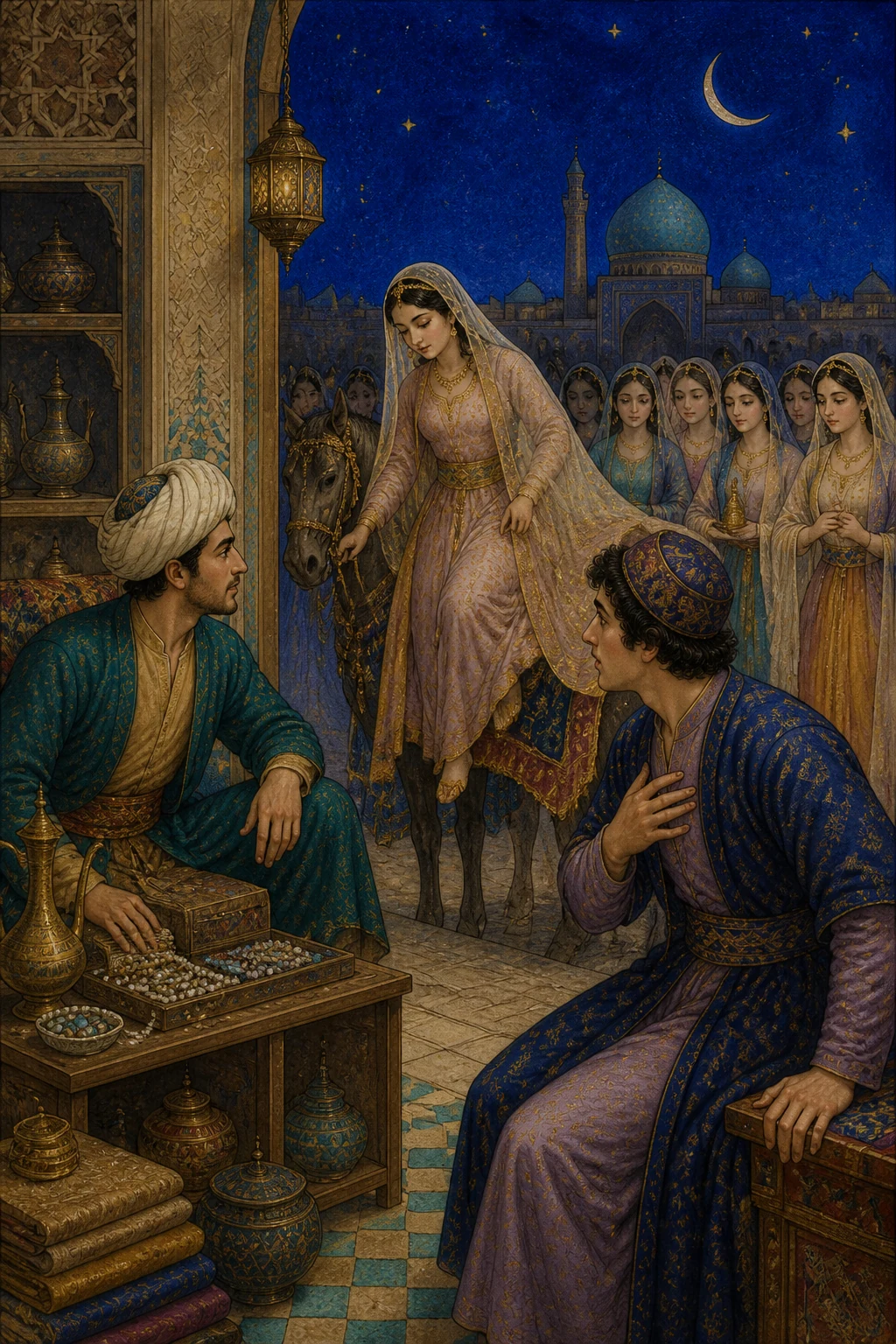
The people of Damascus gathered at the Persian’s shop to admire Ni‘ma’s beauty, the elegance of the shop, and the wares it contained. The Persian spoke to Ni‘ma in Persian, and Ni‘ma answered in the same language, for he knew it, as was customary among the sons of the great. The Persian became famous among the people of Damascus. They described their ailments to him, and he gave them medicines. They brought him bottles filled with the urine of the sick, and he would examine them and say, “The person whose urine is in this bottle suffers from such-and-such an illness.” The sick person would say, “This physician speaks the truth.” He continued to attend to people’s needs, and the people of Damascus flocked to him. His fame spread throughout the city and the houses of the great. One day, as he sat in his shop, an old woman approached on a donkey whose saddlecloth was of brocade studded with jewels. She stopped before the shop, drew in the donkey’s reins, and beckoned to the Persian, saying, “Take my hand.” He took her hand and helped her down. She asked, “Are you the Persian physician who has come from Iraq?” “Yes,” he replied. She said, “I have a daughter who is ill.” She brought out a bottle for him, and when he had examined its contents, he asked, “My lady, what is the girl’s name, so that I may calculate her star and discover the hour most favourable for her to take her medicine?” She replied, “Brother of the Persians, her name is Ni‘am.” Then dawn overtook Shahrazad, and she fell silent, leaving her tale untold.
When it was the two hundred and forty-second night
She said: It has reached me, O fortunate king, that when the Persian heard Ni‘am’s name, he began calculating and writing upon his hand. He said, “My lady, I cannot prescribe a medicine until I know what land she comes from, because climates differ. Tell me where she was brought up and how old she is.” The old woman replied, “She is fourteen years old and was brought up in Kufa, in Iraq.” “And how many months has she been here?” he asked. “Only a few months,” she replied. When Ni‘ma heard the old woman’s words and recognized his girl’s name, his heart began to pound. The Persian said, “Such-and-such medicines will suit her.” The old woman replied, “Give me what you have prescribed, with the blessing of God Most High.” She tossed ten dinars onto the shop counter. The physician looked at Ni‘ma and told him to prepare the medicinal ingredients. The old woman gazed at Ni‘ma and said, “God protect you, my son! She looks just like you.” Then she asked the Persian, “Brother of the Persians, is this your slave or your son?” “He is my son,” the Persian replied. Ni‘ma put the ingredients in a box, took a piece of paper, and wrote these two verses:
“When Ni‘am grants me the favour of a glance, Sa‘da can bring no joy, and Juml no beauty. They say, ‘Forget her, and you shall have twenty like her.’ But she has no equal, and I shall never forget her.” He slipped the paper inside the box, sealed it, and wrote upon the lid in Kufic script, “I am Ni‘ma ibn al-Rabi‘ of Kufa.” Then he placed the box before the old woman. She took it, bade them farewell, and returned to the caliph’s palace. When she brought the ingredients up to the girl, she set the medicine before her and said, “My lady, a Persian physician has come to our city, and I have never seen anyone more knowledgeable about illnesses. After he had examined the bottle, I told him your name, and he recognized your illness and prescribed your medicine. Then he ordered his son to prepare this medicine for you. There is no one in Damascus more beautiful or charming than his son, or more finely dressed, and no one has a shop like his.” The girl took the box and saw her master’s name and his father’s written upon the lid. At the sight, her colour changed, and she said, “Without doubt, the owner of the shop has come on my account.” Then she said to the old woman, “Describe this boy to me.” She replied, “His name is Ni‘ma. He has a scar on his right eyebrow, wears splendid clothes, and is perfectly handsome.” The girl said, “Give me the medicine, with God’s blessing and help.” She took it and drank it, laughing, and said, “This is a blessed medicine.” Then she searched the box and found the paper. She unfolded it and read it, and when she understood its meaning, she was certain that it was her master. Her spirits revived, and she rejoiced.
When the old woman saw her laughing, she said, “This is indeed a blessed day.” Ni‘am said, “Mistress steward, I want food and drink.” The old woman told the slave girls, “Set the tables and bring fine dishes for your mistress.” They brought the food, and she sat down to eat. Just then ‘Abd al-Malik ibn Marwan came in. Seeing the girl seated and eating, he was delighted. The steward said, “Commander of the Faithful, may you rejoice in the recovery of your slave girl Ni‘am! A physician has arrived in this city, and I have never seen anyone more knowledgeable about illnesses and their remedies. I brought her a medicine from him, and she took a single dose and recovered, Commander of the Faithful.” He said, “Take a thousand dinars and see that she is fully cured.” Then he went out, delighted at the girl’s recovery. The old woman took the thousand dinars to the Persian’s shop and gave them to him. She told him that the girl belonged to the caliph and handed him a letter Ni‘am had written. The Persian took it and passed it to Ni‘ma. At the sight of her handwriting, he fell unconscious. When he revived, he opened the letter and found these words: “From the slave girl robbed of her blessing, deceived by a trick, and parted from her heart’s beloved. To proceed: Your letter has reached me, gladdening my breast and delighting my heart. It was as the poet said:
‘The letter has come—may I never lose the fingers that wrote it, till it was steeped in perfume! It was as though Moses had been restored to his mother, or Joseph’s shirt had come to Jacob.’” When Ni‘ma read these verses, tears streamed from his eyes. The steward asked, “What makes you weep, my son? May God never bring tears to your eyes!” The Persian replied, “My lady, how should my son not weep, when this girl is his slave and he is her master, Ni‘ma ibn al-Rabi‘ of Kufa? Her recovery depends on seeing him, for she has no illness but love for him…” Then dawn overtook Shahrazad, and she fell silent, leaving her tale untold.
When it was the two hundred and forty-third night
She said: It has reached me, O fortunate king, that the Persian said to the old woman, “How should my son not weep, when this girl is his slave and he is her master, Ni‘ma ibn al-Rabi‘ of Kufa? Her recovery depends on seeing him, for she has no illness but love for him. Take these thousand dinars for yourself, my lady, and I shall give you still more. Look upon us with compassion, for we know no one but you who can set this matter right.” The old woman asked Ni‘ma, “Are you her master?” “Yes,” he replied. “You speak the truth,” she said, “for she never ceases to speak of you.” Ni‘ma told her everything that had happened to him, from beginning to end. She said, “Young man, it is through me alone that you shall be reunited with her.” Then she mounted and returned at once to the girl. Looking into her face, she laughed and said, “My daughter, you have every reason to weep and fall ill at being parted from your master, Ni‘ma ibn al-Rabi‘ of Kufa.” Ni‘am replied, “The veil has been lifted for you, and the truth made plain.” The old woman said, “Take comfort and be glad. By God, I shall bring you together, even if it costs me my life.” Then she returned to Ni‘ma and said, “I have been back to your girl and spoken with her. I found that her longing for you is greater even than yours for her. The Commander of the Faithful wishes to lie with her, but she refuses him. If you are steadfast and stout of heart, I shall bring you together and risk my life alongside you. I shall devise a trick and contrive a way to bring you into the palace of the Commander of the Faithful, so that you may meet the girl, for she cannot come out.” Ni‘ma said, “May God reward you with goodness.”
She bade him farewell and went to the girl, saying, “Your master is dying of love for you and longs to meet you. What do you say to that?” Ni‘am replied, “I too am dying, and I long to meet him.” Then the old woman took a bundle containing jewels, ornaments, and a suit of women’s clothes, and went to Ni‘ma. “Come with me somewhere we can be alone,” she said. He went with her into a room behind the shop. She painted designs upon his skin, adorned his wrists, dressed his hair, and clothed him as a slave girl, decking him out with the finest adornments a girl could wear, until he looked like one of the houris of Paradise. When the steward saw him thus, she said, “Blessed be God, the best of creators! By God, you are more beautiful than the girl herself!” Then she told him, “Walk, putting your left foot forward and drawing your right foot back, and sway your hips.” He walked before her as she instructed, and when she saw that he had mastered a woman’s gait, she said, “Wait here until I come tomorrow night, God willing. I shall take you into the palace. When you see the chamberlains and servants, be resolute, lower your head, and speak to no one. I shall answer them for you. Success rests with God.”
When morning came on the following day, the steward went to him, took him with her, and brought him up to the palace. She entered first, and he followed close behind. The chamberlain tried to stop him, but she said, “You most ill-omened of slaves! This is the maid of Ni‘am, the favourite of the Commander of the Faithful. How dare you prevent her from entering?” Then she said, “Come in, girl.” He entered with the old woman, and they went on until they reached the door leading to the palace courtyard. The old woman said to him, “Ni‘ma, be strong and take heart. Enter the palace, turn left, count five doors, and go through the sixth. That is the door of the room prepared for you. Do not be afraid, and if anyone speaks to you, do not answer.” She walked with him until they reached the doors, where the chamberlain in charge met her and asked, “Who is this girl?” Then dawn overtook Shahrazad, and she fell silent, leaving her tale untold.
When it was the two hundred and forty-fourth night
She said: It has reached me, O fortunate king, that the chamberlain met the old woman and asked, “Who is this girl?” She replied, “Our mistress wishes to buy her.” The servant said, “No one enters without the permission of the Commander of the Faithful. Go back, for I shall not let her in. Those are my orders.” The steward said, “Great chamberlain, where are your wits? Ni‘am, the caliph’s slave girl, to whom his heart is bound, has begun to recover, and the Commander of the Faithful can scarcely believe she is well. She wishes to buy this girl, so do not bar her way, lest she hear that you have prevented her from entering and become angry with you. If she is angry with you, she will have your head cut off.” Then she said, “Go in, girl, and pay no heed to him. Do not tell your mistress that the chamberlain tried to stop you.” Ni‘ma lowered his head and entered the palace. He meant to turn left, but made a mistake and turned right. He meant to count five doors and enter the sixth, but counted six and entered the seventh. Passing through that doorway, he found a room carpeted with brocade, its walls hung with silk curtains embroidered in gold. Incense burners held aloeswood, ambergris, and fragrant musk. At the far end stood a couch spread with brocade. Ni‘ma sat upon it, not knowing what fate had written for him.
While he sat reflecting on his situation, the sister of the Commander of the Faithful entered with her maid. Seeing the youth seated there, she took him for a girl and approached him, asking, “Who are you, girl? What is your story, and why have you come into this room?” Ni‘ma said nothing and gave her no answer. She said, “Girl, if you are one of my brother’s favourites and he is angry with you, I shall plead with him on your behalf.” Still Ni‘ma gave no answer. She told her maid, “Stand at the door of the room and let no one enter.” Then she approached him, gazed at his beauty, and said, “Young girl, tell me who you are. What is your name, and why have you come here? I have never seen you in our palace.” Ni‘ma did not answer. At this the king’s sister grew angry and laid her hand upon his chest, but found no breasts. She was about to uncover him to discover the truth when Ni‘ma said, “My lady, I am a slave: buy me. I seek your protection: grant it to me.” She replied, “You have nothing to fear. Who are you, and who brought you into this room of mine?” Ni‘ma said, “O princess, I am known as Ni‘ma ibn al-Rabi‘ of Kufa. I have risked my life for my slave girl Ni‘am, whom al-Hajjaj tricked, seized, and sent here.” “You have nothing to fear,” she told him. Then she called her maid and said, “Go to Ni‘am’s chamber.” Meanwhile, the steward had gone to Ni‘am’s chamber and asked her, “Has your master reached you?” “No, by God,” she replied. The steward said, “Perhaps he made a mistake, entered another chamber instead of yours, and lost his way.” Ni‘am exclaimed, “There is no power and no strength save in God, the Most High, the Almighty! Our time has come; we are lost.” The two sat brooding over their plight.
While they were in this state, the maid of the caliph’s sister came in, greeted Ni‘am, and said, “My mistress invites you to visit her.” “I hear and obey,” she replied. The steward said, “Perhaps your master is with the caliph’s sister, and the truth has come to light.” Ni‘am rose at once and went to the caliph’s sister, who said to her, “Your master is sitting here with me. It seems he mistook the room. Neither you nor he has anything to fear, God willing.” When Ni‘am heard these words from the caliph’s sister, her heart was reassured. She went towards her master Ni‘ma, and when he saw her, he rose to meet her. Then dawn overtook Shahrazad, and she fell silent, leaving her tale untold.
When it was the two hundred and forty-fifth night
She said: I have heard, O fortunate king, that when Ni‘ma saw his slave girl, Nu‘m, he rose and went to her, and each clasped the other to the breast. Then they fell to the ground in a swoon. When they recovered, the caliph’s sister said to them, “Sit down, so that we may consider how to escape the predicament in which we find ourselves.” They replied, “We hear and obey. Yours is the command.” She said, “By God, no harm shall ever come to you from us.” Then she told her maid, “Bring food and drink.” The maid brought them, and they ate their fill, then sat drinking. The cups went round, and their sorrows slipped away. Ni‘ma said, “If only I knew what will happen after this!” The caliph’s sister asked him, “Ni‘ma, do you love your slave girl Nu‘m?” He replied, “My lady, it is my love for her that has brought me to this pass, risking my very life.” Then she asked Nu‘m, “Nu‘m, do you love your master Ni‘ma?” She answered, “My lady, it is my love for him that has wasted my body and brought me so low.” The princess said, “By God, you truly love one another. May whoever would part you come to nothing! Be comforted, then, and set your hearts at ease.” They rejoiced at this, and Nu‘m asked for a lute. When it was brought, she took it and tuned it, delighted them with its melodies, and sang these verses:
When slanderers would have nothing but our parting, though neither you nor I owed them a debt of blood, and launched assault upon assault against our ears, while few were left to shield me or to lend me aid, I marched against them with your eyes, my tears, my sighs: with sword, with flood, with fire. Then Nu‘m handed the lute to her master Ni‘ma and said, “Sing us some verses.” He took it and tuned it, delighted them with its melodies, then sang:
The full moon would resemble you, were its face not stained; the sun would be your equal, did it never suffer eclipse. I marvel—and how many marvels love contains! In it are grief and longing and consuming passion. Short seems the road when I travel to my beloved, and long when I turn away. When he had finished his verses, she filled a cup and handed it to him. He took it and drank. Then she filled another cup and handed it to the caliph’s sister, who drank it, took the lute, tuned it and tightened its strings, and sang these two verses:
Grief and sorrow dwell within my heart, and a mighty anguish stirs within my breast. My body’s wasting is plain for all to see: love has made my flesh a prey to sickness. Then she handed the lute to Ni‘ma ibn al-Rabi‘. He took it, tuned its strings, and sang these two verses:
O you to whom I gave my soul, who then tormented it! I sought to wrest it free from you, but had no power. Save a lover now from ruin, before death comes: this is his final breath. They went on reciting poetry and drinking to the music of the strings, filled with delight and gladness, joy and mirth. While they were thus engaged, the Commander of the Faithful entered. At the sight of him, they rose and kissed the ground before him. He looked at Nu‘m, who had the lute with her, and said, “Nu‘m, praise be to God, who has relieved you of your suffering and pain.” Then he turned to Ni‘ma, dressed as he was, and asked, “Sister, who is this slave girl beside Nu‘m?” His sister replied, “Commander of the Faithful, she is a charming girl among the favourites. Nu‘m will neither eat nor drink unless she is with her.” Then she recited the poet’s words:
Two opposites, united yet distinct in beauty; the beauty of a thing is shown by its opposite. The caliph said, “By Almighty God, she is as lovely as Nu‘m herself. Tomorrow I shall set aside an apartment for her beside hers, and have furnishings and fabrics brought out for her, and everything she needs taken there, in honour of Nu‘m.” The caliph’s sister called for food and served her brother. He ate and sat with them in their gathering, then filled a cup and motioned to Nu‘m to sing him some verses. After drinking two cups, she took the lute and sang these two verses:
When my drinking companion gives me cup after cup, three cups whose wine roars as it pours, I spend the night trailing my skirts in pride, as though I ruled you, Commander of the Faithful! The Commander of the Faithful was delighted. He filled another cup, handed it to Nu‘m, and bade her sing. After drinking it, she touched the strings and sang these verses:
O noblest man of this age, without an equal who might boast of sharing your distinction! O peerless one, whose station is in loftiness and bounty, O lord and king renowned throughout the world! O sovereign over all the sovereigns of the earth, you give abundantly, without reproach or weariness. May my Lord preserve you, to the bitter grief of your foes, and may good fortune and victory adorn your rising star! When the caliph heard these verses from Nu‘m, he said, “God bless you, Nu‘m! How eloquent your tongue, how clear your expression!” They continued in joy and merriment until midnight. Then the caliph’s sister said, “Listen, Commander of the Faithful. I came upon a tale in a book concerning a man of high rank.” The caliph asked, “What was the tale?” His sister replied, “Know, Commander of the Faithful, that in the city of Kufa there was a youth called Ni‘ma ibn al-Rabi‘. He had a slave girl whom he loved and who loved him, and they had been brought up together in the same bed. When they came of age and their love for one another had taken firm hold, fate struck them with its calamities, time afflicted them with its scourges, and they were condemned to separation. Slanderers plotted against them until the girl left his house, and they stole her away. The man who stole her then sold her to a king for ten thousand dinars. The girl loved her master as dearly as he loved her, so he left his family and his home, travelled in search of her, and contrived to meet her.” But morning overtook Shahrazad, and she fell silent, leaving her tale untold.
When it was the two hundred and forty-sixth night
She said: I have heard, O fortunate king, that Ni‘ma remained far from his family and his homeland, risking his life and staking his very soul, until he managed to meet his slave girl, whose name was Nu‘m. “When he found her, they had scarcely sat down together before the king who had bought her from her abductor came in upon them. He acted in haste and ordered them both to be killed, neither judging his own case fairly nor allowing them any respite before passing sentence. What do you say, Commander of the Faithful, of this king’s lack of justice?” The Commander of the Faithful replied, “This is indeed extraordinary. That king ought to have shown mercy when he had them in his power, for he was bound to consider three things: first, that they loved one another; second, that they were in his house and at his mercy; and third, that a king should be deliberate in judging between people—how much more so in a matter that concerns himself! This king has acted in a manner unworthy of kings.” His sister said to him, “Brother, by the King of heaven and earth, bid Nu‘m sing, and listen to her song.” He said, “Nu‘m, sing to me.” She delighted them with her melodies and sang these verses:
Time has betrayed me, as it has ever been treacherous, sobering hearts and leaving them a prey to anxious thoughts. It parts lovers after their reunion, till tears stream down their cheeks. They were with me, and I with them, and sweet was my life, while time lavished its bounty on our union. Now I shall weep blood and flowing tears, mourning you through all my nights and days. When the Commander of the Faithful heard this poem, he was deeply moved. His sister said to him, “Brother, whoever passes judgment upon himself is bound to uphold it and act upon his word. You have passed such a judgment upon yourself.” Then she said, “Ni‘ma, rise to your feet, and you too, Nu‘m.” They stood, and the caliph’s sister said, “Commander of the Faithful, this woman standing here is Nu‘m, who was stolen. Al-Hajjaj ibn Yusuf al-Thaqafi stole her and sent her to you, lying when he claimed in his letter that he had bought her for ten thousand dinars. This man standing here is Ni‘ma ibn al-Rabi‘, her master. By the sanctity of your pure forefathers, I beg you to pardon them and give them to one another, that you may earn the reward for your kindness to them. They are in your power; they have eaten your food and drunk your drink. I stand as their intercessor and ask that their lives be granted me.” Then the caliph said, “You speak the truth. I have passed that judgment, and I do not give a judgment only to go back on it.” Then he asked, “Nu‘m, is this your master?” She replied, “Yes, Commander of the Faithful.” He said, “You have nothing to fear. I give you to one another.” Then he asked, “Ni‘ma, how did you discover where she was? Who described this place to you?” He replied, “Commander of the Faithful, hear my story and attend to my account. By your pure fathers and forefathers, I shall hide nothing from you.” He then told him everything that had happened to him: what the Persian physician had done for him, what the stewardess had done, how she had brought him into the palace, and how he had mistaken the doors. The caliph marvelled greatly, then said, “Bring me the Persian.” They brought him before him, and he made him one of his intimates, bestowed a robe of honour upon him, and ordered a handsome reward for him, saying, “A man of such resourcefulness deserves a place among our intimates.”
Then the caliph treated Ni‘ma and Nu‘m kindly and bestowed gifts upon them, rewarding the stewardess as well. They stayed with him for seven days in happiness and good fortune, enjoying the most comfortable of lives. Then Ni‘ma asked leave for himself and his slave girl to depart, and the caliph permitted them to return to Kufa. They set out, and Ni‘ma was reunited with his father and mother. They lived in the greatest happiness until there came to them the Destroyer of Delights and the Sunderer of Companies. When Amjad and As‘ad heard this tale from Bahram, they marvelled greatly and said, “This is indeed a wondrous thing!” But morning overtook Shahrazad, and she fell silent, leaving her tale untold.
When it was the two hundred and forty-seventh night
She said: I have heard, O fortunate king, that when Amjad and As‘ad heard this tale from Bahram, the Magian who had embraced Islam, they marvelled greatly. They spent the night there, and when morning came, Amjad and As‘ad mounted their horses and went to see the king. They asked permission to enter, and it was granted. When they came in, he received them with honour, and they sat conversing. While they were thus engaged, the people of the city began shouting and screaming and crying for help. The chamberlain came in to the king and said, “A king has encamped outside the city with his armies. Their weapons are drawn, and we do not know what they intend.” The king told his vizier Amjad and his brother As‘ad what he had heard from the chamberlain. Amjad said, “I shall go out to him and discover his business.” So Amjad went outside the city and found the sovereign with a great army and mounted mamluks. When they saw Amjad, they recognized him as an envoy from the city’s king, and took him before their sovereign. He approached and kissed the ground, only to find that the ruler was a woman with a veil drawn across her face. She said, “Know that I seek nothing in this city of yours but a beardless slave boy. If I find him among you, no harm shall come to you; but if I do not, there will be fierce war between us, for I have come only in search of him.” Amjad asked, “O queen, what does this slave look like? What is his story, and what is his name?” She replied, “His name is As‘ad, and mine is Marjana. This slave came to me in the company of Bahram the Magian, who would not consent to sell him. I took him by force, but Bahram laid hands on him and stole him from me by night. As for his appearance, it is such and such.”
When Amjad heard this, he knew that she meant his brother As‘ad, and said to her, “O queen of the age, praise be to God, who has brought us relief! This slave is my brother.” Then he told her his story and all that had befallen them in foreign lands, explaining why they had left the Ebony Isles. Queen Marjana marvelled at this and rejoiced at the prospect of meeting As‘ad. She bestowed a robe of honour upon his brother Amjad, who then returned to the king and told him what had happened. They were delighted, and the king went out with Amjad and As‘ad to visit the queen. When they entered her presence, they sat conversing.
While they were thus engaged, a cloud of dust rose until it filled the horizons. After a while it cleared to reveal a vast army, like a surging sea, fully equipped with arms and armour. They advanced upon the city and encircled it as a ring encircles the little finger, then drew their swords. Amjad and As‘ad said, “We belong to God, and to Him we shall return! What is this mighty army? These must surely be enemies. Unless we join forces with Queen Marjana to fight them, they will take the city from us and kill us. We have no choice but to go out to them and discover their business.” Then Amjad rose and went out through the city gate, passed beyond Queen Marjana’s army, and reached the host. There he found that it was the army of his grandfather King al-Ghayur, the father of his mother, Queen Budur. But morning overtook Shahrazad, and she fell silent, leaving her tale untold.
When it was the two hundred and forty-eighth night
She said: I have heard, O fortunate king, that when Amjad reached the army, he found it belonged to his grandfather King al-Ghayur, lord of the islands, the seas, and the seven palaces. When he came before him, he kissed the ground and delivered his message. The king said, “My name is King al-Ghayur, and I have come here on my travels, for time has afflicted me with the loss of my daughter Budur. She left me and has never returned, and I have heard no news of her or of her husband, Qamar al-Zaman. Have you any news of them?” When Amjad heard this, he bowed his head for a while in thought, until he was certain that this was his mother’s father. Then he raised his head, kissed the ground before him, and told him that he was the son of his daughter Budur. When the king heard that he was his daughter Budur’s son, he threw himself upon him, and they both wept. Then King al-Ghayur said, “Praise be to God for your safety, my son, and for bringing us together!” Amjad told him that his daughter Budur was well, as was his father Qamar al-Zaman, and that they were in a city called the Ebony Isle. He explained that his father Qamar al-Zaman had grown angry with him and his brother and ordered them put to death, but that the treasurer had taken pity on them and spared their lives. King al-Ghayur said, “I shall take you and your brother back to your father, reconcile you with him, and stay with you.” Amjad kissed the ground before him. Then King al-Ghayur bestowed a robe of honour upon his daughter’s son, and Amjad returned smiling to the king and told him King al-Ghayur’s story. The king marvelled greatly, then sent him gifts of hospitality—horses, camels, sheep, fodder, and other provisions. He sent the same to Queen Marjana, and when they told her what had happened, she said, “I shall go with you at the head of my army and help bring about the reconciliation.”
While they were thus engaged, a cloud of dust rose until it filled the horizons and darkened the day. Beneath it they heard shouting, cries, and the neighing of horses, and saw swords flashing and spears levelled. When the newcomers drew near the city and saw the two armies, they beat their drums. At this sight the king said, “This can only be a blessed day! Praise be to God, who has brought us to terms with these two armies. God Most High willing, He will bring us to terms with this army too.” Then he said, “Amjad, go out with your brother As‘ad and discover the business of these troops, for this is a mighty host, greater than any I have ever seen.” Amjad and his brother As‘ad went out together. The king had closed the city gate for fear of the armies surrounding it, so they opened the gates and proceeded until they reached the newly arrived host. They found it was the army of the king of the Ebony Isles, and with it was their father, Qamar al-Zaman. At the sight of him they kissed the ground before him and wept. When Qamar al-Zaman saw them, he threw himself upon them and wept bitterly, begged their forgiveness, and clasped them to his breast. Then he told them of the terrible loneliness he had suffered since their parting. Amjad and As‘ad told him that King al-Ghayur had arrived there. Qamar al-Zaman mounted with his closest attendants, took his sons Amjad and As‘ad with him, and rode until they drew near King al-Ghayur’s camp. One of them rode ahead to tell King al-Ghayur that Qamar al-Zaman had arrived, and he came out to meet him. They were reunited and marvelled at these events, and at how they had all come together in that place. The people of the city prepared feasts, all manner of dishes and sweetmeats, and supplied horses, camels, provisions, fodder, and everything the armies needed.
While they were thus engaged, a cloud of dust rose until it filled the horizons. The earth trembled beneath the horses, and the drums thundered like raging winds. The whole army was equipped with weapons and coats of mail, and every man wore black. In their midst rode an aged man whose beard reached his breast, and he too was clothed in black. When the people of the city saw this mighty host, the city’s ruler said to the sovereigns, “Praise be to God, by whose leave you have all assembled on a single day and proved to be acquainted with one another! But what is this vast army that fills the horizons?” The sovereigns replied, “Do not fear it. We are three rulers, and each of us has many troops. If these are enemies, we shall fight them at your side, even if their numbers were three times as great.”
While they were thus engaged, a messenger came from that army towards the city. They brought him before Qamar al-Zaman, King al-Ghayur, Queen Marjana, and the king of the city. He kissed the ground and said, “This king comes from the lands of Persia. He lost his son many years ago and has been searching for him throughout the world. If he finds him among you, no harm shall come to you; but if he does not, he will make war upon you and lay your city waste.” Qamar al-Zaman said, “It need not come to that. But what is he called in the lands of Persia?” The messenger replied, “He is called King Shahriman, lord of the Islands of Khaldan. He has gathered these armies from the lands through which he has passed in his search for his son.”
When Qamar al-Zaman heard the messenger’s words, he gave a great cry and fell senseless to the ground. He lay in his swoon for a while, then recovered and wept bitterly. He said to Amjad and As‘ad and their attendants, “Go, my sons, with the messenger. Greet your grandfather, my father King Shahriman, and give him the good news that I am here. He is grieving over my loss and still wears black on my account.” Then he told the assembled sovereigns everything that had happened to him in his youth, and they all marvelled. They went out with Qamar al-Zaman to his father. Qamar al-Zaman greeted him, and they embraced and fell senseless from the greatness of their joy. When they recovered, the king told his son all that had befallen him. The other sovereigns then greeted him. They sent Marjana back to her own country after marrying her to As‘ad, urging her never to cease writing to them. Then they married Amjad to Bustan, Bahram’s daughter, and all travelled to the city of Ebony. Qamar al-Zaman met privately with his father-in-law and told him all that had happened and how he had been reunited with his sons. He rejoiced and congratulated him on his safe return. Then King al-Ghayur, Queen Budur’s father, went in to his daughter, greeted her, and soothed his longing for her in their reunion. They stayed in the city of Ebony for a full month, after which King al-Ghayur departed with his daughter for his own country. But morning overtook Shahrazad, and she fell silent, leaving her tale untold.
Izvirnik
حكاية نعمة ونِعَم - الليالي ٢٣٧ إلى ٢٤٨
Naslednje strani prikazujejo izvirno besedilo za primerjavo.
فلما كانت الليلة ٢٣٧
قال بهرام: ذكروا — والله أعلم — أنه كان بمدينة الكوفة رجل من وجوه أهلها، يقال له: الربيع بن حاتم، وكان كثير المال مُرفَّه الحال، وكان قد رُزِق ولدًا فسمَّاه نعمة الله، فبينما هو ذات يوم بدكة النخاسين إذ نظر جارية تُعرض للبيع، وعلى يدها وصيفة صغيرة بديعة في الحسن والجمال، فأشار الربيع إلى النخاس وقال له: بكم هذه الجارية وابنتها؟ فقال: بخمسين دينارًا. فقال الربيع: اكتب العهد وخذ المال سلِّمه لمولاها. ثم دفع للنخاس ثمن الجارية وأعطاه دلالته، وتسلَّم الجارية وابنتها ومضى بهما إلى بيته، فلما نظرت ابنة عمه إلى الجارية قالت له: يا ابن العم، ما هذه الجارية؟ قال: اشتريتها رغبةً في هذه الصغيرة التي على يديها، واعلمي أنها إذا كبرت ما يكون في بلاد العرب والعجم مثلها ولا أجمل منها. فقالت لها ابنة عمه: ما اسمك يا جارية؟ فقالت: يا سيدتي، اسمي توفيق. قالت: وما اسم ابنتك؟ قالت: سعد. قالت: صدقت، لقد سعدتِ وسعد مَن اشتراكِ. ثم قالت: يا ابن عمي، ما تسميها؟ قال: ما تختارينه أنت. قالت: نسميها نِعَم. قال الربيع: لا بأس بذلك.
ثم إن الصغيرة نِعَم تربَّت مع نعمة بن الربيع في مهد واحد إلى حين بلغا من العمر عشر سنين، وكان كل شخص منهما أحسن من صاحبه، وصار الغلام يقول لها يا أختي، وهي تقول له يا أخي، ثم أقبل الربيع على ولده نعمة حين بلغا هذا السن، وقال له: يا ولدي، ليست نِعَم أختك بل هي جاريتك، وقد اشتريتها على اسمك وأنت في المهد، فلا تَدْعُها بأختك من هذا اليوم. قال نعمة لأبيه: فإذا كان كذلك فأنا أتزوجها. ثم إنه دخل على والدته، وأعلمها بذلك، فقالت: يا ولدي، هي جاريتك. فدخل نعمة بن الربيع بتلك الجارية وأحَبَّها، ومضى عليهما تسع سنين وهما على تلك الحالة، ولم يكن بالكوفة جارية أحسن من نِعَم، ولا أحلى ولا أظرف منها، وقد كبرت وقرأت القرآن والعلوم، وعرفت أنواع اللعب والآلات، وبرعت في المغنى وآلات الملاهي، حتى إنها فاقت جميع أهل عصرها. فبينما هي جالسة ذات يوم من الأيام مع زوجها نعمة بن الربيع في مجلس الشراب، أخذت العود وشدت أوتاره وأنشدت هذين البيتين:
إِذَا كُنْتَ لِي مَوْلًى أَعِيشُ بِفَضْلِهِ وَسَيْفًا بِهِ أَفْنِي رِقَابَ النَّوَائِبِ
فَمَا لِي إِلَى زَيْدٍ وَعَمْرٍو شَفَاعَةٌ سِوَاكَ إِذَا ضَاقَتْ عَلَيَّ مَذَاهِبِي
فطرب نعمة طربًا عظيمًا ثم قال لها: بحياتي يا نِعَم أن تغنِّي لنا على الدف وآلات الطرب. فأطربت بالنغمات وغنَّت بهذه الأبيات:
وَحَيَاةِ مَنْ مَلَكَتْ يَدَاهُ قِيَادِي لَأُخَالِفَنَّ عَلَى الْهَوَى حُسَّادِي
وَلَأُغْضِبَنَّ عَوَاذِلِي وَأُطِيعُكُمْ وَلَأَهْجُرَنَّ تَلَذُّذِي وَرُقَادِي
وَلَأَجْعَلَنَّ لَكَمْ بِأَكْتَافِ الْحَشَى قَبْرًا وَلَمْ يَشْعُرْ بِذَاكَ فُؤَادِي
فقال الغلام: لله درُّكِ يا نِعم. فبينما هما في أطيب عيش وإذا بالحجاج في دار نيابته يقول: لا بد لي أن أحتال على أخذ هذه الجارية التي اسمها نِعَم، وأرسلها إلى أمير المؤمنين عبد الملك بن مروان؛ لأنه لا يوجد في قصره مثلها ولا أطيب من غناها. ثم إنه استدعى بعجوز قهرمانة وقال لها: امضي إلى دار الربيع واجتمعي بالجارية نِعم وتسبَّبي في أخذها؛ لأنه لم يوجد على وجه الأرض مثلها. فقبِلت العجوز من الحجاج ما قاله، ولما أصبحت لبست أثوابها الصوف، وحطَّت في رقبتها سبحة حبَّاتها ألوف. وأدرك شهرزاد الصباح فسكتَتْ عن الكلام المباح.
فلما كانت الليلة ٢٣٨
قالت: بلغني أيها الملك السعيد، أن العجوز قبلت ما قاله الحجاج، ولما أصبحت لبست أثوابها الصوف، ووضعت في رقبتها سبحة عدد حبَّاتها ألوف، وأخذت بيدها عكازًا وركوة يمانية وسارت وهي تقول: سبحان الله، والحمد لله، ولا إله إلا الله، والله أكبر، ولا حول ولا قوة إلا بالله العلي العظيم. ولم تزل في تسبيح وابتهال وقلبها ملآن بالمكر والمحال حتى وصلت إلى دار نعمة بن الربيع عند صلاة الظهر، فقرعت الباب ففتح لها البواب وقال: ما تريدين؟ قالت: أنا فقيرة من العابدات، وأدركتني صلاة الظهر، وأريد أن أصلي في هذا المكان المبارك. فقال لها البواب: يا عجوز، إن هذه دار نعمة بن الربيع، وليست بجامع ولا مسجد. فقالت: أنا أعرف أنه لا جامعَ ولا مسجدَ مثل دار نعمة بن الربيع، وأنا قهرمانة من قصر أمير المؤمنين خرجت طالبة العبادة والسياحة. فقال لها البواب: لا أمكِّنك من أن تدخلي. وكثُر بينهما الكلام فتعلَّقت به العجوز وقالت له: هل يُمنَع مثلي من دخول دار نعمة بن الربيع وأنا أعبر إلى ديار الأمراء والأكابر؟ فخرج نعمة وسمع كلامها فضحك، وأمرها أن تدخل خلفه، فدخل نعمة وسارت العجوز خلفه حتى دخل بها على نِعَم، فسلَّمت عليها العجوز بأحسن سلام، ولما نظرت إلى نِعم تعجَّبت من فرط جمالها، ثم قالت لها: يا سيدتي، أعيذك بالله الذي ألَّفَ بينك وبين مولاك في الحسن والجمال.
ثم انتصبت العجوز في المحراب، وأقبلت على الركوع والسجود والدعاء إلى أن مضى النهار وأقبل الليل بالاعتكار، فقالت الجارية: يا أمي، أريحي قدمَيْك ساعةً. فقالت العجوز: يا سيدتي، مَن طلب الآخرة أتعب نفسه في الدنيا، ومَن لم يُتعِب نفسه في الدنيا لم ينل منازل الأبرار في الآخرة. ثم إن نِعم قدَّمت الطعام للعجوز، وقالت لها: كلي من طعامي، وادعي لي بالتوبة والرحمة. فقالت العجوز: يا سيدتي إني صائمة، وأما أنت فصبية يصلح لك الأكل والشرب والطرب، والله يتوب عليك، وقد قال الله تعالى: إِلَّا مَن تَابَ وَآمَنَ وَعَمِلَ عَمَلًا صَالِحًا . ولم تزل الجارية جالسة مع العجوز ساعة تحدثها، ثم قالت لسيدها: يا سيدي، احلف على هذه العجوز أن تقيم عندنا مدةً، فإن على وجهها أثر العبادة. فقال: أخلي لها مجلسًا للعبادة، ولا تخلِّي أحدًا يدخل عليها، فلعل الله — سبحانه وتعالى — ينفعنا ببركتها، ولا يفرق بيننا.
ثم باتت العجوز ليلتها تصلي وتقرأ إلى الصباح، فلما أصبح الصباح جاءت إلى نعمة ونِعم وصبَّحت عليهما، وقالت لهما: استودعتكما الله. فقالت لها نِعم: إلى أين تمضين يا أمي وقد أمرني سيدي أن أخلي لك مجلسًا تعتكفين فيه للعبادة؟ فقالت العجوز: الله يبقيه، ويديم نعمته عليكما، ولكن أريد منكما أن توصوا البواب أنه لا يمنعني من الدخول إليكما، وإن شاء الله تعالى أدور في الأماكن الطاهرة، وأدعو لكما عقب الصلاة والعبادة في كل يوم وليلة. ثم خرجت من الدار والجارية نِعم تبكي على فراقها، وما تعلم السبب الذي أتت إليها من أجله، ثم إن العجوز توجَّهت إلى الحجاج، فقال لها: ما وراءك؟ فقالت له: إني نظرت إلى الجارية فرأيتها لم تلد النساءُ أحسنَ منها في زمانها. فقال لها الحجاج: إنْ فعلت ما أمرتك به يصل إليك مني خير جزيل. فقالت له: أريد منك المهلة شهرًا كاملًا. فقال لها: أمهلتُك شهرًا. ثم إن العجوز جعلت تتردد إلى دار نعمة وجاريته نِعم. وأدرك شهرزاد الصباح فسكتَتْ عن الكلام المباح.
فلما كانت الليلة ٢٣٩
قالت: بلغني أيها الملك السعيد، أن العجوز صارت تتردد إلى دار نعمة ونِعم، وهما يزيدان في إكرامها، وما زالت العجوز تمسي وتصبح عندهما، ويرحب بها كلُّ مَن في الدار، حتى إن العجوز اختَلَتْ بالجارية يومًا من الأيام، وقالت: يا سيدتي، والله إني حضرت الأماكن الطاهرة ودعوت لك، وأتمنى أن تكوني معي حتى تَرَي المشايخ الواصلين، ويدعون لك بما تختارين. فقالت لها الجارية نِعم: بالله يا أمي أن تأخذيني معك. فقالت لها: استأذني حماتك وأنا آخذك معي. فقالت الجارية لحماتها أم نعمة: يا سيدتي، اسألي سيدي أن يخلِّيني أخرج أنا وأنت يومًا من الأيام مع أمي العجوز إلى الصلاة والدعاء مع الفقراء في الأماكن الشريفة. فلما أتى نعمة وجلس، تقدَّمت إليه العجوز وقبَّلت يديه، فمنعها من ذلك، ودعت له وخرجت من الدار.
فلما كان ثاني يوم جاءت العجوز ولم يكن نعمة في الدار، فأقبلت على الجارية نعم وقالت لها: قد دعونا لكم البارحة، ولكن قُومي في هذه الساعة تفرَّجي، وعودي قبل أن يجيء سيدك. فقالت الجارية لحماتها: سألتك بالله أن تأذني لي في الخروج مع هذه المرأة الصالحة لأتفرج على أولياء الله في الأماكن الشريفة، وأعود بسرعة قبل مجيء سيدي. فقالت أم نعمة: أخشى أن يعلم سيدك. فقالت العجوز: والله لا أدعها تجلس على الأرض، بل تنظر وهي واقفة على أقدامها ولا تبطئ. ثم أخذت الجارية بالحيلة وتوجهت بها إلى قصر الحجاج، وعرَّفته بمجيئها بعد أن حطَّتها في مقصورة، فأتى الحجاج ونظر إليها، فرآها أجمل أهل زمانها، ولم يرَ مثلها، فلما رأته نِعَم سترت وجهها، فلم يفارقها حتى استدعى بحاجبه، وأركب معه خمسين فارسًا، وأمره أن يأخذ الجارية على نجيب سابق، ويتوجه بها إلى دمشق، ويسلِّمها إلى أمير المؤمنين عبد الملك بن مروان، وكتب له كتابًا، وقال له: أعطِه هذا الكتاب وخذ منه الجواب، وأسرع إليَّ بالرجوع. فتوجه الحاجب وأخذ الجارية على هجين وسافر بها وهي باكية العين من أجل فراق سيدها، حتى وصلوا إلى دمشق، واستأذن على أمير المؤمنين فأذن له، فدخل الحاجب عليه وأخبره بخبر الجارية، فأخلى لها مقصورة، ثم دخل الخليفة على حريمه فرأى زوجته، فقال لها: إن الحجاج قد اشترى لي جارية من بنات ملوك الكوفة بعشرة آلاف دينار، وأرسل إليَّ هذا الكتاب، وهي صحبة الكتاب. فقالت له زوجته: … وأدرك شهرزاد الصباح فسكتَتْ عن الكلام المباح.
فلما كانت الليلة ٢٤٠
قالت: بلغني أيها الملك السعيد، أن الخليفة لما أخبر زوجته بقصة الجارية، قالت له زوجته: زادك الله من فضله. ثم دخلت أخت الخليفة على الجارية، فلما رأتها قالت: والله ما خاب مَن أنت في منزله، ولو كان ثمنك مائة ألف دينار. فقالت لها الجارية نِعَم: يا صبيحة الوجه، هذا قصر مَن مِن الملوك؟ وأي مدينة هذه المدينة؟ قالت لها: هذه مدينة دمشق، وهذا قصر أخي أمير المؤمنين عبد الملك بن مروان. ثم قالت للجارية: كأنك ما علمت هذا. قالت: والله يا سيدتي لا علمَ لي بهذا. قالت: والذي باعك وقبض ثمنك ما أعلمك بأن الخليفة قد اشتراك؟ فلما سمعت الجارية ذلك الكلام سكبت دموعها وبكت، وقالت في نفسها: لقد تمَّتِ الحيلة عليَّ. ثم قالت في نفسها: إن تكلَّمْتُ فما يصدقني أحد، ولكن أسكت وأصبر لعلمي أن فرج الله قريب. ثم إنها أطرقت رأسها حياءً، وقد احمرَّت خدودها من أثر السفر والشمس، فتركتها أخت الخليفة في ذلك اليوم، وجاءتها في اليوم الثاني بقماش وقلائد من الجواهر وألبستها، فدخل عليها أمير المؤمنين، وجلس إلى جانبها، فقالت له أخته: انظر إلى هذه الجارية التي قد كمَّل الله فيها الحسن والجمال. فقال الخليفة لنِعَم: أزيحي القناع عن وجهك. فلم تُزِح القناع عن وجهها، فلم يرَ وجهها وإنما رأى معاصمها، فوقعت محبتها في قلبه، وقال لأخته: لا أدخل عليها إلا بعد ثلاثة أيام حتى تستأنس بك. ثم قام وخرج من عندها، فصارت الجارية متفكِّرة في أمرها، ومتحسِّرة على افتراقها من سيدها نعمة. فلما أتى الليل ضعفت الجارية بالحمى، ولم تأكل ولم تشرب، وتغيَّرَ وجهها ومحاسنها، فعرَّفوا الخليفة بذلك فشقَّ عليه أمرها، ودخل عليها بالأطباء وأهل البصائر؛ فلم يقف لها أحدٌ على طبٍّ.
هذا ما كان من أمرها، وأما ما كان من أمر سيدها نعمة، فإنه أتى إلى داره وجلس على فراشه، ونادى: يا نِعَم. فلم تجبه، فقام مسرعًا ونادى، فلم يدخل عليه أحد، وكل جارية في البيت اختفت خوفًا منه، فخرج نعمة إلى والدته فوجدها جالسة ويدها على خدها، فقال لها: يا أمي، أين نِعَم؟ فقالت له: يا ولدي، مع مَن هي أوثق مني عليها، وهي العجوز الصالحة، فإنها خرجت معها لتزور الفقراء وتعود. فقال: ومتى كان لها عادة بذلك؟ وفي أي وقت خرجت؟ قالت: خرجت بكرة النهار. قال: وكيف أذِنْتِ لها بذلك؟ فقالت: يا ولدي، هي التي أشارت عليَّ بذلك. فقال نعمة: لا حول ولا قوة إلا بالله العلي العظيم. ثم خرج من بيته وهو غائب عن الوجود، ثم توجه إلى صاحب الشرطة فقال له: أتحتال عليَّ وتأخذ جاريتي من داري؟ فلا بد لي أن أسافر وأشتكيك إلى أمير المؤمنين. فقال صاحب الشرطة: ومَن أخذها؟ فقال: عجوز صفتها كذا وكذا، وعليها ملبوس من الصوف، وبيدها سبحة عدد حبَّاتها ألوف. فقال له صاحب الشرطة: أوقفني على العجوز وأنا أخلِّص لك جاريتك. فقال: ومَن يعرف العجوز؟ فقال له صاحب الشرطة: ومَن يعلم الغيب إلا الله سبحانه وتعالى؟! وقد علم صاحب الشرطة أنها محتالة الحجاج، فقال له نعمة: ما أعرف جاريتي إلا منك، وبيني وبينك الحجاج. فقال له: امضِ إلى مَن شئتَ. فتوجَّه نعمة إلى قصر الحجاج، وكان والده من أكابر أهل الكوفة، فلما وصل إلى بيت الحجاج دخل حاجب الحجاج عليه، وأعلمه بالقضية، فقال له: عليَّ به. فلما وقف بين يديه قال له الحجاج: ما بالك؟ فقال له نعمة: كان من أمري ما هو كذا وكذا. فقال: هاتوا صاحب الشرطة ونأمره أن يفتش على العجوز. فلما حضر صاحب الشرطة قال له: أريد منك أن تفتش على جارية نعمة بن الربيع. فقال له صاحب الشرطة: لا يعلم الغيب إلا الله تعالى. فقال له الحجاج: لا بد أن تركب الخيل وتبصر الجارية في الطرقات وتنظر في البلدان. وأدرك شهرزاد الصباح فسكتَتْ عن الكلام المباح.
فلما كانت الليلة ٢٤١
قالت: بلغني أيها الملك السعيد، أن الحجاج قال لصاحب الشرطة: لا بد أن تركب الخيل، وتنظر في البلدان والطرقات، وتفتش على الجارية. ثم التفت إلى نعمة وقال له: إن لم ترجع جاريتك دفعتُ لك عشرَ جوارٍ من داري، وعشرَ جوارٍ من دار صاحب الشرطة. ثم قال لصاحب الشرطة: اخرج في طلب الجارية. فخرج صاحب الشرطة، ونعمة مغموم، وقد يئس من الحياة، وكان قد بلغ من العمر أربع عشرة سنة، ولا نبات بعارضيه، فجعل يبكي وينتحب، وانعزل عن داره، ولم يزل يبكي إلى الصباح، فأقبل والده عليه، وقال له: يا ولدي، إن الحجاج قد احتال على الجارية وأخذها، ومن ساعة إلى ساعة يأتي الله بالفرج من عنده. فتزايدت الهموم على نعمة، وصار لا يعلم ما يقول، ولا يعرف مَن يدخل عليه، وأقام ضعيفًا ثلاثة أشهر حتى تغيَّرت أحواله ويئس منه أبوه، ودخلت عليه الأطباء فقالوا: ما له دواء إلا الجارية.
فبينما والده جالس يومًا من الأيام إذ سمع بطبيب ماهر أعجمي، وقد وصفه الناس بإتقان الطب والتنجيم وضرب الرمل؛ فدعا به الربيع، فلما حضر أجلسه الربيع إلى جانبه وأكرمه، وقال له: انظر حال ولدي. فقال لنعمة: هات يدك. فأعطاه يده فجسَّ مفاصله، ونظر في وجهه وضحك، والتفت إلى أبيه وقال: ليس بولدك غير مرض في قلبه. فقال: صدقتَ يا حكيم، فانظر في شأن ولدي بمعرفتك، وأخبرني بجميع أحواله، ولا تكتم عني شيئًا من أمره. فقال الأعجمي: إنه متعلق بجارية، وهذه الجارية في البصرة أو في دمشق، وما دواء ولدك غير اجتماعه بها. فقال الربيع: إن جمعتَ بينهما فلك عندي ما يسرك، وتعيش عمرك كله في المال والنعمة. فقال له العجمي: إن هذا الأمر قريب وسهل. ثم التفت إلى نعمة وقال له: لا بأس عليك، فطب نفسًا وقر عينًا. ثم قال للربيع: أَخْرِج من مالك أربعة آلاف دينار. فأخرجها وسلَّمها للأعجمي، فقال له الأعجمي: أريد أن ولدك يسافر معي إلى دمشق، وإن شاء الله تعالى لا أرجع إلا بالجارية. ثم التفت العجمي إلى الشاب وقال له: ما اسمك؟ قال: نعمة. قال: نعمة اجلس وكن في أمان الله تعالى، لقد جمع الله بينك وبين جاريتك. فاستوى جالسًا، فقال له: ثبِّت قلبك فنحن نسافر مثل هذا اليوم، فكُلْ واشرب وانبسط لتقوى على السفر. ثم إن العجمي أخذ في قضاء حوائجه من جميع ما يحتاج إليه، واستكمل من والد نعمة عشرة آلاف دينار، وأخذ منه الخيل والجمال وغير ذلك مما يُحتاج لحمل الأثقال في الطريق.
ثم إن نعمة ودَّع والده وسافر مع الحكيم إلى حلب، فلم يقع على خبر الجارية، ثم إنهما وصلا إلى دمشق وأقاما فيها ثلاثة أيام، وبعد ذلك أخذ الأعجمي دكانًا وملأ رفوفها بالصيني النفيس والأغطية، وزركش الرفوف بالذهب والقطع المثمنة، وحطَّ قدَّامه أواني من القناني فيها سائر الأدهان، وسائر الأشربة، ووضع حول القناني أقداحًا من البلور، وحطَّ الأصطرلاب قدَّامه، ولبس أثواب الحكمة والطب، وأوقف بين يديه نعمة وألبسه قميصًا وملوطة من الحرير، وفوَّطه في وسطه بفوطة من الحرير مزركشة بالذهب، ثم قال العجمي لنعمة: يا نعمة، أنت من اليوم ولدي فلا تدعُني إلا بأبيك، وأنا لا أدعوك إلا بالولد. فقال نعمة: سمعًا وطاعة.
ثم إن أهل دمشق اجتمعوا على دكان العجمي ينظرون إلى حسن نعمة، وإلى حسن الدكان والبضائع التي فيها، والعجمي يكلِّم نعمة بالفارسية ونعمة يكلِّمه كذلك بتلك اللغة؛ لأنه كان يعرفها على عادة أولاد الأكابر، واشتهر ذلك الأعجمي عند أهل دمشق، وجعلوا يصفون له الأوجاع وهو يعطيهم الأدوية، ويأتونه بالقوارير المملوءة ببول المرضى فيبصرها ويقول: إن مرض صاحب البول الذي في هذه القارورة كذا وكذا. فيقول صاحب المرض: إن هذا الطبيب صادق. ثم صار يقضي حاجة الناس، واجتمعت عليه أهل دمشق وشاع خبره في المدينة وفي بيوت الأكابر. فبينما هو ذات يوم جالس إذ أقبلت عليه عجوز راكبة على حمار، برذعته من الديباج المرصَّع بالجواهر، فوقفت على دكان العجمي وشدَّت لجام الحمار، وأشارت للعجمي وقالت له: أمسك يدي. فأخذ يدها فنزلت من فوق الحمار وقالت: أأنت الطبيب العجمي الذي جئت من العراق؟ قال: نعم. قالت: اعلم أن لي بنتًا وبها مرض. وأخرجت له قارورة، فلما نظر العجمي إلى ما في القارورة قال لها: يا سيدتي، ما اسم هذه الجارية حتى أحسب نجمها، وأعرف أي ساعة يوافقها فيها شرب الدواء؟ فقالت: يا أخا الفرس، اسمها نِعَم. وأدرك شهرزاد الصباح فسكتَتْ عن الكلام المباح.
فلما كانت الليلة ٢٤٢
قالت: بلغني أيها الملك السعيد، أن العجمي لما سمع اسم نِعَم، جعل يحسب ويكتب على يده، وقال لها: يا سيدتي، ما أصف لها دواء حتى أعرف من أي أرض هي لأجل اختلاف الهواء، فعرِّفيني في أي أرض تربَّت، وكم سنة سنُّها؟ فقالت العجوز: سنُّها أربع عشرة سنة، ومرباها بأرض الكوفة من العراق. فقال: وكم شهرًا لها في هذه الديار؟ فقالت له: أقامت في هذه الديار شهورًا قليلة. فلما سمع نعمة كلام العجوز وعرف اسم جاريته خفق قلبه، فقال لها الأعجمي: يوافقها من الأدوية كذا وكذا. فقالت له العجوز: أعطني ما وصفت على بركة الله تعالى. ورمت له عشرة دنانير على الدكان، فنظر الحكيم إلى نعمة، وأمره أن يهيئ لها عقاقير الدواء، وصارت العجوز تنظر إلى نعمة وتقول: أعيذك بالله يا ولدي، إن شكلها مثل شكلك. ثم قالت العجوز للعجمي: يا أخا الفرس، هل هذا مملوكك أم ولدك؟ فقال لها العجمي: إنه ولدي. ثم إن نعمة وضع لها الحوائج في علبة، وأخذ ورقة وكتب فيها هذين البيتين:
إِذَا أَنْعَمَتْ نُعْمٌ عَلَيَّ بِنَظْرَةٍ فَلَا أَسْعَدَتْ سَعْدَى وَلَا أَجْمَلَتْ جُمْلُ
وَقَالُوا اسْلُ عَنْهَا تُعْطَ عِشْرِينَ مِثْلَهَا وَلَيْسَ لَهَا مِثْلٌ وَلَسْتُ لَهَا أَسْلُو
ثم دسَّ الورقة في داخل العلبة وختمها، وكتب على غطاء العلبة بالخط الكوفي: أنا نعمة بن الربيع الكوفي. ثم وضع العلبة قدَّام العجوز، فأخذتها وودَّعتهما وانصرفت متوجِّهة إلى قصر الخليفة، فلما طلعت العجوز بالحوائج إلى الجارية، وضعت الدواء قدامها، ثم قالت لها: يا سيدتي، اعلمي أنه قد أتى إلى مدينتنا طبيب عجمي ما رأيت أحدًا أعرف بأمور الأمراض منه، فذكرتُ له اسمك بعد أن رأى القارورة فعرف مرضك ووصف دواءك، ثم أمر ولده فشد لك هذا الدواء، وليس في دمشق أجمل ولا أظرف من ولده، ولا أحسن ثيابًا منه، ولا يوجد لأحد دكان مثل دكانه. فأخذَتِ العلبةَ فرأت مكتوبًا على غطائها اسم سيدها واسم أبيه، فلما رأت ذلك تغيَّرَ لونها وقالت: لا شك أن صاحب الدكان أتى في شأني. ثم قالت للعجوز: صفي لي هذا الصبي. فقالت: اسمه نعمة، وعلى حاجبه الأيمن أثر، وعليه ملابس فاخرة، وله حسن كامل. فقالت الجارية: ناوليني الدواء على بركة الله تعالى وعونه. فأخذت الدواء وشربته وهي تضحك، وقالت لها: إنه دواء مبارك. ثم فتَّشت في العلبة فرأت الورقة ففتحتها وقرأتها، فلما فهمت معناها تحقَّقت أنه سيدها، فطابت نفسها وفرحت.
فلما رأتها العجوز قد ضحكت، قالت لها: إن هذا اليوم يوم مبارك. فقالت نِعَم: يا قهرمانة أريد الطعام والشراب. فقالت العجوز للجواري: قدِّمن الموائد والأطعمة الفاخرة لسيدتكن. فقدَّمن إليها الأطعمة، وجلست للأكل، وإذا بعبد الملك بن مروان قد دخل عليهن، ونظر الجارية جالسة وهي تأكل الطعام ففرح، ثم قالت القهرمانة: يا أمير المؤمنين، يهنيك عافية جاريتك نعم، وذلك أنه وصل إلى هذه المدينة رجل طبيب ما رأيت أعرف منه بالأمراض ودوائها، فأتيت لها منه بدواء فتعاطت منه مرة واحدة فحصلت لها العافية يا أمير المؤمنين. فقال أمير المؤمنين: خذي ألف دينار وقومي بإبرائها. ثم خرج وهو فرحان بعافية الجارية، وراحت العجوز إلى دكان العجمي بالألف دينار وأعطته إياها، وأعلمته أنها جارية الخليفة، وناولته ورقة كانت نِعَم قد كتبتها، فأخذها العجمي وناولها لنعمة، فلما رآها عرف خطها فوقع مغشيًّا عليه، فلما أفاق فتح الورقة فوجد مكتوبًا فيها: من الجارية المسلوبة من نعمتها، المخدوعة في عقلها، المفارقة لحبيب قلبها، أما بعدُ؛ فإنه قد ورد كتابكم عليَّ فشرح الصدر وسرَّ الخاطر، وكان كقول الشاعر:
وَرَدَ الْكِتَابُ فَلَا عُدِمْتَ أَنَامِلًا كَتَبَتْ بِهِ حَتَّى تَضَمَّخَ طِيبَا
فَكَأَنَّ مُوسَى قَدْ أُعِيدَ لِأُمِّهِ أَوْ ثَوْبَ يُوسُفَ قَدْ أَتَى يَعْقُوبَا
فلما قرأ نعمة هذا الشعر هملت عيناه بالدموع، فقالت له القهرمانة: ما الذي يبكيك يا ولدي، لا أبكى الله لك عينًا؟ فقال العجمي: يا سيدتي، كيف لا يبكي ولدي وهذه جاريته وهو سيدها نعمة بن الربيع الكوفي؟ وعافية هذه الجارية مرهونة برؤيته، وليس بها علة إلا هواه … وأدرك شهرزاد الصباح فسكتَتْ عن الكلام المباح.
فلما كانت الليلة ٢٤٣
قالت: بلغني أيها الملك السعيد، أن العجمي قال للعجوز: كيف لا يبكي ولدي وهذه جاريته وهو سيدها نعمة بن الربيع الكوفي؟ وعافية هذه الجارية مرهونة برؤيته، وليس لها علة إلا هواه، فخذي أنت يا سيدتي هذه الألف دينار لك، ولك عندي أكثر من ذلك، وانظري لنا بعين الرحمة، ولا نعرف إصلاحَ هذا الأمر إلا منك. فقالت العجوز لنعمة: هل أنت مولاها؟ فقال: نعم. قالت: صدقت، فإنها لا تفتر عن ذكرك. فأخبرها نعمة بما قد جرى له من الأول إلى الآخر، فقالت العجوز: يا غلام، لا تعرف اجتماعك بها إلا مني. ثم ركبت وعادت من وقتها ودخلت على الجارية، فنظرت في وجهها وضحكت وقالت لها: يحق لك يا بنتي أن تبكي وتمرضي من أجل فراق سيدك نعمة بن الربيع الكوفي. فقالت نِعَم: قد انكشف لك الغطاء وظهر لك الحق. فقالت لها العجوز: طيبي نفسًا وانشرحي صدرًا، فوالله لأجمعن بينكما ولو كان في ذلك ذهاب روحي. ثم إنها رجعت إلى نعمة وقالت له: إني رجعت لجاريتك واجتمعت بها، فوجدت عندها من الشوق إليك أكثر مما عندك لها، وذلك أن أمير المؤمنين يريد أن يجتمع بها وهي تمتنع منه، فإن كان لك جنان ثابت وقوة قلب، فأنا أجمع بينكما وأخاطر بنفسي معكما، وأدبِّر حيلة وأعمل مكيدة في دخولك قصر أمير المؤمنين حتى تجتمع بالجارية، فإنها ما تقدر أن تخرج. فقال لها نعمة: جزاكِ الله خيرًا.
ثم ودَّعته وذهبت إلى الجارية، وقالت لها: إن سيدك قد ذهبت روحه في هواك، وهو يريد الاجتماع بك، فما تقولين في ذلك؟ فقالت نِعَم: وأنا كذلك قد ذهبت روحي، وأريد الاجتماع به. فعند ذلك أخذت العجوز بقجة فيها حلي ومصاغ وبدلة من ثياب النساء، وتوجَّهت إلى نعمة، وقالت له: ادخل بنا مكانًا وحدنا. فدخل معها قاعة خلف الدكان، ونقشته وزيَّنت معاصمه، وزوَّقت شعره، وألبسته لباس جارية، وزيَّنته بأحسن ما تتزين به الجواري؛ فصار كأنه من حور الجنان، فلما رأته القهرمانة في تلك الصفة قالت: تبارك الله أحسن الخالقين، والله إنك لأحسن من الجارية. ثم قالت له: امشِ وقدِّم الشمال وأخِّر اليمين، وهزَّ أردافك. فمشى قدَّامها كما أمرته، فلما رأته قد عرف مشي النساء، قالت له: امكث حتى آتيك ليلة غد إن شاء الله تعالى فآخذك وأدخل بك القصر، وإذا نظرت الحجَّاب والخدامين فقوِّ عزمك، وطأطئ رأسك، ولا تتكلم مع أحد، وأنا أكفيك كلامهم، وبالله التوفيق.
فلما أصبح الصباح أتته القهرمانة في ثاني يوم، وأخذته وطلعت به القصر ودخلت قدامه، ودخل هو وراءها في إثرها، فأراد الحاجب أن يمنعه من الدخول فقالت له: يا أنحس العبيد، إنها جارية نِعَم محظية أمير المؤمنين، فكيف تمنعها من الدخول؟ ثم قالت: ادخلي يا جارية. فدخل مع العجوز، ولم يزالا داخلين إلى الباب الذي يُتوصَّل منه إلى صحن القصر، فقالت له العجوز: يا نعمة، قوِّ نفسك وثبِّت قلبك، وادخل القصر، وخذ على شمالك، وعد خمسة أبواب، وادخل الباب السادس، فإنه باب المكان المعد لك، ولا تَخَفْ، وإذا كلَّمك أحد فلا تتكلم معه. ثم سارت به حتى وصلت إلى الأبواب، فقابَلَها الحاجبُ المعدُّ لتلك الأبواب، وقال لها: ما هذه الجارية؟ وأدرك شهرزاد الصباح فسكتَتْ عن الكلام المباح.
فلما كانت الليلة ٢٤٤
قالت: بلغني أيها الملك السعيد، أن الحاجب قابل العجوز وقال لها: ما هذه الجارية؟ فقالت له العجوز: إن سيدتنا تريد اشتراءها. فقال الخادم: ما يدخل أحد إلا بإذن أمير المؤمنين، فارجعي فإني لا أخلِّيها تدخل؛ لأنني أُمِرت بهذا. فقالت له القهرمانة: أيها الحاجب الكبير، أين عقلك؟ إن نِعَم جارية الخليفة الذي قلبه متعلِّق بها قد توجَّهت إليها العافية، وما صدق أمير المؤمنين بعافيتها، وتريد اشتراء هذه الجارية فلا تمنعها من الدخول لئلا يبلغها أنك منعتها فتغضب عليك، وإنْ غضبَتْ عليك تسبَّبت في قطع رأسك. ثم قالت: ادخلي يا جارية، ولا تسمعي كلامه، ولا تخبري سيدتك أن الحاجب منعك من الدخول. فطأطأ نعمة رأسه ودخل القصر، وأراد أن يمشي إلى جهة يساره فغلط ومشى إلى جهة يمينه، وأراد أن يعد خمسة أبواب ويدخل السادس، فعدَّ ستة ودخل السابع. فلما دخل في ذلك الباب رأى موضعًا مفروشًا بالديباج، وحيطانه عليها ستائر الحرير المرقومة بالذهب، وفيه مباخر العود والعنبر والمسك الأذفر، ورأى سريرًا في الصدر مفروشًا بالديباج، فجلس عليه نعمة ولم يعلم بما كُتِب له في الغيب.
فبينما هو جالس متفكر في أمره، إذ دخلت عليه أخت أمير المؤمنين ومعها جاريتها، فلما رأت الغلام جالسًا ظنَّتْه جارية، فتقدَّمت إليه وقالت له: مَن تكونين يا جارية؟ وما خبرك؟ وما سبب دخولك هذا المكان؟ فلم يتكلم نعمة، ولم يردَّ عليها جوابًا، فقالت: يا جارية، إنْ كنتِ من محاظي أخي وقد غضب عليك، فأنا أستعطفه عليك. فلم يرد نعمة عليها جوابًا؛ فعند ذلك قالت لجاريتها: قفي على باب المجلس ولا تدعي أحدًا يدخل. ثم تقدَّمت إليه ونظرت إلى جماله، وقالت: يا صبية، عرِّفيني مَن تكونين؟ وما اسمك؟ وما سبب دخولك هنا؟ فإني لم أنظرك في قصرنا. فلم يرد نعمة عليها جوابًا، فعند ذلك غضبت أخت الملك ووضعت يدها على صدر نعمة فلم تجد له نهودًا، فأرادت أن تكشف ثيابه لتعلم خبره، فقال لها نعمة: يا سيدتي، أنا مملوك فاشتريني، وأنا مستجير بك فأجيريني. فقالت له: لا بأس عليك، فمَن أنت؟ ومَن أدخلك مجلسي هذا؟ فقال لها نعمة: أنا أيتها الملكة أُعرَف بنعمة بن الربيع الكوفي، وقد خاطرت بروحي لأجل جاريتي نِعَم التي احتال عليها الحجاج وأخذها وأرسلها إلى هنا. فقالت له: لا بأس عليك. ثم صاحت على جاريتها، وقالت لها: امضي إلى مقصورة نِعَم. وقد كانت القهرمانة أتت إلى مقصورة نِعَم، وقالت لها: هل وصل إليك سيدك؟ فقالت: لا والله. فقالت القهرمانة: لعله غلط فدخل مقصورة غير مقصورتك، وتاه عن مكانك. فقالت نِعَم: لا حول ولا قوة إلا بالله العلي العظيم، قد فرغ أجلنا وهلكنا. وجلستا متفكرتين.
فبينما هما كذلك إذ دخلت عليهما جارية أخت الخليفة، فسلمت على نِعَم وقالت لها: إن مولاتي تدعوك إلى ضيافتها. فقالت: سمعًا وطاعة. فقالت القهرمانة: لعل سيدك عند أخت الخليفة، وقد انكشف الغطاء. فنهضت نِعَم من وقتها وساعتها حتى دخلت على أخت الخليفة، فقالت لها: هذا مولاك جالس عندي، وكأنه غلط في المكان، وليس عليك ولا عليه خوف إن شاء الله تعالى. فلما سمعت نِعَم هذا الكلام من أخت الخليفة اطمأنت نفسها، وتقدَّمت إلى مولاها نعمة، فلما نظرها قام إليها. وأدرك شهرزاد الصباح فسكتَتْ عن الكلام المباح.
فلما كانت الليلة ٢٤٥
قالت: بلغني أيها الملك السعيد، أن نعمة لما نظر إلى جاريته نعم قام إليها، وضمَّ كلُّ واحد منهما صاحبه إلى صدره، ثم وقعا على الأرض مغشيًّا عليهما. فلما أفاقا قالت لهما أخت الخليفة: اجلسا حتى نتدبر في الخلاص من الأمر الذي وقعنا فيه. فقالا لها: سمعًا وطاعة، والأمر لك. فقالت: والله ما ينالكما منا سوء أبدًا. ثم قالت لجاريتها: أحضري الطعام والشراب. فأحضرت ذلك فأكلوا بحسب الكفاية، ثم جلسوا يشربون، فدارت عليهم الأقداح، وزالت عنهم الأتراح، فقال نعمة: ليت شعري بعد ذلك ما يكون. فقالت له أخت الخليفة: نعمة، هل تحب نِعم جاريتك؟ فقال لها: يا سيدتي، إن هواها هو الذي حملني على ما أنا فيه من المخاطرة بروحي. ثم قالت لنِعم: يا نِعم هل تحبين سيدك نعمة؟ قالت: يا سيدتي، إن هواه هو الذي أذاب جسمي وغيَّر حالي. فقالت: والله إنكما متحابان، فلا كان مَن يفرِّق بينكما، فقرَّا عينًا وطيبَا نفسًا. ففرحا بذلك، وطلبت نِعم عودًا فأحضروه لها، فأخذته وأصلحته، وأطربت بالنغمات وأنشدت هذه الأبيات:
وَلَمَّا أَبَى الْوَاشُونَ إِلَّا فِرَاقَنَا وَلَيْسَ لَهُمْ عِنْدِي وَعِنْدَكَ مِنْ ثَارِ
وَشَنُّوا عَلَى أَسْمَاعِنَا كُلَّ غَارَةٍ وَقَلَّ حُمَاتِي عِنْدَ ذَاكَ وَأَنْصَارِي
غَزَوْتُهُمُ مِنْ مُقْلَتَيْكَ وَأَدْمُعِي وَمِنْ نَفَسِي بِالسَّيْفِ وَالسَّيْلِ وَالنَّارِ
ثم إن نِعمًا أعطت العود لسيدها نعمة وقالت له: غنِّ لنا شعرًا. فأخذه وأصلحه، وأطرب بالنغمات، ثم أنشد هذه الأبيات:
الْبَدْرُ يَحْكِيكِ لَوْلَا أَنَّهُ كَلَفٌ وَالشَّمْسُ مِثْلُكِ لَوْلَا الشَّمْسُ تَنْكَسِفُ
إِنِّي عَجِبْتُ وَكَمْ فِي الْحُبِّ مِنْ عَجَبٍ فِيهِ الْهُمُومُ وَفِيهِ الْوَجْدُ وَالْكَلَفُ
أَرَى الطَّرِيقَ قَرِيبًا حِينَ أَسْلُكُهُ إِلَى الْحَبِيبِ بَعِيدًا حِينَ أَنْصَرِفُ
فلما فرغ من شعره ملأت له قدحًا وناولته إياه، فأخذه وشربه، ثم ملأت قدحًا آخر وناولته لأخت الخليفة فشربته، وأخذت العود وأصلحته وشدت أوتاره، وأنشدت هذين البيتين:
غَمٌّ وَحُزْنٌ فِي الْفُؤَادِ مُقِيمُ وَجَوًى تَرَدَّدَ فِي حَشَايَ عَظِيمُ
وَنُحُولُ جِسْمٍ قَدْ تَبَدَّى ظَاهِرًا فَالْجِسْمُ مِنِّي بِالْغَرَامِ سَقِيمُ
ثم ناولت العود لنعمة بن الربيع، فأخذه وأصلح أوتاره، وأنشد هذين البيتين:
يَا مَنْ وَهَبْتُ لَهُ رُوحِي فَعَذَّبَهَا وَرُمْتُ تَخْلِيصَهَا مِنْهُ فَلَمْ أُطِقِ
دَارِكْ مُحِبًّا بِمَا يُنْجِيهِ مِنْ تَلَفٍ قَبْلَ الْمَمَاتِ فَهَذَا آخِرُ الرَّمَقِ
ولم يزالوا ينشدون الأشعار ويشربون على نغمات الأوتار، وهم في لذة وحبور وفرح وسرور. فبينما هم كذلك إذ دخل عليهم أمير المؤمنين، فلما نظروه قاموا إليه وقبَّلوا الأرض بين يديه، فنظر إلى نِعم والعود معها، فقال: يا نِعم، الحمد لله الذي أذهب عنك البأس والوجع. ثم التفت إلى نعمة وهو على تلك الحالة، وقال: يا أختي، مَن هذه الجارية التي في جانب نِعم؟ فقالت له أخته: يا أمير المؤمنين، إن هذه جارية من المحاظي أنيسة، لا تأكل نِعم ولا تشرب إلا وهي معها. ثم أنشدت قول الشاعر:
ضِدَّانِ وَاجْتَمَعَا افْتِرَاقًا فِي الْبَهَا وَالضِّدُّ يَظْهَرُ حُسْنُهُ بِالضِّدِّ
فقال الخليفة: والله العظيم إنها مليحة مثلها، وفي غد أخلي لها مجلسًا بجانب مجلسها، وأُخرِج لها الفرش والقماش، وأنقل إليها جميع ما يصلح لها إكرامًا لنِعم. واستدعت أخت الخليفة بالطعام فقدَّمته لأخيها، فأكل وجلس معهم في تلك الحضرة، ثم ملأ قدحًا وأومأ إلى نِعم أن تنشد له شيئًا من الشعر، فأخذت العود بعد أن شربت قدحين، وأنشدت هذين البيتين:
إِذَا مَا نَدِيمِي عَلَّنِي ثُمَّ عَلَّنِي ثَلَاثَةَ أَقْدَاحٍ لَهُنَّ هَدِيرُ
أَبِيتُ أَجُرُّ الذَّيْلَ تِيهًا كَأَنَّنِي عَلَيْكَ أَمِيرَ الْمُؤْمِنِينَ أَمِيرُ
فطرب أمير المؤمنين، وملأ قدحًا آخر وناوله إلى نِعم، وأمرها أن تغني، فبعد أن شربت القدح جست الأوتار، وأنشدت هذه الأبيات:
يَا أَشْرَفَ النَّاسِ فِي هَذَا الزَّمَانِ وَمَا لَهُ مَثِيلٌ بِهَذَا الْأَمْرِ يَفْتَخِرُ
يَا وَاحِدًا فِي الْعُلَا وَالْجُودِ مَنْصِبُهُ يَا سَيِّدًا مَلِكًا فِي الْكُلِّ مُشْتَهَرُ
يَا مَالِكًا لِمُلُوكِ الْأَرْضِ قَاطِبَةً تُعْطِي الْجَزِيلَ وَلَا مَنٌّ وَلَا ضَجَرُ
أَبْقَاكَ رَبِّي عَلَى رَغْمِ الْعِدَا كَمَدًا وَزَانَ طَالِعَكَ الْإِقْبَالُ وَالظَّفْرُ
فلما سمع الخليفة من نِعم هذه الأبيات قال لها: لله درك يا نِعم! ما أفصح لسانك وأوضح بيانك! ولم يزالوا في فرح وسرور إلى نصف الليل، ثم قالت أخت الخليفة: اسمع يا أمير المؤمنين، إني رأيت حكاية في الكتب عن بعض أرباب المراتب. قال الخليفة: وما تلك الحكاية؟ فقالت له أخته: اعلم يا أمير المؤمنين أنه كان بمدينة الكوفة صبي يُسمَّى نعمة بن الربيع، وكان له جارية يحبها وتحبه، وكانت قد تربت معه في فراش واحد، فلما بلغا وتمكَّن حبهما من بعضهما رماهما الدهر بنكباته، وجار عليهما الزمان بآفاته، وحكم عليهما بالفراق، وتحيَّلت عليهما الوشاة حتى خرجت من داره، وأخذوها سرقةً من مكانه، ثم إن سارِقَها باعَهَا لبعض الملوك بعشرة آلاف دينار، وكان عند الجارية لمولاها من المحبة مثل ما عنده لها؛ ففارق أهله وداره وسافر في طلبها، وتسبَّب في اجتماعه بها. وأدرك شهرزاد الصباح فسكتَتْ عن الكلام المباح.
فلما كانت الليلة ٢٤٦
قالت: بلغني أيها الملك السعيد، أن نعمة لم يزل مفارقًا لأهله ووطنه، وخاطر بنفسه، وبذل مهجته حتى توصَّل إلى اجتماعه بجاريته، وكان يقال لها نِعم، فلما اجتمع بها لم يستقر بهما الجلوس حتى دخل عليهما الملك الذي كان اشتراها من الذي سرقها؛ فعجل عليهما وأمر بقتلهما، ولم ينصف من نفسه، ولم يمهل عليهما في حكمه؛ فما تقول يا أمير المؤمنين في قلة إنصاف هذا الملك؟ فقال أمير المؤمنين: إن هذا الشيء عجاب، فكان ينبغي لذلك الملك العفو عند المقدرة؛ لأنه يجب عليه أن يحفظ لهما ثلاثة أشياء؛ الأول: أنهما متحابان، والثاني: أنهما في منزله وتحت قبضته، والثالث: أن الملك ينبغي له التأني في الحكم بين الناس، فكيف بالأمر الذي يتعلق به؟ فهذا الملك قد فعل فعلًا لا يشبه فعل الملوك. فقالت له أخته: يا أخي، بحق ملك السموات والأرض أن تأمر نِعمًا بالغناء وتسمع ما تغني به. فقال: يا نِعم، غنِّ لي. فأطربت بالنغمات، وأنشدت هذه الأبيات:
غَدَرَ الزَّمَانُ وَلَمْ يَزَلْ غَدَّارَا يُصْحِي الْقُلُوبَ وَيُورِثُ الْأَفْكَارَا
وَيُفَرِّقُ الْأَحْبَابَ بَعْدَ تَجَمُّعٍ فَتَرَى الدُّمُوعَ عَلَى الْخُدُودِ غِزَارَا
كَانُوا وَكُنْتُ وَكَانَ عَيْشِي نَاعِمًا وَالدَّهْرُ يَجْمَعُ شَمْلَنَا مِدْرَارَا
فَلَأَبْكِيَنَّ دَمًا وَدَمْعًا سَاجِمًا أَسَفًا عَلَيْكَ لَيَالِيًا وَنَهَارَا
فلما سمع أمير المؤمنين هذا الشعر طرب طربًا عظيمًا، فقالت له أخته: يا أخي، مَن حكم على نفسه بشيء لزمه القيام به، والعمل بقوله، وأنت قد حكمت على نفسك بهذا الحكم. ثم قالت: يا نعمة، قف على قدميك، وكذا قفي أنت يا نِعم. فوقفَا، فقالت أخت الخليفة: يا أمير المؤمنين، إن هذه الواقفة هي نِعم المسروقة، سرقها الحجاج بن يوسف الثقفي وأوصلها لك، وكذب فيما ادَّعاه من كتابه من أنه اشتراها بعشرة آلاف دينار، وهذا الواقف هو نعمة بن الربيع سيدها، وأنا أسألك بحرمة آبائك الطاهرين أن تعفو عنهما، وتهبهما لبعضهما؛ لتغنم أجرهما، فإنهما في قبضتك، وقد أكلا من طعامك وشربَا من شرابك، وأنا الشفيعة فيهما المستوهبة دمهما. فعند ذلك قال الخليفة: صدقتِ، أنا حكمت بذلك، وما أحكم بشيء وأرجع فيه. ثم قال: يا نِعم، هل هذا مولاكِ؟ قالت له: نَعَم يا أمير المؤمنين. فقال: لا بأس عليكما، فقد وهبتكما لبعضكما. ثم قال: يا نعمة، وكيف عرفتَ بمكانها؟ ومَن وصف لك هذا المكان؟ فقال: يا أمير المؤمنين، اسمع خبري وأنصت إلى حديثي، فوحق آبائك وأجدادك الطاهرين لا أكتم عنك شيئًا. ثم حدثه بجميع ما كان من أمره، وما فعله معه الحكيم العجمي، وما فعلته القهرمانة، وكيف دخلت به القصر وغلط في الأبواب؛ فتعجب الخليفة من ذلك غاية العجب، ثم قال: عليَّ بالعجمي. فأحضروه بين يديه فجعله من جملة خواصه، وخلع عليه خلعة، وأمر له بجائزة مليحة، وقال: مَن يكون هذا تدبيره يجب أن نجعله من خواصنا.
ثم إن الخليفة أحسن إلى نعمة ونِعم وأنعم عليهما، وأنعم على القهرمانة، وقعدا عنده سبعة أيام في سرور وحظ وأرغد عيش، ثم طلب نعمة منه الإذن بالسفر هو وجاريته، فأذن لهما بالسفر إلى الكوفة. فسافرَا واجتمع بوالده ووالدته، وأقاموا في أطيب عيش إلى أن أتاهم هادم اللذات ومفرِّق الجماعات. فلما سمع الأمجد والأسعد هذا الحديث من بهرام، تعجَّبَا منه غاية العجب، وقالا: إن هذا لشيء عجيب. وأدرك شهرزاد الصباح فسكتَتْ عن الكلام المباح.
فلما كانت الليلة ٢٤٧
قالت: بلغني أيها الملك السعيد، أن الأمجد والأسعد لما سمعا من بهرام المجوسي الذي أسلم هذه الحكاية، تعجَّبَا منها غاية العجب، وباتا تلك الليلة، ولما أصبح الصباح ركب الأمجد والأسعد، وأرادا أن يدخلا على الملك فاستأذنا في الدخول فأذن لهما، فلما دخلا أكرمهما، وجلسوا يتحدثون. فبينما هم كذلك، وإذا بأهل المدينة يصيحون ويتصارخون ويستغيثون، فدخل الحاجب على الملك وقال له: إن ملكًا من الملوك نزل بعساكره على المدينة وهم شاهرون السلاح، وما ندري ما مرادهم. فأخبر الملك وزيره الأمجد وأخاه الأسعد بما سمعه من الحاجب، فقال الأمجد: أنا أخرج إليه وأكشف خبره. فخرج الأمجد إلى ظاهر المدينة فوجد الملك ومعه عسكر كثير ومماليك راكبة، فلما نظروا إلى الأمجد عرفوا أنه رسول من عند ملك المدينة، فأخذوه وأحضروه قدَّام السلطان، فلما صار قدامه قبَّل الأرض بين يديه، وإذا بالملك امرأة ضاربة لها لثامًا، فقالت: اعلم أنه ما لي عندكم غرض في هذه المدينة إلا مملوك أمرد، فإن وجدتُه عندكم فلا بأس عليكم، وإن لم أجده وقع بيني وبينكم القتال الشديد؛ لأنني ما جئت إلا في طلبه. فقال الأمجد: أيتها الملكة، ما صفة هذا المملوك؟ وما خبره؟ وما اسمه؟ فقالت: اسمه الأسعد، وأنا اسمي مرجانة، وهذا المملوك جاءني صحبة بهرام المجوسي، وما رضي أن يبيعه، فأخذته منه غصبًا فعدا عليه وأخذه من عندي بالليل سرقةً، وأما أوصافه فإنها كذا وكذا.
فلما سمع الأمجد ذلك علم أنه أخوه الأسعد، فقال لها: يا ملكة الزمان، الحمد لله الذي جاءنا بالفرج، إن هذا المملوك هو أخي. ثم حكى لها حكايته وما جرى لهما في بلاد الغربة، وأخبرها بسبب خروجهما من جزائر الأبنوس، فتعجَّبت الملكة مرجانة من ذلك، وفرحت بلقاء الأسعد، وخلعت على أخيه الأمجد. ثم بعد ذلك عاد الأمجد إلى الملك وأعلمه بما جرى؛ ففرحوا بذلك، ونزل الملك هو والأمجد والأسعد قاصدين الملكة، فلما دخلوا عليها جلسوا يتحدثون.
فبينما هم كذلك، وإذا بغبار طار حتى سدَّ الأقطار، وبعد ساعة انكشف ذلك الغبار عن عسكر جرَّار، مثل البحر الزخَّار، وهم مُهيَّئون بالعُدد والسلاح، فقصدوا المدينة، ثم داروا بها كما يدور الخاتم بالخنصر، وشهروا سيوفهم، فقال الأمجد والأسعد: إنا لله وإنا إليه راجعون، ما هذا الجيش الكبير؟ إن هذه أعداء لا محالة، وإن لم نتفق مع هذه الملكة مرجانة على قتالهم أخذوا منا المدينة وقتلونا، وليس لنا حيلة إلا أننا نخرج إليهم ونكشف خبرهم. ثم قام الأمجد وخرج من باب المدينة، وتجاوز جيش الملكة مرجانة، فلما وصل إلى العسكر وجده عسكر جدِّه الملك الغيور أبي أمه الملكة بدور. وأدرك شهرزاد الصباح فسكتَتْ عن الكلام المباح.
فلما كانت الليلة ٢٤٨
قالت: بلغني أيها الملك السعيد، أن الأمجد لما وصل إلى العسكر وجده عسكر جدِّه الملك الغيور، صاحب الجزائر والبحور والسبعة قصور، فلما صار قدَّامه قبَّل الأرض بين يديه وبلَّغه الرسالة. قال الملك: أنا اسمي الملك الغيور، وقد جئت عابر سبيل؛ لأن الزمان قد فجعني في ابنتي بدور، فإنها فارقتني وما رجعت إليَّ، وما سمعت لها ولا لزوجها قمر الزمان خبرًا، فهل عندكم خبر بهما؟ فلما سمع الأمجد ذلك أطرق إلى الأرض ساعة يتفكر حتى تحقق أنه جده أبو أمه، ثم رفع رأسه، وقبَّل الأرض بين يديه، وأخبره أنه ابن بنته بدور؛ فلما سمع الملك أنه ابن بنته بدور، رمى نفسه عليه وصارا يبكيان، ثم قال الملك الغيور: الحمد لله يا ولدي على السلامة حيث اجتمعتُ بك. ثم حكى له الأمجد أن ابنته بدور في عافية، وكذلك أبوه قمر الزمان، وأخبره أنهما في مدينة يقال لها جزيرة الأبنوس، وحكى له أن قمر الزمان والده غضب عليه وعلى أخيه وأمر بقتلهما، وأن الخازندار رقَّ لهما وتركهما بلا قتل، فقال الملك الغيور: أنا أرجع بك وبأخيك إلى والدك وأصلح بينكم وأقيم عندكم. فقبَّل الأرض بين يديه، ثم خلع الملك الغيور على الأمجد ابن بنته، ورجع مبتسمًا إلى الملك وأعلمه بقصة الملك الغيور، فتعجب منها غاية العجب، ثم أرسل له آلات الضيافة من الخيل والجمال والغنم والعليق وغير ذلك، وأخرج للملكة مرجانة كذلك، وأعلموها بما جرى، فقالت: أنا اذهب معكم بعسكري وأكون ساعية في الصلح.
فبينما هم كذلك، وإذا بغبار قد ثار حتى سدَّ الأقطار، واسودَّ منه النهار، وسمعوا من تحته صياحًا وصراخًا وصهيل الخيل، ورأوا سيوفًا تلمع ورماحًا تشرع، فلما قربوا من المدينة ورأوا العسكرين دقوا الطبول، فلما رأى الملك ذلك قال: ما هذا النهار إلا نهار مبارك، الحمد لله الذي أصلحنا مع هذين العسكرين، وإن شاء الله تعالى يصلحنا مع هذا العسكر أيضًا. ثم قال: يا أمجد، اخرج أنت وأخوك الأسعد، واكشفا لنا خبر هذه العساكر، فإنه جيش ثقيل ما رأيت أثقل منه. فخرج الاثنان الأمجد وأخوه الأسعد بعد أن أغلق الملك باب المدينة خوفًا من العسكر المحيط بها، ففتحا الأبواب وسارا حتى وصلا إلى العسكر الذي وصل؛ فوجداه عسكر ملك جزائر الأبنوس، وفيه والدهما قمر الزمان، فلما نظراه قبَّلا الأرض بين يديه وبكيا، فلما رآهما قمر الزمان رمى روحه عليهما، وبكى بكاءً شديدًا، واعتذر لهما وضمَّهما إلى صدره، ثم أخبرهما بما قاساه بعدهما من الوحشة الشديدة لفراقهما. ثم إن الأمجد والأسعد ذكرَا له عن الملك الغيور أنه وصل إليهم، فركب قمر الزمان في خواصه، وأخذ ولديه الأمجد والأسعد معه، وساروا حتى وصلوا إلى قرب عسكر الملك الغيور، فسبق واحد منهم إلى الملك الغيور وأخبره أن قمر الزمان وصل، فطلع إلى ملاقاته، فاجتمعوا ببعضهم وتعجَّبوا من هذه الأمور، وكيف اجتمعوا في هذا المكان، وصنع أهل المدينة الولائم وأنواع الأطعمة والحلويات، وقدَّموا الخيول والجمال، والضيافات والعليق، وما تحتاج إليه العساكر.
فبينما هم كذلك، وإذا بغبار قد ثار حتى سدَّ الأقطار، وارتجَّت الأرض من الخيول، وصارت الطبول كعواصف الرياح، والجيش جميعه بالعدد والأزراد، وكلهم لابسون السواد، وفي وسطهم شيخ كبير، وذقنه واصلة إلى صدره، وعليه ملابس سود، فلما نظر أهل المدينة هذه العساكر العظيمة، قال صاحب المدينة للملوك: الحمد لله الذي اجتمعتم بإذنه تعالى في يوم واحد، وطلعتم كلكم معارف، فما هذا العسكر الجرار الذي قد سدَّ الأقطار؟ فقال له الملوك: لا تخف منه، فنحن ثلاثة ملوك، وكل ملك له عساكر كثيرة، فإن كانوا أعداء نقاتلهم معك، ولو زادوا ثلاثة أمثالهم.
فبينما هم كذلك وإذا برسول من تلك العساكر قد أقبل متوجهًا إلى هذه المدينة، فقدَّموه بين يدي قمر الزمان والملك الغيور والملكة مرجانة والملك صاحب المدينة؛ فقبل الأرض وقال: إن هذا الملك من بلاد العجم، وقد فقد ولده من مدة سنين، وهو دائر يفتش عليه في الأقطار، فإن وجده عندكم فلا بأس عليكم، وإن لم يجده وقع الحرب بينه وبينكم، وأخرب مدينتكم. فقال له قمر الزمان: ما يصل إلى هذا، ولكن ما يقال له في بلاد العجم؟ فقال الرسول: يقال له الملك شهرمان صاحب جزائر خالدان، وقد جمع هذه العساكر من الأقطار التي مر بها وهو دائر يفتش على ولده.
فلما سمع قمر الزمان كلام الرسول صرخ صرخة عظيمة، وخرَّ مغشيًّا عليه، واستمر في غشيته ساعة، ثم أفاق وبكى بكاءً شديدًا، وقال للأمجد والأسعد وخواصهما: امشوا يا أولادي مع الرسول، وسلِّموا على جدِّكم والدي الملك شهرمان، وبشرِّوه بي؛ فإنه حزين على فَقْدي، وهو إلى الآن لابس الملابس السود من أجلي. ثم حكى للملوك الحاضرين جميع ما جرى له في أيام صباه؛ فتعجب جميع الملوك من ذلك، ثم نزلوا هم وقمر الزمان وتوجَّهوا إلى والده، فسلم قمر الزمان على والده وعانقا بعضهما ووقعا مغشيًّا عليهما من شدة الفرح، فلما أفاقا حكى لابنه جميع ما جرى له، ثم سلَّم عليه بقية الملوك، وردُّوا مرجانة إلى بلادها بعد أن زوَّجوها للأسعد، ووصوها أنها لا تقطع عنهم مراسلتها، ثم زوَّجوا الأمجد بستان بنت بهرام، وسافروا كلهم إلى مدينة الأبنوس، وخلا قمر الزمان بصهره، وأعلمه بجميع ما جرى له، وكيف اجتمع بأولاده، ففرح وهنَّأه بالسلامة. ثم دخل الملك الغيور أبو الملكة بدور على بنته وسلَّم عليها، وبلَّ شوقه منها، وقعدوا في مدينة الأبنوس شهرًا كاملًا، ثم سافر الملك الغيور بابنته إلى بلده. وأدرك شهرزاد الصباح فسكتَتْ عن الكلام المباح.
Nadaljuj z branjem