Prevod
There is a grove in Haemonia, enclosed on every side by steep, wooded slopes: they call it Tempe. Through it Peneus, pouring from the foot of Pindus, rolls his foaming waters, and with his headlong fall gathers clouds that send up wisps of mist, showers the treetops with spray, and wearies more than the neighboring woods with his roar. This is the home, the dwelling, the innermost sanctuary of the mighty river; seated here in a cave of living rock, he ruled his waters and the nymphs who dwelt within them.
Here the rivers of his country first assemble, uncertain whether to congratulate or comfort their father: poplar-lined Sperchios and restless Enipeus, aged Apidanus, gentle Amphrysos, and Aeas, and soon the other rivers, which, wherever their current carries them, lead their waters, weary from wandering, down to the sea. Inachus alone is absent; hidden deep within his cave, he swells his waters with tears and, utterly wretched, mourns his daughter Io as lost. He does not know whether she lives or dwells among the dead; but since he finds her nowhere, he believes she is no more, and in his heart fears the worst.
Jupiter had seen her returning from her father's river, and said, “O maiden worthy of Jupiter, destined to bless some man, whoever he may be, with your embrace, seek the shade of the deep woods”—and he pointed to their shade— “while the heat lasts and the sun stands highest in the sky. But if you fear to enter the haunts of wild beasts alone, you shall venture safely into the woodland's depths with a god to guard you: no common god, but I who hold heaven's mighty scepter in my hand, I who hurl the wandering thunderbolts.
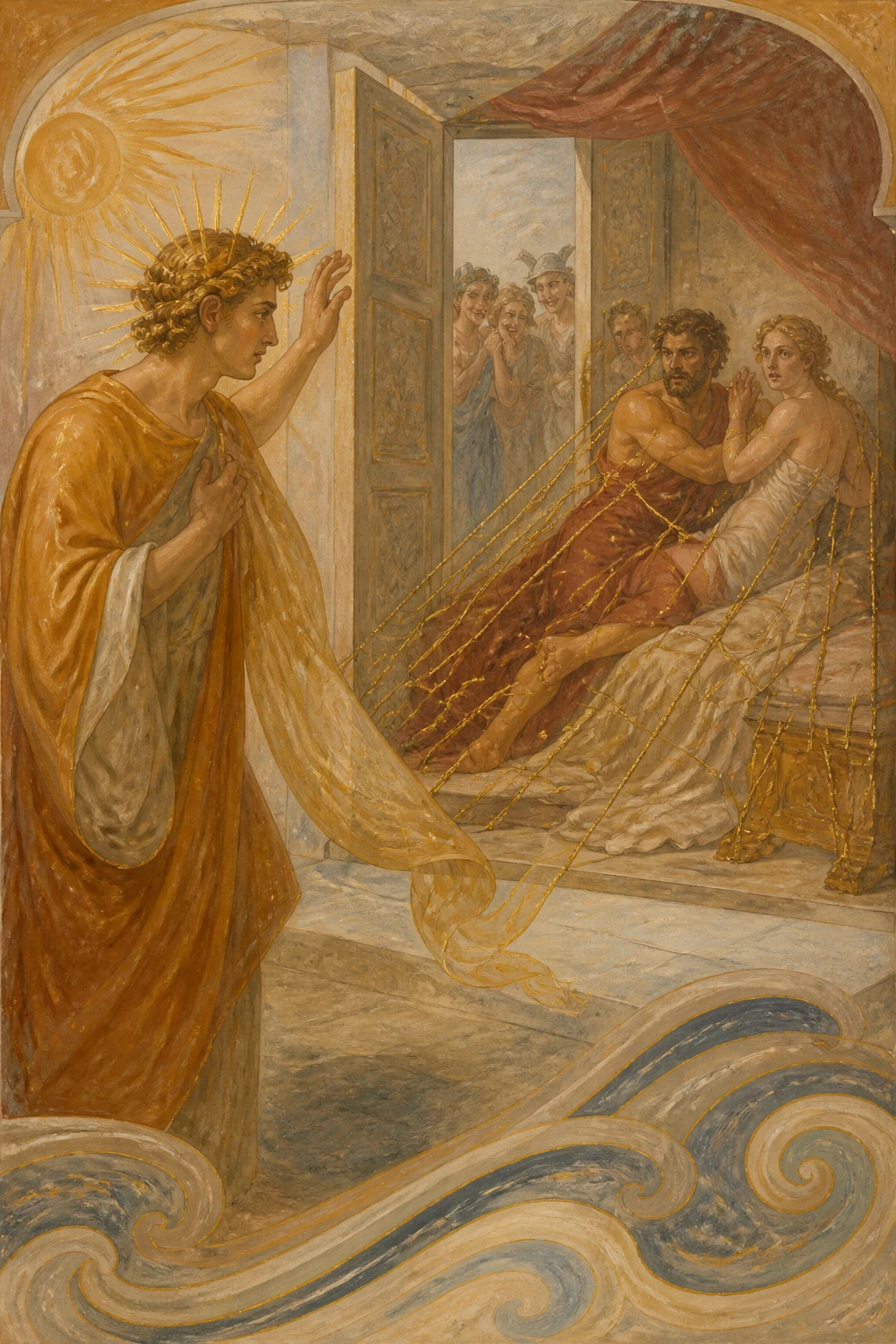
Do not flee from me!”—for she was fleeing. Already she had left the pastures of Lerna and the tree-planted fields of Lyrcea, when the god drew a veil of darkness over the broad earth, halted her flight, and robbed her of her chastity. Meanwhile Juno looked down upon the heart of the countryside and, wondering that drifting clouds had given it the look of night in the bright daylight, knew they had not risen from a river or been breathed out by the damp earth.
She looked about to see where her husband was, for she knew his secret affairs, having caught him so often before. When she could not find him in heaven, she said, “Either I am mistaken, or I am being wronged,” and, gliding down from the heights of heaven, stood upon the earth and ordered the clouds to withdraw. He had foreseen his wife's arrival and had changed the daughter of Inachus into a gleaming heifer.
Even as a cow she was lovely. Saturn's daughter, though unwillingly, praised her beauty, and asked whose she was, where she came from, and to what herd she belonged, as though she knew nothing. Jupiter lied that she had sprung from the earth, hoping to forestall further questions about her origin. Saturn's daughter asked for her as a gift. What could he do? To surrender his beloved was cruel; not to give her would arouse suspicion. Shame urged him one way, love held him back the other. Love would have conquered shame; but if he denied so small a gift as a cow to one who shared his lineage and his bed, she might seem no mere cow.
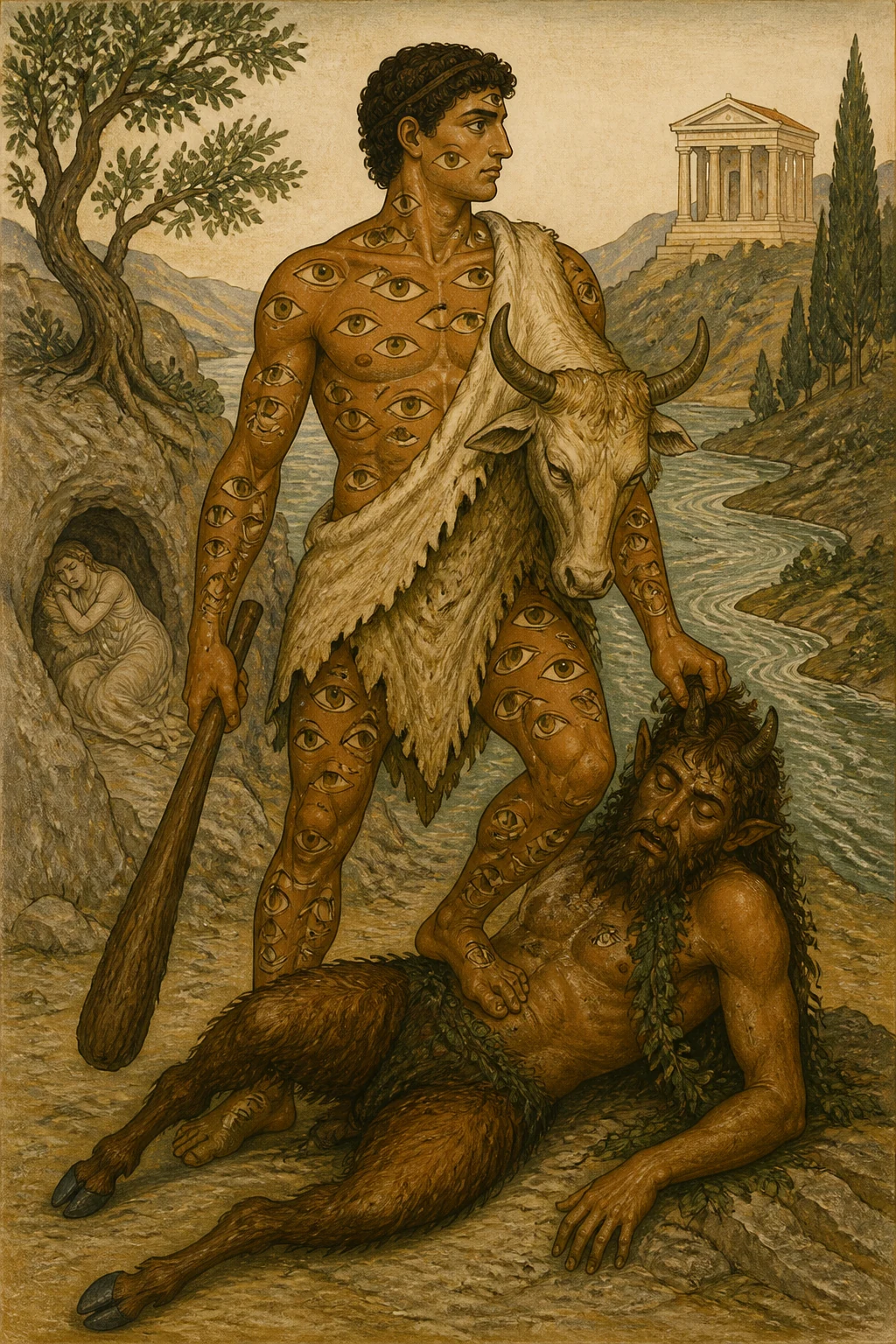
Even with her rival given to her, the goddess did not at once put aside all fear: she distrusted Jupiter and dreaded his deceit, until she entrusted the heifer to Argus, Arestor's son, to guard. Argus had a hundred eyes set all around his head: two at a time would take their turn at rest, while the others kept watch and remained at their posts. Whatever position he took, he could look at Io; even with his back turned, he kept Io in his sight.
By day he let her graze; when the sun sank beneath the earth, he shut her up and bound her neck with chains it did not deserve. She fed on the leaves of trees and bitter grass, and for her bed the unhappy creature lay upon the earth, not always grassy, and drank from muddy streams. Even when she wished to stretch her arms to Argus in supplication, she had no arms to stretch toward him; and when she tried to plead, a lowing came from her mouth.
She trembled at the sound, terrified by her own voice. She came, too, to the banks where she had often played, the banks of Inachus; and when she saw her unfamiliar horns reflected in the water, she recoiled in terror from herself. The Naiads did not know her, nor did Inachus himself know who she was; but she followed her father and her sisters, letting them touch her and offering herself to their admiring hands.
Old Inachus plucked some grass and held it out to her: she licked his hands and kissed her father's palms, unable to restrain her tears. If only words would come, she would beg for help and tell her name and her misfortune. Instead of speech, the letters her hoof traced in the dust revealed the sorrowful truth of her body's transformation. “Wretched man that I am!” her father Inachus cried, and, clinging to the horns and neck of the snow-white, moaning heifer, “Wretched man that I am!” he cried again. “Are you the daughter I sought through all the earth? When I could not find you, my grief was lighter than now that you are found. You are silent, and give no answering words to mine; you only draw deep sighs
from your breast and, all you can do, low in answer to my voice. Yet, knowing nothing, I was preparing your bridal chamber and wedding torches; my first hope was a son-in-law, my next, grandchildren. Now you must find a husband in the herd, and from the herd bear a son. Nor may I end such bitter sorrow through death: it is a curse to be a god; the door of death is barred, and stretches my grief through all eternity!”
As he mourned, star-eyed Argus thrust him aside, tore the daughter from her father, and dragged her away to distant pastures. He himself climbed a lofty mountain peak and sat there, keeping watch on every side. But heaven's ruler could no longer endure the sufferings of Phoroneus's descendant, and summoned the son whom the radiant Pleiad had borne him, commanding him to put Argus to death.
It took him little time to fasten wings to his feet, take his sleep-bringing wand in his powerful hand, and set his cap upon his hair. Once equipped, Jupiter's son leaped down from his father's citadel to earth. There he removed his cap and laid aside his wings, keeping only his wand. With it, like a shepherd, he drove goats through the lonely countryside, gathering them as he went, and played upon his pipe of reeds.
Charmed by the unfamiliar music, Juno's watchman said, “Whoever you are, you might sit here with me upon this rock. Nowhere is there richer grass for your flock, and you see how welcome the shade is for shepherds.” Atlas's grandson sat down and, talking of many things, held him in conversation as the day passed, and by playing his joined reeds tried to overcome those watchful eyes.
But Argus struggled to resist the soothing sleep, and though some of his eyes surrendered to slumber, others remained awake. He also asked how the pipe had been invented, for its invention was recent. Then the god said, “In the cold mountains of Arcadia, among the woodland nymphs of Nonacris, there was one Naiad more renowned than all the rest: the nymphs called her Syrinx.
More than once she had eluded pursuing satyrs and all the other gods who dwell in shady woods and fertile fields. She honored the goddess of Ortygia in her pursuits, and in her virginity itself. Dressed, too, like Diana, she might have deceived you and been taken for Latona's daughter, had her bow not been of horn, and the goddess's of gold. Even so, she deceived many. As she returned from Mount Lycaeus, Pan saw her, his head wreathed with sharp pine needles, and spoke these words”—it remained to tell what he said, and how the nymph, spurning his pleas, fled through the wilderness until she reached the quiet stream of sandy Ladon.
There, when the waters barred her flight, she begged her river-sisters to transform her; and Pan, just as he thought he had caught Syrinx, found marsh reeds in his arms instead of the nymph's body. As he sighed there, his breath stirring through the reeds made a thin sound, like a voice lamenting. Captivated by this new art and the sweetness of its music, the god said, “This, at least, shall remain my way of speaking with you!”
And so, joining reeds of unequal length with wax, he preserved the maiden's name. As he was about to tell all this, the Cyllenian saw that every eye had yielded, and all their lids were closed in sleep. At once he hushed his voice and deepened that slumber, stroking the drowsy eyes with his enchanted wand. Without delay he struck the nodding head with his curved blade where it joined the neck, hurled it bloodied from the rock, and stained the steep cliff with its blood.
Argus, you lie fallen; the light you held in all those eyes is quenched, and one night possesses all a hundred. Saturn's daughter gathered them and set them in the feathers of her own bird, filling its tail with starry jewels. At once she blazed with anger, allowing it no delay, and thrust a dreadful Fury before the eyes and into the mind of her Argive rival, buried unseen goads within her breast, and drove her fleeing in terror through the whole world.
You, Nile, remained the final stage of her boundless ordeal. As soon as she reached you, she sank to her knees at the river's edge and, arching her neck backward, raised her face, all she could raise, toward the stars. With groans and tears and mournful lowing, she seemed to plead with Jupiter and beg an end to her suffering. He clasped his arms about his wife's neck and begged her at last to end the punishment. “Put aside your fears for the future,” he said. “She will never again cause you grief.” And he called the Stygian waters to witness.
When the goddess was appeased, Io regained her former features and became what she had been: the hair fled from her body, her horns dwindled, her great round eyes grew smaller, her broad mouth narrowed, her shoulders and hands returned, and her hooves vanished, dividing into five nails apiece. Nothing of the heifer's form remained in her except its whiteness. Content now with the service of two feet, the nymph stood upright, yet feared to speak, lest she low like a heifer, and timidly tried the words so long unused.