Prevod
Phoebus’s first love was Daphne, daughter of Peneus, a love bestowed not by blind chance, but by Cupid’s savage anger. The Delian god, proud of his recent conquest of the serpent, had seen Cupid bending his bow by drawing back the string. “What have you to do with warriors’ weapons, wanton boy?” he had said. “Such burdens suit my shoulders, for I can deal sure wounds to beasts and enemies alike, and lately brought down swollen Python, whose deadly belly covered so many acres, with countless arrows.
Be content to kindle whatever loves you will with your torch, and do not lay claim to my glory.” Venus’s son replied, “Your bow may pierce all things, Phoebus, but mine shall pierce you. As all living creatures yield to a god, so much does your glory fall below mine.” He spoke, and beating the air with his wings, swiftly alighted on the shady summit of Parnassus. From his arrow-bearing quiver he drew two shafts with opposite powers: one banishes love, the other kindles it.
The one that kindles love is golden, with a gleaming, sharpened point; the one that banishes it is blunt, with lead beneath its shaft. This one the god lodged in the nymph, Peneus’s daughter; with the other he pierced Apollo through the bones to the marrow. At once he loves; she shuns the very name of lover, delighting in the forest’s shadows and the skins of captured beasts, emulating the unmarried Phoebe.
A ribbon bound her loosely flowing hair. Many sought her hand, but she rejected all her suitors; unwilling to endure or know a man, she roamed the pathless woods, caring nothing for Hymen, or Love, or what marriage might be. Often her father said, “Daughter, you owe me a son-in-law.” Often her father said, “My child, you owe me grandchildren.” But she, loathing the marriage torch as though it were a crime, would flush with a modest blush across her lovely face, and, clinging with coaxing arms about her father’s neck, say, “Dearest father, let me enjoy perpetual virginity. Diana’s father granted her this before.”
He indeed consents; but that beauty of yours forbids you to be what you desire. Your loveliness resists your prayer. Phoebus loves Daphne at first sight and longs to marry her; he hopes for what he longs for, deceived by his own prophetic powers. As light stubble burns when the ears of grain are gathered, as hedges catch fire from torches that a passing traveler has chanced to hold too close, or left behind at daybreak, so the god went up in flames; so all his heart burns, and with hope he feeds a fruitless love.
He sees her unadorned hair hanging down her neck and says, “What if it were arranged?” He sees her eyes flashing with fire like stars; he sees her lips, which merely seeing cannot satisfy. He praises her fingers, hands, and arms, bare more than halfway to the shoulder. Whatever lies hidden he imagines lovelier still. She flees swifter than the light breeze, nor stops at his words calling her back: “Nymph, daughter of Peneus, stay, I beg you! I am no enemy pursuing you.
Nymph, stay! So a lamb flees a wolf, a deer a lion, so doves flee an eagle on fluttering wings, each fleeing its own enemy. Love is my reason for pursuing you. Ah, wretched me! Take care you do not fall headlong, or brambles scratch your legs, too fair to suffer, and I cause you pain. The ground you hurry over is rough. Run more slowly, I beg you; check your flight, and I too will follow more slowly.
At least ask who it is you please. I am no mountain dweller, no shepherd, no shaggy herdsman watching over cattle and flocks here. Rash girl, you do not know, you do not know whom you flee, and that is why you flee. The land of Delphi, Claros, Tenedos, and the royal city of Patara serve me. Jupiter is my father. Through me, what shall be, what has been, and what is are revealed; through me, songs accord with strings.
My arrow is sure, yet one arrow is surer than mine: the one that wounded my heart, till then untouched. Medicine is my invention; throughout the world I am called the bringer of aid, and the power of healing herbs is subject to me. Alas, no herb can cure love, and the arts that help all others cannot help their master.” He would have said more, but Peneus’s daughter fled in frightened haste, leaving him and his unfinished words behind, lovely even then. The winds laid bare her body, the opposing gusts fluttered her garments against her, and the light breeze swept her streaming hair behind her; flight only heightened her beauty. But the youthful god can no longer bear
to waste his coaxing words, and, urged on by Love himself, follows her at full speed. As when a Gallic hound has seen a hare in an open field, and one runs for its prey, the other for its life: the hound seems about to fasten on it, hopes at every moment to seize it, and grazes its heels with outstretched muzzle; the hare, unsure whether it is already caught, snatches itself from the very jaws and escapes the mouth that brushes it: so raced the god and maiden, he swift with hope, she with fear.
Yet the pursuer, aided by the wings of Love, is faster, allows her no rest, and looms over her fleeing back, his breath upon the hair scattered across her neck. Her strength exhausted, she grew pale, and, overcome by the effort of her headlong flight, looked toward Peneus’s waters. “Help me, Father!” she cried. “If you rivers have divine power, Earth, either gape to swallow me, whose beauty pleased too well, or else destroy by changing it this form that brings me harm.
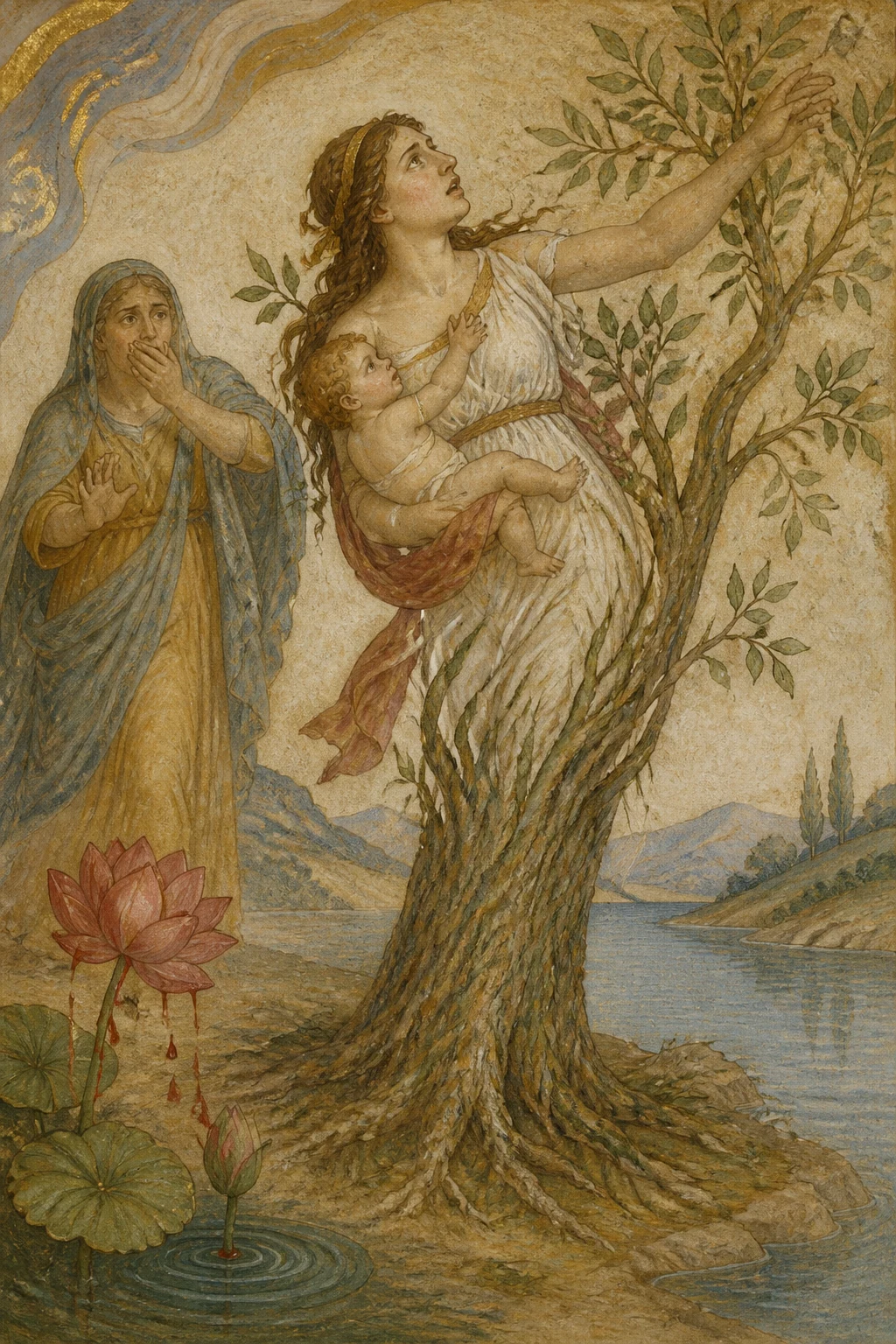
Destroy by changing it this form that pleased too well!” Scarcely had her prayer ended when a heavy numbness seized her limbs. Her soft breast was enclosed in a thin layer of bark; her hair grew into leaves, her arms into branches; her feet, so swift a moment before, clung fast in sluggish roots; her face became the treetop. Only her radiance remained. Even so, Phoebus loves her. Laying his right hand on the trunk, he feels her heart still trembling beneath the new bark, and, clasping the branches in his arms as though they were her limbs, he kisses the wood; yet the wood shrinks from his kisses.
The god said to her, “Since you cannot be my bride, you shall at least be my tree. Always you shall adorn my hair, my lyre, my quiver, O laurel. You shall attend the leaders of Latium when joyful voices sing their triumph and the Capitol beholds their long processions. You too shall stand before Augustus’s doors, a most faithful guardian of his doorway, and keep watch over the oak between them.
And as my head is ever youthful, its hair unshorn, so you too shall wear forever the glory of undying leaves.” Paean had finished. The laurel nodded with its newly fashioned branches and seemed to bow its crown as though it were a head.