Waltey
Mars, Venera, Levkotoa in Klitija
Ovidove preobrazbe · OvidO besedilu
Mars, Venera, Levkotoa in Klitija
- Vir
- Ovidove preobrazbe
- Avtor
- Ovid
- Jezik branja
- English
- Jezik izvirnika
- Latin
- Čas branja
- 6 min branja
- Obseg
- 5 strani
- Naslov izvirnika
- Mars, Venus, Leucothoe, and Clytie
O izvirniku
Ovidove preobrazbe
Pesniški tok antičnih preobrazb, kjer bogovi, ljudje in narava stalno menjavajo obliko. Bralni jezik je English, izvirnik pa prihaja iz vira Ovidove preobrazbe v jeziku Latin.
Besedilo
Mars, Venera, Levkotoa in Klitija
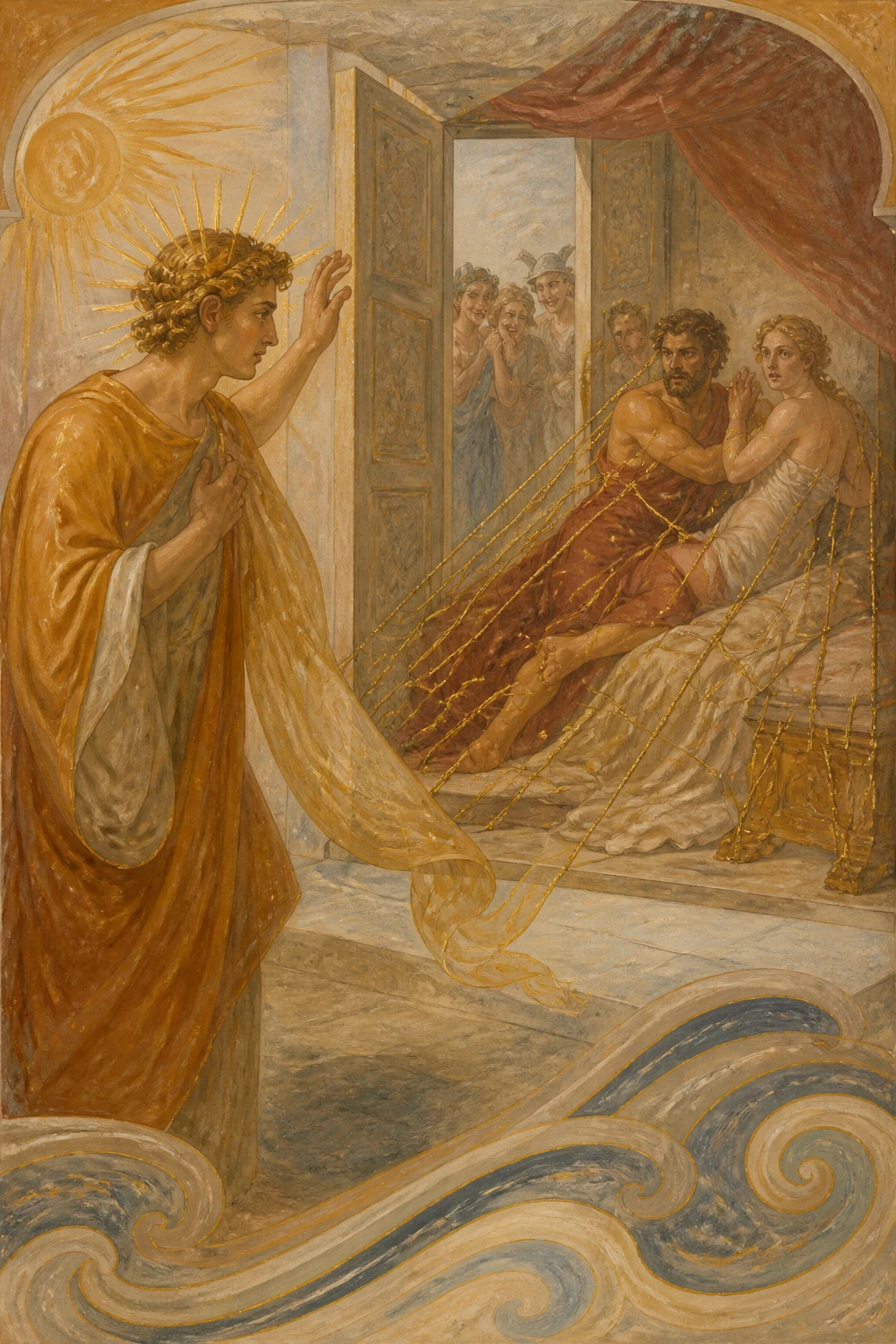
She had finished; after a brief interval, Leuconoe began to speak, and her sisters fell silent. “Love also captured the Sun, who governs all things with his heavenly light: I shall tell of the Sun’s loves. This god, they say, was the first to see Venus committing adultery with Mars: this god sees everything first. Grieved by the deed, he showed her husband, Juno’s son, their stolen pleasures and the place where they met. At this, both his wits and the work his craftsman’s hand was holding deserted him. At once he filed slender chains of bronze, nets and snares so fine they could escape the eye (not the finest threads could surpass that workmanship,
nor the spider’s web that hangs from the highest beam), and made them respond to the lightest touch, the slightest movement, then deftly arranged them around the bed. When his wife and her lover came together in that bed, her husband’s cunning and his newly devised bonds caught them both and held them fast in mid-embrace. At once the god of Lemnos flung open the ivory doors and let the gods inside. There the lovers lay, bound in shame; and one of the merrier gods wished to suffer such disgrace himself. The gods laughed, and long this was the best-known tale in all of heaven.
The Cytherean goddess, remembering his betrayal, exacted revenge: in his turn, the one who had exposed her secret love she wounded with a love like her own. What use now, son of Hyperion, are your beauty, your bright complexion, your radiant eyes? You, who scorch all lands with your fires, are scorched by a new fire; you, who ought to behold all things, gaze only at Leucothoe, fixing upon one maiden the eyes you owe the world. Now you rise in the eastern sky too early, now you sink too late beneath the waves, and linger over your gazing, stretching out the winter hours.
Sometimes your light fails, and the sickness of your mind passes into your beams: darkened, you terrify mortal hearts. Nor do you grow pale because the moon, nearer the earth, has come between you and us: love gives you that pallor. Her alone you love; neither Clymene nor Rhodos holds you now, nor the lovely mother of Circe of Aeaea, nor Clytie, who, though scorned, still sought your embrace and even then bore a grievous wound of love. Leucothoe made you forget them all: she was born to Eurynome, the loveliest woman of the incense-bearing land. But once the daughter grew, she surpassed her mother as her mother surpassed all others.
Her father, Orchamus, ruled the Achaemenian cities, and was reckoned seventh in descent from ancient Belus. Beneath the western sky lie the pastures of the Sun’s horses. They feed on ambrosia instead of grass: it nourishes limbs wearied by their daily service and restores them for their toil. While the horses there graze on their heavenly food, and Night takes her turn, the god enters his beloved’s chamber, disguised as her mother, Eurynome, and sees Leucothoe among twelve maidservants, by lamplight, drawing out fine threads from her twirling spindle.
Then, after kissing the dear girl as a mother would, he said, ‘This is a private matter. Servants, leave us, and allow a mother the freedom to speak in confidence.’ They obeyed, and the god, left in the chamber without witnesses, said, ‘I am he who measures out the long year, who sees all things, through whom the earth sees all things, the eye of the world. Believe me, you have won my heart.’ She trembled, and in her fear the distaff and spindle fell from her loosened fingers.
Even her terror became her. He delayed no longer, but returned to his true form and his accustomed splendour. The maiden, though frightened by the unexpected sight, was overcome by the god’s radiance and, ceasing to protest, endured his force. Clytie grew jealous—for her love of the Sun had been immoderate—and, spurred by anger at her rival, spread word of the affair, then told her father of the scandal. Fierce and merciless, though she pleaded and stretched her hands towards the Sun’s light, crying, ‘He took me by force, against my will,’ her father cruelly buried her deep in the earth and heaped a heavy mound of sand above her.
Hyperion’s son scattered it with his rays and opened a path for you to lift your buried face towards the light. But you could no longer raise your head, poor nymph, crushed to death beneath the earth’s weight: you lay a lifeless body. They say the ruler of the winged horses had seen nothing more sorrowful since the fires that Phaethon kindled. He tried, indeed, with the power of his rays, to bring the warmth of life back to her cold limbs.
But since fate resisted even those mighty efforts, he sprinkled her body and the ground with fragrant nectar, and, after long lamenting, said, ‘Still, you shall reach the heavens.’ At once her body, steeped in heavenly nectar, dissolved and drenched the earth with its fragrance. Slowly, sending roots through the clods, a shoot of frankincense rose and pierced the mound with its tip.
But Clytie—though love might excuse her grief, and grief her betrayal—the giver of light visited no more, and ended his lovemaking with her. From then on the nymph, driven mad by love, wasted away. Unable to bear her home, she sat beneath the open sky, night and day, on the bare earth, naked, her loosened hair unkempt. For nine days, without food or water, she sustained her fast on dew alone and her own tears, never stirring from the ground, only watching the face of the passing god and turning her own towards him.
Her limbs, they say, took root in the soil, and a sickly pallor changed part of her bloodless flesh to leaves. Another part was red: a flower much like a violet covered her face. Though held fast by roots, she turns towards her Sun, and, changed, still keeps her love.”
Izvirnik
Mars, Venus, Leucothoe, and Clytie
Naslednje strani prikazujejo izvirno besedilo za primerjavo.
Source ID: ovid_metamorphoses_story_026 Citation: Ovid, Metamorphoses 4.167-4.270 Original language: Latin Source: PerseusDL canonical-latinLit Source URL: https://github.com/PerseusDL/canonical-latinLit/blob/master/data/phi0959/phi006/phi0959.phi006.perseus-lat2.xml Segmentation certainty: medium 167: Desierat, mediumque fuit breve tempus, et orsa est 168: dicere Leuconoe: vocem tenuere sorores.
169: “Hunc quoque, siderea qui temperat omnia luce, 170: cepit amor Solem: Solis referemus amores. 171: Primus adulterium Veneris cum Marte putatur 172: hic vidisse deus: videt hic deus omnia primus. 173: Indoluit facto, Iunonigenaeque marito 174: furta tori furtique locum monstravit. At illi 175: et mens et quod opus fabrilis dextra tenebat 176: excidit. Extemplo graciles ex aere catenas 177: retiaque et laqueos, quae lumina fallere possent, 178: elimat (non illud opus tenuissima vincant 179: stamina, non summo quae pendet aranea tigno), 180: utque leves tactus momentaque parva sequantur
181: efficit et lecto circumdata collocat arte. 182: Ut venere torum coniunx et adulter in unum, 183: arte viri vinclisque nova ratione paratis 184: in mediis ambo deprensi amplexibus haerent. 185: Lemnius extemplo valvas patefecit eburnas 186: admisitque deos: illi iacuere ligati 187: turpiter; atque aliquis de dis non tristibus optat 188: sic fieri turpis: superi risere, diuque 189: haec fuit in toto notissima fabula caelo.
190: Exigit indicii memorem Cythereia poenam, 191: inque vices illum, tectos qui laesit amores, 192: laedit amore pari. Quid nunc, Hyperione nate, 193: forma colorque tibi radiataque lumina prosunt? 194: Nempe tuis omnes qui terras ignibus uris, 195: ureris igne novo; quique omnia cernere debes, 196: Leucothoen spectas, et virgine figis in una, 197: quos mundo debes oculos. Modo surgis Eoo 198: temperius caelo, modo serius incidis undis, 199: spectandique mora brumales porrigis horas, 200: deficis interdum, vitiumque in lumina mentis 201: transit et obscurus mortalia pectora terres.
202: Nec, tibi quod lunae terris propioris imago 203: obstiterit, palles: facit hunc amor iste colorem. 204: Diligis hanc unam; nec te Clymeneque Rhodosque 205: nec tenet Aeaeae genetrix pulcherrima Circes, 206: quaeque tuos Clytie quamvis despecta petebat 207: concubitus ipsoque illo grave vulnus habebat 208: tempore: Leucothoe multarum oblivia fecit, 209: gentis odoriferae quam formosissima partu 210: edidit Eurynome. Sed postquam filia crevit, 211: quam mater cunctas, tam matrem filia vicit.
212: Rexit Achaemenias urbes pater Orchamus, isque 213: septimus a prisco numeratur origine Belo. 214: Axe sub Hesperio sunt pascua Solis equorum. 215: Ambrosiam pro gramine habent: ea fessa diurnis 216: membra ministeriis nutrit reparatque labori. 217: Dumque ibi quadrupedes caelestia pabula carpunt, 218: noxque vicem peragit, thalamos deus intrat amatos, 219: versus in Eurynomes faciem genetricis, et inter 220: bis sex Leucothoen famulas ad lumina cernit 221: levia versato ducentem stamina fuso.
222: Ergo ubi ceu mater carae dedit oscula natae, 223: “res” ait “arcana est. Famulae, discedite neve 224: eripite arbitrium matri secreta loquendi.” 225: Paruerant: thalamoque deus sine teste relicto 226: “ille ego sum” dixit, “qui longum metior annum, 227: omnia qui video, per quem videt omnia tellus, 228: mundi oculus. Mihi, crede, places.” Pavet illa, metuque 229: et colus et fusus digitis cecidere remissis.
230: Ipse timor decuit. Nec longius ille moratus 231: in veram rediit speciem solitumque nitorem: 232: at virgo, quamvis inopino territa visu, 233: victa nitore dei posita vim passa querella est. 234: Invidit Clytie (neque enim moderatus in illa 235: Solis amor fuerat), stimulataque paelicis ira 236: vulgat adulterium diffamatumque parenti 237: indicat. Ille ferox inmansuetusque precantem 238: tendentemque manus ad lumina Solis et “ille 239: vim tulit invitae” dicentem defodit alta 240: crudus humo, tumulumque super gravis addit harenae.
241: Dissipat hunc radiis Hyperione natus iterque 242: dat tibi, qua possis defossos promere vultus. 243: Nec tu iam poteras enectum pondere terrae 244: tollere, nympha, caput corpusque exsangue iacebas. 245: Nil illo fertur volucrum moderator equorum 246: post Phaethonteos vidisse dolentius ignes. 247: Ille quidem gelidos radiorum viribus artus 248: si queat in vivum temptat revocare calorem: 249: sed quoniam tantis fatum conatibus obstat, 250: nectare odorato sparsit corpusque locumque, 251: multaque praequestus “tanges tamen aethera” dixit.
252: Protinus inbutum caelesti nectare corpus 253: dilicuit terramque suo madefecit odore: 254: virgaque per glaebas sensim radicibus actis 255: turea surrexit tumulumque cacumine rupit. 256: At Clytien, quamvis amor excusare dolorem, 257: indiciumque dolor poterat, non amplius auctor 258: lucis adit venerisque modum sibi fecit in illa. 259: Tabuit ex illo dementer amoribus usa 260: nympha larum inpatiens, et sub Iove nocte dieque 261: sedit humo nuda, nudis incompta capillis, 262: perque novem luces expers undaeque cibique 263: rore mero lacrimisque suis ieiunia pavit
264: nec se movit humo: tantum spectabat euntis 265: ora dei vultusque suos flectebat ad illum. 266: Membra ferunt haesisse solo, partemque coloris 267: luridus exsangues pallor convertit in herbas; 268: est in parte rubor, violaeque simillimus ora 269: flos tegit. Illa suum, quamvis radice tenetur, 270: vertitur ad Solem, mutataque servat amorem.”
Nadaljuj z branjem