Waltey
Imenitni mladi podganec in past
014 THE FINE YOUNG RAT AND THE TRAP
Živalske zgodbe Clare Dillingham Pierson · Clara Dillingham PiersonO besedilu
Imenitni mladi podganec in past
- Vir
- Živalske zgodbe Clare Dillingham Pierson
- Avtor
- Clara Dillingham Pierson
- Jezik branja
- Slovenščina
- Jezik izvirnika
- English
- Čas branja
- 11 min branja
- Obseg
- 9 strani
- Naslov izvirnika
- 014 THE FINE YOUNG RAT AND THE TRAP
O izvirniku
Živalske zgodbe Clare Dillingham Pierson
Devetindevetdeset avtorskih zgodb o živalih na kmetiji, travniku, v gozdu, ob ribniku in ponoči. Bralni jezik je Slovenščina, izvirnik pa prihaja iz vira Živalske zgodbe Clare Dillingham Pierson v jeziku English.
Besedilo
Imenitni mladi podganec in past
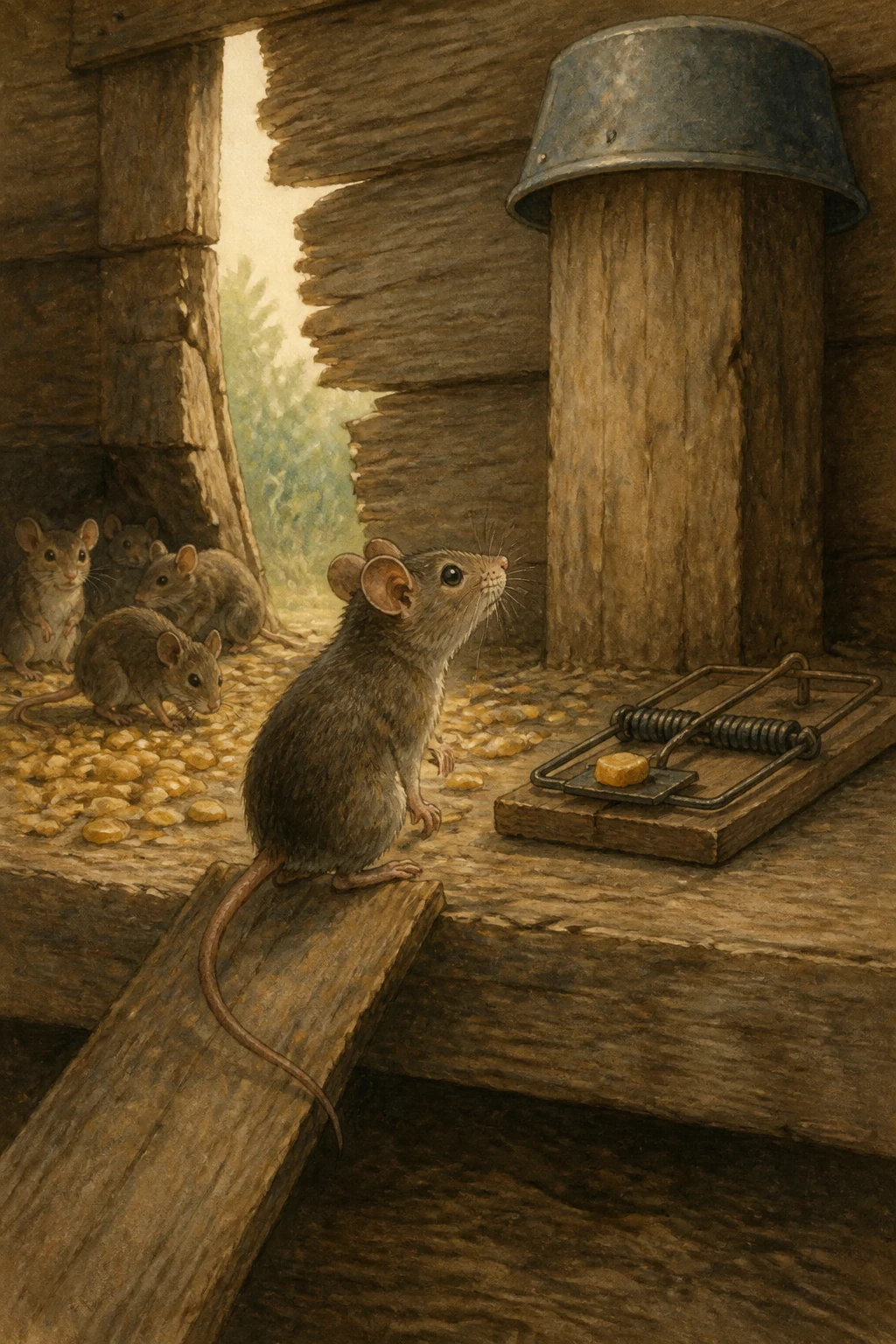
Miši so se imenitno zabavale v koruznjaku. Kmetov hlapec je ob njem malomarno pustil naslonjeno desko, po kateri so se lahko povzpele in skozi eno od velikih špranj v steni smuknile noter. Nekatere med njimi so bile tu sploh prvič. Ko je kmet postavljal koruznjak, je na vrh vsakega lesenega stebra poveznil pločevinasto posodo z odprtino navzdol, nato pa skoznje pribil talne tramove. Tako je lačnim Mišim preprečil, da bi prišle do koruze.
To je bil zanje velik dan in njihovi sekalci se bodo prav gotovo dovolj obrusili, ne da bi jih morale še kako drugače obrabljati. Veste, na to morajo vse Podgane in Miši zelo paziti, saj jim sprednji zobje ves čas rastejo, zato morajo vsak dan glodati trde stvari, da jim ne zrastejo predolgi.
Te Miši je zares skrbela samo ena stvar, in sicer Mačka. Jastrebov in Sov se niso bale, ker so živele v zaprtih prostorih. Podlasice niso pogosto prihajale do skednja, ljudje pa so, kadar so bili v bližini, povzročali toliko hrupa, da se jim je vsaka budna Miš zlahka umaknila s poti. Z Mačko je bilo drugače. Ponoči je nenehno prežala naokrog, prav takrat, ko so imele najlepše zabave; in marsikatero mlado Miš je od polnočne večerje pregnal pogled na njene oči, ki so se v temi svetile kakor ognjene krogle. Podnevi ni bilo tako hudo, saj so jo lahko videle prihajati, poleg tega pa je takrat večino časa spala.
Tudi v koruznjaku so se pogovarjale o njej. »Je katera od vas danes videla Mačko?« je vprašal Najstarejši mišek. Nihče ni odgovoril. Potem pa je neki mladi mišek, ki ga je zmeraj kaj skrbelo, dejal: »Kaj pa, če bi zdaj prišla iz skednja! Kaj pa, če bi se napotila naravnost proti koruznjaku! Kaj pa, če bi se postavila tik pod tla! Kaj pa, če bi nas ujela, ko bi skočili dol! Kaj pa, če—«
Toda tedaj so mu vse druge mlade Miši zacvilile, naj neha, ena med njimi pa je izjavila, da se ji ob sami misli na to dlaka postavlja pokonci. Najstarejši mišek je spregovoril precej ostro. »Kaj pa, če bi ti,« je rekel prvemu mlademu mišku, »več jedel in manj govoril? Dovolj prijetnih reči je, o katerih se lahko pogovarjamo, ne da bi takole strašil vse svoje prijatelje.«
Mlada Miš, ki je rekla, da se ji dlaka postavlja pokonci, ni mogla pojesti ničesar več, tako je bila prestrašena. »Kaj bi lahko storili,« je vprašala, »če bi prišla Mačka?«
»Ostali bi prav tam, kjer smo,« je odgovorila njena mama. »Pri zaprtih vratih nas ne bi mogla doseči. Zdaj pa jej naprej in ne bodi neumna.«
Po deski je pritekel Podganček. »Dobro jutro,« je rekel. »Ste slišali novico?« »Ne, ne!« so vzkliknile Miši, pohitele na tisto stran koruznjaka in pokukale skozi špranjo.
»Rumena mucka je bila z mamo na lovu in pravijo, da gre njen brat nocoj.« »No,« je rekla neka mišja mama, »vedela sem, da moramo to pričakovati, vendar sem upala, da bosta še malo počakala. Zdaj pa, otroci,« je dodala, »le pazite nase! Vem, da morate med iskanjem hrane zahajati tudi na nevarne kraje, toda nikar se tam ne ustavljajte, da bi klepetali ali si čistili kožuščke. Za to si poiščite varne kotičke, sicer me bo ves čas skrbelo za vas.«
»Bomo,« so vse male Miši zacvilile v en glas. »Zelo, zelo bomo previdne.« »Hvala za novico,« je Najstarejši mišek rekel Podgančku. »Tudi mi ti bomo skušali sporočiti, kadar bomo izvedeli za kakšno novo nevarnost.«
Podganček, ki je bil postaven mladenič, je stekel po deski navzdol in odšel. Niso ga mogle povabiti na kosilo, saj je bil prevelik in preveč čokat, da bi se stlačil skozi špranje, vendar je razumel, kako je s tem, in vedel, da si lahko hrano poišče drugje. Zdaj je stekel k svinjaku, da bi si prilastil del zajtrka, ki ga je kmet pravkar pustil tam. Pogosto je to storil takoj, ko je kmet odšel, in Prašiči ga niso nikoli nadlegovali. Morda zato, ker so vedeli, da bo, če ga preženejo, ko pride sam, naslednjič pripeljal vse svoje sestre, sestrične in tete, pa tudi brate, bratrance in strice, in da bodo pojedli prav vse, kar imajo.
Ko se je dodobra najedel zajtrka, je stekel pod rob skednja, da bi se očistil. Pri tem je bil vedno zelo natančen. Mama ga je že čisto majhnega naučila, da mora imeti kožušček lepo skrtačen in obraz umit, in to je počel prav kakor Mačka: zmočil si je tačke ter si zdrgnil obraz in vrh glave. S tačkami si je skrtačil tudi kožušček.
Medtem ko je bil tam, je iz skednja nad njim prišla ena njegovih sestričen. Po notranji strani stene je stekla z glavo navzdol, zadnje tačke pa je zasukala tako, da so bile obrnjene nazaj. Tako se je lahko oprijemala z dolgimi, ostrimi kremplji, prav kakor Veverica, in ni padla. Ko je prišla do tal, je bila vsa zasopla, vendar ne od teka.
»Kaj misliš, kaj je kmet zdaj spet naredil?« je vzkliknila. »Že to je bilo dovolj hudo, da je s pločevino zabil luknje, ki smo jih preglodale v njegove žitne zaboje, ampak tole je še hujše. Saj nam ni treba, da bi nam povzročalo toliko težav, vendar me je prizadelo.«
»Kaj pa je?« jo je vprašal bratranec. »Past!« je rekla. »Grozna, bleščeča past. Podganček z druge kmetije mi je povedal zanjo. Odprta in ploska leži na dnu žitnega zaboja — prav tistega, v katerega sva sinoči preglodala luknjo — in na sredini je čudovit košček sira. Podganček, ki mi je povedal zanjo, pravi, da se past sproži in stisne vsakogar, ki se dotakne sira.«
»Pha!« je vzkliknil mladi Podganček, ki je pravkar zajtrkoval v svinjaku. »Pa naj leži tam! Saj se nam je ni treba dotikati, čeprav si jo bom nekoč že ogledal. Mislim, da je dobro poznati stvari.«
»Raje bi videla, da si je ne bi ogledoval,« je rekla sestrična, ki ga je imela zelo rada. »Podganček z druge kmetije pravi, da je pasti zelo nevarno že samo gledati, posebno če imaš prazen želodec.«
»Potem bo za Podgančka z druge kmetije najbolje, da se jim ne približuje,« je rekel mladenič in dvignil tačko, da bi preveril, ali so mu brčice lepo urejene. »Tako ali tako nimam prav dobrega mnenja o njem. Misli, da ve vse, ker je potoval. Želim si, da ne bi imela ničesar opraviti z njim. Stavim, da si bila z njim v žitnem zaboju, ko si videla past.«
»Da,« je rekla, »bila sem.« »No,« je odvrnil, »oba sta jo varno odnesla in tudi jaz jo bom. Morda nisem posebno bister, vendar mislim, da imam dovolj pameti, da se ne pustim ujeti v past.« Nato je zavil v svojo luknjo in zaspal. Vso noč je tekal naokrog in bil je zelo utrujen. Pa tudi nejevoljen. Sestrična mu je že drugič pripovedovala, kaj je rekel Podganček z druge kmetije, in zdelo se mu je, da ji je ta vse preveč všeč.
Ko se je zbudil, je bila spet noč; prebudilo ga je topotanje Lisastega sivca po tleh nad njegovo glavo. Nekaj trenutkov se skoraj ni mogel spomniti, kje je. Potem mu je bilo vse jasno. Bil je v svoji prijetni luknjici pod skednjem in bila je noč. Spomnil se je nečesa v zvezi z Rumeno mucko. Kaj je že bilo? Aha, začela je loviti. No, nje se še ni bal. Toda tu je bilo še nekaj — past! Spraševal se je, ali je sestrična spet v tistem zaboju. Prav lahko, da ji njen prijatelj, Podganček z druge kmetije, ravno zdaj razkazuje past. Tudi sam bo šel tja, in to takoj.
Stekel je po steni navzgor, skozi odprtino in čez skedenj do žitnega zaboja. Noč je bila mesečna in v skednju ni bilo prav temno. Pokrov zaboja je bil dvignjen. Morda ga je kmetov hlapec pozabil zapreti. Morda pa je v njem ostalo tako malo žita, da se mu ga ni zdelo vredno zapirati. Kakor koli že, zdaj je past lahko povsem razločno videl. V zaboju ni bilo nikogar drugega in stopil je čisto blizu nje.
»Za nič na svetu se je ne bi dotaknil,« je rekel, ko je vstopil v zaboj, »vendar mi ne more škoditi, če si jo ogledam.« Ko se je približal, je skrbno pazil, da se z repom ni niti oplazil ob verigo, s katero je bila past pritrjena. »Torej je to tista strašna, nevarna past?« je rekel. »Ni videti posebno grozljiva. Tale sir pa res lepo diši.« Dvakrat ali trikrat je povohal. »V vsem življenju sem sir okusil samo enkrat,« je rekel, »zdaj pa skoraj umiram od lakote. Prav rad bi ga malo pogrizljal.« Gledal ga je in premišljeval o njem, dokler se mu ni zazdelo, da ne more kar oditi in pustiti sira tam.
Potem je pomislil: »Če zelo previdno stopim čez te bleščeče jeklene reči in tačke postavljam samo na dno zaboja, se past ne more sprožiti. Potem bom zgrabil sir in skočil … Skoraj prepričan sem, da mi bo uspelo … Saj res, vem, da mi bo.« In tako je Podganček, ki je prišel samo pogledat past, začel dvigovati najprej eno tačko in nato drugo čez bleščeče ukrivljene palice ter se pripravil, da bo pograbil sir in zbežal.
»Zdaj!« je vzkliknil. »Ena, dve, tri!« Res ga je pograbil in skočil, toda tudi past je skočila, po svoje, kakor pač znajo pasti, in Podganček, ki je dobil sir, je zanj plačal z zadnjimi tremi obročki svojega repa. »Au!« je zavpil. »Moj rep! Moj rep! Moj lepi, dolgi, koščeni rep, ves prekrit z luskami in kratkimi dlačicami!« Zdaj mu za sir ni bilo več prav nič mar. Še videti ga ni hotel, saj bi veliko raje spet imel konico repa, kakor pojedel cel zaboj sira.
»Kakšen bo zdaj videti!« je rekel. »Tako štrcljast in top. Pa vedno mi je tako dobro služil. Lahko sem ga ovil okoli palice, da sem se obdržal pokonci, kadar sem imel polne tačke, in velikokrat sem z njim zakotalil jajca po tleh, tako da sem ga ovil okoli njih.« Nato je zaslišal podganje glasove ter jo urno ucvrl iz zaboja in navzdol v svojo luknjo.
V zaboj sta prišla njegova sestrična in Podganček z druge kmetije. »Ne glej pasti,« ji je govoril, »ampak jej žito iz bolj oddaljenega kota.«
»Ne bom,« je odgovorila in napol zaprla oči, da je ne bi videla. Bil je ob njej in spotaknila sta se ob sir, ki je zdaj ležal na dnu zaboja, stran od pasti. »Kako pa se je to zgodilo?« je rekel. »Najprej ga pojejva, potem pa ugotoviva.« S tem nasvetom je pokazal, da je Podganček z veliko zdrave pameti.
Ko sta ga pojedla, sta začela pogledovati proti pasti. Ker v njej ni bilo več sira, ki bi ju mamljivo vabil, sta se pri tem počutila povsem varna. Ugotovila sta, da se je past sprožila, in v njej so ležali zadnji trije obročki nekega podganjega repa.
»Kako grozno!« je vzkliknila. »Upam, da jih ni izgubil kateri od najinih prijateljev.« »Hm, hm!« je rekel Podganček z druge kmetije. »Koga sem že videl s takim repom? Ta rep sem zagotovo že videl — tvoj bratranec je bil!«
»Ubožec!« je rekla. »Moram ga obiskati.« »Oh, ne hodi zdaj,« je vzkliknil Podganček z druge kmetije. »Mislim, da bi bil morda rad nekaj časa sam. Poleg tega,« je prijazno dodal, da bi jo pregovoril, »še nisi poskusila žita, pa je zelo dobro.«
»N-no,« je odgovorila, »morda bi bil bratranec res bolj zadovoljen, če zdaj ne bi prišla.« Tako je ostala, Podganček z druge kmetije pa ji je pripovedoval čudovite zgodbe o svojih potovanjih in imela sta imenitno večerjo.
Ko je njen bratranec spet začel tekati naokrog, je bil precej bolj žalosten in moder Podganček. Včasih so ga mlajše Podgane vprašale, kako je izgubil konico repa. »Ker ga nisem obrnil proti mamljivi nevarnosti,« je odgovarjal zelo resno. Potem ko jim je povedal zgodbo, je vselej dodal: »Mamljivi nevarnosti moraš obrniti rep takoj, ko jo zagledaš. Če namreč čakaš in gledaš ter hrepeniš po nečem, česar ne bi smel vzeti, se bo gotovo zgodilo kaj hudega, in marsikatera Podgana je prav tako izgubila še veliko več kakor konico repa.«
Izvirnik
014 THE FINE YOUNG RAT AND THE TRAP
Naslednje strani prikazujejo izvirno besedilo za primerjavo.
The Mice were having a great frolic in the corn-crib. The farmer's man had carelessly left a board leaning up against it in such a way that they could walk right up and through one of the big cracks in the side. It was the first time that some of them had ever been here. When the farmer built the crib, he had put a tin pan, open side down, on top of each of the wooden posts, and had then nailed the floor beams of the crib through these pans. That had kept the hungry Mice from getting into the corn.
This was a great day for them, and their gnawing-teeth would certainly be worn down enough without giving them any extra wear. That, you know, is one thing about which all Rats and Mice have to be very careful, for their front teeth are growing all the time, and they have to gnaw hard things every day to keep them from becoming too long.
There was only one thing that ever really troubled these Mice, and that was the Cat. They did not feel afraid of Hawks and Owls because they lived indoors. Weasels did not often come up to the barn, and men made so much noise when they were around that any wide-awake Mouse could easily keep out of their way. With the Cat it was different. She was always prowling around in the night-time, just when they had their finest parties; and many a young Mouse had been scared away from a midnight supper by seeing her eyes glowing like balls of fire in the darkness. By daylight it was not so bad, for they could see her coming, and besides, she slept much of the time then.
They were talking about her when in the corn-crib. "Have any of you seen the Cat to-day?" asked the Oldest Mouse.
Nobody answered. Then one young fellow, who was always worrying, said: "Supposing she should come out of the barn now! Supposing she should come right toward this corn-crib! Supposing she should stand right under the floor! Supposing she should catch us as we jumped down! Supposing----"
But here the other young Mice all squeaked to him to stop, and one of them declared that it made her fur stand on end to think of it. The Oldest Mouse spoke quite sharply. "Supposing," said he to the first young Mouse, "you should eat more and talk less. There are enough pleasant things to speak about without scaring all your friends in this way."
The young Mouse who said that her fur stood on end couldn't eat anything more, she was so frightened. "What could we do," she said, "if the Cat should come?"
"Stay right where we are," answered her mother. "She couldn't reach us with the door closed. Now go on with your eating and don't be foolish."
A Rat ran up the board. "Good-morning," said he. "Have you heard the news?"
"No, no!" cried the Mice, hurrying to that side of the corn-crib, and peeping through the crack.
"The Yellow Kitten has been hunting with her mother, and they say that her brother is going to-night."
"Well," said a mother Mouse, "I knew we would have to expect it, but I did hope they would wait a while. Now, children," she added, "do be careful! I know that when you are looking for food you have to go into dangerous places, but don't stop there to talk or to clean your fur. Find safe corners for that, or I shall worry about you all the time."
"We will," squeaked all the little Mice together. "We will be very, very careful."
"Thank you for the news," said the Oldest Mouse to the Rat. "We will try to send you word of new dangers when we hear of them."
The Rat, who was a fine young fellow, ran down the board and away. They could not ask him in to lunch, because he was too large and stout to squeeze through the cracks, but he understood how it was, and knew that he could find food elsewhere. Now he ran to the Pig-pen to snatch a share of the breakfast which the farmer had just left there. He often did this as soon as the farmer went away, and the Pigs never troubled him. Perhaps that was because they knew that if they drove him away when he came alone, he would bring all his sisters and his cousins and his aunts, and his brothers and his uncles too, the next time, and would eat every bit of food they had.
After he had taken a hearty breakfast, he ran under the edge of the barn to clean himself. He was always very particular about this. His mother had taught him when very small that he must keep his fur well brushed and his face washed, and he did it just as a Cat would, by wetting his paws and scrubbing his face and the top of his head. He brushed his fur coat with his paws also.
While he was here, one of his cousins came from the barn above. She ran down the inside of the wall, head foremost, and her hind feet were turned around until they pointed backward. That let her hold on with her long, sharp claws, quite as a Squirrel does, and kept her from tumbling. She was much out of breath when she reached the ground, but it was not from running.
"What do you think that farmer has done now?" she cried. "It was bad enough for him to nail tin over the holes we gnawed into his grain-bins, but this is worse still. It needn't make us so much trouble, but it hurts my feelings."
"What is it?" asked her cousin.
"A trap!" said she. "A horrible, shining trap. The Rat from the other farm told me about it. It lies open and flat on the floor of a grain-bin,--the very one you and I gnawed into last night,--and there is a lovely piece of cheese in the middle of it. The Rat who told me about it says that as soon as one touches the cheese, the trap springs shut on him."
"Bah!" exclaimed the young Rat who had just eaten breakfast in the Pig-pen. "Let it stay there! We don't have to touch it, although I do mean to look at it some time. I believe in knowing about things."
"I wish you wouldn't look at it," said his cousin, who was very fond of him.
"The Rat from the other farm says it is very dangerous to even look at traps, especially if your stomach is empty."
"Then the Rat from the other farm might better keep away," said this young fellow, as he put one paw up to see that his whiskers were all right. "I don't think very much of him anyway. He thinks he knows everything because he has travelled. I wish you would have nothing to do with him. I dare say you were in the grain-bin with him when you saw the trap."
"Yes," said she, "I was."
"Well," said he, "you both got away safely, and I shall too. I may not be very clever, but I think I do know enough to keep out of a trap." Then he turned into his hole and went to sleep. He had been running around all night, and was very tired. He was cross, too. This was the second time that his cousin had told him what the Rat from the other farm had said, and he thought she liked him altogether too well.
When he awakened, it was night again and he was aroused by the stamping of the Dappled Gray on the floor above his head. For a minute he could hardly think where he was. Then it all came to him. He was in his own cozy little hole under the barn, and it was night. He remembered something about the Yellow Kitten. What was it? Oh yes, she had begun hunting. Well, he was not afraid of her yet. But there was something else--the trap! He wondered if his cousin were in that bin again. As like as not her friend, the Rat from the other farm, was showing her the trap now. He would go up there himself, and at once, too.
He ran up the wall, through an opening, and across the barn floor to the grain-bin. It was a moonlight night and the barn was not very dark. The cover of the bin was raised. Perhaps the farmer's man had forgotten to close it. Perhaps there was so little grain left in it that the man didn't care to. At any rate, he could now see the trap quite plainly. There was nobody else in the bin, and he went close to it.
"I would not touch it for anything," said he, as he entered the bin, "but it will not hurt me to look at it."
When he went nearer, he was very careful to see that his tail did not even brush against the chain which held the trap down. "So that is the terrible, dangerous trap?" said he. "It doesn't look particularly dreadful. That is fine-smelling cheese though." He sniffed two or three times. "I have tasted cheese only once in my whole life," said he, "and I am almost starved now. I wouldn't mind a nibble at that." He looked at it and thought about it until it seemed to him he could not go away and leave that cheese there.
Then he thought, "If I am very careful to step over these shining steel things and rest my feet only on the floor, it cannot spring the trap. Then I will snatch the cheese and jump.... I am pretty sure I can do it.... Why, yes, I know I can." So the Rat who had come just to look at the trap, began to lift first one foot and then another over the shining curved bars, and got all ready to catch up the cheese and run.
"Now!" he cried. "One, two, three!" He did snatch it and jump, but the trap jumped, too, in its own trappy way, and the Rat who got the cheese left the three tip rings of his tail to pay for it. "Ouch!" he cried. "My tail! My tail! My beautiful, long, bony tail, all covered with scales and short hair!" He did not care at all for the cheese now. He did not want to see it, for he would rather have had the point on his tail again than to eat a whole binful of cheese.
"How it will look!" said he. "So stumpy and blunt. And it has been so very useful always. I could wind it around a stick to hold myself up when my paws were full, and many a time I have rolled eggs across the floor by curling it around them." Then he heard Rat voices and scampered out and down to his own hole.
His cousin and the Rat from the other farm came into the bin. "Don't look at the trap," he was saying, "but just eat your grain from the farther corner."
"I won't," she answered, and she half closed her eyes to keep from seeing it. He was beside her and they stumbled over the cheese, which now lay on the floor away from the trap. "How does this happen?" said he. "We will eat it first and then find out." By this advice he showed that he was a Rat of excellent sense.
When they had eaten it, they began to look toward the trap. As there was no longer any cheese in it to tempt them, they felt perfectly safe in doing so. They found that it had been sprung, and there lay the last three rings of some Rat's tail.
"How dreadful!" she exclaimed. "I hope that was not lost by any of our friends."
"Hum-hum!" said the Rat from the other farm. "Now, whom have I seen wearing that? I have certainly seen that tail before--it was your cousin!"
"Poor fellow!" said she. "I must go to see him."
"Oh, don't go now," cried the Rat from the other farm. "I think he might want to be alone for a while. Besides," he added coaxingly, "you haven't tasted of the grain yet, and it is very good."
"W-well," answered she, "perhaps my cousin would just as soon not have me come now." So she waited, and the Rat from the other farm told her wonderful stories of his travels, and they had a very fine supper.
When her cousin began to run around again, he was a much sadder and wiser Rat. Sometimes the younger Rats would ask him how he lost the tip of his tail. "By not turning it toward a tempting danger," he would answer, very solemnly. Then, after he had told them the story, he always added, "The time to turn your tail toward a tempting danger is the minute you see it, for if you wait and look and long for something you ought not to take, there is sure to be trouble, and many a Rat has lost more than the tip of his tail in just that way."
Nadaljuj z branjem