Prevod
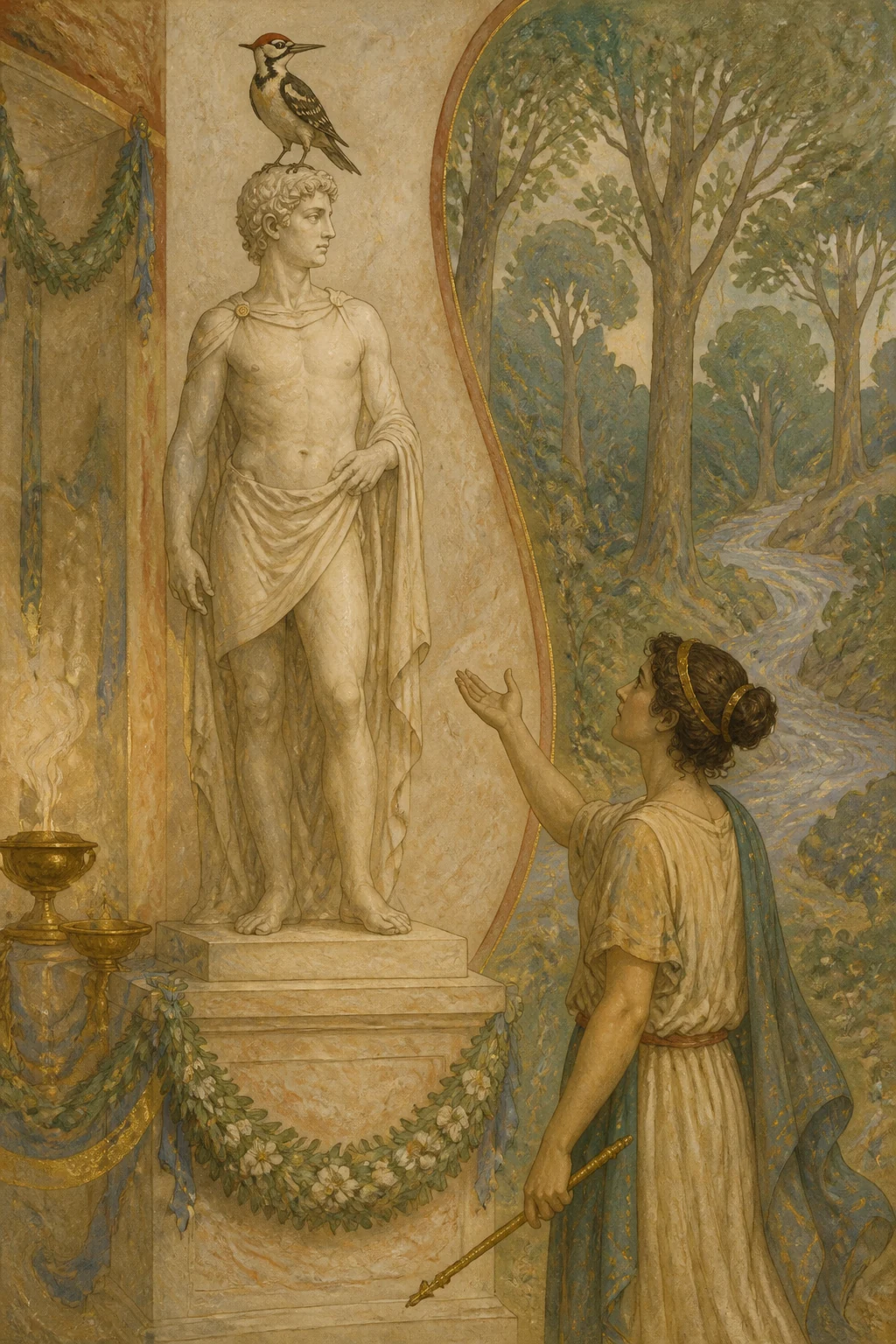
With his heart schooled by these and other teachings, Numa, they say, returned to his homeland and, freely invited, accepted the reins of the Latin people. Blessed with a nymph as his wife and the Camenae as his guides, he taught the rites of worship and led a people accustomed to savage warfare toward the arts of peace. When, grown old, he had fulfilled his reign and his allotted years, the women of Latium, the people, and the senators wept for Numa’s death; but his wife, abandoning the city, hid herself in the dense woods of the Arician valley, disrupting the rites of Orestes’ Diana with her groans and lamentations. Ah, how often the nymphs of the grove and lake
urged her to desist and spoke words of comfort! How often Theseus’ son said to her as she wept, “Set bounds to your grief! Yours is not the only fate worth mourning; consider the like misfortunes of others: you will bear your own more gently. Would that another’s story, not mine, could ease your sorrow! Yet mine can do so too. I think some tale has reached your ears of one Hippolytus, who, through his father’s credulity and a wicked stepmother’s deceit, met his death. You will marvel, and I shall scarcely convince you, but I am he. Once Pasiphaë’s daughter tried in vain to lure me into defiling my father’s marriage bed; then, reversing the charge, the wretched woman accused me
of desiring what she herself desired—was it more from fear of exposure or anger at rejection? My father drove me, innocent, from the city and cursed me as I went, praying for my destruction. In exile, I was driving my chariot toward Pittheus’ Troezen and was already following the shores of the Corinthian gulf, when the sea rose, and an enormous mass of water seemed to arch and swell into the shape of a mountain, to bellow, and to split apart at its very crest.
Out of the bursting waves a horned bull was hurled, rising breast-high into the yielding air, spewing seawater from its nostrils and gaping mouth. My companions’ hearts quailed. My own spirit remained fearless, with woes enough in my exile. Then the spirited horses turned their heads toward the sea and shuddered, ears pricked, panicking at the monster; they dashed the chariot toward the lofty rocks. I struggled to pull the useless reins, coated in white foam, leaning backward as I strained the yielding straps.
Yet the horses’ frenzy would not have overcome my strength, had not a wheel, where it turns about the unbroken axle, struck a tree stump and shattered into pieces. I was flung from the chariot, my limbs caught in the reins. You might have seen my living entrails dragged along, my sinews snagged on the stump, some limbs torn away, others caught and left behind, my bones breaking with a dreadful crack, my exhausted spirit breathed out, and no part of my body left recognizable: all of it was one great wound.
Can you, nymph, or dare you compare your calamity with mine? I saw, too, the kingdoms bereft of light and bathed my mangled body in Phlegethon’s waters. Nor would life have been restored to me but for the potent medicine of Apollo’s son. When, through powerful herbs and the healing god’s aid, I regained it, to Dis’s outrage, Cynthia, lest my presence deepen resentment at this gift, screened me with thick clouds.
And so that I might be safe and be seen without danger, she added years to my age and left my face unrecognizable. Long she hesitated whether to give me Crete or Delos as my home; then, passing over both, she placed me here and bade me also lay aside the name that might recall horses. “You who once were Hippolytus,” she said, “shall now be Virbius, still the same man!”
Since then I have dwelt in this grove, one of the lesser gods, sheltered by my mistress’s divinity and numbered among her attendants.”