Prevod
In which the reader makes the acquaintance of a she-devil, a lip-smacking, bell-ringing beauty Leonorcica Michel was what we should now call a bold, dashing Lima girl, what in Viceroy Amat’s day was known as a saucy little minx, one of those who tie their garters above the knee. Twenty-seven years old, with more knowledge of the world than Columbus ever discovered, a rosy complexion, eyes with more questions and answers than the catechism, a nose as roguish as a notary’s, mischievous lips, and a bosom broad enough for a shipwrecked sailor to cling to: such, in brief, was the girl. Add to these perfections the daintiest of feet, a shapely calf, a slender waist, and a swaggering, saucy air of the sort that could send a shiver through the very dead in the churchyard. In short, the girl was no boccato di cardinale, but a morsel fit for an entire ecumenical council.
It seems to me that this portrait is more than enough to make us expect great things of that sticky little piece of work, who was like the canary that goes for a bath, then shakes itself dry with art and craft.
To crown her good fortune, Leonorcica was married to a most respectable Spanish grocer, a greater fool than the man who tried to roast butter, and meeker than all the rams in Christendom and the Moorish lands put together. The poor fellow knew nothing but how to water his wine, pass off cat for hare, and make a very pretty penny in his shop, which his wicked wife took care to spend handsomely on ribbons and frills—not to make her husband fonder of her, but to bewitch the officers of the king’s regiments. The girl, fickle by nature, had been seized by the devil in military guise, and... you might as well set a greyhound after her virtue! No wonder someone remarked: “There must be something wrong with marriage, since it needs a priest’s blessing.”
Whenever her simpleton of a husband caught her at shady tricks and far from innocent games with the military, instead of taking up a cudgel and crippling her, he contented himself with saying:
“Look here, wife, I don’t like these tin soldiers in my house, and one of these days my temper will get the better of me and I’ll do something that’ll make a stir.” “Well, look here, you worm, just you try it,” the young woman would answer, hands on hips and eyes fixed squarely on her victim.
They say the grocer once went to lodge a complaint with the ecclesiastical judge and petition for a divorce, pleading that his spouse ill-treated him. “Good heavens, man! Does she strike you?” His Lordship asked.
“No, sir,” replied the poor devil, “she doesn’t beat me... but she does cheat on me.” This husband was made of the same stuff as that other who sang: My wife was stolen three days ago; enough of your jokes now: let her come home.
At last his patience reached its limit, and the husband did... something that made a stir. Did he break his helpmeet’s legs? Did he smash some gallant’s skull? Not a bit of it! Reasoning philosophically, he concluded that a man was a fool to ruin himself over the dirty tricks of a wicked hussy; that this roguish world was well stocked with women; and that, as someone or other had said, women are like frogs: for every one that dives below, four rise to the surface.
So, overnight, he sold the grocery, and with the money the business brought him moved to Chile, where he opened a tavern in Valdivia.
What lucky little anchovies! Instead of being put into the stewpot, they are left in peace in the water. Translated into plain English, this metaphor means that Leonorcica, far from whimpering and tearing her hair, sounded the muster, reviewed her friends from the barracks, and without further ado chose as her showpiece lover the ensign of the Córdoba regiment, Don Juan Francisco Pulido, a young fellow who always went about more splendidly decked out than a king in a fancy pack of cards.
II A Dash of History If my first book of TRADITIONS has come into your hands, kindly reader, you will have made the acquaintance of His Excellency Don Manuel Amat y Juniet, thirty-first viceroy of Peru for His Majesty Ferdinand VI. Today we shall enlarge upon the historical particulars we have already recorded concerning him.
In the last century, the captaincy-general of Chile was a stepping-stone to the viceroyalty. Manso de Velazco, Amat, Jáuregui, O’Higgins, and Avilés, after governing Chile, went on to become viceroys of Peru.
Amat took charge of the government late in 1761. “He came,” says one historian, “with a reputation for energy, organizational ability, intelligence, uprightness to the point of severity, and great zeal for the public interest, without neglecting his own advantage.” He had proved his personal courage during an uprising of prisoners in Santiago. Amat entered the prison alone and, though greeted with a hail of stones, held the rebels at bay with his sword. The following day he hanged eighteen of them. As you can see, the man was not one to stand on ceremony.
Amat began his administration when Spain’s war with England and Portugal was at its fiercest, and the American colonies feared an invasion. The new viceroy saw most effectively to the defense of the coast from Panama to Chile, and sent substantial aid in arms and money to Paraguay and Buenos Aires. In Lima he organized civic militias numbering five thousand infantry and two thousand cavalry, and had himself acknowledged as colonel of the regiment of nobles, which had a strength of four hundred men. Once peace had been made, Charles III rewarded Amat with the cross of Saint Januarius and sent Lima twenty-two knighthoods in various orders for those citizens who had most distinguished themselves by their zeal in raising, equipping, and training the militias.
During his administration the Provincial Council of 1772 was held, presided over by Archbishop Don Diego Parada, at which the canons of Saint Toribio’s Council were confirmed.
One curious feature of this Council was that Amat, having invested the Franciscan friar Juan de Marimón, his fellow countryman, confessor, and indeed kinsman, with the office of theological representative of the royal patronage, found himself in the awkward position of having to dismiss him and banish him to Trujillo for two years. At the session of February 28, Father Marimón, arguing against Bishop Espiñeyra and the cross-bearing friar Durán, who defended the doctrine of probabilism, was somewhat caustic toward his opponents. Called to order, Marimón slapped the lectern and replied: “No shouting, Your Most Illustrious Lordship. Respect must be met with respect, and if Your Lordship shouts at me again, I have the stronger lungs and shall get the better of you.” One of the volumes of Miscellaneous Papers in the Lima Library contains a pamphlet by Father Durán of the Order of the Ministers of the Sick, a letter from Bishop Friar Pedro Ángel de Espiñeyra, Amat’s decree, and a reply by Marimón, as well as the sermon the latter preached at the funeral of Father Pachi, who died in the odor of sanctity.
The viceroy, whose liberalism in religious matters was ahead of his time, exerted his influence, though without success, to compel the friars to live communally and reform their ways, which were certainly far from evangelical. Lima then contained within its walls the trifling number of thirteen hundred friars, while the convents housed seven hundred women living in idleness.
To spy on the friars who went astray in the neighborhoods of Abajo el Puente, Amat had the palace balcony overlooking the little square of Los Desamparados built, and spent many hours concealed behind its latticework.
The Mercedarian friars must have given him some cause for resentment, for whenever he caught sight of a habit belonging to that order he would mutter under his breath: “A fine white target!” Those who heard him thought the viceroy was referring to the cloth of the habit, until one inquisitive fellow ventured to ask him what he meant, whereupon Amat said: “A fine target for a cannonball!”
On another occasion we have spoken of the prudent and judicious measures Amat took to carry out the royal order expelling the members of the Society of Jesus. The viceroy immediately opened, in the former Jesuit college, the famous Convictorio de San Carlos, which has given the Americas so many illustrious men.
When the crews of the ships Septentrión and Astuto mutinied in Callao over delays in their pay, crying, “Long live the king, and death to his bad government!” the viceroy raised the flag of justice on a tower, driving the point home with seven cannon shots. He then went aboard and, after the briefest inquiry, ordered the two ringleaders hanged from the yardarms and decimated the mutinous sailors, shooting seventeen. Amat used to say that justice should be like lightning.
Amat devoted much attention to the good order, cleanliness, and embellishment of Lima. A hospital for sailors in Bellavista; a church for the Nazarenas, on whose construction he sometimes worked as a carpenter; the Alameda and the Acho bullring; and the Coliseo, no longer standing, for cockfights, all dated from his time. He also began construction of the Paseo de Aguas, which was never completed but, judging by what can still be seen, would have rivaled Saint-Cloud and Versailles.
Licentious in his habits, he greatly scandalized the country with his love affairs. The spicy tales linking Amat’s name with that of Micaela Villegas, La Perricholi, an actress in the Lima theater, would fill many pages.
Amat’s contemporaries accused him of a lack of integrity in his handling of public funds, offering as proof that he had come from Chile with only a modest fortune and, despite all he lavished on La Perricholi, who lived in outrageous luxury, left office a millionaire. We neither add nor subtract anything; we do not venture into such deep waters, and say charitably that the viceroy managed, at the judicial review of his administration, to have this charge dismissed as the offspring of human envy and malice.
In July 1776, after nearly fifteen years in office, he was replaced by His Excellency Don Manuel Guirior. Amat retired to Catalonia, his native land, where, though an ailing octogenarian, he married a young niece of his. Amat’s coat of arms was a golden shield bearing a seven-headed bird in azure.
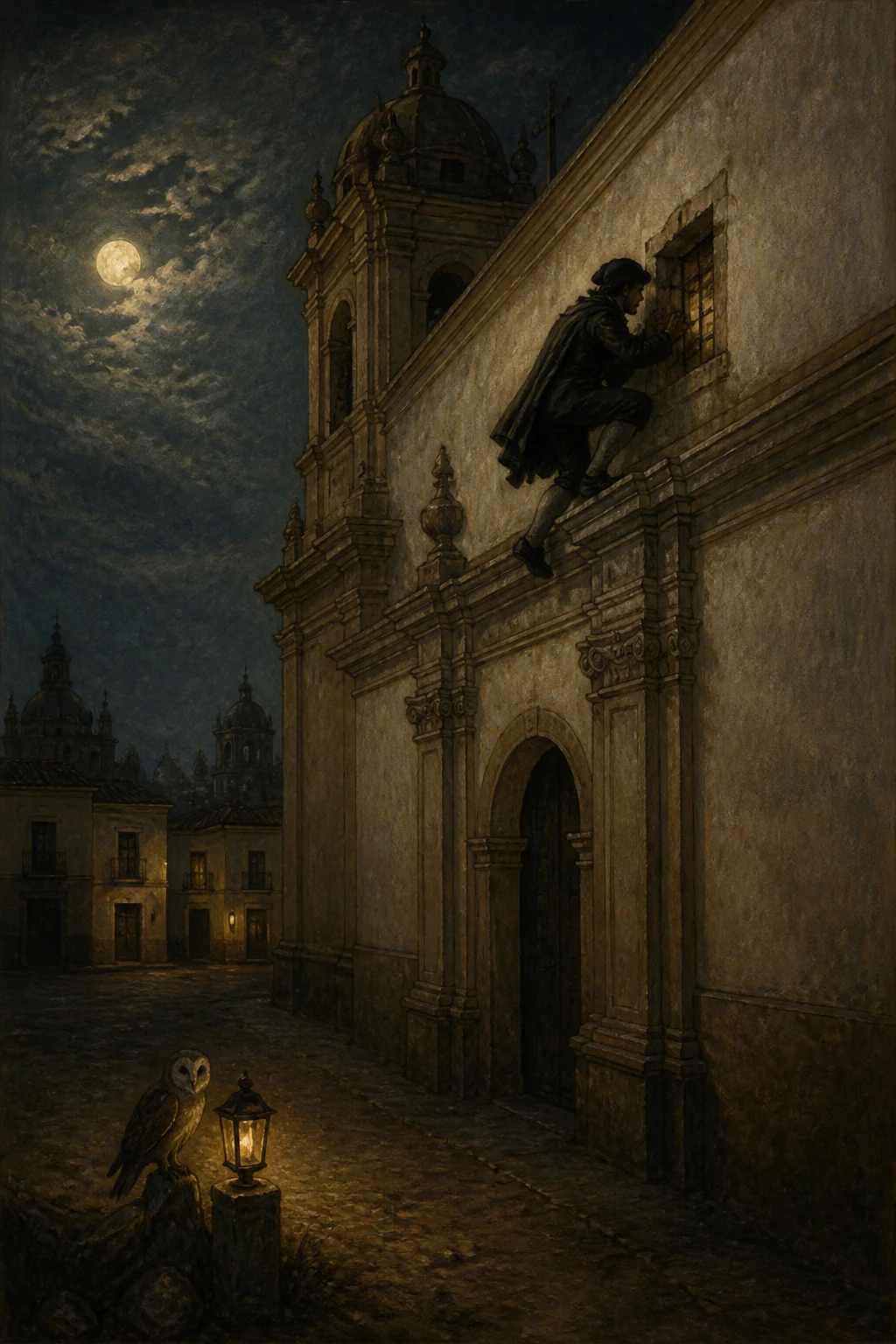
III Where the Reader Will Find Three Puns, Not Contrived but Historical Around the year 1772, the inhabitants of this City of the Kings, now virtually republican, were in the grip of the deepest panic. Who was brave enough to poke his nose into those streets after ten at night? A scurry of cats or rats across the roof was enough to send the women of a household into swoons, the men into a fright, and everyone into a tremendous hullabaloo.
The situation warranted no less. Every two or three nights there was a major robbery, and according to the chroniclers of the time, the methods used in these crimes departed from the practices hitherto followed by the disciples of Cacus. Underground passages, holes opened by means of fire, wire ladders, and other mechanical inventions revealed, quite apart from the unfailing success of their exploits, that the thieves were not only men of mettle with hair on their chests, but men of imagination and calculation. On the night of July 10 they carried out a robbery estimated at thirty thousand pesos.
That the thieves were no ordinary riffraff was acknowledged by the viceroy himself, who, talking one afternoon with the officers of the guard at his table, said in his broad Catalan accent:
“Devilish lot o’ thieves!” “Indeed, Your Excellency,” replied Ensign Don Juan Francisco Pulido. “One must admit that their work has quite a polish.”
Then the artillery lieutenant Don José Manuel Martínez Ruda interrupted him: “The ensign must forgive me. I find nothing polished about it. Quite the contrary: since they strip a house against its owner’s will, I say their methods are distinctly rough.”
“Well, gentlemen, I can see you have your sparks of wit,” added the municipal magistrate Don Tomás Muñoz, a man so keen-witted he could hear the horse on a playing card gallop. “But it is not for nothing that I wield a staff of office, and I shall bring it down most artfully on these rogues who have the whole town saying its prayers.”
IV Where It Is Proved That in the Long Run the Bull Ends in the Slaughterhouse and the Thief on the Gallows At nightfall on July 31 of the aforesaid year 1772, a soldier slipped cautiously into the house of the municipal magistrate Don Tomás Muñoz and spent an hour in secret conversation with him.
Shortly afterward, patrols of constables and officers of the police force Amat had founded under the name of the Cloaked Men were making their rounds through the city. On the morning of August 1, everyone learned that Lieutenant Ruda, Ensign Pulido, six soldiers of the Savoy regiment, three of the Córdoba regiment, and eight civilians were lodged in the court prison, gripped fast in heavy irons. Keeping them company were Doña Leonor Michel and Doña Manuela Sánchez, the two officers’ mistresses, and three women of the common people, mistresses of soldiers. It was only fair that those who had shared the sweet should share the bitter. Whoever ate the meat must gnaw the bone.
The trial record, a most curious document indeed, preserved in the archives of the Most Excellent Supreme Court, is too long to summarize. Suffice it to say that on August 13 there was not a soul in Lima who failed to turn out in the Plaza Mayor, where the regular troops and civic militias were drawn up.
After being stripped of their ranks with all the solemn ceremony prescribed by military regulations, the officers Ruda and Pulido went, together with nine of their accomplices, to swing from the gallows erected opposite the alley of Petateros. The executioner then cut off their heads, which were displayed on spikes in Callao and Lima.
The remaining prisoners received sentences of penal servitude, and four were acquitted, among them Doña Manuela Sánchez, Ruda’s mistress. The proceedings show that, though she had indeed enjoyed the profits, she had never known where the money came from.
V In Which Is Copied a Sentence with Enough Oil to Light a Lamp “As for Doña Leonor Michel, receiver of stolen goods, I sentence her to suffer fifty lashes, to be administered in her prison by the hand of the executioner, and to have her head and eyebrows shaved; and after being passed three times beneath the gallows, she shall be taken to the royal religious house of Amparadas de la Concepción in this city, to perform the lowest and most menial duties of the house, the mother superior being expressly charged to keep her under the strictest guard and precaution until a ship shall be found departing for the garrison of Valdivia, whither she shall be conveyed under official warrant to live in union with her husband, and she shall remain perpetually in the said garrison town.—This sentence was given and pronounced by His Excellency Don Manuel de Amat y Juniet, Knight of the Order of Saint John, member of His Majesty’s Council, Gentleman of His Bedchamber with right of entry, Lieutenant General of His Royal Armies, Viceroy, Governor, and Captain General of these kingdoms of Peru and Chile; and he signed his name thereto while holding audience in his cabinet in the City of the Kings, on August 11, 1772, in the presence of Don Pedro Juan Sanz, his secretary of the chamber, and Don José Garmendia, his secretary of correspondence.—Gregorio González de Mendoza, Notary to His Majesty and to the Military.”
Good gracious! Wouldn’t you say that sentence has three pairs of mighty fine dangling ornaments? We do not know whether the husband appealed to the king against ecclesiastical coercion over the clause which, though he had had neither bite nor sup of the business, obliged him to live in union with the better half the Church had given him, or whether he shut his eyes and accepted the bill of exchange—which he may well have done, for there are all sorts of characters in the vineyard of the Lord.