Waltey
Luka svetoskrunec
Tradiciones peruanas
Tradiciones peruanas · Ricardo PalmaO besedilu
Luka svetoskrunec
- Vir
- Tradiciones peruanas
- Avtor
- Ricardo Palma
- Jezik branja
- English
- Jezik izvirnika
- Español
- Čas branja
- 10 min branja
- Obseg
- 8 strani
- Naslov izvirnika
- 006 Lucas el sacrílego
O izvirniku
Tradiciones peruanas
Šestindvajset Palmovih avtorskih zgodovinskih tradicij iz konkretnega Gutenbergovega zvezka. Bralni jezik je English, izvirnik pa prihaja iz vira Tradiciones peruanas v jeziku Español.
Besedilo
Luka svetoskrunec
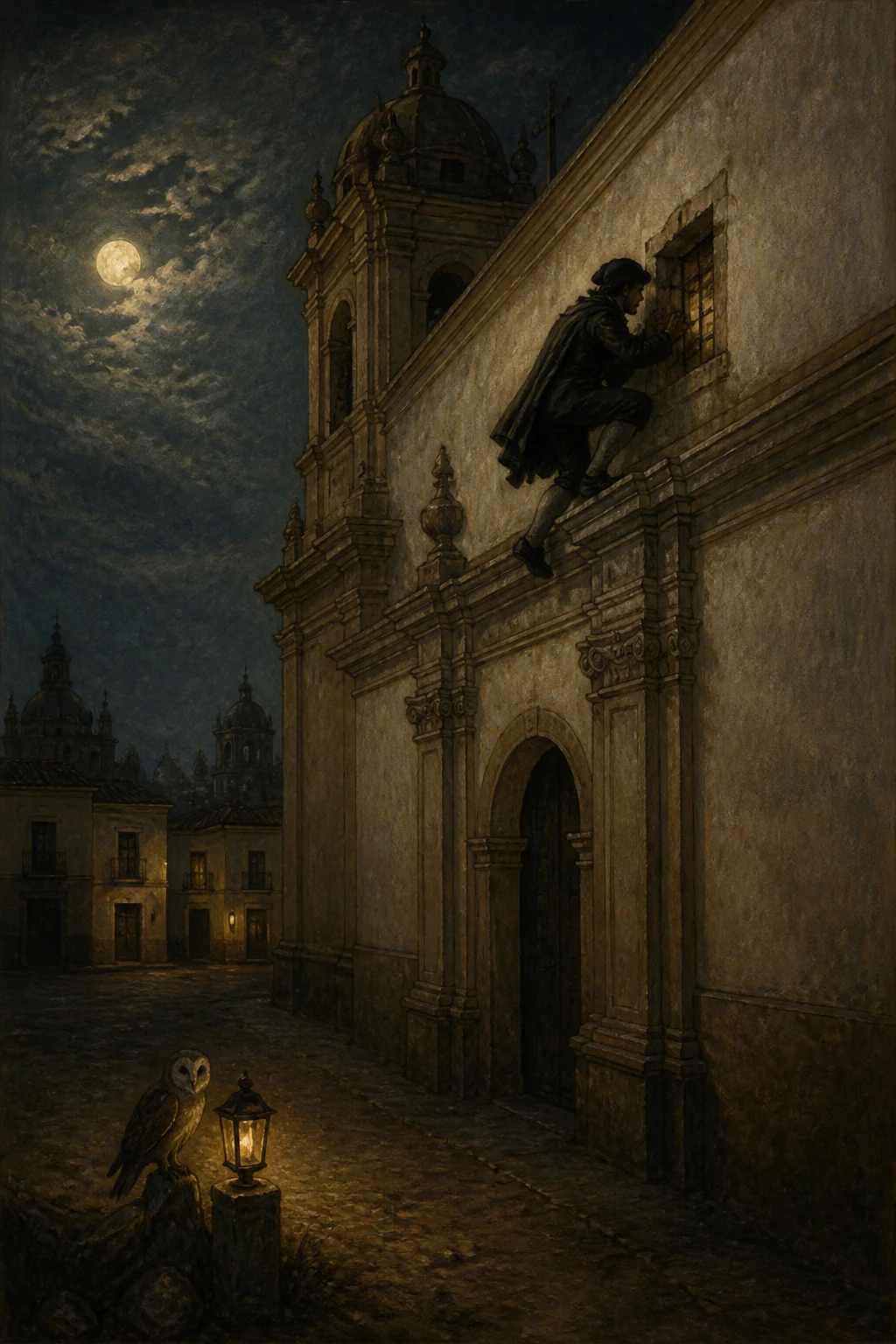
Anyone passing through the little square of San Agustín at eleven o’clock on the night of October 22, 1743, would have seen a figure on the cornice of the church façade, struggling to squeeze inside through a narrow skylight. The climber must surely have performed great feats of agility and balance to reach that perch, and any Christian who had caught sight of him would have crossed himself, taking him for the Evil One, or at the very least a goblin. And let it not be forgotten that in those days it was common knowledge that, on certain nights, the little square of San Agustín was overrun by a procession of souls from purgatory, each carrying a taper. I neither add nor subtract a thing; but I suspect that with the republic and gaslight we have put the fear of God into those blessed souls, who now sit sulking quietly wherever His Divine Majesty was pleased to put them.
The church forecourt did not then have the magnificent iron railing that adorns it today, and the city’s night watch was so neglected that it was exceedingly difficult to find a patrol. The good people of Lima shut themselves up at home at ten o’clock, after putting out the lantern by the door, and the city was plunged into utter darkness, much to the delight of cats and owls, devotees of other people’s property, and those inclined to amorous adventures.
The discerning reader, who cannot believe in goblins or crowned devils, and who, as is fashionable in these civilized times, perhaps does not even believe in God, will have suspected that the man slipping through the church skylight is a thief. Think the worst, and you will be right.
Indeed. With the help of a rope, our man lowered himself into the church and walked resolutely toward the high altar. I do not know, reader, whether you have ever found yourself at night in a vast church, with no light but that cast by a few little lamps at the feet of the sacred images, hearing the fluttering and ominous cries of the birds that nest in its towers and vaults. For my part, I can say that nothing has ever left so somber and solemn an impression on my spirit, and for that reason I consider sextons and altar boys, not saints, exactly, but the stoutest-hearted men in Christendom. The heroes of Independence are nothing beside them!
On reaching the tabernacle, our man opened its inner compartment, took out the monstrance, wrapped the divine Host in his handkerchief and left it on the altar, then departed through the same skylight by which he had entered.
Only two days later, on the morning of Saturday the 25th, when the consecrated Host was to be renewed, was the theft discovered. The golden sunburst had vanished, valued at more than forty thousand pesos, its precious pearls, rubies, diamonds, sapphires, opals, and emeralds gifts from Lima’s leading families. Although the pedestal was also of gold and an admirable work of art, it had not tempted the thief’s greed.
It is easy to imagine the commotion this sacrilege must have caused among the devout townspeople. According to the learned writer in the Diario de Lima, in the issues of October 4 and 5, 1791, there was a penitential procession, a sermon on David’s text, Exurge, Domine, et judica causam tuam, ceaseless public prayers, the imprisonment of lay brothers and sextons, and notices offering rewards to anyone who denounced the thief. The theaters were closed, and mourning became universal when, as the days passed without the culprit being discovered, the ecclesiastical authorities resorted to the dreadful measure of pronouncing censures and extinguishing candles.
For his part, the Marquis of Villagarcía, Viceroy of Peru, had fulfilled his duty by taking every measure within his power to capture the sacrilegious wretch. Couriers were dispatched without respite to the corregidores and other authorities of the viceroyalty, until, toward the end of November, a constable arrived in Lima from don Jerónimo Solá, intendant of Huancavelica and former member of the Council of the Indies. He carried dispatches informing His Excellency that the thief was lodged in jail, duly fitted with a pair of Biscayan stockings—that is, iron shackles. Well does the proverb say that between priestly cap and soldier’s helmet, great things are done.
The bells pealed, the theater reopened, the citizens put off their mourning, and Lima gave itself over to festivities and rejoicing. II Following the plan we have adopted in the TRADITIONS, this is the place for a brief historical account of the administration of His Excellency don José de Mendoza Caamaño y Sotomayor, Marquis of Villagarcía, Monroy, and Cusano, Count of Barrantes and Lord of Vista Alegre, Rubianes, and Villanueva, twenty-ninth Viceroy of Peru under His Majesty don Felipe V, who, at the age of sixty, assumed the government of these kingdoms on January 4, 1736.
The Marquis of Villagarcía was most reluctant to accept the viceroyalty of Peru, and when one of the king’s ministers urged him not to reject what so many coveted, he said:
“Sir, pray lay me at His Majesty’s feet, for I revere him as justice and duty require, and explain to him that, having reckoned the matter up for myself, I find it better to live a poor gentleman than to die a rich viceroy.”
The sovereign found the excuse groundless, and his appointee had to embark for America. As he was succeeding the forceful Marquis of Castelfuerte, the law of compensations demanded a less severe policy from the new viceroy. Thus, through tact and moderation, Villagarcía managed to prevent the disturbances in Oruro from spreading and to hold in check Juan Santos of Cuzco, who had proclaimed himself Inca.
He was less fortunate with the English admirals Vernon and Jorge Andson, whose piratical raids kept the coast in alarm. With great effort, and by imposing a levy on commerce, the viceroy managed to fit out a squadron; its commander, however, invariably kept his ships out of range of the English guns, allowing Andson to capture the Manila galleon, which carried a cargo valued at more than three million pesos.
It was under his government that the mining district of Cerro de Pasco began to acquire the importance it enjoys today. Among other curious events of his time, mention should be made of the northern lights seen one night in Cuzco, and the murder, by the fanatical inhabitants of Cuenca, of the surgeon attached to the scientific expedition that visited America under the learned La Condamine. Seeing foreigners examining the heavens through great telescopes, the simple natives imagined that these men were practicing witchcraft and the black arts.
Concerning the arrival of the scientific commission, we read in a valuable manuscript in the Library of Lima, entitled Voyage to the Globe of the Moon, that the people of Lima nicknamed the distinguished Spanish naval officers don Jorge Juan and don Antonio de Ulloa, and the French scholars Gaudin and La Condamine, the Knights of the Fixed Point, in allusion to their intention of determining precisely the size and shape of the earth. One pedant, believing that the four commissioners had the power to move the equator as far from Lima as they pleased, began grumbling among the ignorant populace against the viceroy, the Marquis of Villagarcía, accusing him of being a miser and a weakling: merely to save the fifteen or twenty thousand pesos the work might cost, he was allowing the equator to remain where it was and the inhabitants to endure the fierce summer heat. It seems it took some little effort to convince the populace that this charlatan was spouting nonsense. So the anonymous author of the aforementioned manuscript relates.
After nine and a half years in office, and when he least expected it, the viceroy was unceremoniously replaced by the future Count of Superunda in July 1745. This slight so deeply affected the aged Marquis of Villagarcía that, while returning to Spain aboard the Héctor, he died at sea off the Patagonian coast in December of that same year.
III Lucas de Valladolid was a mestizo from the city of Huamanga who worked in Lima as a silversmith. The finest jewels made in those days were the work of his hands. But Master Lucas was generous to a fault, squandering his earnings on gambling, wine, and women of easy virtue.
The Augustinian fathers held him in high regard, and Master Lucas was always among their guests on feast days. Our silversmith therefore knew every inch of the monastery and church, a circumstance that helped him carry out the theft of the monstrance as we have already related.
Once in possession of so valuable a prize, he took it home, dismantled the sunburst, melted down the gold, and set some of the stones in rings. Seeing the uproar his crime had caused, he resolved to leave the city and set out for Huancavelica, first burying part of his wealth on the slope of San Cristóbal.
Intendant Solá’s wife was a native of Lima, and Master Lucas called on her to offer six magnificent rings for sale. A splendid emerald gleamed in one of them, and as the lady examined it, she exclaimed, “How curious! This stone is identical to the one I gave for the monstrance of San Agustín.”
The silversmith grew flustered and soon took his leave. A few minutes later, the intendant entered his wife’s room and told her that a courier had just arrived from Lima with news of the sacrilegious theft.
“Why, my dear,” the lady interrupted, “I had the thief here in the house only a short while ago.” Acting on the intendant’s wife’s information, a search for Master Lucas began at once, but he had already left town. Efforts were redoubled, and several Indians immediately set out in every direction to hunt down the criminal, managing to seize him three leagues away.
The sacrilegious thief began with stubborn denials; but they applied thumbscrews, or gave him a quarter-turn of the wheel, and he sang out the whole truth. When the viceroy received the dispatch from the intendant of Huancavelica, he sent a company of his own escort to guard the prisoner.
When the man reached Lima in January 1744, it took great effort to keep the populace from tearing him to pieces. Mob justice, it seems, is nothing new!
A few days later the thief was placed in the condemned cell, where he asked to be granted four months to make a monstrance finer than the one he had destroyed. The Augustinians interceded, and the request was granted.
Wealthy families contributed gold and fresh jewels, and four months later, to the day, the monstrance—a true work of art—was finished. During that interval, Master Lucas gave such convincing proofs of repentance in his prison that he was granted the mercy of having his sentence commuted.
That is to say, instead of roasting him as a sacrilegious wretch, they very neatly hanged him as a thief.
Izvirnik
006 Lucas el sacrílego
Naslednje strani prikazujejo izvirno besedilo za primerjavo.
CRÓNICA DE LA ÉPOCA DEL VIGÉSIMONONO VIRREY DEL PERÚ
I
El que hubiera pasado por la plazuela de San Agustín a la hora de las once de la noche del 22 de octubre de 1743, habría visto un bulto sobre la cornisa de la fachada del templo, esforzándose a penetrar en él por una estrecha claraboya. Grandes pruebas de agilidad y equilibrio tuvo sin duda que realizar el escalador hasta encaramarse sobre la cornisa, y el cristiano que lo hubiese contemplado habría tenido que santiguarse tomándolo por el enemigo malo o por duende cuando menos. Y no se olvide que, por aquellos, tiempos, era de pública voz y fama que, en ciertas noches, la plazuela de San Agustín era invadida por una procesión de ánimas del purgatorio con cirio en mano. Yo ni quito ni pongo; pero sospecho que con la república y el gas les hemos metido el resuello a las ánimas benditas, que se están muy mohinas y quietas en el sitio donde a su Divina Majestad plugo ponerlas.
El atrio de la iglesia no tenía por entonces la magnífica verja de hierro que hoy la adorna, y la policía nocturna de la ciudad estaba en abandono tal, que era asaz difícil encontrar una ronda. Los buenos habitantes de Lima se encerraban en casita a las diez de la noche, después de apagar el farol de la puerta, y la población quedaba sumergida en plena tiniebla, con gran contentamiento de gatos y lechuzas, de los devotos de la hacienda ajena y de la gente dada a amorosas empresas.
El avisado lector, que no puede creer en duendes ni en demonios coronados, y que, como es de moda en estos tiempos de civilización, acaso no cree ni en Dios, habrá sospechado que es un ladrón el que se introduce por la claraboya de la iglesia. Piensa mal y acertarás.
En efecto. Nuestro hombre con auxilio de una cuerda se descolgó al templo, y con paso resuelto se dirigió al altar mayor.
Yo no sé, lector, si alguna ocasión te has encontrado de noche en un vasto templo, sin más luz que la que despiden algunas lamparillas colocadas al pie de las efigies, y sintiendo el vuelo y el graznar fatídico de esas aves que anidan en las torres y bóvedas. De mí sé decir que nada ha producido en mi espíritu una impresión más sombría y solemne a la vez, y que por ello tengo a los sacristanes y monaguillos en opinión, no diré de santos, sino de ser los hombres de más hígados de la cristiandad. ¡Me río yo de los bravos de la Independencia!
Llegado nuestro hombre al sagrario, abrió el recamarín, sacó la Custodia envolvió en su pañuelo la Hostia divina, dejándola sobre el altar y salió del templo por la misma claraboya que le había dado entrada.
Sólo dos días después, en la mañana del sábado 25, cuando debía hacerse la renovación de la Forma, vino a descubrirse el robo. Había desaparecido el sol de oro, evaluado en más de cuarenta mil pesos, y cuyas ricas perlas, rubíes, brillantes, zafiros, ópalos y esmeraldas eran obsequio de las principales familias de Lima. Aunque el pedestal era también de oro v admirable como obra de arte, no despertó la codicia del ladrón.
Fácil es imaginarse la conmoción que este sacrilegio causaría en el devoto pueblo. Según refiere el erudito escritor del Diario de Lima, en los números del 4 y 5 de octubre de 1791, hubo procesión de penitencia, sermón sobre el texto de David: Exurge, Domine, et judica causam tuam, constantes rogativas, prisión de legos y sacristanes, y carteles fijando premios para quien denunciase al ladrón. Se cerraron los coliseos y el duelo fué general cuando, corriendo los días sin descubrirse al delincuente, recurrió la autoridad eclesiástica al tremendo resorte de leer censuras y apagar candelas.
Por su parte el marqués de Villagarcía, virrey del Perú, había llenado su deber, dictando todas las providencias eme en su arbitrio estaban para capturar al sacrílego. Los expresos a los corregidores y demás autoridades del virreinato se sucedieron sin tregua, hasta que a fines de noviembre llegó a Lima un alguacil del intendente de Huancavelica don Jerónimo Solá, ex consejero de Indias, con pliegos en los que éste comunicaba a su excelencia que el ladrón se hallaba aposentado en la cárcel y con su respectivo par de calcetas de Vizcaya. Bien dice el refrán que entre bonete y almete se hacen cosas de copete.
Las campanas se echaron a vuelo, el teatro volvió a funcionar, los vecinos abandonaron el luto, y Lima se entregó a fiestas y regocijos.
II
Ciñéndonos al plan que hemos seguido en las TRADICIONES, viene aquí a cuento una rápida reseña histórica de la época de mando del excelentísimo señor don José de Mendoza Caamaño y Sotomayor, marqués de Villagarcía, de Monroy y de Cusano, conde de Barrantes y Señor de Vista Alegre, Rubianes y Villanueva vigésimonono virrey del Perú por su majestad don Felipe V, y que, a la edad de sesenta años, se hizo cargo del gobierno de estos reinos en 4 de enero de 1736.
El marqués de Villagarcía se resistió mucho a aceptar el virreinato del Perú, y persuadiéndolo uno de los ministros del rey para que no rechazase lo que tantos codiciaban, dijo:
--Señor, vueseñoría me ponga a los pies de Su Majestad, a quien venero como es justo y de ley, y represéntele que haciendo cuentas conmigo mismo, he hallado que me conviene más vivir pobre hidalgo que morir rico virrey.
El soberano encontró sin fundamento la excusa, y el nombrado tuvo que embarcarse para América.
Sucediendo al enérgico marqués de Castelfuerte, la ley de las compensaciones exigía del nuevo virrey una política menos severa. Así, a fuerza de sagacidad y moderación, pudo el de Villagarcía impedir que tomasen incremento las turbulencias de Oruro y mantener a raya al cuzqueño Juan Santos, que se había proclamado Inca.
No fué tan feliz con los almirantes ingleses Vernon y Jorge Andson, que con sus piraterías alarmaban la costa. Haciendo grandes esfuerzos e imponiendo una contribución al comercio, logró el virrey alistar una escuadra, cuyo jefe evitó siempre poner sus naves al alcance de los cañones ingleses, dando lugar a que Andson apresara el galeón de Manila, que llevaba un cargamento valuado en más de tres millones de pesos.
Bajo su gobierno fué cuando el mineral del Cerro de Pasco principió a adquirir la importancia de que hoy goza, y entre otros sucesos curiosos de su época merecen consignarse la aurora boreal que se vió una noche en el Cuzco, y la muerte que dieron los fanáticos habitantes de Cuenca al cirujano de la expedición científica que a las órdenes del sabio La Condamine visitó la América. Los sencillos naturales pensaron, al ver unos extranjeros examinando el cielo con grandes telescopios, que esos hombres se ocupaban de hechicerías y malas artes.
A propósito de la venida de la comisión científica, leemos en un precioso manuscrito que existe en la Biblioteca de Lima, titulado Viaje al globo de la luna, que el pueblo limeño bautizó a los ilustres marinos españoles don Jorge Juan y don Antonio de Ulloa y a los sabios franceses Gaudin y La Condamine con el sobrenombre de los caballeros del punto fijo, aludiendo a que se proponían determinar con fijeza la magnitud y figura de la tierra. Un pedante, creyendo que los cuatro comisionados tenían la facultad de alejar de Lima cuanto quisiesen la línea equinoccial, se echó a murmurar entre el pueblo ignorante contra el virrey marqués de Villagarcía, acusándolo de tacaño y menguado; pues por ahorrar un gasto de quince o veinte mil pesos que pudiera costar la obra, consentía en que la línea equinoccial se quedase como se estaba y los vecinos expuestos a sufrir los recios calores del verano. Trabajillo parece que costó convencer al populacho de que aquel charlatán ensartaba disparates. Así lo refiere el autor anónimo del ya citado manuscrito.
Después de nueve años y medio de gobierno, y cuando menos lo esperaba, fué el virrey desairosamente relevado con el futuro conde de Superunda en julio de 1745. Este agravio afectó tanto al anciano marqués de Villagarcía, que regresando para España, a bordo del navío Héctor, murió en el mar, en la costa patagónica, en diciembre del mismo año.
III
Lucas de Valladolid era un mestizo, de la ciudad de Huamanga, que ejercía en Lima el oficio de platero. Obra de sus manos eran las mejores alhajas que a la sazón se fabricaban. Pero el maestro Lucas pecaba de generoso, y en el juego, el vino y las mozas de partido derrochaba sus ganancias.
Los padres agustinos le dispensaban gran consideración, y el maestro Lucas era uno de sus obligados comensales en los días de mantel largo. Nuestro platero conocía, pues, a palmos el convento y la iglesia, circunstancia que le sirvió para realizar el robo de la Custodia, tal como lo dejamos referido.
Dueño de tan valiosa prenda, se dirigió con ella a su casa, desarmó el sol, fundió el oro y engarzó en anillos algunas piedras. Viendo la excitación que su crimen había producido, se resolvió a abandonar la ciudad y emprendió viaje a Huancavelica, enterrando antes en la falda del San Cristóbal una parte de su riqueza.
La esposa del intendente Solá era limeña, y a ésta se presentó el maestro Lucas ofreciéndole en venta seis magníficos anillos. En uno de ellos lucía una preciosa esmeralda, y examinándola la señora, exclamó: «¡Qué rareza! Esta piedra es idéntica a la que obsequié para la Custodia de San Agustín».
Turbóse el platero, y no tardó en despedirse.
Pocos minutos después entraba el intendente en la estancia de su esposa, y la participó que acababa de llegar un expreso de Lima con la noticia del sacrílego robo.
--Pues, hijo mío--le interrumpió la señora--, hace un rato que he tenido en casa al ladrón.
Con los informes de la intendenta procedióse en el acto a buscar al maestro Lucas; pero ya éste había abandonado la población. Redobláronse los esfuerzos y salieron inmediatamente algunos indios en todas direcciones en busca del criminal, logrando aprehenderlo a tres leguas de distancia.
El sacrílego principió por una tenaz negativa; pero le aplicaron garrotillo en los pulgares o un cuarto de rueda, y canto de plano.
Cuando el virrey recibió el oficio del intendente de Hancavelica despachó para guarda del reo una compañía de su escolta.
Llegado éste a Lima, en enero de 1744, costó gran trabajo impedir que el pueblo lo hiciese añicos. ¡Las justicias populares son cosa rancia por lo visto!
A los pocos días fué el ladrón puesto en capilla, y entonces solicitó la gracia de que se le acordasen cuatro meses para fabricar una Custodia superior en mérito a la que él había destruido. Los agustinos intercedieron y la gracia fué otorgada.
Las familias pudientes contribuyeron con oro y nuevas alhajas, y cuatro meses después, día por día, la Custodia, verdadera obra de arte, estaba concluída. En este intervalo el maestro Lucas dió en su prisión tan positivas muestras de arrepentimiento que le valieron la merced de que se le conmutase la pena.
Es decir, que en vez de achicharrarlo como a sacrílego, se le ahorcó muy pulcramente como a ladrón.
Nadaljuj z branjem