Prevod
At the beginning of the present century, there lived in the Recollect monastery of the Discalced Friars an octogenarian of austere virtue who wore the habit of a lay brother. The people, who dearly loved the humble monk, knew him only as the Resurrected Man. And here is the authentic and simple tradition concerning him that has come down to us.
I In the year of the three sevens—a number both apocalyptic and famous for the momentous events that took place in America—a man nearing his fortieth summer appeared one day at the hospital of San Andrés, asking to be treated in that holy refuge. From the first, the physicians judged his illness fatal and advised him to pack his bags for a journey to a better world.
Our man heard the fatal verdict without flinching, and after receiving spiritual assistance—or taking the pilot aboard, as a sailor used to say—he summoned Gil Paz, the hospital steward, and spoke to him more or less as follows:
“I came from Spain fifteen years ago, leaving no kin behind, for I am a poor foundling. My life in the Indies has been that of a man honestly seeking his bread through work, but with such contrary fortune that my entire wealth, the fruit of a thousand privations and hardships, amounts to scarcely more than a hundred gold ounces, which you will find in a belt I wear about my body. If, as the physicians believe, and I with them, His Divine Majesty should be pleased to call me into His presence, I bequeath my money to you for your enjoyment, asking only that you clothe my corpse in a good shroud of the seraphic father Saint Francis, and pay for a few Masses for the repose of my sinful soul.”
Don Gil swore by every saint in the calendar that he would faithfully carry out the dying man’s wishes, and that he should have not only his shroud and Masses but a decent funeral as well. Thus comforted, the patient decided that the best thing left for him to do was to die as soon as possible; that very night his extremities began to grow cold, and by five in the morning he was a soul of the next world.
The gold coins passed at once into the pocket of the steward, who was a miser more wretched than avarice itself made flesh. Even his name betrays the man’s meanness: Gil Paz! It would be impossible to be stingier with letters or spend less ink on a signature.
At that time Lima did not yet have its general cemetery, which, as everyone knows, was inaugurated on Tuesday, May 31, 1808; and it is curious to record here that the first body buried in our necropolis, on the following day, was that of a destitute pauper named Matías Isurriaga, who fell from a scaffold where he was working as a mason and was flattened like a pancake in the entrance court of the cemetery itself.
Let us leave the dead man in peace for a while, and, as the gravedigger opens the trench, smoke a cigarette and chat about the government and politics of those days. The dead were buried in a large yard or burial ground attached to each hospital, or in the vaults of churches, at no small risk to public health.
Our Don Gil reflected that the deceased had asked for a great many frills; that he could go into the common grave without holy water, prayers, or Masses for his soul; and that, as for clothing, he was well enough equipped in the threadbare trousers and grimy shirt in which the Grim Reaper had caught him.
“Down in the hole it is not like the world,” Gil Paz philosophized, “where we set such store by outward show and appearances, and many a man cuts a figure thanks to the cloth of his coat. What gall the dead fellow had! I shall certainly never be the one to flatter his vanity by spending the four pesos that Franciscan sackcloth costs. Wanting luxury even to rot in the earth! Was such presumption ever seen? It is a wonder he did not take a fancy to being buried in suede gloves, bell-topped boots, and a lace ruff! Into the hole with the rascal just as he is, and let him thank me for not sending him off in the costume Father Adam wore before he tasted the forbidden delicacy.”
And two black slaves belonging to the hospital picked up the corpse and carried it to the yard that served as a cemetery. II His Excellency Don Manuel Guirior, a native of Navarre and a kinsman of Saint Francis Xavier, knight of the Order of Saint John, lieutenant general of the Royal Navy, gentleman of the bedchamber, and Marquis of Guirior, was serving as viceroy in the New Kingdom of Granada, where he had married Doña María Ventura, a young woman from Bogotá, when Charles III promoted him to the government of Peru.
Accompanied by his wife, Guirior arrived in Lima incognito on July 17, 1776, as Amat’s successor. His public reception took place with great pomp on December 3, four months after he had assumed office. His shrewd judgment and sound administrative abilities soon won him general esteem. He devoted much attention to the conversion of unbelievers and even founded colonies and forts in Chanchamayo, which were later destroyed by the savages. In Lima he established public lighting at a small charge to the residents, and he was the first viceroy to issue proclamations against the deluge known as Carnival water fights. It is true that then, as now, such proclamations remained a dead letter.
Guirior was the only viceroy who gave to the hospitals the ten pesos which, by royal decree, were allotted to His Excellency for sorbets and pastries whenever he honored a theatrical performance with his presence. During his administration the Viceroyalty of Buenos Aires was established, and the demarcation of Peru’s boundaries was completed in accordance with the treaty of 1777 between Spain and Portugal—a treaty that has since brought us some vexations with Brazil and Ecuador.
In that same ill-fated year of the three sevens, the court sent us Don José de Areche, a member of the Council of the Indies, with the title of superintendent and inspector general of the Royal Treasury, and vested with such sweeping powers that they made the viceroy’s authority almost a mockery. The royal envoy’s true mission was to squeeze the orange until not a drop of juice remained. Areche raised the tribute levied on the indigenous people to a million pesos; he created the board of tithes; state monopolies and sales taxes yielded handsome returns; he burdened merchants and miners with taxes and extortions, and tightened the cord so fiercely that serious disturbances broke out in Huaraz, Lambaveque, Huánuco, Pasco, Huancavelica, Moquegua, and other places, where magistrates, tax collectors, and royal officials were put to death by the populace. “Feelings ran so high,” says Lorente, “that in Arequipa the boys at a school killed one of their fellows who had played the part of a customs officer in their games, and on the plain of Santa Marta two thousand Arequipans dared, though unsuccessfully, to give battle to the royal militia.” In Cuzco a vast conspiracy was discovered just in time, led by Don Lorenzo Farfán and an indigenous chief, who were arrested and ended their lives on the scaffold.
Guirior tried hard to convince the superintendent that he was on the wrong path; that discontent was immense, and that the harshness of his measures would not enable him to establish the new taxes but would instead create the danger of the whole country resorting to armed protest—a prediction borne out two years later, under another viceroy, by the bloody rebellion of Tupac-Amaru. But Areche believed the king had sent him to Peru to enrich the royal treasury at the expense of the conquered land, without standing on ceremony, and that Peruvians were serfs whose sweat, turned into gold, must pass into the coffers of Charles III. He therefore informed the sovereign that Guirior was hindering him in fleecing the country, and that another viceroy should be appointed, since His Excellency was damned if he was any use as a ravening, bloodthirsty wolf. After four years in office, and without the slightest formality of courtesy, Don Manuel Guirior, the thirty-second viceroy of Peru, found himself dismissed and summoned to Madrid, where he died a few months after his arrival.
His was a life well lived. Both in the review of his administration and in the secret inquiry conducted against him, the viceroy emerged vindicated, and Areche was severely punished.
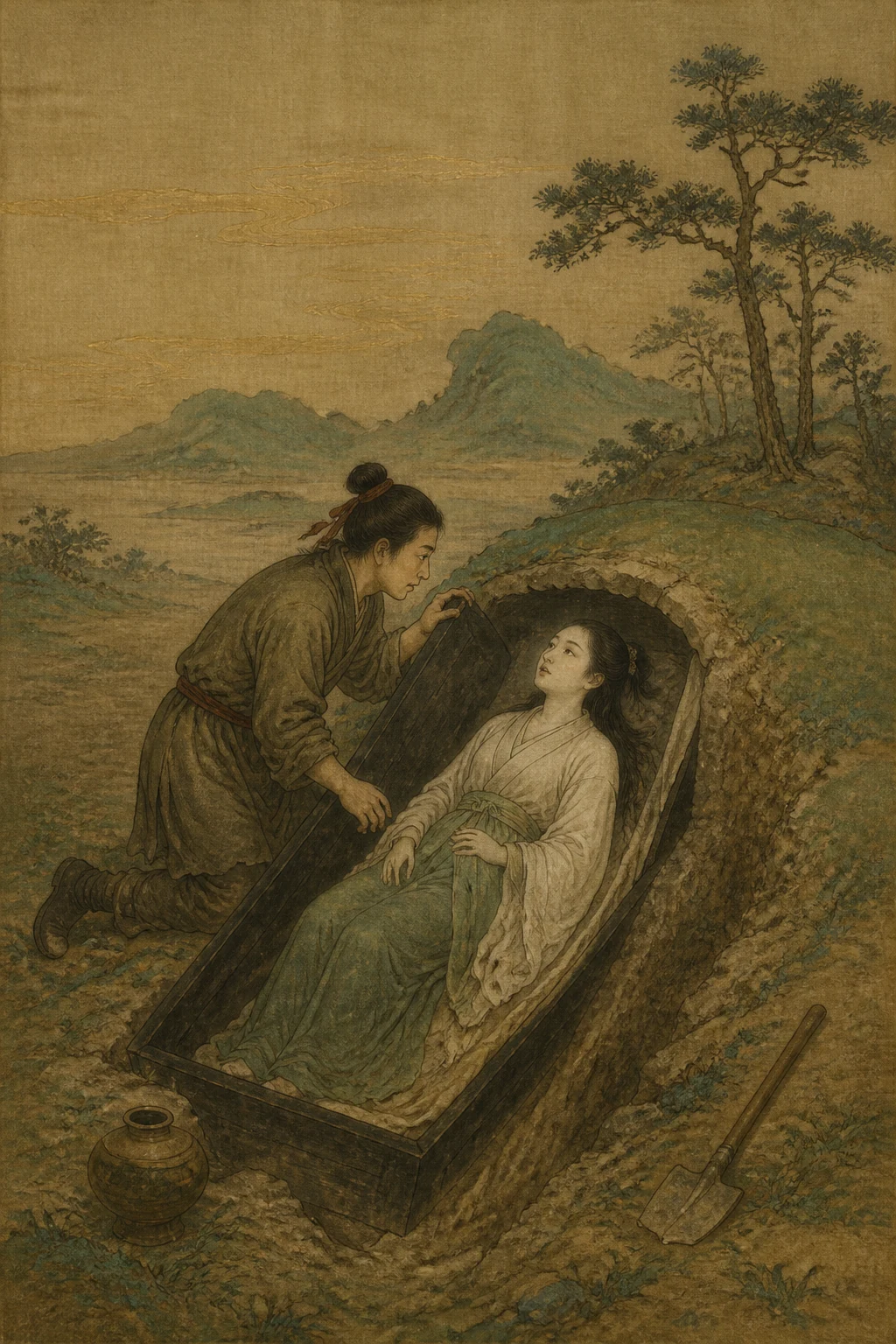
III While the gravedigger was opening the trench, a cool, playful breeze brushed the dead man’s face. He cannot, in truth, have been properly dead, for his muscles began to twitch feebly, then he opened his eyes, and at last, through one of those marvelous instincts of the human organism, grasped his situation. Had our Spaniard taken another couple of minutes to recover from his seizure or cataleptic fit, the shovelfuls of earth would have left him no room to stir and protest.
Absorbed in his familiar, gloomy task, the gravedigger failed to notice the resurrection taking place until the dead man got up on his legs and began walking toward the gate. The graveyard owl fell down in a fit, almost literally fulfilling the words of the song:
The living man fell down dead, and the dead man took to his heels. Don Gil was in the San Ignacio ward, making sure the dispensers did not use too much sugar to sweeten the herbal infusions, when a hand rested familiarly on his shoulder and he heard a sepulchral voice say: “Miser! Where is my shroud?”
Don Gil turned around in terror. Whether it was the fright of seeing a resurrected man of so strange an appearance, or whether the voice of conscience spoke too loudly within him, the fact is that from that instant the wretched fellow lost his reason. His sacrilegious avarice was punished with madness.
As for the Spaniard, a fortnight later he left the hospital fully recovered, and after distributing in alms the gold coins that had caused Don Gil’s misfortune, he took the habit of a lay brother in the monastery of the Discalced Friars. Respectable people who knew him and were acquainted with him assure us that he lived to die in the odor of sanctity, sometime around the year 1812.