Prevod
Anyone passing through the little square of San Agustín at eleven o’clock on the night of October 22, 1743, would have seen a figure on the cornice of the church façade, struggling to squeeze inside through a narrow skylight. The climber must surely have performed great feats of agility and balance to reach that perch, and any Christian who had caught sight of him would have crossed himself, taking him for the Evil One, or at the very least a goblin. And let it not be forgotten that in those days it was common knowledge that, on certain nights, the little square of San Agustín was overrun by a procession of souls from purgatory, each carrying a taper. I neither add nor subtract a thing; but I suspect that with the republic and gaslight we have put the fear of God into those blessed souls, who now sit sulking quietly wherever His Divine Majesty was pleased to put them.
The church forecourt did not then have the magnificent iron railing that adorns it today, and the city’s night watch was so neglected that it was exceedingly difficult to find a patrol. The good people of Lima shut themselves up at home at ten o’clock, after putting out the lantern by the door, and the city was plunged into utter darkness, much to the delight of cats and owls, devotees of other people’s property, and those inclined to amorous adventures.
The discerning reader, who cannot believe in goblins or crowned devils, and who, as is fashionable in these civilized times, perhaps does not even believe in God, will have suspected that the man slipping through the church skylight is a thief. Think the worst, and you will be right.
Indeed. With the help of a rope, our man lowered himself into the church and walked resolutely toward the high altar. I do not know, reader, whether you have ever found yourself at night in a vast church, with no light but that cast by a few little lamps at the feet of the sacred images, hearing the fluttering and ominous cries of the birds that nest in its towers and vaults. For my part, I can say that nothing has ever left so somber and solemn an impression on my spirit, and for that reason I consider sextons and altar boys, not saints, exactly, but the stoutest-hearted men in Christendom. The heroes of Independence are nothing beside them!
On reaching the tabernacle, our man opened its inner compartment, took out the monstrance, wrapped the divine Host in his handkerchief and left it on the altar, then departed through the same skylight by which he had entered.
Only two days later, on the morning of Saturday the 25th, when the consecrated Host was to be renewed, was the theft discovered. The golden sunburst had vanished, valued at more than forty thousand pesos, its precious pearls, rubies, diamonds, sapphires, opals, and emeralds gifts from Lima’s leading families. Although the pedestal was also of gold and an admirable work of art, it had not tempted the thief’s greed.
It is easy to imagine the commotion this sacrilege must have caused among the devout townspeople. According to the learned writer in the Diario de Lima, in the issues of October 4 and 5, 1791, there was a penitential procession, a sermon on David’s text, Exurge, Domine, et judica causam tuam, ceaseless public prayers, the imprisonment of lay brothers and sextons, and notices offering rewards to anyone who denounced the thief. The theaters were closed, and mourning became universal when, as the days passed without the culprit being discovered, the ecclesiastical authorities resorted to the dreadful measure of pronouncing censures and extinguishing candles.
For his part, the Marquis of Villagarcía, Viceroy of Peru, had fulfilled his duty by taking every measure within his power to capture the sacrilegious wretch. Couriers were dispatched without respite to the corregidores and other authorities of the viceroyalty, until, toward the end of November, a constable arrived in Lima from don Jerónimo Solá, intendant of Huancavelica and former member of the Council of the Indies. He carried dispatches informing His Excellency that the thief was lodged in jail, duly fitted with a pair of Biscayan stockings—that is, iron shackles. Well does the proverb say that between priestly cap and soldier’s helmet, great things are done.
The bells pealed, the theater reopened, the citizens put off their mourning, and Lima gave itself over to festivities and rejoicing. II Following the plan we have adopted in the TRADITIONS, this is the place for a brief historical account of the administration of His Excellency don José de Mendoza Caamaño y Sotomayor, Marquis of Villagarcía, Monroy, and Cusano, Count of Barrantes and Lord of Vista Alegre, Rubianes, and Villanueva, twenty-ninth Viceroy of Peru under His Majesty don Felipe V, who, at the age of sixty, assumed the government of these kingdoms on January 4, 1736.
The Marquis of Villagarcía was most reluctant to accept the viceroyalty of Peru, and when one of the king’s ministers urged him not to reject what so many coveted, he said:
“Sir, pray lay me at His Majesty’s feet, for I revere him as justice and duty require, and explain to him that, having reckoned the matter up for myself, I find it better to live a poor gentleman than to die a rich viceroy.”
The sovereign found the excuse groundless, and his appointee had to embark for America. As he was succeeding the forceful Marquis of Castelfuerte, the law of compensations demanded a less severe policy from the new viceroy. Thus, through tact and moderation, Villagarcía managed to prevent the disturbances in Oruro from spreading and to hold in check Juan Santos of Cuzco, who had proclaimed himself Inca.
He was less fortunate with the English admirals Vernon and Jorge Andson, whose piratical raids kept the coast in alarm. With great effort, and by imposing a levy on commerce, the viceroy managed to fit out a squadron; its commander, however, invariably kept his ships out of range of the English guns, allowing Andson to capture the Manila galleon, which carried a cargo valued at more than three million pesos.
It was under his government that the mining district of Cerro de Pasco began to acquire the importance it enjoys today. Among other curious events of his time, mention should be made of the northern lights seen one night in Cuzco, and the murder, by the fanatical inhabitants of Cuenca, of the surgeon attached to the scientific expedition that visited America under the learned La Condamine. Seeing foreigners examining the heavens through great telescopes, the simple natives imagined that these men were practicing witchcraft and the black arts.
Concerning the arrival of the scientific commission, we read in a valuable manuscript in the Library of Lima, entitled Voyage to the Globe of the Moon, that the people of Lima nicknamed the distinguished Spanish naval officers don Jorge Juan and don Antonio de Ulloa, and the French scholars Gaudin and La Condamine, the Knights of the Fixed Point, in allusion to their intention of determining precisely the size and shape of the earth. One pedant, believing that the four commissioners had the power to move the equator as far from Lima as they pleased, began grumbling among the ignorant populace against the viceroy, the Marquis of Villagarcía, accusing him of being a miser and a weakling: merely to save the fifteen or twenty thousand pesos the work might cost, he was allowing the equator to remain where it was and the inhabitants to endure the fierce summer heat. It seems it took some little effort to convince the populace that this charlatan was spouting nonsense. So the anonymous author of the aforementioned manuscript relates.
After nine and a half years in office, and when he least expected it, the viceroy was unceremoniously replaced by the future Count of Superunda in July 1745. This slight so deeply affected the aged Marquis of Villagarcía that, while returning to Spain aboard the Héctor, he died at sea off the Patagonian coast in December of that same year.
III Lucas de Valladolid was a mestizo from the city of Huamanga who worked in Lima as a silversmith. The finest jewels made in those days were the work of his hands. But Master Lucas was generous to a fault, squandering his earnings on gambling, wine, and women of easy virtue.
The Augustinian fathers held him in high regard, and Master Lucas was always among their guests on feast days. Our silversmith therefore knew every inch of the monastery and church, a circumstance that helped him carry out the theft of the monstrance as we have already related.
Once in possession of so valuable a prize, he took it home, dismantled the sunburst, melted down the gold, and set some of the stones in rings. Seeing the uproar his crime had caused, he resolved to leave the city and set out for Huancavelica, first burying part of his wealth on the slope of San Cristóbal.
Intendant Solá’s wife was a native of Lima, and Master Lucas called on her to offer six magnificent rings for sale. A splendid emerald gleamed in one of them, and as the lady examined it, she exclaimed, “How curious! This stone is identical to the one I gave for the monstrance of San Agustín.”
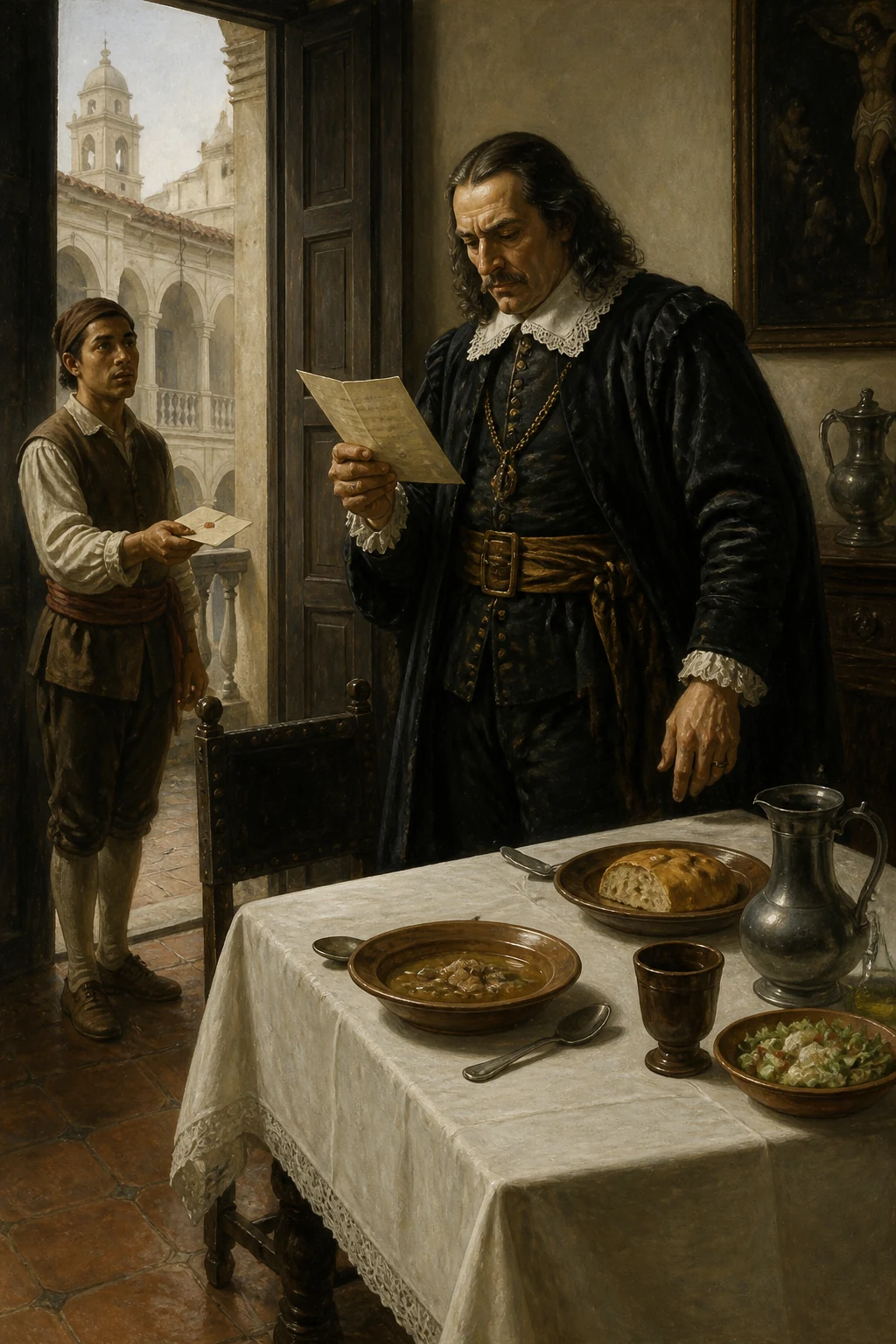
The silversmith grew flustered and soon took his leave. A few minutes later, the intendant entered his wife’s room and told her that a courier had just arrived from Lima with news of the sacrilegious theft.
“Why, my dear,” the lady interrupted, “I had the thief here in the house only a short while ago.” Acting on the intendant’s wife’s information, a search for Master Lucas began at once, but he had already left town. Efforts were redoubled, and several Indians immediately set out in every direction to hunt down the criminal, managing to seize him three leagues away.
The sacrilegious thief began with stubborn denials; but they applied thumbscrews, or gave him a quarter-turn of the wheel, and he sang out the whole truth. When the viceroy received the dispatch from the intendant of Huancavelica, he sent a company of his own escort to guard the prisoner.
When the man reached Lima in January 1744, it took great effort to keep the populace from tearing him to pieces. Mob justice, it seems, is nothing new!
A few days later the thief was placed in the condemned cell, where he asked to be granted four months to make a monstrance finer than the one he had destroyed. The Augustinians interceded, and the request was granted.
Wealthy families contributed gold and fresh jewels, and four months later, to the day, the monstrance—a true work of art—was finished. During that interval, Master Lucas gave such convincing proofs of repentance in his prison that he was granted the mercy of having his sentence commuted.
That is to say, instead of roasting him as a sacrilegious wretch, they very neatly hanged him as a thief.