O besedilu
Galateja, Akis in Polifem
- Vir
- Ovidove preobrazbe
- Avtor
- Ovid
- Jezik branja
- English
- Jezik izvirnika
- Latin
- Čas branja
- 10 min branja
- Obseg
- 8 strani
- Naslov izvirnika
- Galatea, Acis, and Polyphemus
O izvirniku
Ovidove preobrazbe
Pesniški tok antičnih preobrazb, kjer bogovi, ljudje in narava stalno menjavajo obliko. Bralni jezik je English, izvirnik pa prihaja iz vira Ovidove preobrazbe v jeziku Latin.
Besedilo
Galateja, Akis in Polifem
Then, remembering that the Trojans traced their blood back to Teucer, they made for Crete, but could not long endure the climate of that land; leaving its hundred cities, they longed to reach the harbors of Ausonia. A storm raged and tossed the men about; and when they sheltered in the treacherous harbors of the Strophades, winged Aello drove them off. And now they had sailed past the ports of Dulichium, Ithaca, and Samos, and the homes of Neritos, the kingdom of deceitful Ulysses.
They saw Ambracia, once disputed by the gods, and the stone that bore the likeness of the judge transformed, a place now famous for Apollo of Actium; and Dodona’s land, whose oak gives voice to prophecy, and the bays of Chaonia, where, with her son Molossus king, a woman escaped a wicked blaze on wings that sprang beneath her. Next they sought the Phaeacians’ fields, rich in fruitful orchards; from there they reached Epirus and Buthrotos, ruled by the Phrygian prophet, and its imitation Troy.
Then, assured of what lay ahead—for Helenus, Priam’s son, had foretold it all with faithful counsel—they entered Sicilian waters. That land runs out into the sea in three points: Pachynus faces the rain-bearing winds of the south; Lilybaeum lies open to the gentle west winds; Pelorus looks toward the Bears that never touch the sea, and the north wind. Here the Trojans came, and, borne by oars and a favorable tide, their fleet reached the sands of Zancle as night fell.
Scylla haunts the right-hand shore, restless Charybdis the left: one swallows ships she seizes, then spews them back; the other has her dark belly ringed with savage dogs, though she wears a maiden’s face—and, unless everything the poets have handed down is fiction, she was once a maiden too. Many suitors sought her; she rejected them and went to the nymphs of the sea, who loved her dearly, and told them how she had thwarted the young men’s love.
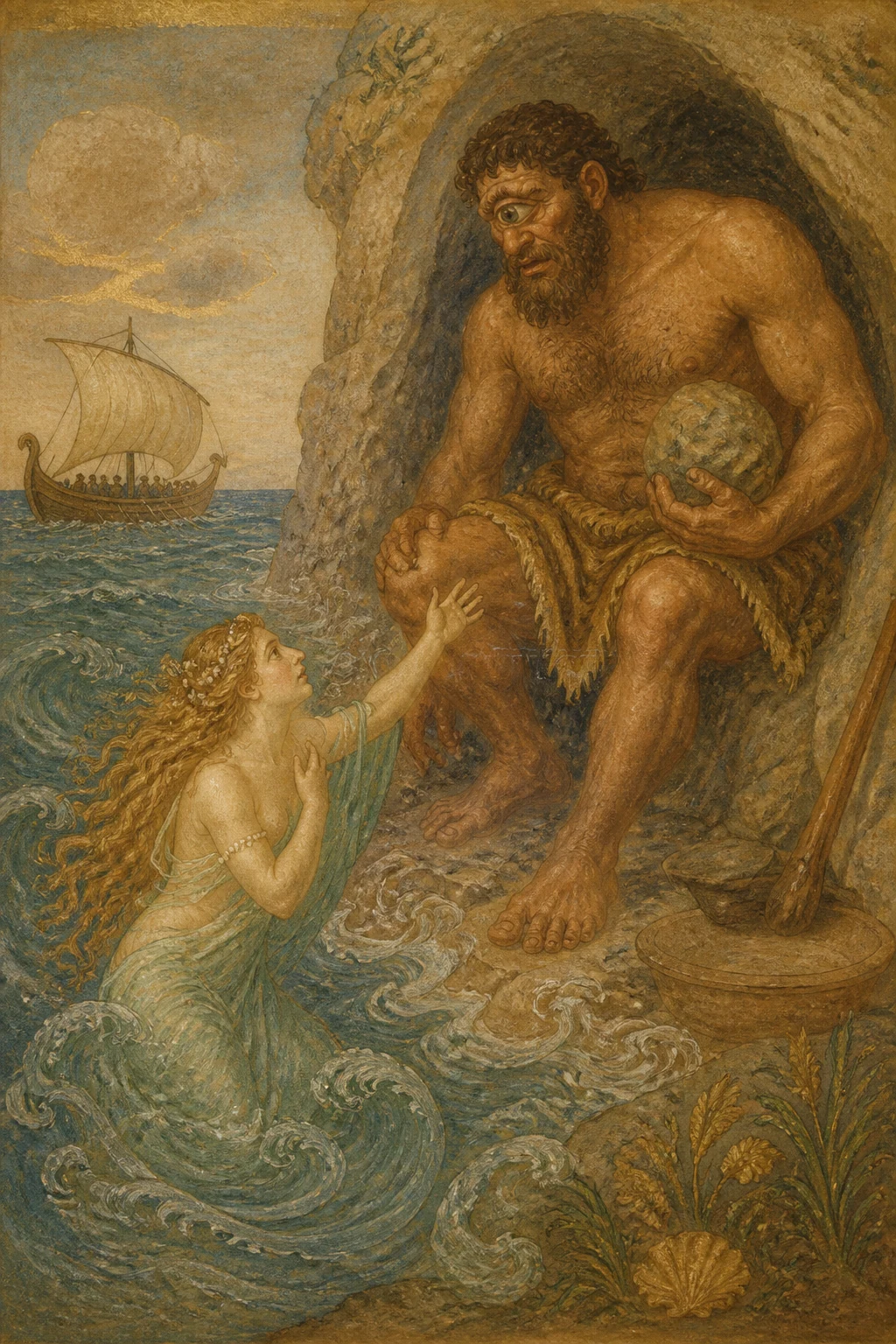
As Galatea offered her hair for Scylla to comb, she sighed and spoke to her in words like these: “Yet you, dear maiden, are sought by men of no cruel race, and may refuse them safely, as you do. But I, whose father is Nereus, whom sea-blue Doris bore, and who am guarded by a host of sisters, could only escape the Cyclops’ love through sorrow.” And tears choked her voice as she spoke.
When the maiden had wiped them away with her marble-white thumb and comforted the goddess, she said, “Tell me, dearest; do not hide the cause of your grief—I am true to you!” The Nereid answered Crataeis’ daughter with this tale: “Acis was the son of Faunus and the nymph Symaethis, a great delight indeed to his father and his mother, but a greater one to me, for he had bound himself to me alone.
He was handsome, and, having passed his sixteenth birthday, had marked his tender cheeks with the faintest down. I sought him, while the Cyclops pursued me without end. If you should ask whether my hatred of the Cyclops or my love for Acis was the stronger, I will tell you: both were equal. How mighty is your sovereign power, kind Venus! That savage creature, a terror even to the woods themselves, whom no stranger ever saw unscathed, who scorned great Olympus and its gods, learned what love was; seized by fierce desire, he burned, forgetting his flocks and his caves.
Now you care for your looks, now you care to please, now you comb your bristling hair with a rake, Polyphemus, now you take pleasure in trimming your shaggy beard with a sickle and studying your fierce face in the water, arranging its expression. Your love of slaughter, your savagery, your boundless thirst for blood are stilled, and ships come and go in safety. Meanwhile Telemus had been brought to Sicily’s Aetna— Telemus, son of Eurymus, whom no bird’s omen ever deceived.
He approached the dreadful Polyphemus and said, “That single eye you bear in the middle of your forehead—Ulysses will take it from you!” He laughed. “Most foolish of prophets, you are wrong,” he said. “Another has already stolen it!” Thus he scorned the prophet whose truthful warnings went unheard, and either weighed down the shore with his enormous strides or, weary, returned to his shadowy cave.
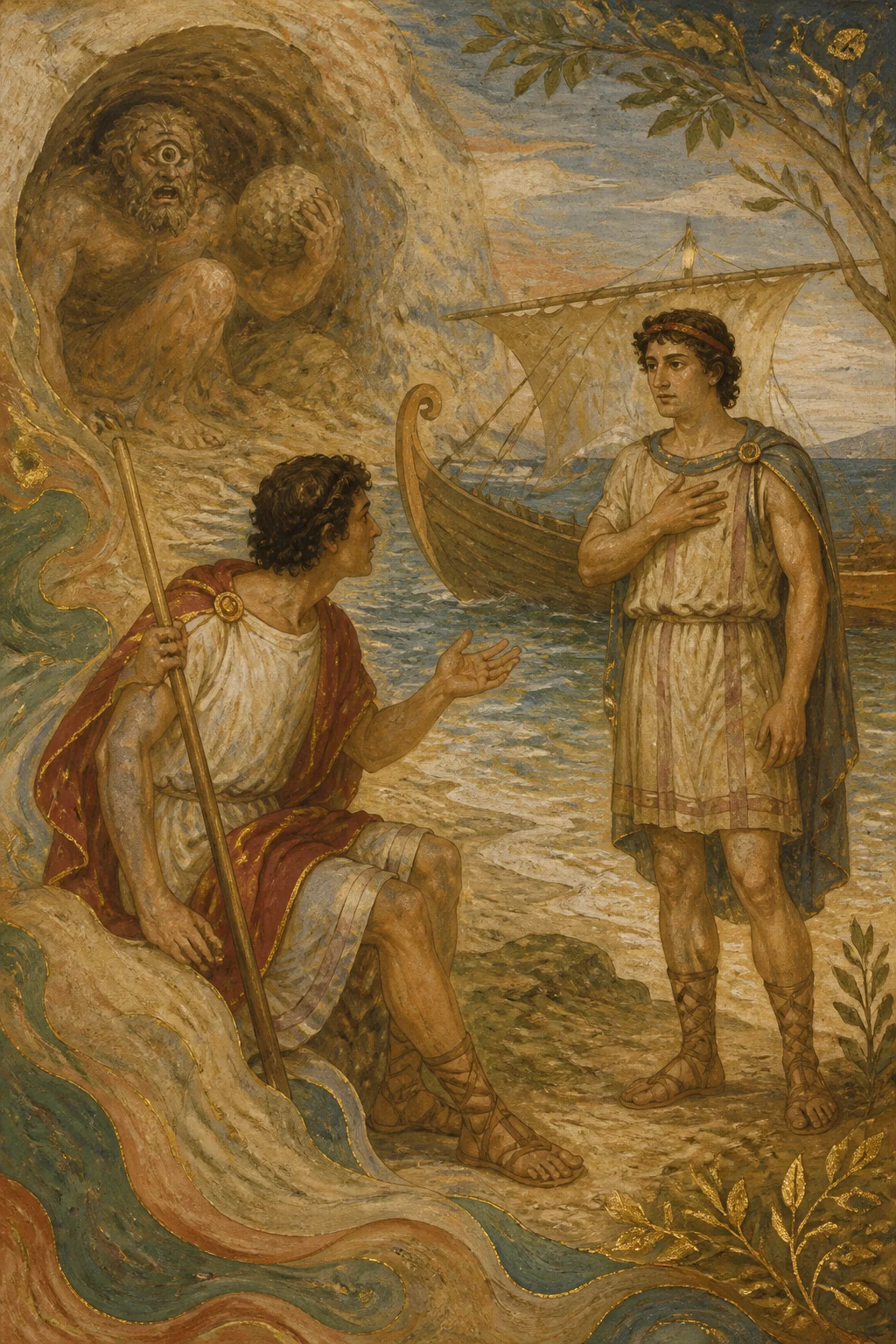
A hill juts out into the sea, tapering to a long point, with the waves flowing round it on either side. The savage Cyclops climbed it and sat halfway up; his woolly flock followed without a shepherd. When he had laid before his feet the pine that served him as a staff, though fit to carry a ship’s sail-yards, and taken up his pipe of a hundred reeds joined together, all the mountains felt its shepherd’s music, and the waves felt it too. Hidden behind a rock, sitting in my Acis’ lap, I drank in his words from far away and remembered what I heard: “Galatea, whiter than the petals of snowy privet,
more blooming than the meadows, taller than a lofty alder, more shining than glass, more playful than a tender kid, smoother than shells polished by the ceaseless sea, more welcome than winter sunshine or summer shade, more splendid than fruit, more striking than a towering plane tree, clearer than ice, sweeter than a ripened grape, softer than swans’ feathers or curdled milk, and, if you would not flee, lovelier than a well-watered garden; yet you, that same Galatea, are fiercer than untamed bullocks, harder than an ancient oak, more treacherous than the waves, more unyielding than willow wands or white bryony vines, more immovable than these rocks, more violent than a river,
prouder than a peacock praised, more searing than fire, rougher than thistles, more savage than a mother bear, deafer than the sea, more pitiless than a snake trodden underfoot, and—what above all I wish I could take from you— swifter in flight not merely than a stag pursued by baying hounds, but even than the winds and the winged breeze! Yet if you knew me well, you would regret your flight, condemn your own delay, and strive to keep me.
I have caves, part of the mountain, their roofs of living rock, where neither the sun at the height of summer nor winter’s cold is felt; I have fruit weighing down the branches, and grapes like gold upon long trailing vines, and purple grapes as well: both kinds I keep for you. With your own hands you shall gather the soft strawberries that grow in woodland shade, and autumn cornel berries, and plums—not only those dark with black juice, but the finer kinds as well, golden as fresh wax.
With me as your husband, you shall never lack chestnuts or the fruit of the strawberry tree: every tree shall serve you. All this flock is mine; many more wander in the valleys, many the woods conceal, and many are sheltered in my caves. If you happened to ask, I could not tell you how many: only a poor man counts his flock! As for their excellence, take nothing on my word: you can see for yourself how their swollen udders scarcely fit between their legs.
There are lambs, the younger offspring, in the warm sheepfolds, and kids of the same age in other pens. I always have snow-white milk: some is set aside for drinking, and some is thickened with dissolved rennet. Nor shall you have only common pets, the easy gifts of fallow deer, hares, a goat, a pair of doves, or a nest taken from a treetop. I have found two playmates for you, so alike you could scarcely tell them apart, the cubs of a shaggy bear, high in the mountains.
I found them and said, ‘These we shall keep for my lady!’ Only lift your shining head now from the blue sea; come now, Galatea, and do not scorn my gifts. Surely I know myself: only lately I saw my reflection in clear water, and the sight of my beauty pleased me. Look how huge I am! Jupiter himself in heaven has no greater body—you are always telling me that some Jupiter or other reigns there. Abundant hair hangs over my fierce face and shades my shoulders like a grove.
And do not think it ugly that my body bristles thickly with stiff hair: a tree is ugly without its leaves; a horse is ugly unless a mane veils its golden neck. Feathers clothe birds; their own wool adorns sheep; a beard and shaggy body hair become a man. I have one eye in the middle of my forehead, but it is as large as a mighty shield. Well? Does not the great Sun see all this from heaven? Yet the Sun has just one orb!
And remember, my father rules in your own sea: I offer him as your father-in-law. Only take pity and hear your suppliant’s prayers! To you alone I yield. I, who scorn Jupiter, heaven, and the piercing thunderbolt, revere you, daughter of Nereus: your anger is fiercer than lightning. I could bear this scorn of yours more patiently if you fled from everyone. But why, rejecting the Cyclops, do you love Acis and prefer Acis to my embrace?
Let him please himself, then; let him please you too, Galatea, though I wish he did not. Only give me the chance, and he shall learn that my strength matches my enormous frame! I shall tear out his living entrails, scatter his mangled limbs over the fields and through your waves—so let him mingle with you! For I am burning, and, wounded, my fire blazes all the fiercer; I seem to bear Aetna, brought here with all its power, inside my breast—and you, Galatea, are unmoved.”
After these vain laments—for I could see it all— he rose, and like a bull maddened by the loss of his cow, could not stand still, but roamed the woods and familiar glades. Then the savage creature saw Acis and me, unsuspecting, fearing nothing of the kind. “I see you!” he shouted. “And I shall make this the last embrace you lovers share!” His voice was as mighty as an angry Cyclops’ ought to be: Aetna shuddered at the cry.
Terrified, I plunged beneath the nearby sea; the son of Symaethis turned his back and fled, crying, “Help me, Galatea, I beg you! Help me, my parents, and receive me, doomed to die, into your realms!” The Cyclops pursued him, tore a piece from the mountain, and hurled it. Though only the very tip of the rock struck Acis, it buried him completely. But I did the one thing fate allowed: I gave Acis the powers of his forefathers.
Crimson blood flowed from beneath the boulder, and within a little while its redness began to fade, turning first the color of a river muddied by rain, then slowly clearing. At my touch the boulder split, and tall, living reeds sprang up through its cracks; the hollow mouth of the rock rang with leaping water. Then, wonder of wonders, a youth suddenly rose waist-high, his new horns wreathed with bending reeds.
Except that he was larger, and his whole face sea-blue, he was Acis. Yet even so he was still Acis, transformed into a river, and its waters kept his ancient name.”
Izvirnik
Galatea, Acis, and Polyphemus
Naslednje strani prikazujejo izvirno besedilo za primerjavo.
Source ID: ovid_metamorphoses_story_089 Citation: Ovid, Metamorphoses 13.705-13.897 Original language: Latin Source: PerseusDL canonical-latinLit Source URL: https://github.com/PerseusDL/canonical-latinLit/blob/master/data/phi0959/phi006/phi0959.phi006.perseus-lat2.xml Segmentation certainty: medium 705: Inde recordati Teucros a sanguine Teucri 706: ducere principium, Cretam tenuere locique 707: ferre diu nequiere Iovem, centumque relictis 708: urbibus Ausonios optant contingere portus: 709: saevit hiems iactatque viros, Strophadumque receptos 710: portubus infidis exterruit ales Aello.
711: Et iam Dulichios portus Ithacamque Samonque 712: Neritiasque domus, regnum fallacis Ulixis, 713: praeter erant vecti: certatam lite deorum 714: Ambraciam versique vident sub imagine saxum 715: iudicis, Actiaco quae nunc ab Apolline nota est, 716: vocalemque sua terram Dodonida quercu 717: Chaoniosque sinus, ubi nati rege Molosso 718: inpia subiectis fugere incendia pennis.
719: Proxima Phaeacum felicibus obsita pomis 720: rura petunt, Epiros ab his regnataque vati 721: Buthrotos Phrygio simulataque Troia tenetur. 722: Inde futurorum certi, quae cuncta fideli 723: Priamides Helenus monitu praedixerat, intrant 724: Sicaniam: tribus haec excurrit in aequora pinnis, 725: e quibus imbriferos est versa Pachynos ad austros, 726: mollibus expositum zephyris Lilybaeon, ad arctos 727: aequoris expertes spectat boreamque Peloros.
728: Hac subeunt Teucri, et remis aestuque secundo 729: sub noctem potitur Zanclaea classis harena. 730: Scylla latus dextrum, laevum inrequieta Charybdis 731: infestat: vorat haec raptas revomitque carinas, 732: illa feris atram canibus succingitur alvum, 733: virginis ora gerens, et, si non omnia vates 734: ficta reliquerunt aliquo quoque tempore virgo. 735: Hanc multi petiere proci; quibus illa repulsis 736: ad pelagi nymphas, pelagi gratissima nymphis, 737: ibat et elusos iuvenum narrabat amores.
738: Quam, dum pectendos praebet Galatea capillos, 739: talibus adloquitur, referens suspiria, dictis: 740: “Te tamen, o virgo, genus haud inmite virorum 741: expetit, utque facis, potes his impune negare; 742: At mihi, cui pater est Nereus, quam caerula Doris 743: enixa est, quae sum turba quoque tuta sororum, 744: non nisi per luctus licuit Cyclopis amorem 745: effugere,” — et lacrimae vocem impediere loquentis.
746: Quas ubi marmoreo detersit pollice virgo 747: et solata deam est, “refer, o carissima,” dixit. 748: “neve tui causam tege (sic sum fida) doloris!” 749: Nereis his contra resecuta Crataeide natam est: 750: “Acis erat Fauno nymphaque Symaethide cretus, 751: magna quidem patrisque sui matrisque voluptas, 752: nostra tamen maior: nam me sibi iunxerat uni. 753: Pulcher et octonis iterum natalibus actis 754: signarat teneras dubia lanugine malas.
755: Hunc ego, me Cyclops nulla cum fine petebat. 756: En si quaesieris, odium Cyclopis, amorne 757: Acidis in nobis fuerit praesentior, edam: 758: par utrumque fuit. Pro quanta potentia regni 759: est, Venus alma, tui! Nempe ille inmitis et ipsis 760: horrendus silvis et visus ab hospite nullo 761: impune et magni cum dis contemptor Olympi, 762: quid sit amor, sensit validaque cupidine captus 763: uritur, oblitus pecorum antrorumque suorum.
764: Iamque tibi formae, iamque est tibi cura placendi, 765: iam rigidos pectis rastris, Polypheme, capillos, 766: iam libet hirsutam tibi falce recidere barbam 767: et spectare feros in aqua et componere vultus. 768: Caedis amor feritasque sitisque inmensa cruoris 769: cessant, et tutae veniunt abeuntque carinae. 770: Telemus interea Siculam delatus ad Aetnen, 771: Telemus Eurymides, quem nulla fefellerat ales, 772: terribilem Polyphemon adit “lumen” que, “quod unum 773: fronte geris media, rapiet tibi” dixit “Ulixes!”
774: Risit et “o vatum stolidissime, falleris,” inquit, 775: “altera iam rapuit!” Sic frustra vera monentem 776: spernit et aut gradiens ingenti litora passu 777: degravat aut fessus sub opaca revertitur antra. 778: Prominet in pontum cuneatus acumine longo 779: collis utrumque latus circumfluit aequoris unda; 780: huc ferus ascendit Cyclops mediusque resedit, 781: lanigerae pecudes nullo ducente secutae.
782: Cui postquam pinus, baculi quae praebuit usum, 783: ante pedes posita est, antemnis apta ferendis, 784: sumptaque harundinibus compacta est fistula centum, 785: senserunt toti pastoria sibila montes, 786: senserunt undae; latitans ego rupe meique 787: Acidis in gremio residens procul auribus hausi 788: talia dicta meis auditaque verba notavi: 789: “Candidior folio nivei, Galatea, ligustri, 790: floridior pratis, longa procerior alno, 791: splendidior vitro, tenero lascivior haedo, 792: levior adsiduo detritis aequore conchis, 793: solibus hibernis, aestiva gratior umbra,
794: nobilior pomis, platano conspectior alta, 795: lucidior glacie, matura dulcior uva, 796: mollior et cygni plumis et lacte coacto 797: et, si non fugias, riguo formosior horto 798: saevior indomitis eadem Galatea iuvencis, 799: durior annosa quercu, fallacior undis, 800: lentior et salicis virgis et vitibus albis, 801: his inmobilior scopulis, violentior amne, 802: laudato pavone superbior, acrior igni, 803: asperior tribulis, feta truculentior ursa, 804: surdior aequoribus, calcato inmitior hydro, 805: et, quod praecipue vellem tibi demere possem.
806: Non tantum cervo claris latratibus acto, 807: verum etiam ventis volucrique fugacior aura! 808: At bene si noris, pigeat fugisse morasque 809: ipsa tuas damnes et me retinere labores. 810: Sunt mihi, pars montis, vivo pendentia saxo 811: antra, quibus nec sol medio sentitur in aestu 812: nec sentitur hiems; sunt poma gravantia ramos, 813: sunt auro similes longis in vitibus uvae, 814: sunt et purpureae: tibi et has servamus et illas.
815: Ipsa tuis manibus silvestri nata sub umbra 816: mollia fraga leges, ipsa autumnalia corna 817: prunaque, non solum nigro liventia suco, 818: verum etiam generosa novasque imitantia ceras. 819: Nec tibi castaneae me coniuge, nec tibi deerunt 820: arbutei fetus: omnis tibi serviet arbor. 821: Hoc pecus omne meum est, multae quoque vallibus errant, 822: multas silva tegit, multae stabulantur in antris.
823: Nec, si forte roges, possim tibi dicere, quot sint: 824: pauperis est numerare pecus! De laudibus harum 825: nil mihi credideris: praesens potes ipse videre, 826: ut vix circueant distentum cruribus uber. 827: Sunt, fetura minor, tepidis in ovilibus agni, 828: sunt quoque, par aetas, aliis in ovilibus haedi. 829: Lac mihi semper adest niveum: pars inde bibenda 830: servatur, partem liquefacta coagula durant.
831: Nec tibi deliciae faciles vulgataque tantum 832: munera contingent, dammae leporesque caperque 833: parve columbarum demptusve cacumine nidus: 834: inveni geminos, qui tecum ludere possint, 835: inter se similes, vix ut dignoscere possis, 836: villosae catulos in summis montibus ursae, 837: inveni et dixi “dominae servabimus istos!” 838: Iam modo caeruleo nitidum caput exsere ponto, 839: iam, Galatea, veni, nec munera despice nostra.
840: Certe ego me novi liquidaeque in imagine vidi 841: nuper aquae, placuitque mihi mea forma videnti. 842: Adspice, sim quantus! Non est hoc corpore maior 843: Iuppiter in caelo: nam vos narrare soletis, 844: nescio quem regnare Iovem. Coma plurima torvos 845: prominet in vultus umerosque, ut lucus, obumbrat. 846: Nec mea quod rigidis horrent densissima saetis 847: corpora, turpe puta turpis sine frondibus arbor, 848: turpis equus, nisi colla iubae flaventia velent; 849: pluma tegit volucres, ovibus sua lana decori est 850: barba viros hirtaeque decent in corpore saetae.
851: Unum est in media lumen mihi fronte, sed instar 852: ingentis clipei. Quid? non haec omnia magnus 853: Sol videt e caelo? Soli tamen unicus orbis! 854: Adde, quod in vestro genitor meus aequore regnat: 855: hunc tibi do socerum; tantum miserere precesque 856: supplicis exaudi! tibi enim succumbimus uni. 857: Quique Iovem et caelum sperno et penetrabile fulmen, 858: Nerei, te veneror: tua fulmine saevior ira est. — 859: Atque ego contemptus essem patientior huius, 860: si fugeres omnes; sed cur Cyclope repulso 861: Acin amas praefersque meis complexibus Acin?
862: Ille tamen placeatque sibi placeatque licebit, 863: quod nollem, Galatea, tibi; modo copia detur, 864: sentiet esse mihi tanto pro corpore vires! 865: Viscera viva traham divisaque membra per agros 866: perque tuas spargam (sic se tibi misceat!) undas. 867: Uror enim, laesusque exaestuat acrior ignis, 868: cumque suis videor translatam viribus Aetnam 869: pectore ferre meo: nec tu, Galatea, moveris.”
870: Talia nequiquam questus (nam cuncta videbam) 871: surgit et ut taurus vacca furibundus adempta, 872: stare nequit silvaque et notis saltibus errat: 873: cum ferus ignaros nec quicquam tale timentes 874: me videt atque Acin “video” que exclamat “et ista 875: ultima sit, faciam, veneris concordia vestrae!” 876: Tantaque vox, quantam Cyclops iratus habere 877: debuit, illa fuit: clamore perhorruit Aetne.
878: Ast ego vicino pavefacta sub aequore mergor, 879: terga fugae dederat conversa Symaethius heros 880: et “fer opem, Galatea, precor, mihi! ferte, parentes” 881: dixerat “et vestris periturum admittite regnis!” 882: Insequitur Cyclops partemque e monte revulsam 883: mittit, et extremus quamvis pervenit ad illum, 884: angulus is molis totum tamen obruit Acin. 885: At nos, quod fieri solum per fata licebat, 886: fecimus, ut vires adsumeret Acis avitas.
887: Puniceus de mole cruor manabat, et intra 888: temporis exiguum rubor evanescere coepit 889: fitque color primo turbati fluminis imbre 890: purgaturque mora; tum moles tacta dehiscit, 891: vivaque per rimas proceraque surgit harundo, 892: osque cavum saxi sonat exsultantibus undis: 893: miraque res, subito media tenus exstitit alvo 894: incinctus iuvenis flexis nova cornua cannis, 895: qui, nisi quod maior, quod toto caerulus ore, 896: Acis erat. Sed sic quoque erat tamen Acis, in amnem 897: versus, et antiquum tenuerunt flumina nomen.”
Nadaljuj z branjem