Prevod
Then, remembering that the Trojans traced their blood back to Teucer, they made for Crete, but could not long endure the climate of that land; leaving its hundred cities, they longed to reach the harbors of Ausonia. A storm raged and tossed the men about; and when they sheltered in the treacherous harbors of the Strophades, winged Aello drove them off. And now they had sailed past the ports of Dulichium, Ithaca, and Samos, and the homes of Neritos, the kingdom of deceitful Ulysses.
They saw Ambracia, once disputed by the gods, and the stone that bore the likeness of the judge transformed, a place now famous for Apollo of Actium; and Dodona’s land, whose oak gives voice to prophecy, and the bays of Chaonia, where, with her son Molossus king, a woman escaped a wicked blaze on wings that sprang beneath her. Next they sought the Phaeacians’ fields, rich in fruitful orchards; from there they reached Epirus and Buthrotos, ruled by the Phrygian prophet, and its imitation Troy.
Then, assured of what lay ahead—for Helenus, Priam’s son, had foretold it all with faithful counsel—they entered Sicilian waters. That land runs out into the sea in three points: Pachynus faces the rain-bearing winds of the south; Lilybaeum lies open to the gentle west winds; Pelorus looks toward the Bears that never touch the sea, and the north wind. Here the Trojans came, and, borne by oars and a favorable tide, their fleet reached the sands of Zancle as night fell.
Scylla haunts the right-hand shore, restless Charybdis the left: one swallows ships she seizes, then spews them back; the other has her dark belly ringed with savage dogs, though she wears a maiden’s face—and, unless everything the poets have handed down is fiction, she was once a maiden too. Many suitors sought her; she rejected them and went to the nymphs of the sea, who loved her dearly, and told them how she had thwarted the young men’s love.
As Galatea offered her hair for Scylla to comb, she sighed and spoke to her in words like these: “Yet you, dear maiden, are sought by men of no cruel race, and may refuse them safely, as you do. But I, whose father is Nereus, whom sea-blue Doris bore, and who am guarded by a host of sisters, could only escape the Cyclops’ love through sorrow.” And tears choked her voice as she spoke.
When the maiden had wiped them away with her marble-white thumb and comforted the goddess, she said, “Tell me, dearest; do not hide the cause of your grief—I am true to you!” The Nereid answered Crataeis’ daughter with this tale: “Acis was the son of Faunus and the nymph Symaethis, a great delight indeed to his father and his mother, but a greater one to me, for he had bound himself to me alone.
He was handsome, and, having passed his sixteenth birthday, had marked his tender cheeks with the faintest down. I sought him, while the Cyclops pursued me without end. If you should ask whether my hatred of the Cyclops or my love for Acis was the stronger, I will tell you: both were equal. How mighty is your sovereign power, kind Venus! That savage creature, a terror even to the woods themselves, whom no stranger ever saw unscathed, who scorned great Olympus and its gods, learned what love was; seized by fierce desire, he burned, forgetting his flocks and his caves.
Now you care for your looks, now you care to please, now you comb your bristling hair with a rake, Polyphemus, now you take pleasure in trimming your shaggy beard with a sickle and studying your fierce face in the water, arranging its expression. Your love of slaughter, your savagery, your boundless thirst for blood are stilled, and ships come and go in safety. Meanwhile Telemus had been brought to Sicily’s Aetna— Telemus, son of Eurymus, whom no bird’s omen ever deceived.
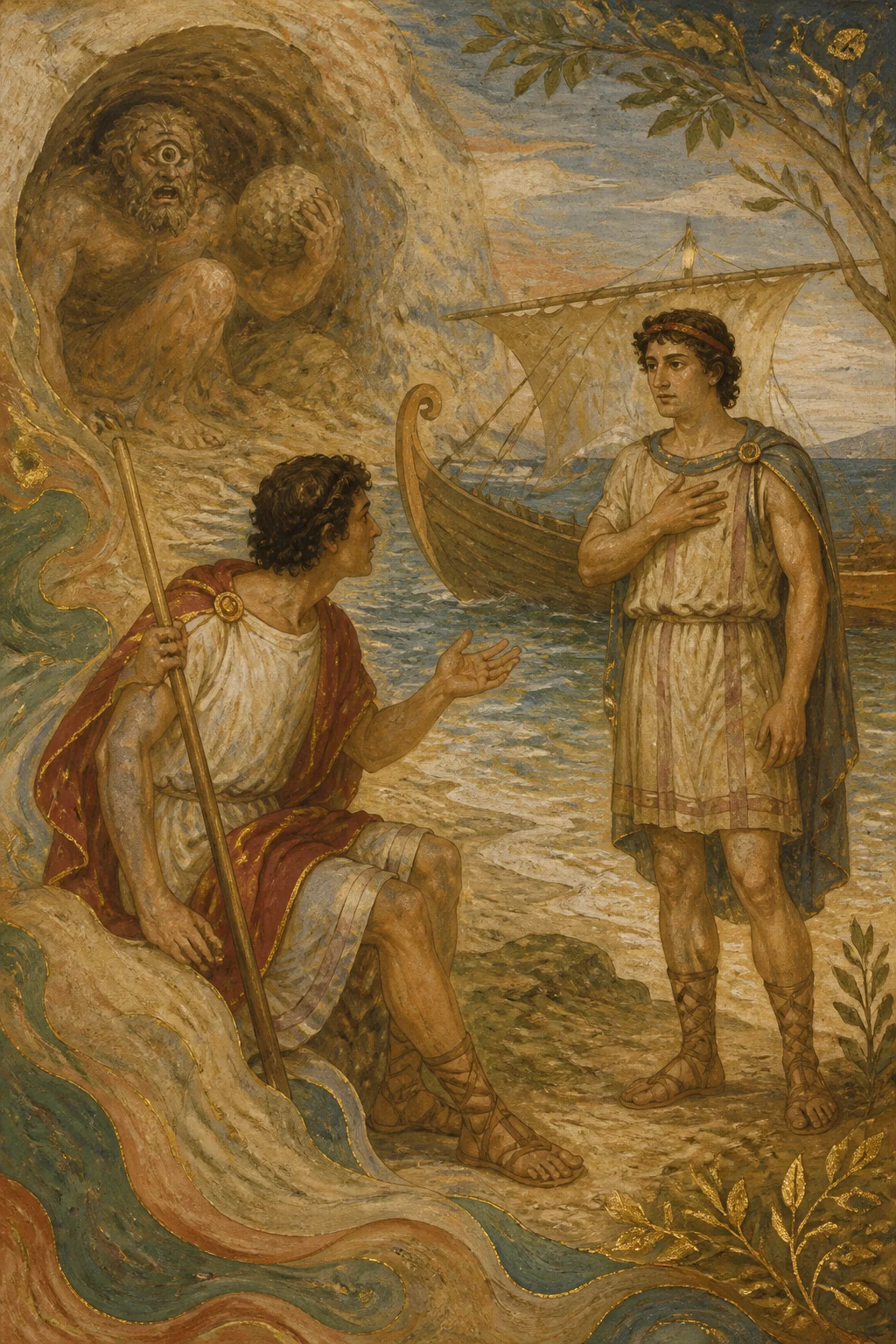
He approached the dreadful Polyphemus and said, “That single eye you bear in the middle of your forehead—Ulysses will take it from you!” He laughed. “Most foolish of prophets, you are wrong,” he said. “Another has already stolen it!” Thus he scorned the prophet whose truthful warnings went unheard, and either weighed down the shore with his enormous strides or, weary, returned to his shadowy cave.
A hill juts out into the sea, tapering to a long point, with the waves flowing round it on either side. The savage Cyclops climbed it and sat halfway up; his woolly flock followed without a shepherd. When he had laid before his feet the pine that served him as a staff, though fit to carry a ship’s sail-yards, and taken up his pipe of a hundred reeds joined together, all the mountains felt its shepherd’s music, and the waves felt it too. Hidden behind a rock, sitting in my Acis’ lap, I drank in his words from far away and remembered what I heard: “Galatea, whiter than the petals of snowy privet,
more blooming than the meadows, taller than a lofty alder, more shining than glass, more playful than a tender kid, smoother than shells polished by the ceaseless sea, more welcome than winter sunshine or summer shade, more splendid than fruit, more striking than a towering plane tree, clearer than ice, sweeter than a ripened grape, softer than swans’ feathers or curdled milk, and, if you would not flee, lovelier than a well-watered garden; yet you, that same Galatea, are fiercer than untamed bullocks, harder than an ancient oak, more treacherous than the waves, more unyielding than willow wands or white bryony vines, more immovable than these rocks, more violent than a river,
prouder than a peacock praised, more searing than fire, rougher than thistles, more savage than a mother bear, deafer than the sea, more pitiless than a snake trodden underfoot, and—what above all I wish I could take from you— swifter in flight not merely than a stag pursued by baying hounds, but even than the winds and the winged breeze! Yet if you knew me well, you would regret your flight, condemn your own delay, and strive to keep me.
I have caves, part of the mountain, their roofs of living rock, where neither the sun at the height of summer nor winter’s cold is felt; I have fruit weighing down the branches, and grapes like gold upon long trailing vines, and purple grapes as well: both kinds I keep for you. With your own hands you shall gather the soft strawberries that grow in woodland shade, and autumn cornel berries, and plums—not only those dark with black juice, but the finer kinds as well, golden as fresh wax.
With me as your husband, you shall never lack chestnuts or the fruit of the strawberry tree: every tree shall serve you. All this flock is mine; many more wander in the valleys, many the woods conceal, and many are sheltered in my caves. If you happened to ask, I could not tell you how many: only a poor man counts his flock! As for their excellence, take nothing on my word: you can see for yourself how their swollen udders scarcely fit between their legs.
There are lambs, the younger offspring, in the warm sheepfolds, and kids of the same age in other pens. I always have snow-white milk: some is set aside for drinking, and some is thickened with dissolved rennet. Nor shall you have only common pets, the easy gifts of fallow deer, hares, a goat, a pair of doves, or a nest taken from a treetop. I have found two playmates for you, so alike you could scarcely tell them apart, the cubs of a shaggy bear, high in the mountains.
I found them and said, ‘These we shall keep for my lady!’ Only lift your shining head now from the blue sea; come now, Galatea, and do not scorn my gifts. Surely I know myself: only lately I saw my reflection in clear water, and the sight of my beauty pleased me. Look how huge I am! Jupiter himself in heaven has no greater body—you are always telling me that some Jupiter or other reigns there. Abundant hair hangs over my fierce face and shades my shoulders like a grove.
And do not think it ugly that my body bristles thickly with stiff hair: a tree is ugly without its leaves; a horse is ugly unless a mane veils its golden neck. Feathers clothe birds; their own wool adorns sheep; a beard and shaggy body hair become a man. I have one eye in the middle of my forehead, but it is as large as a mighty shield. Well? Does not the great Sun see all this from heaven? Yet the Sun has just one orb!
And remember, my father rules in your own sea: I offer him as your father-in-law. Only take pity and hear your suppliant’s prayers! To you alone I yield. I, who scorn Jupiter, heaven, and the piercing thunderbolt, revere you, daughter of Nereus: your anger is fiercer than lightning. I could bear this scorn of yours more patiently if you fled from everyone. But why, rejecting the Cyclops, do you love Acis and prefer Acis to my embrace?
Let him please himself, then; let him please you too, Galatea, though I wish he did not. Only give me the chance, and he shall learn that my strength matches my enormous frame! I shall tear out his living entrails, scatter his mangled limbs over the fields and through your waves—so let him mingle with you! For I am burning, and, wounded, my fire blazes all the fiercer; I seem to bear Aetna, brought here with all its power, inside my breast—and you, Galatea, are unmoved.”
After these vain laments—for I could see it all— he rose, and like a bull maddened by the loss of his cow, could not stand still, but roamed the woods and familiar glades. Then the savage creature saw Acis and me, unsuspecting, fearing nothing of the kind. “I see you!” he shouted. “And I shall make this the last embrace you lovers share!” His voice was as mighty as an angry Cyclops’ ought to be: Aetna shuddered at the cry.
Terrified, I plunged beneath the nearby sea; the son of Symaethis turned his back and fled, crying, “Help me, Galatea, I beg you! Help me, my parents, and receive me, doomed to die, into your realms!” The Cyclops pursued him, tore a piece from the mountain, and hurled it. Though only the very tip of the rock struck Acis, it buried him completely. But I did the one thing fate allowed: I gave Acis the powers of his forefathers.
Crimson blood flowed from beneath the boulder, and within a little while its redness began to fade, turning first the color of a river muddied by rain, then slowly clearing. At my touch the boulder split, and tall, living reeds sprang up through its cracks; the hollow mouth of the rock rang with leaping water. Then, wonder of wonders, a youth suddenly rose waist-high, his new horns wreathed with bending reeds.
Except that he was larger, and his whole face sea-blue, he was Acis. Yet even so he was still Acis, transformed into a river, and its waters kept his ancient name.”