Prevod
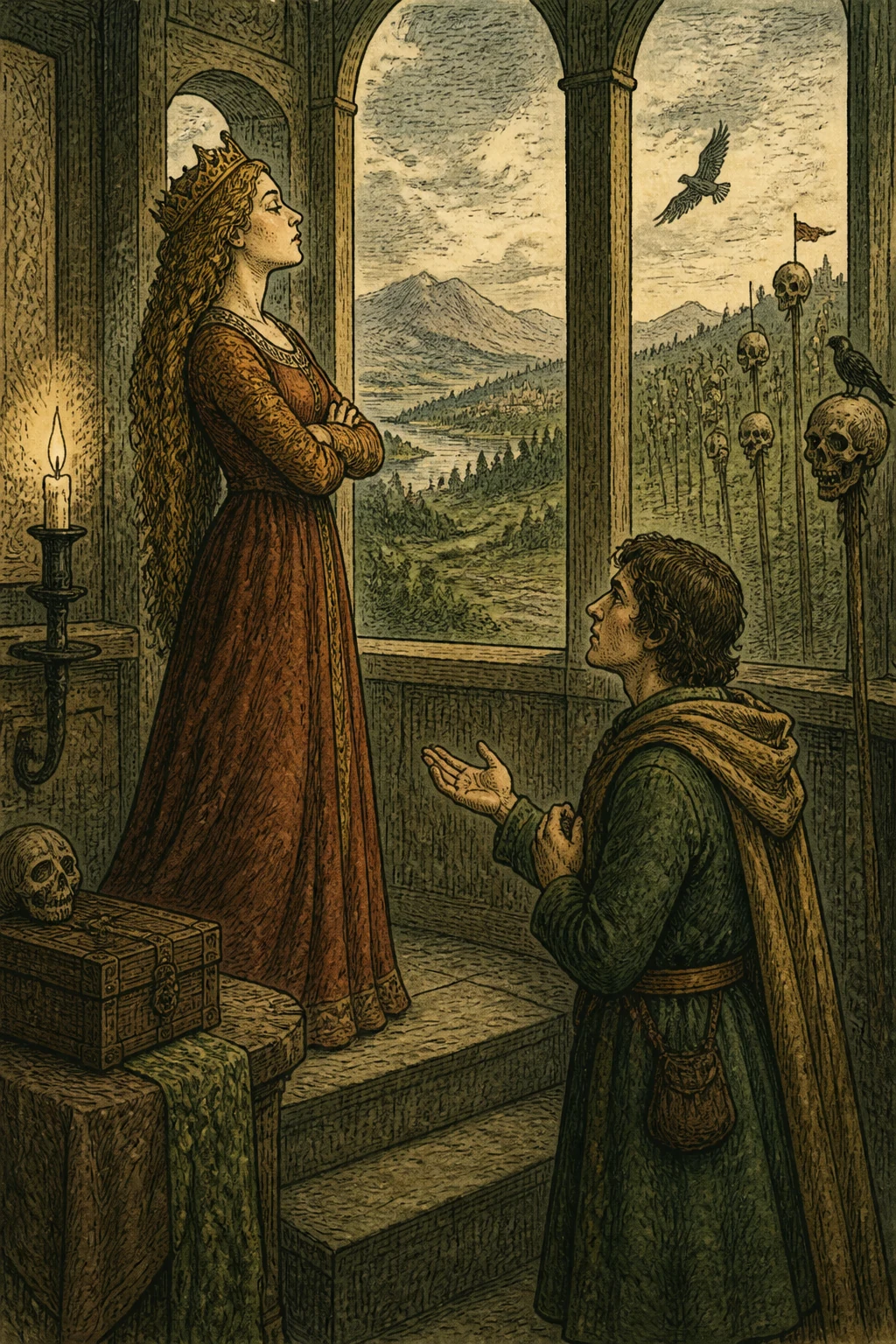
Once upon a time, as never before, there lived an emperor. His hair had turned gray, yet he had never been blessed with so much as a single child. The poor emperor was wasting away on his feet, longing to have, like other men, a son of his own, however puny, but all in vain. Then, in his old age, fortune took pity on him at last, and he was granted such a darling little boy that once you saw him you could never tire of looking at him. The emperor named him Aleodor. When the child was christened, the emperor gathered guests from east, south, and north to share in his joy. For three days and three nights the celebrations lasted, with such feasting and merrymaking that those who were there remembered it all their lives. The older the boy grew, the cleverer and more capable he became. Before long, however, the emperor stood at the brink of the grave. When his dying hour came, he took the child upon his knee and said, “My darling boy, God is calling me. The moment has come for me to pay the debt we all must pay. I can see that you will become a great man. Even after I am dead, my bones will rejoice in the grave at your deeds. As for ruling the empire, I have nothing to tell you, for I know that with your good sense you will govern it well. There is only one thing I must say: do you see that mountain over there? Never let temptation lead you to hunt upon it, for your life would be in danger. That mountain belongs to Half a Man Riding Half a Lame Hare, and whoever trespasses on his land does not escape unpunished.” Having spoken these words, his mouth gaped three times and he gave up his soul. He departed, as all living things upon the earth must do, as though he had never existed since the world began. His family mourned him, the boyars mourned him, and the people mourned him; but in the end they had to bury him. When Aleodor ascended his father’s throne, young though he was, he set the country’s affairs in order like a grown man. Everyone was content with his rule, and the people counted it a blessing from above to live in his time. Aleodor often went hunting to while away the hours left over from the business of his empire. He remembered what his father had told him and strove to honor his words faithfully. One day, however, lost in thought, he somehow strayed onto the misshapen creature’s land. He had scarcely gone ten or twenty paces before he found its owner standing before him. Now he was not so much afraid of having trespassed on that hideous, loathsome creature’s land as angry with himself for breaking the command his father had laid upon him with his dying breath. The monster said to him, “Every lawbreaker who crosses my boundary becomes my slave.” “First you must understand,” Aleodor answered, “that I entered your domain through carelessness and against my will, and that I mean you no harm.” “I took you for a different sort of fellow, but I see you mean to beg my pardon like all the other cowards.” “God forbid! I have told you the plain truth. If you want a fight, take your choice: shall we cross swords, strike at one another with maces, or wrestle?” “None of those. If you wish to escape punishment, there is only one way: you must go and bring me the daughter of Emperor Verdeș.” Aleodor tried to draw back, saying first that the affairs of his empire would not allow him to undertake so long a journey, then offering one excuse and another. But it was no use! The misshapen creature would hear none of it. He kept repeating that Aleodor must bring him Emperor Verdeș’s daughter if he wished to escape the disgrace of being called a thief and a trespasser upon another’s rights, and keep his life into the bargain. Aleodor knew he was at fault. Unwittingly though he had done it, he knew he had wronged the monster by setting foot on his estate. He also knew that with such a devil of a fellow it was best to give him what he wanted and be rid of him, and have no dealings with him afterward. At last he promised to carry out the task set before him. Half a Man Riding Half a Lame Hare knew that once Aleodor had given his word, he would keep it, being an honorable man, and said, “Go with God, and may He help you return successful.” Aleodor set out. As he went along, turning over in his mind how best to fulfill the task—for he had given his word—he came to the edge of a pond, where a pike lay on the bank, struggling for its life. When he saw it, he went to pick it up and satisfy his hunger with it. The pike said, “Do not kill me, handsome prince. Put me back in the water instead, and I shall be of great service to you when you least expect it.” Aleodor listened and put it back in the water. Then the pike said, “Take this little scale, and whenever you think of me, I shall be with you.” The young man went on, marveling at such an encounter. Soon he came upon a raven with a broken wing. He was about to kill it when the raven said, “Handsome prince, handsome prince, rather than burden your soul with my death, you would do better to bind my wing, for I shall be of great service to you.” Aleodor listened, for he was a brave and kindly lad, and bound its wing. As he was about to leave, the raven said, “Take this little feather, brave young man, and whenever you think of me, I shall be with you.” Aleodor took the feather and continued on his way. He had gone scarcely a thousand paces when he came upon a horsefly. Just as he was about to crush it beneath his foot, the horsefly said, “Spare my life, Emperor Aleodor, and I shall save you from death. Take this bit of down from my wing, and whenever you think of me, I shall be with you.” Hearing these words, and hearing himself called by name, Aleodor at once lifted his foot and let the horsefly go wherever it pleased. He journeyed on for no one knows how many days, until he reached the palace of Emperor Verdeș. Once there, he stood at the gate and waited for someone to come and ask his business. He waited one day, then two; but as for anyone coming to ask what he wanted—not a soul. On the third day Emperor Verdeș summoned his servants and gave them a scolding they would never forget. “How can a man stand at my gate for three days,” he said, “without any of you going to find out what he wants? Is this what I pay you wages for? Is this what I keep you here to prosper in my service for?” The servants shifted uneasily and did not know what to answer. At last they called Aleodor and brought him before the emperor. “What do you want, young man,” the emperor asked, “and why are you waiting at the gates of my court?” “What should I want, mighty emperor?” he answered. “I have been sent to ask for your daughter’s hand.” “Very well, my lad. But first we must make an agreement, for that is the custom at my court. You may hide wherever you please on three successive days. If my daughter finds you, your head will be cut off and set upon the one stake left without a head out of a hundred. But if she cannot find you, you shall receive her from me with all the honors due to an emperor.” “I trust in God, mighty emperor, that He will not let me perish. We may yet find something other than a man’s head to put upon that stake. Let us make the agreement.” And so they made their agreement, set it down in writing, and sealed it. The princess was brought before them, and they agreed that the next day he should hide himself as best he could. Once the bargain was struck, however, he was seized by a restlessness that tormented him more cruelly than death. He thought and thought about the best place to hide. After all, it was his own head at stake, not some trifle. As he walked along deep in thought, devising one plan after another, he remembered the pike. He took out the scale, looked at it, and thought of its owner, and lo and behold, the pike was there already, saying, “What do you wish of me, handsome prince?” “What should I wish? This is what has happened to me. Can you advise me what to do?” “Do not fret any longer. Leave it to me.” With a flick of its tail, it turned Aleodor into a little fish and hid him at the bottom of the sea among the other fish of his kind. When the princess rose, she took her spyglass and looked through it in every direction. But she could not see him. Whereas the others who had come to seek her hand had hidden in cellars, behind houses or haystacks, or in some deserted tower, Aleodor had hidden so well that the princess began to fear she would be beaten. Then it occurred to her to look through her spyglass into the sea, and she caught sight of him at the bottom among the little fish. It seems her spyglass was enchanted. “Come out of there, you rascal!” she said, laughing. “What have you gone and shriveled yourself up like that for? A great strapping fellow like you, turning yourself into a tiny fish and hiding at the bottom of the sea!” He had no choice but to come out. Then she said to the emperor, “Father, I think this young man may prove a match for me. And he is so charming and handsome! Even if I find him the third time, forgive him, Father, for he is no fool like the others. His very bearing shows there is something uncommon about him.” “We shall see,” the emperor answered.
The next day Aleodor thought of the raven. It was there before him in an instant and said, “What do you wish of me, master?” “Look, my dear fellow, this is what has happened to me. Can you advise me?” “Let us see what we can do.” It struck him with its wing, turned him into a young raven, and slipped him into a flock that had risen as high as the raging winds. As soon as the princess rose, she took her spyglass and searched everywhere for him again. She looked on the earth: he was not there. She searched the rivers and the seas: he was not there. The princess grew troubled. Then, toward noon, it occurred to her to look upward. She spotted him in the heights of heaven among the flock of ravens, shook her finger at him, and said, “Aha, you rogue! Come down from there, fellow! What have you turned yourself into a scrawny little bird for? You cannot escape me even in heaven.” He came down, for there was nothing else he could do. The emperor, too, began to marvel at Aleodor’s cleverness and to lend an ear to his daughter’s pleas. But since the agreement was that he should hide three times, the emperor said, “Wonderful indeed, but let us see where he will hide next.” Early on the third morning, Aleodor thought of the horsefly, which came in a flash. When he had explained what he wanted, the horsefly said, “Leave it to me, and if she finds you, you may hold me answerable!” It turned him into a nit and hid him in the princess’s braid without her feeling a thing. When the princess rose and took her spyglass, she searched for him all day, but could not find the slightest trace of him. She was beside herself, for she could sense him and felt sure he was somewhere close at hand, yet she could not see him. She searched through her spyglass in the sea, on the earth, and in the air, but saw him nowhere. Toward evening, worn out from so much searching, she cried, “Show yourself at last! I can feel that you are somewhere close by, but I cannot see you. You have beaten me; I shall be yours.” When he heard her admit defeat, he slipped gently down from her braid and showed himself. The emperor had no more to say and gave him his daughter. When they set out, he saw them off with great honor, accompanying them beyond the borders of his empire. On the road, they stopped to rest. After they had eaten a little, Aleodor laid his head in her lap and fell asleep. The emperor’s daughter kept gazing at him, drinking in his handsome face and fine bearing. Her heart urged her on, and she could not restrain herself: she kissed him. Aleodor woke and gave her such a slap that the dogs in Giurgiu could hear it. She wept and said, “Aleodor, my dear, what a heavy hand you have!” “I slapped you for what you did, for I did not win you for myself, but for the one who sent me.” “Well then, my dear fellow, why did you not tell me so before we left home? I should have known what to do. But never mind; even now it is not too late.” They set off again and arrived safe and sound at the home of Half a Man Riding Half a Lame Hare. “Here I am, having fulfilled my task,” Aleodor said, and made to leave. When the princess saw that horror, she shuddered with disgust and would not stay with him for anything in the world. The misshapen creature sidled up to her and began to flatter her with honeyed words, trying to win her over with kindness. But the princess said, “Get out of my sight, Satan, or I shall send you back to your mother, Hell, who spewed you onto the face of the earth!” The inhuman monster was melting with love for the princess. He stretched himself out with his belly on the ground and tried every coaxing word and lure to persuade her to take him as her husband. But heaven help him if he dared come near her! She held him rooted to the spot with her eyes from a good way off. She called him nothing but a devil, a monster, and a filthy creature. “Begone from the face of the earth, unclean thing, so the world may be rid of a plague and a pestilence like you!” He persisted a little longer, but when he found himself so thoroughly rebuffed, the monster burst with rage at being treated with such contempt by a mere wretch of a woman. Then Aleodor extended his dominion over the estate of Half a Man Riding Half a Lame Hare, took Emperor Verdeș’s daughter for his wife, and returned to his own empire. When his people and the crowds saw him coming back with a bride beside him so lovely that even the stars smiled upon her, they welcomed him with great rejoicing. He ascended the imperial throne once more, and they ruled and lived in happiness until the end of their days. And I mounted a saddle, and told you the tale just so.