Waltey
Kari v lesenem krilu
Norske Folkeeventyr · Peter Christen Asbjørnsen in Jørgen MoeO besedilu
Kari v lesenem krilu
- Vir
- Norske Folkeeventyr
- Avtor
- Peter Christen Asbjørnsen in Jørgen Moe
- Jezik branja
- English
- Jezik izvirnika
- Norsk
- Čas branja
- 22 min branja
- Obseg
- 18 strani
- Naslov izvirnika
- 019 Kari Træstak
O izvirniku
Norske Folkeeventyr
Norveške ljudske pravljice o gozdu, gorah, prebrisanih junakih in nevarnih bitjih. Bralni jezik je English, izvirnik pa prihaja iz vira Norske Folkeeventyr v jeziku Norsk.
Besedilo
Kari v lesenem krilu
Once upon a time there was a king who had lost his wife. By his queen he had a daughter who was so kind and so beautiful that no one could have been kinder or more beautiful. For a long time he mourned the queen, whom he had loved dearly, but at last he grew weary of living alone and married a widowed queen who also had a daughter. But this girl was as ugly and wicked as the other was kind and fair.
The stepmother and her daughter were jealous of the princess because she was so beautiful, but as long as the king was at home they dared not harm her, for he loved her dearly.
Some time passed, and then the king went to war with another king and set off on campaign. Now the queen thought she could do as she pleased, and she starved the princess and beat her and gave her no peace wherever she went. At last she thought everything too good for her, and set her to mind the cattle. So the princess went with the cattle and herded them in the woods and on the mountains. She was given little or nothing to eat, and grew pale and thin, and nearly all the time she wept and was sorrowful.
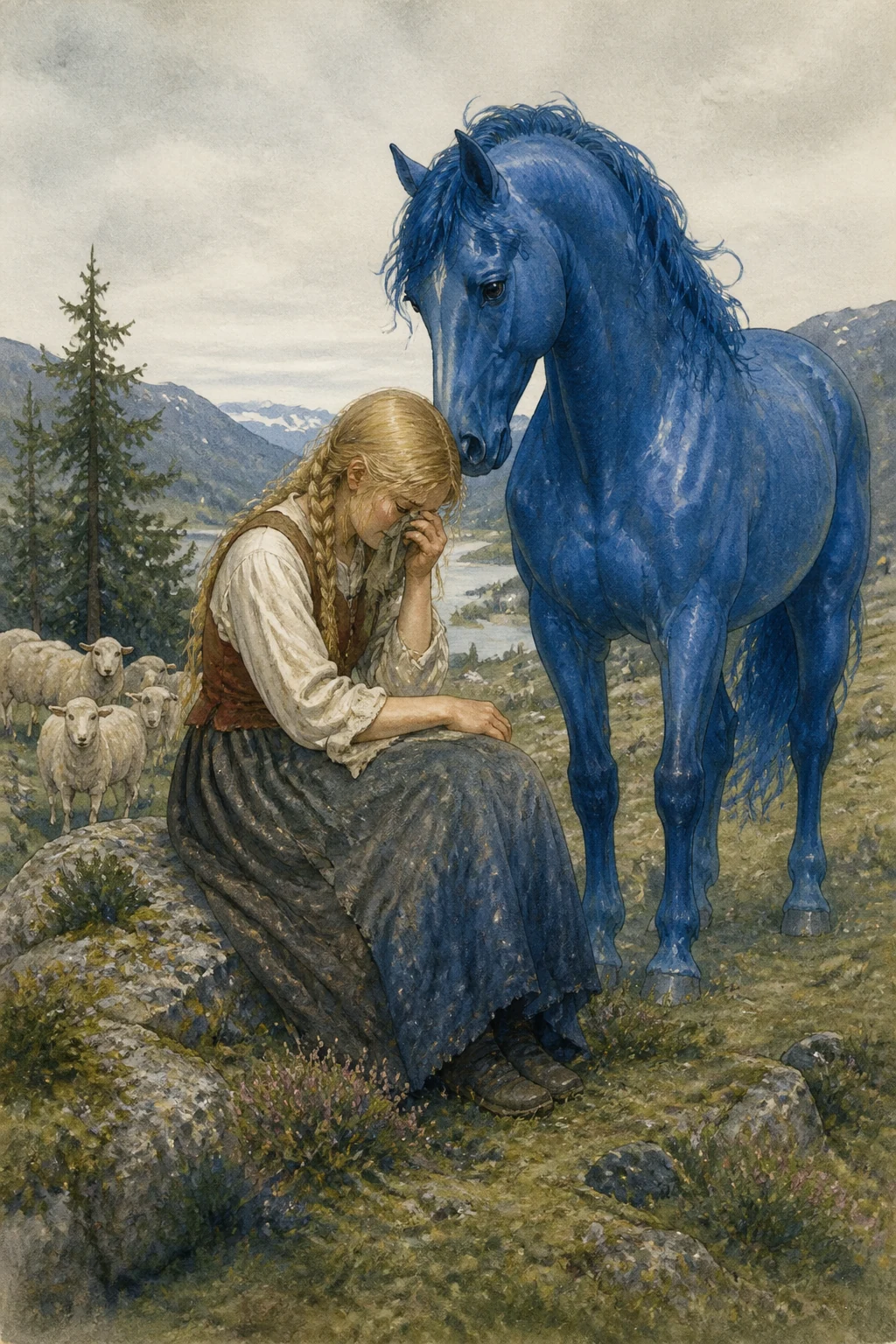
Among the cattle was a great blue ox, whose coat was always sleek and shining. He often came up to the princess and let her stroke him. Once, when she was sitting weeping and sorrowing again, he came over and asked why she was always so sad. She said nothing, but went on crying. “Yes,” said the ox, “I know well enough, even if you will not tell me. You are crying because the queen is cruel to you and is all but starving you to death.
“But you need not worry about food, for in my left ear there is a cloth, and if you take it out and spread it open, you may have as many dishes as you wish.” She did so, taking the cloth and spreading it on the grass, and it laid itself with the finest dishes anyone could wish for: there was wine and mead and sweet cake as well. She soon grew plump again, with rosy cheeks and a fair complexion, so that the queen and her scrawny daughter turned all manner of colours with vexation. The queen could not understand how her stepdaughter could come to look so well on such poor fare;
so she told a maid to follow her into the woods and watch her, to find out how it came about, for she believed one of the servants was giving her food. The maid followed her into the woods and kept watch, and saw the stepdaughter take the cloth from the blue ox’s ear and spread it out, and saw it lay itself with the finest dishes, which the stepdaughter ate and enjoyed. The maid went home and told the queen. Now the king returned, having defeated the other king against whom he had gone to war. There was great rejoicing throughout the palace, and no one was happier than the king’s daughter. But the queen took to her bed and paid the doctor a great deal of money to say that she could not recover unless she had some meat from the blue ox to eat. Both the princess and the servants asked the doctor whether nothing else would help, and pleaded for the ox, for everyone was fond of him, and they said there was not his equal in the whole kingdom. But no, he must be slaughtered and he would be slaughtered; there was no other remedy. When the princess heard this, she was deeply distressed and went down to the byre to see the ox. He too stood with his head hanging, looking so sorrowful that she began to cry. “What are you crying for?” asked the ox. Then she told him that the king had come home again, and that the queen had taken to her bed, and had made the doctor say she could not recover unless she had some meat from the blue ox to eat, and now he was to be slaughtered. “Once they have killed me, they will soon take your life as well,” said the ox;
“if you agree with me, we shall leave tonight.” The princess thought it a dreadful thing to leave her father, but it was worse still to live under the same roof as the queen, and so she promised the ox that she would come.
That evening, when everyone else had gone to bed, the princess stole down to the byre to the ox, and he took her on his back and hurried away as fast as he could. When the servants got up at dawn to slaughter the ox, he was gone, and when the king rose and asked for his daughter, she too was missing. He sent messengers in every direction to search for them and had inquiries made outside the churches, but no one had seen anything of them. Meanwhile the ox travelled through many lands with the princess on his back, until they came to a great copper forest, where the trees and branches and leaves and flowers and everything else were made of copper.
But before they entered the forest, the ox said to the princess, “Once we are in the forest, you must take great care not to touch so much as a leaf, or it will be the end of both you and me, for a troll with three heads lives here, and the forest belongs to him.” Oh, goodness, she would take great care and touch nothing at all. She was very careful, bending aside to avoid the branches and pushing them away with her hands, but the forest was so thick that it was almost impossible to get through, and for all her care she could not help tearing off a leaf, which remained in her hand.
“Oh, oh, what have you done?” said the ox. “Now I must fight for our lives; but keep the leaf safe.” Soon afterwards they reached the end of the forest, and a troll with three heads came rushing towards them. “Who is touching my forest?” said the troll. “It is as much mine as yours,” said the ox. “Then we shall fight for it!” screamed the troll. “So be it,” said the ox. They charged at one another and fought, and the ox gored and kicked with all his might, but the troll fought back just as fiercely, and it took the whole day before the ox overcame him. By then he was so covered in wounds and so weak that he could scarcely walk.
So they had to rest for a day, and the ox told the princess to take the horn of ointment hanging from the troll’s belt and rub him with it. Then he recovered, and the next day they went on their way again. They travelled for many, many days, until at last they came to a silver forest, where the trees and branches and leaves and flowers and everything else were made of silver.
Before the ox entered it, he said to the princess, “Once we are in this forest, for God’s sake take great care. You must touch nothing at all, nor tear off so much as a leaf, or it will be the end of both you and me. A troll with six heads owns this forest, and I do not think I can master him.” “No,” said the princess, “I shall take care and touch nothing you do not want me to touch.” But when they entered the forest, it was so thick and close that they could scarcely get through. She was as careful as she could be, bending aside to avoid the branches and pushing them away with her hands, but every moment the branches struck her in the eyes, and for all her care she could not help tearing off a leaf.
“Oh, oh, what have you done?” said the ox. “Now I must fight for our lives, for this troll has six heads and is twice as strong as the other. But look after the leaf and keep it safe.” All at once the troll appeared. “Who is touching my forest?” he said. “It is as much mine as yours,” said the ox. “Then we shall fight for it!” screamed the troll. “So be it,” said the ox, and rushed at the troll, goring out his eyes and driving his horns right through him, so that his guts spilled out. But the troll fought back just as fiercely, and it took three whole days before the ox killed him. By then he was so weak and wretched that he could scarcely move, and so covered in wounds that blood streamed from him. He told the princess to take the horn of ointment hanging from the troll’s belt and rub him with it. She did so, and he recovered;
but they had to stay there and rest for a week before he was strong enough to go any farther. At last they set out again, but the ox was still weak, and at first they made slow progress. To spare him, the princess said that she was young and light on her feet and could easily walk, but he would not hear of it: she had to sit on his back again. They travelled for a long time and through many lands, and the princess had no idea where they were going, but at last they came to a golden forest. It was so splendid that gold dripped from it, and the trees and branches and flowers and leaves were all of pure gold.
Here it was just as it had been in the copper forest and the silver forest. The ox told the princess that she must on no account touch anything, for a troll with nine heads owned the forest. He was much bigger and stronger than the other two together, and the ox did not think he could overcome him.
No, she would be sure to take care and touch nothing at all; he could depend upon it. But when they entered the forest, it was even thicker than the silver forest, and the farther they went, the worse it became. The trees grew thicker and thicker and closer and closer, until at last she thought they could not possibly get through. She was so terribly afraid of tearing anything off that she twisted and bent this way and that to avoid the branches and pushed them away with her hands. But every moment they struck her in the eyes, so that she could not see where she was reaching, and before she knew it she had a golden apple in her hand. She was so frightened that she wept and wanted to throw it away, but the ox told her to keep it and put it safely by. He comforted her as best he could, but he thought it would be a hard battle, and doubted whether it would end well.
All at once the troll with nine heads appeared, and he was so hideous that the princess scarcely dared look at him. “Who is touching my forest?” he screamed. “It is as much mine as yours,” said the ox. “Then we shall fight for it!” screamed the troll. “So be it,” said the ox. They charged at one another and fought, and it was so dreadful to see that the princess almost fainted. The ox gored out the troll’s eyes and drove his horns right through him, so that his entrails spilled out, but the troll fought back just as fiercely, for whenever the ox gored one head to death, the others breathed life into it again. It took a whole week before he managed to kill him. By then he was so utterly weak and wretched that he could not move at all. He had wounds all over him, and could not even tell the princess to take the horn of ointment from the troll’s belt and rub him with it. But she did so all the same, and he recovered, though they had to stay there and rest for three weeks before he could walk again.
Then they set off slowly, for the ox said they had a little farther to go, and they crossed many great ridges covered with thick forest. They went on like this for some time, and then climbed into the mountains. “Can you see anything?” asked the ox. “No, I see nothing but the sky and the wild mountains,” said the princess.
When they climbed higher, the mountains grew more level, so that they could see farther around them. “Can you see anything now?” asked the ox. “Yes, I can see a little castle, far, far away,” said the princess. “It is not so little as you think,” said the ox. At last they came to a great hill with a sheer rock face.
“Can you see anything now?” asked the ox. “Yes, now I can see the castle close by, and now it is much, much bigger!” said the princess. “That is where you must go,” said the ox. “Just below the castle there is a pigsty, and that is where you must stay. When you get there, you will find a wooden skirt. Put it on and go up to the castle, and say your name is Kari Woodenskirt and ask for work.
“But now you must take your penknife and cut off my head. Then you must skin me, roll up the hide, and lay it beneath that rock face, with the copper leaf and the silver leaf and the golden apple inside it. There is a stick standing over by the rock; whenever you want anything from me, just knock on the rock face with it.” At first she would not do it at all, but when the ox said it was the only thanks he wanted for what he had done for her, she had no choice. Bitterly though it grieved her, she toiled and cut away at the great beast with her knife until she had taken off his head and hide. Then she folded the hide beneath the rock face and put the copper leaf, the silver leaf, and the golden apple inside it.
When she had done this, she went over to the pigsty, weeping and sorrowing all the way. There she put on the wooden skirt and went up to the royal palace;
when she came into the kitchen, she asked for work and said her name was Kari Woodenskirt. Yes, said the cook, she could certainly have work; she could stay and wash the dishes, for the one who had done it before had just gone away. “But when you grow tired of being here, I suppose you will go your way too.” No, she certainly would not.
She proved quite a good hand at washing dishes. On Sunday there were to be visitors at the palace, and Kari asked if she might take washing water up to the prince. But the others laughed at her and said, “What would you want up there?
“Do you think the prince will have anything to do with you, looking as you do?” But she would not give in, and kept asking until at last they gave her leave. As she went up the stairs, her wooden skirt made such a dreadful clatter that the prince came out and asked, “What sort of creature are you?” “I was to bring you some washing water,” said Kari. “Do you think I would use washing water you had brought?” said the prince, and threw the water over her. She had to put up with that, but afterwards she asked leave to go to church. This too was granted, for the church was close by.
But first she went to the rock and knocked with the stick that stood there, just as the ox had told her. At once a man came out and asked what she wanted. The princess said that she had been given leave to go to church and hear the sermon, but had no clothes to wear.
Then he brought her a dress that shone like the copper forest, and she was given a horse and saddle as well. When she came to church, she was so beautiful and so splendidly dressed that everyone wondered who she was, and scarcely anyone listened to what the parson said, for they were looking at her instead. The prince himself fell so deeply in love that he did not take his eyes off her for a moment.
Just as she was leaving the church, the prince ran after her and drew the church door shut behind her, catching one of her gloves in his hand. As she went to mount her horse, the prince came after her again and asked where she was from. “I am from Washingwaterland,” said Kari, and while the prince took out the glove to return it to her, she said:
“Light before and dark behind, let the prince no longer see where today my ride takes me.” The prince had never seen the like of that glove, and he travelled far and wide, asking after the land from which the noble lady who had left her glove behind had said she came. But no one could tell him where it lay.
The next Sunday someone had to take a towel up to the prince. “Oh, may I take it up?” said Kari. “What good would that do?” said the others in the kitchen. “You saw how you fared last time.” Kari would not give in, but kept asking until they gave her leave, and then she ran up the stairs with her wooden skirt clattering. The prince rushed out, and when he saw that it was Kari, he snatched the towel from her and flung it straight in her face. “Be off with you, you ugly troll!” he said. “Do you think I would use a towel you have touched with those black fingers of yours?” Afterwards the prince went to church, and Kari also asked leave to go. They asked what she wanted at church, when she had nothing to wear but that wooden skirt and was so black and ugly. But Kari said the parson preached so beautifully, and what he said did her so much good, that at last they gave her leave. She went to the rock and knocked, and the man came out and gave her a dress much finer than the first. It was covered in silver and shone like the silver forest, and she was also given a magnificent horse with a silver-embroidered cloth and a silver bridle.
When the princess reached the church, the congregation were still standing outside on the slope. Everyone wondered who she could be, and the prince was there at once, offering to hold her horse while she dismounted. But she sprang down and said there was no need, for the horse was so well trained that it stood still when she commanded it and came when she called. Then they all went into church, but scarcely anyone listened to what the parson said, for they were looking at her instead, and the prince fell even more deeply in love than before. When the sermon was over and she had left the church and was about to mount her horse, the prince came up again and asked where she was from. “I am from Towelland,” said the princess, and just then she dropped her riding whip. As the prince stooped to pick it up, she said:
“Light before and dark behind, let the prince no longer see where today my ride takes me!” Away she went again, and the prince could not tell what had become of her. He travelled far and wide, asking after the land she had said she came from, but no one could tell him where it lay, and once again the prince had to make the best of it.
The next Sunday someone had to take a comb up to the prince. Kari asked leave to take it, but the others reminded her of what had happened last time, and scolded her for wanting to show herself to the prince, black and ugly as she was in her wooden skirt. But she would not stop asking until they let her take the comb up to him. When she came clattering up the stairs again, the prince rushed out, took the comb and threw it after her, and told her to be off. Afterwards the prince went to church, and Kari asked leave to go too. Again they asked what she wanted there, when she was so ugly and black and had no clothes fit to be seen in. The prince or someone else might catch sight of her, they said, and then there would be trouble for her and for them as well. But Kari said they would have other things to look at, and she would not stop asking until she was allowed to go.
Now it happened just as it had the other two times. She went to the rock and knocked with the stick, and the man came out and gave her a dress even more magnificent than the others. It was almost entirely of pure gold and studded with diamonds, and she was also given a magnificent horse with a gold-embroidered cloth and a golden bridle.
When the princess reached the church, the parson and the congregation were still standing on the slope, waiting for her. The prince came running to hold her horse, but she sprang down and said:
“No, thank you, there is no need, for my horse is so well trained that it stands still when I command it.” Then they all hurried into church, and the parson climbed into the pulpit, but no one listened to what he said, for they were looking at her instead and wondering where she came from. The prince was even more deeply in love than on either of the two previous Sundays; he noticed nothing, but only gazed at her.
When the sermon was over and the princess was about to leave the church, the prince had spread a patch of raw tar in the church porch, meaning to offer her his help in crossing it. But she paid it no heed, set her foot right in the middle of the tar, and sprang across, leaving one of her golden shoes stuck fast. When she had mounted her horse, the prince came rushing out of the church and asked where she was from. “From Combland,” said Kari; but when the prince tried to hand her the golden shoe, she said:
“Light before me, dark behind, let the prince no longer see where today my ride takes me.” This time too the prince could not tell what had become of her, and for a long time he travelled about the world asking after Combland. But as no one could tell him where it was, he had it proclaimed that he would marry whoever could wear the golden shoe. Women both fair and ugly came from far and wide, but none had a foot small enough to put on the golden shoe. At last Kari Woodenskirt’s wicked stepmother came with her daughter, and the shoe fitted her. But she was ugly and looked so ill-tempered that the prince was very reluctant to keep his promise. Nevertheless, preparations were made for the wedding, and she was dressed as a bride. But as they rode to church, a little bird sat in a tree and sang:
“A piece of heel and a piece of toe; Kari Woodenskirt’s shoe is full of blood!” When they looked, they found the bird had spoken the truth, for blood was trickling out of the shoe. Then all the serving girls and all the women in the palace had to come forward and try on the shoe, but it would fit none of them. “But where is Kari Woodenskirt?” asked the prince, when all the others had tried it, for he understood birdsong well and remembered what the bird had said. “Oh, her!” said the others. “There is no use in her coming forward, for she has feet as big as a horse’s.” “That may be,” said the prince, “but since all the others have tried it, Kari may as well have a turn too!” “Kari!” he called through the door, and Kari came up the stairs, her wooden skirt clattering as though a whole regiment of dragoons were charging up. “Now you shall try on the golden shoe and become a princess too!” said the other girls, laughing and mocking her. Kari picked up the shoe and slipped her foot into it with perfect ease, cast off her wooden skirt, and there she stood in her golden dress, shining all over, with the matching golden shoe on her other foot.
When the prince recognised her, he was so happy that he ran to embrace and kiss her, and when he learned that she was a king’s daughter, he was happier still. Then they held the wedding, and snip, snap, snout, this tale is told out.
Izvirnik
019 Kari Træstak
Naslednje strani prikazujejo izvirno besedilo za primerjavo.
Der var engang en Konge, som var bleven Enkemand. Efter sin Dronning havde han en Datter, som var saa snild og saa deilig, at Ingen kunde være mere snild og deilig. Han gik nu længe og sørgede over Dronningen, som han havde holdt meget af, men tilsidst blev han kjed af at leve eenlig, og giftede sig med en Enkedronning, som ogsaa havde en Datter; men denne var ligesaa styg og slem som den anden var snild og vakker.
Stedmoderen og hendes Datter vare misundelige paa Kongsdatteren, fordi hun var saa deilig, men saalænge som Kongen var hjemme, turde de ikke gjøre hende Noget, for han holdt meget af hende. Der gik nu hen en Tid, saa fik han Krig med en anden Konge og drog ud i Leding, da syntes Dronningen hun kunde gjøre hvad hun vilde, og saa baade sultede og slog hun Kongsdatteren og var efter hende i hver Krog. Tilsidst syntes hun at Alting var for godt til hende, og saa satte hun hende til at gjæte Kreaturene. Hun gik da med Kreaturene og gjætede dem paa Skoven og Fjeldet. Mad fik hun Lidet eller Intet af, bleg og maver blev hun og næsten altid græd hun og var bedrøvet.
I Buskaben var der en stor, blaa Stud, som bestandig holdt sig saa peen og blank, og ofte kom den hen til Kongsdatteren og lod hende kjæle sig. Engang, som hun sad og græd og var bedrøvet igjen, kom den hen til hende og spurgte hvorfor hun bestandig var saa sørgmodig. Hun svarede ingen Ting, men blev ved at græde. „Ja,“ sagde Studen, „jeg veed det nok, endda du ikke vil sige mig det, du græder fordi Dronningen er slem imod dig og fordi hun er rede at sulte dig ihjel.
Men Mad behøver du ikke at sørge for, thi i det venstre Øret mit ligger der en Dug, og naar du tager og breder den ud, kan du faae saa mange Retter du vil. Det gjorde hun, tog Dugen og bredte den ud paa Græsset, og saa dækkede den op med de deiligste Retter, Nogen kunde ønske sig: der var baade Viin og Mjød og Sødkage. Hun kom nu snart i Huld igjen og blev saa rund og rød og hvid, at Dronningen og hendes tørskranglede Datter bleve baade blaae og blege af Ærgrelse over det. Dronningen kunde slet ikke begribe hvorledes Steddatteren kunde komme til at see saa godt ud paa saa daarlig Kost; saa sagde hun til en Terne, at hun skulde gaae efter hende i Skoven og passe paa og see, hvorledes det hang sammen, for hun troede, at nogen af Tjenestefolkene gav hende Mad. Ternen
gik da efter hende i Skoven og passede paa, og saa fik hun see, at Steddatteren tog Dugen ud af Øret paa den blaae Studen og bredte den ud, og at den dækkede op med de deiligste Retter, som Steddatteren spiste og gjorde sig tilgode med. Det gik Ternen hjem og fortalte Dronningen. Nu kom Kongen hjem og havde vundet over den anden Konge, han havde været i Leding imod; der blev da stor Glæde over hele Slottet, og Ingen var gladere end Kongens Datter. Men Dronningen lagde sig syg og betalte Doktoren mange Penge for at han skulde sige, hun ikke kunde blive frisk igjen, uden hun fik Kjød af den blaae Studen at spise. Baade Kongsdatteren og Folkene spurgte nu Doktoren, om ikke noget Andet kunde hjælpe,
og bade for Studen, for Alle holdt af den, og de sagde, at der ikke gaves Mage til Stud i hele Riget; men nei, den maatte slagtes og den skulde slagtes, der var intet andet Raad. Da Kongsdatteren hørte det, blev hun meget bedrøvet og gik ned i Fjøset til Studen. Den stod der ogsaa og hængte med Hovedet og saa saa sørgmodig ud, at hun begyndte at græde over det. „Hvad græder du for?“ sagde Studen. Saa fortalte hun, at Kongen var kommen hjem igjen, og at Dronningen havde lagt sig syg, og at hun havde faaet Doktoren til at sige, at hun ikke kunde blive frisk, dersom hun ikke fik Kjød af den blaae Studen at spise, og nu skulde han slagtes. „Faaer de først dræbt mig, tage de snart Livet af dig ogsaa,“ sagde Studen;
„hvis du synes som jeg, saa reise vi vor Vei i Nat.“ Ja, Kongsdatteren syntes nok det var slemt at reise bort fra sin Fader, men det var endda værre at være i Huus med Dronningen, og saa lovede hun Studen, at hun skulde komme. Om Kvelden, da alle de Andre havde lagt sig, listede Kongsdatteren sig ned i Fjøset til Studen, og saa tog den hende paa Ryggen og foer af Gaarde det forteste, den kunde. Da nu Folkene kom op i Otten om Morgenen og skulde slagte Studen, var den væk, og da Kongen kom op og spurgte efter Datteren, var hun ogsaa borte. Han sendte Bud ud paa alle Kanter for at lede efter dem og lyste efter dem fra Kirkebakken, men der var Ingen, som havde seet Noget til dem. Imidlertid foer Studen gjennem mange Lande med Kongsdatteren paa
Ryggen, og saa kom de til en stor Kobberskov, hvor baade Træer og Grene og Blade og Blomster og Alting var af Kobber. Men førend de reiste ind i Skoven, sagde Studen til Kongsdatteren: „Naar vi nu kommer ind i Skoven, maa du tage dig vel i Agt, saa du ikke rører et Blad af den engang, ellers er det forbi baade med mig og med dig, for her boer et Trold med tre Hoveder, som eier den.“ Nei kors, hun skulde tage sig vel vare og ikke røre Noget. Hun var saa forsigtig og bøiede sig til Side for Grenene, og skjød dem bort med Hænderne, men det var saa trangskovet, at det næsten ikke var muligt at komme frem, og hvorledes hun end bar sig ad, kom hun ligevel
til at rive af et Blad, som hun beholdt i Haanden sin. „Au, au, hvad gjorde du nu?“ sagde Studen, „nu gjælder det at slaaes paa Liv og Død; men gjem bare Bladet vel.“ Strax efter var de ved Enden af Skoven, og da kom der et Trold farende med tre Hoveder. „Hvem er det, som rører min Skov?“ sagde Troldet. „Den er ligesaameget min som din,“ sagde Studen. „Ja, det skal vi nappes om,“ skreg Troldet. „Kan saa det,“ sagde Studen. Saa rendte de sammen og sloges, og Studen den stangede og sparkede af alle Livsens Kræfter, men Troldet slog lige godt, og det varede hele Dagen førend Studen fik Bugt med det, og da var den saa fuld af Saar og saa ussel, at den næsten ikke orkede at gaae.
Saa maatte de hvile over en Dag, og saa sagde Studen til Kongsdatteren, at hun skulde tage det Smurningshornet, som hang ved Bæltet til Troldet og smøre den med; da kom den sig, og Dagen efter ranglede de afsted igjen. De reiste nu i mange, mange Dage, og saa kom de langt om længe til en Sølvskov; der vare baade Træer og Grene og Blade og Blomster og Alting af Sølv.
Førend Studen gik ind i den, sagde den til Kongsdatteren: „Naar vi nu komme ind i denne Skoven, maa du for Guds Skyld tage dig vel i Agt; du maa slet ikke røre nogen Ting og ikke rive af saa meget som et Blad, for ellers er det forbi baade med dig og med mig; her er et Trold med sex Hoveder, som eier den, og det troer jeg ikke jeg kan raade med.“ „Nei,“ sagde Kongsdatteren, „jeg skal nok tage mig vare og ikke røre ved det, du ikke vil, jeg skal røre.“ Men da de kom ind i Skoven, var den saa tæt og saa trang, at de næsten ikke kunde komme frem. Hun var saa forsigtig som hun kunde, og bøiede sig til Siden for Grenene og skjød dem bort foran sig med Hænderne, men hvert Øieblik slog Grenene hende i Øinene, og hvorledes hun end bar sig ad, saa kom hun til at rive
af et Blad. „Au, au, hvad gjorde du nu?“ sagde Studen; „nu gjælder det at slaaes paa Liv og Død, for dette Troldet har sex Hoveder og er dobbelt saa stærkt som det andet; men pas bare paa Bladet og gjem det vel.“ Ret som det var, saa kom Troldet: „Hvem er det, som rører ved min Skov?“ sagde det. „Den er ligesaameget min som din,“ sagde Studen. „Det skal vi nappes om,“ skreg Troldet. „Kan saa det,“ sagde Studen, og røg paa Troldet og stangede ud Øinene paa det og kjørte Hornene tværs igjennem det, saa at Tarmene randt ud, men det slog lige godt, og det varede i tre samfulde Dage, førend Studen fik Livet af
det. Men da var den ogsaa saa ussel og elendig, at den med Nød og Neppe kunde røre sig og saa fuld med Saar, at Blodet randt af den. Saa sagde den til Kongsdatteren, at hun skulde tage Smurningshornet, som hang ved Bæltet paa Troldet, og smøre den med. Det gjorde hun, og saa kom den sig; men de maatte ligge over og hvile en Uge, førend den orkede at gaae længer. Endelig gav de sig paa Veien igjen, men Studen var daarlig endda, og det gik kun smaat i Begyndelsen. For at spare den, sagde Kongsdatteren, at hun var ung og let paa Foden, hun kunde gjerne gaae, men det fik hun slet ikke Lov til, hun maatte sætte sig op paa Ryggen hans igjen. Saa reiste de i
lang Tid og gjennem mange Lande, og Kongsdatteren vidste slet ikke, hvor det bar hen, men langt om længe kom de til en Guldskov: den var saa gjild, at Guldet dryppede af den, og baade Træer og Grene og Blomster og Blade vare af bare Guld. Her gik det lige ens som i Kobberskoven og Sølvskoven. Studen sagde til Kongsdatteren, at hun slet ikke paa nogen Maade maatte røre ved den, for der var et Trold med ni Hoveder, som eiede den, det var meget større og stærkere end begge de andre tilsammen, og den troede slet ikke den kunde faae Bugt med det.
Nei, hun skulde nok passe sig for det og slet ikke røre ved den, det kunde han nok vide. Men da de kom ind i Skoven, saa var den endda tættere end Sølvskoven, og jo længer de kom, desto værre blev det: Skoven blev tættere og tættere og trangere og trangere, og tilsidst syntes hun, de ikke paa nogen Sæt eller Viis kunde komme frem; hun var nu saa inderlig bange for at rive af Noget, at hun sad og vendte og bøiede sig baade hid og did for Grenene og skjød dem bort foran sig med Hænderne, men hvert Øieblik slog de hende i Øinene, saa at hun ikke kunde see hvor hun greb hen, og førend hun vidste af det, havde hun et Guldæble i Haanden. Hun var nu saa hjertelig angest, at hun græd og vilde kaste det igjen; men Studen sagde, hun skulde
beholde det og gjemme det vel, og trøstede hende saa godt han kunde, men han troede, det vilde blive en haard Dyst, og han tvivlede om, det vilde gaae godt. Ret som det var, saa kom Troldet med de ni Hoveder, det var saa fælt, at Kongsdatteren næsten ikke turde see paa det. „Hvem er det, som rører min Skov?“ skreg det. „Den er ligesaameget min som din,“ sagde Studen. „Det skal vi nappes om,“ skreg Troldet. „Kan saa det,“ sagde Studen, og saa rendte de sammen og sloges, og det var saa fælt at see paa, at Kongsdatteren var nær ved at daane. Studen stangede ud Øinene paa det og kjørte Hornene tværs igjennem det, saa at Indvoldene væltede ud, men Troldet slog lige godt, for naar Studen fik stanget ihjel et Hoved, blæste de øvrige Liv i
det igjen, og det varede en heel Uge, førend den var istand til at faae Livet af det. Men da var den saa reent ussel og elendig at den slet ikke kunde røre sig; Saar havde den over det Hele; den kunde ikke engang sige saameget som at Kongsdatteren skulde tage Smurningshornet ved Troldets Bælte og smøre den med. Men hun gjorde det alligevel, og da kom den sig ogsaa, men de maatte ligge over og hvile i tre Uger, førend den var istand til at gaae igjen.
Da reiste de saa smaat afsted, for Studen sagde at de skulde lidt længere frem, og saa kom de over mange store Aaser med tyk Skov. Dette varede nu en Stund, saa kom de op i Fjeldet. „Seer du Noget?“ spurgte Studen. „Nei, jeg seer ikke andet, end Himmel og vilde Fjeldet,“ sagde Kongsdatteren. Da de kom høiere op, blev Fjeldet slettere, saa de kunde see videre om sig. „Seer du Noget nu?“ sagde Studen. „Ja, jeg seer et lidet Slot, langt, langt borte,“ sagde Prindsessen. „Det er nok ikke saa lidet endda,“ sagde Studen. Langt om længe kom de til en stor Haug, hvor der var en tværbrat Bjergvæg.
„Seer du Noget nu?“ sagde Studen. „Ja, nu seer jeg Slottet tæt ved, nu er det meget, meget større!“ sagde Kongsdatteren. „Did skal du,“ sagde Studen; „strax nedenfor Slottet er der et Grisehuus, hvor du skal være. Naar du kommer did, finder du en Træstak der, den skal du tage paa dig og gaae frem til Slottet og sige, du hedder Kari Træstak og bede om Tjeneste. Men nu skal du tage Pennekniven din og skjære Hovedet af mig med, saa skal du flaae mig og virre Huden sammen og lægge den under Bjergvæggen der, og inde i Huden skal du lægge Kobberbladet og Sølvbladet og Guldæblet. Borte ved Bjerget staaer der en Kjæp; naar du vil mig Noget, saa banker du bare paa Bjergvæggen her med den.“ I Begyndelsen vilde hun slet ikke gjøre det, men da Studen sagde,
at det var den eneste Tak, han vilde have for det, han havde gjort mod hende, saa kunde hun ikke Andet. Hvor inderlig ondt det end gjorde hende, saa trællede og skar hun med Kniven paa det store Dyr, til hun fik Hovedet og Huden af, saa lagde hun den sammen borte under Bjergvæggen, og lagde Kobberbladet og Sølvbladet og Guldæblet ind i den. Da hun havde gjort det, saa gik hun bortover til Svinehuset, men alt som hun gik, græd hun og var bedrøvet. Der tog hun Træstakken paa sig og saa gik hun frem til Kongsgaarden; da hun kom ind i Kjøkkenet, bad hun om Tjeneste og sagde at hun hedte Kari Træstak. Ja, sagde Kokken, det kunde hun nok faae, hun kunde faae Lov at være der og vaske op,
for den som havde gjort det før, var nylig gaaet sin Vei, „men naar du bliver kjed af at være her, saa gaaer vel du ogsaa din Kaas.“ Nei det skulde hun da slet ikke. Hun var nu nok saa ordentlig til at vadske op. Om Søndagen skulde der komme Fremmede til Kongsgaarden, saa bad Kari om hun fik Lov, at gaae med Vaskevand til Prindsen, men de øvrige loe af hende og sagde: „Hvad vil du der?
troer du Prindsen vil vide Noget af dig, som seer saaledes ud?“ Hun gav sig dog ikke, men blev ved at bede, og endelig fik hun ogsaa Lov. Da hun gik op over Trapperne ramlede det saa forfærdelig i Træstakken, at Prindsen kom ud og spurgte: „Hvad er du for En?“ „Jeg skulde nok bringe Vaskevand op til Jer, jeg,“ sagde Kari. „Troer du, jeg vil have det Vaskevand, du bringer?“ sagde Prindsen og slog Vandet over hende. Hun maatte nu gaae med det, men saa bad hun om Lov til at gaae til Kirken; det fik hun ogsaa, for Kirken laa saa nær ved.
Men først gik hun hen til Bjerget og bankede paa med Kjæppen, som stod der, saaledes som Studen havde sagt. Strax kom der ud en Mand, og spurgte hvad hun vilde. Kongsdatteren sagde, at nu havde hun faaet Lov at gaae i Kirken og høre paa Præsten, men hun havde ingen Klæder at have paa sig. Saa bragte han en Kjole til hende som var saa blank som Kobberskoven, og Hest og Sadel fik hun ogsaa. Da hun kom til Kirken, var hun saa vakker og saa gjild, at Alle undredes over hvem hun var, og næsten Ingen hørte efter hvad Præsten sagde, fordi de saa formeget paa hende; Prindsen selv blev saa forelsket at han ikke vendte Øinene fra hende et Øieblik.
I det samme hun gik ud af Kirken, løb Prindsen efter og trak Kirkedøren til efter hende og saa beholdt han den ene Handsken i Haanden. Da hun gik hen og satte sig paa Hesten kom Prindsen igjen efter og spurgte hvor hun var fra: „Jeg er fra Vadskeland,“ sagde Kari, og medens Prindsen tog Handsken frem for at levere hende den, sagde hun: „Lyst foran og mørkt bag, Saa Prindsen ikke seer Hvor jeg rider hen idag.“ Prindsen havde nu aldrig seet Mage til Handske, og han foer baade vidt og bredt og spurgte efter det Land, som den stolte Dame, der reiste fra Handsken sin, havde sagt hun var
fra, men der var Ingen, som kunde sige ham hvor det laa. Om Søndagen skulde En gaae op til Prindsen med et Haandklæde. „Aa faaer jeg Lov at gaae op med det,“ sagde Kari. „Hvad skal det være til,“ sagde de Øvrige, som vare i Kjøkkenet. „Du saa jo hvorledes det gik dig sidst.“ Kari gav sig ikke, men blev ved at bede til hun fik Lov, og saa løb hun op over Trapperne, saa det ramlede i Træstakken. Prindsen foer ud, og da han fik see, at det var Kari, rev han Haandklædet til sig og kastede det lige i Øinene paa hende. „Pak dig nu, dit stygge Trold,“ sagde han, „troer du, jeg vil have et Haandklæde, som du har taget i med de sorte Fingrene dine?“ Siden reiste Prindsen til Kirken, og Kari bad ogsaa om
at faae Lov til at reise did. De spurgte nu hvad hun vilde til Kirken efter, hun som ikke havde noget Andet at have paa sig end den Træstakken, og som var saa sort og fæl. Men Kari sagde at hun syntes, at Præsten var saadan vakker Mand til at præke; hun havde saa godt af det, han sagde, og saa fik hun Lov tilsidst. Hun gik nu hen til Bjerget og bankede paa, og saa kom Manden ud og gav hende en Kjole, som var meget gjildere end den første; den var besat med Sølv overalt og det skinnede af den ligesom af Sølvskoven, og en prægtig Hest med sølvbroderet Dækken og Sølvbidsel fik hun ogsaa.
Da Kongsdatteren kom til Kirken, stode Kirkefolkene udenfor paa Bakken endda; Alle saa undrede de sig nu over, hvad hun var for En, og Prindsen var strax paa Færde og kom og vilde holde Hesten for hende, medens hun steg af. Men hun sprang af og sagde, at det behøvedes ikke, for Hesten var saa vel tæmmet, at den stod stille, naar hun befalede det, og kom, naar hun kaldte paa den. Saa gik de Allesammen i Kirken, men der var næsten Ingen, som hørte efter hvad Præsten sagde, fordi de saae formeget paa hende, og Prindsen blev endnu meget mere forelsket end forrige Gang. Da Prækenen var forbi og hun gik ud af Kirken og skulde sætte sig paa Hesten, kom Prindsen igjen og spurgte hende, hvor hun var fra, „Jeg er
fra Haandklædeland,“ sagde Kongsdatteren, og i det samme slap hun sin Ridepidsk ned; da Prindsen bukkede sig for at tage den op, sagde hun: „Lyst foran og mørkt bag, Saa Prindsen ikke seer Hvor jeg rider hen idag!“ Borte var hun igjen, og Prindsen kunde nu ikke vide hvor hun var bleven af; han foer baade vidt og bredt og spurgte efter det Land, hun havde sagt, hun var fra; men der var Ingen, som kunde sige ham hvor det laa, og Prindsen maatte da give sig tilfreds igjen.
Om Søndagen skulde En gaae op til Prindsen med en Kam; Kari bad om Lov til at gaae med den, men de Øvrige mindede hende om hvorledes det var gaaet sidst og skjændte paa hende, fordi hun vilde vise sig for Prindsen saa sort og saa fæl, som hun var i sin Træstak; men hun holdt ikke op at bede, førend de lode hende gaae op til Prindsen med Kammen. Da hun kom ramlende op over Trapperne igjen, foer Prindsen ud, tog Kammen og kastede den efter hende og bad, hun bare skulde pakke sig. Siden reiste Prindsen til Kirken, og Kari bad ogsaa om Lov; de spurgte igjen, hvad hun skulde der, hun som var saa fæl og sort, og som ikke havde Klæder, hun kunde vise sig blandt Folk i; Prindsen eller nogen Anden kunde gjerne faae see hende, sagde de, saa blev baade hun og de ulykkelige; men
Kari sagde, at de havde nok Andet at see efter, og hun holdt ikke op at bede, førend hun fik Lov at gaae. Nu gik det lige ens som begge de forrige Gange; hun gik hen til Bjerget og bankede paa med Kjæppen, og saa kom Manden ud og gav hende en Kjole, der var endnu meget prægtigere end de forrige; den var næsten af puurt Guld og besat med Diamanter, og en prægtig Hest med guldbroderet Dækken og Guldbidsel fik hun ogsaa.
Da Kongsdatteren kom til Kirken, stode Præsten og Almuen paa Bakken endda, og ventede paa hende. Prindsen kom nu løbende og vilde holde Hesten, men hun sprang af og sagde: „nei Tak, det behøves ikke, for min Hest er saa vel tæmmet, at den staaer stille, naar jeg befaler det.“ Saa skyndte de sig i Kirken Allesammen og Præsten paa Prækestolen, men Ingen hørte efter hvad han sagde, fordi de saae formeget paa hende og undrede sig over, hvor hun var fra, og Prindsen var endnu meget mere forelsket end begge de forrige Gange; han sandsede ikke nogen Ting, men saa bare paa hende.
Da Prækenen var ude og Kongsdatteren skulde gaae af Kirken, havde Prindsen slaaet ud et Kvarter med Raatjære i Kirkesvalen for at komme til at hjælpe hende over; men hun brød sig ikke om det, satte Foden midt ude i Tjæren og sprang over, saa blev den ene Guldskoen siddende igjen, da hun saa havde sat sig paa Hesten, kom Prindsen farende ud af Kirken og spurgte hvor hun var fra. „Fra Kammeland,“ sagde Kari; men da Prindsen vilde række hende Guldskoen, sagde hun: „Lyst foran mig og mørkt bag, Saa Prindsen ikke seer Hvor jeg rider hen i Dag.“ Prindsen kunde da heller ikke nu vide hvor der var bleven
af hende, og saa foer han i langsommelig Tid omkring i Verden og spurgte efter Kammeland, men da Ingen kunde sige ham hvor det var, lod han kundgjøre, at den, der kunde passe Guldskoen, vilde han gifte sig med. Der kom da sammen baade Vakkre og Stygge fra mange Kanter, men der var Ingen, som havde saa liden Fod, at hun kunde faa Guldskoen paa. Langt om længe kom den slemme Stedmoderen til Kari Træstak med sin Datter ogsaa, og hende passede Skoen til, men styg var hun og saa lei saa hun ud, at Prindsen meget nødig gjorde det, han havde lovet. Alligevel blev der dog lavet til Bryllups, og hun blev pyntet til Brud, men da de rede til Kirken, saa sad der en liden Fugl i et Træ og sang:
„Et Stykke af Hæl Og et Stykke af Taa; Kari Træstakkens Sko Er fuld af Blod!“ Og da de saa efter, havde Fuglen sagt sandt, for Blodet silrede ud af Skoen. Saa maatte alle Tjenestepigerne og alle de Fruentimmer, som vare paa Slottet, frem at prøve Skoen paa sig, men der var Ingen, som den vilde passe. „Men hvor er Kari Træstak da?“ spurgte Prindsen, da alle de Øvrige havde passet Skoen, for han forstod sig godt paa Fuglesang og kom vel i Hu, hvad Fuglen havde sagt. „Aa, hun da!“ sagde de Andre, „det kan aldri nytte, hun kommer frem, for hun har
Been saa store som en Hest.“ „Kan nok være det,“ sagde Prindsen, „men siden alle de Andre har prøvet den, saa kan jo Kari ogsaa være med!“ „Kari!“ raabte han ud gjennem Døren, og Kari kom op over Trapperne, og det ramlede i Træstakken, som om det var et heelt Regiment Dragoner, der kom farende. „Nu skal du passe Guldskoen og blive Prindsesse du og!“ sagde de andre Gjenter og loe og gjorde Nar af hende. Kari tog Skoen op, satte Benet i den saa let hun vilde, kastede Træstakken af sig, og saa stod hun der med Guldkjolen paa, saa det skinnede af hende, og paa det andet Been havde hun Magen til Guldskoen.
Da Prindsen nu kjendte hende igjen, blev han saa glad, at han løb bort og omfavnede og kyssede hende, og da han fik høre, hun var en Kongsdatter, blev han endda gladere, og saa blev der Bryllup, og Snip, Snap, Snude, saa er det Eventyr ude.
Nadaljuj z branjem