Prevod
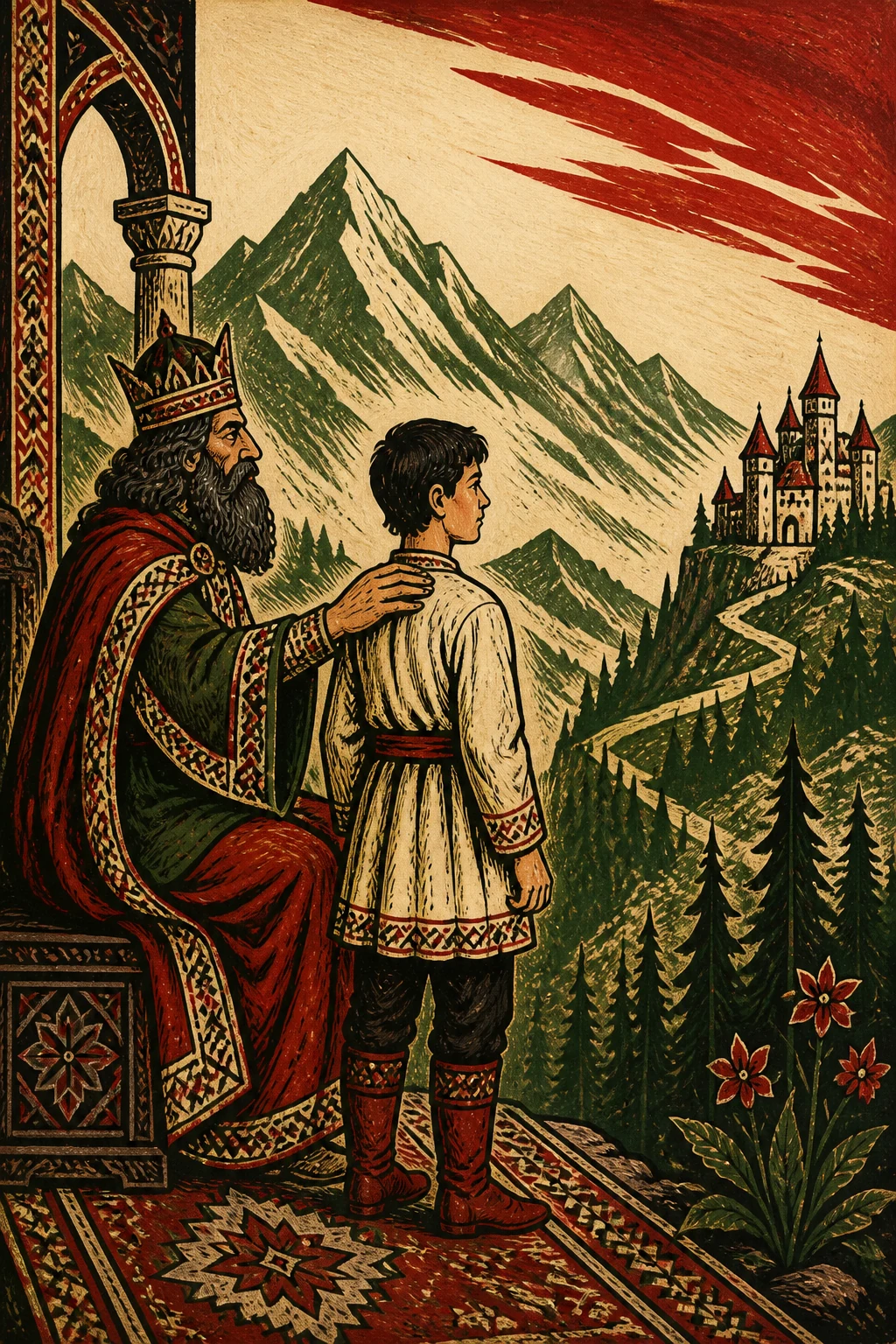
Once upon a time, as there never was before, there lived an emperor who had three sons. When they came of an age to marry, the emperor said to them, “My dear children, you are grown men now. Go and seek your destined brides, so that you too may take your place in the world.” “Father, your words are as sacred to us as an icon before which we bow,” the sons replied. They kissed his hand and made their preparations, each eager to be the first to leave. The eldest son put on his finest clothes and took soldiers and money enough for the journey. Traveling eastward, he reached the court of an emperor who had an only daughter. He asked her father for her hand, and the match was soon agreed upon. The middle son likewise dressed himself as handsomely as he knew how and set off toward the west. He too reached the court of another emperor who had a daughter. They discussed the matter, and before long he too was betrothed. The youngest son, however, had no heart for seeking a bride. Yet he could find no way out of it, for his father kept urging him to make a match for himself as well. So he took some clothes, if only to keep anyone from saying that he had made no preparations, and some money, for one cannot travel without
something to spend, and off he went, though with little enthusiasm. But where was he to go? Why, he did not know himself. He dragged his feet along, one after the other, merely so that he could say he was walking, took a path he happened upon, and followed it without troubling to think where it might lead. And what do you suppose? The path brought him straight to a great pond. On the way he found a long hazel switch and picked it up for no particular reason, without knowing what he would do with it. When he reached the edge of the pond, he sat down and gazed about him in bewilderment. Merely to have something to do, he struck the water with his switch and amused himself by watching the drops leap up whenever he hit it. Then he began to ponder. He saw that every drop, on falling back into the water, made a little ring around itself, which grew wider and wider until it sank once more into the bosom of the water from which it had sprung. In the end, neither the place where the drop had fallen nor the spreading circle around it could be seen, and everything was as it had been before: the surface of the water shone smooth as a mirror. He became lost in thought. He looked without seeing, kept striking the water with his switch, and did not know what he was doing. He no longer felt whether he was there at all. Then a tortoise appeared on the surface of the pond and gazed fondly at him. Wherever he struck with his switch, wherever the ripples opened around its tip, there she was too, never taking her eyes off him. She looked at him as though she would drink him in with her gaze. But he neither saw nor heard her, so deeply was he lost in his musings. At last, somehow or other, he noticed that a tortoise was following the tip of his switch. He looked at her in turn, and something seemed to stir in his heart, though he could make nothing of it. When he finally roused himself from his thoughts, he saw that the sun was setting. He got up unhurriedly and went home without giving anything another thought. The next day he did just the same, with no particular purpose in his head, and without even remembering that he had set out to find a bride.
On the third day, as soon as he rose, he went back to the edge of the pond. It seemed that the thread of fate was drawing him toward his destined bride. As he sat there playing with his switch in the water, while the tortoise kept swimming before him and looking at him longingly, he remembered at last that he had gone out to seek a wife, and that his brothers were to return the next day with their betrothed. Just as he was about to rise and leave to try his own luck, the tortoise suddenly gave a sigh, and he looked at her more closely. He gazed straight into her eyes and felt something strange deep in his heart, as though an arrow had pierced it. He sat down again. He would have liked to leave, but it was as if someone had nailed him to the spot. Again he tried to do something, anything, to get away, but in vain. His feet would not move, as though they had been fastened in the stocks. He marveled at this strange weakness. Glancing once more at the tortoise, he saw her eyes shining with a fire whose warmth seemed to reach him. Then he took his courage in both hands and cried, “Let this be my bride!” “I thank you with all my heart, my dear beloved,” the tortoise answered. “Your words have shattered all the spells that held me captive. You are the one destined for my heart. I shall follow you for as long as there is life in me.” The emperor’s son was rather frightened to hear the tortoise speak. He would have taken to his heels, but her sweet words and the enchanting music of her voice kept his feet rooted where he stood. The tortoise turned three somersaults and became a fairy maiden, delicate, graceful, and more beautiful than any beneath the sun. So dear did she seem to the young man that he could have drunk her up in a spoonful of water. Yet he restrained himself and made no move, lest he offend her or make her unwilling to come with him, for he felt that from that moment onward he could not live without her. They began to talk, scarcely knowing what they said. Now they started one subject, now they abandoned another, until, before they knew it, twilight had fallen.
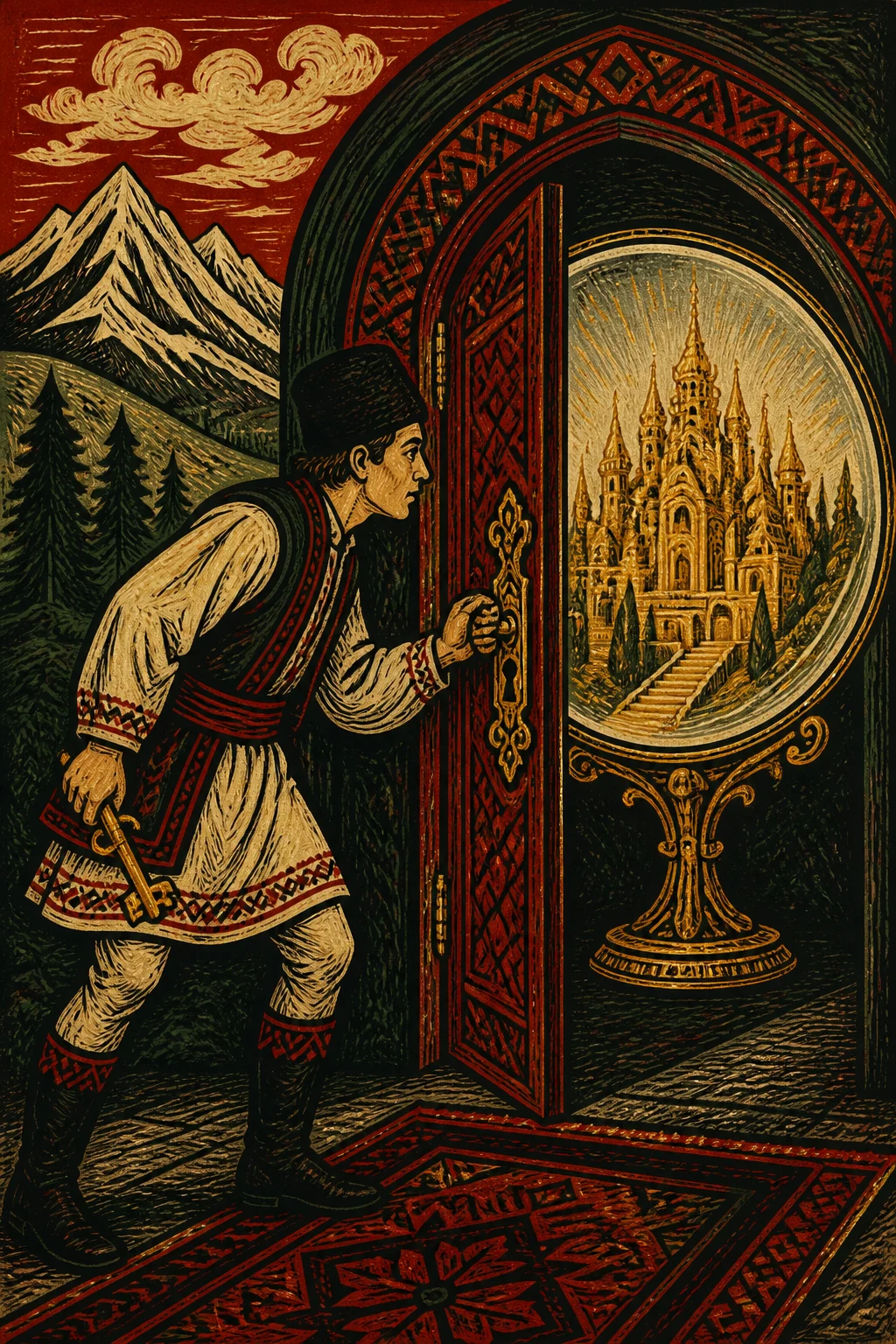
Since his brothers were to arrive the next day with their brides, he told the fairy that he was going to let his father know that he too would be bringing home his betrothed. The tortoise went back into the pond, and he set off for the imperial court. He walked on, yet it seemed that someone kept stopping him along the way. He felt as though someone were tugging at his clothes from behind. Again and again he turned to look back. He saw nothing, but still he kept turning his head and looking. It was fortunate that the road seemed shorter and he reached home when he did, for had the journey been any longer, he might well have ended up with a crooked neck from looking back so often. When he arrived and found the whole family gathered around his father, he began to tell them everything that had happened. But when he came to the part where he had said to the tortoise, “You shall be my bride,” they all burst out laughing at once and began to mock him with sly remarks and tasteless jokes. He tried to tell them who the tortoise really was, but they gave him no chance, snatching the words from his mouth and pelting him with one taunt after another. Seeing how matters stood, he held his tongue and swallowed the humiliation his brothers had heaped upon him before their father. A thousand words now, he thought, would not be worth a penny. Never mind, he told himself; we shall see, for he who laughs last laughs best. The next day each young man hastened to fetch his bride. Meanwhile, the emperor had the palace and the city adorned as beautifully as possible to welcome his daughters-in-law. People went about the city in crowds, as on a feast day; the soldiers prepared for a grand procession, and even the children rejoiced in the emperor’s happiness. One after the other, the two elder sons arrived with their brides. To be fair, the young women were beautiful, and their dresses fitted them as though they had been poured into them. Each brought a handsome dowry, with slaves, horses, and iron-bound carriages. The emperor received them as befitted emperors and emperors’ daughters. Once they were together, the brothers again brought up the subject of their youngest brother’s tortoise, and they and their brides began making fun of him. Their father reproached them, for, whatever anyone might say, the youngest was his child too, and it hurt him to hear the boy mocked. But it was all in vain. Though they no longer spoke ill of him openly before the emperor, behind his back they amused themselves as much as they pleased, nudging one another and laughing. Indeed, the two brothers and their brides agreed to make their youngest brother a laughingstock when he appeared before the emperor with his tortoise. When the youngest son went to fetch his bride, the tortoise came out of the pond to meet him, turned three somersaults, and took human form. They talked for a while, and then the emperor’s son told her to get ready to leave. She answered him, “My dear betrothed, you must know that I too am an emperor’s daughter, and the daughter of a great emperor at that, wealthy and powerful. But accursed spells have covered our palaces with this muddy water, our empire has been stolen from us, and I was changed into the creature you saw.” Her honeyed words and delightful voice, which seemed to soothe the very heart, quite bewildered the poor emperor’s son. Yet he mastered himself and, keeping his composure, said, “Let that be for now. Once I have chosen you, you are mine, and let the world say what it will. Get ready, I tell you, and come, for my father, my brothers, and my sisters-in-law are waiting for us.” “It is our custom,” the fairy added, “to bathe before going to be married.” “We shall bathe at my father’s palace,” he replied. “Why cause a fuss there? Let us bathe here.” She made a gesture with her hand, and the water of the pond drew back to either side. In its place appeared palaces so splendidly adorned that you might have looked at the sun, but not at them. The gold covering the pillars and the moldings beneath the eaves glittered so brightly that it dazzled the eyes. The fairy took the emperor’s son by the hand and led him into the palace. He stood staring in astonishment, for, though he was an emperor’s son, he had never seen such costly wonders. The baths were ready, and the water was as pleasantly warm as milk freshly drawn from a ewe, so each went into a separate bath and washed. The emperor’s son scarcely dared set foot upon the bathroom floor or the precious rugs spread throughout the palace, for fear of spoiling their beauty. The bath was paved with all kinds of polished marble, cunningly arranged into flowers, birds, and every sort of marvelous creature. Water trickled from gilded pipes, and he dipped it up with golden cups and ladles. The towels were of silk, woven with the finest gold thread and pearls. After they had bathed and dressed, they passed through the garden, where the fragrance of the flowers went to their heads. At the fairy’s command, a gold-mounted carriage drew up at the steps, harnessed to four fiery steeds. The carriage was set with precious stones that sparkled in the sunlight with a splendor beyond telling. They climbed in. As he sat down beside her, a bright star appeared upon her brow, shining so brilliantly that it dazzled all who looked at them. Both wore rich and beautiful garments. The horses set off. They flew rather than ran, seeming scarcely to touch the earth. In an instant they reached the palace of the young man’s father, who was waiting for them and wondering at their delay. At the sight of them, everyone understood that this was a woman from another realm, and praised the emperor’s son for so fortunate and unexpected a choice. His elder brothers fell silent before such beauty and wealth. Never before had such splendor and grace been seen beneath the sun, or in their country. They began nudging one another, coming to their senses, and regretting the mockery they had made of their brother. The emperor was beside himself with joy to see his youngest son bring home the wonder of wonders. The fairy behaved with exquisite courtesy and spoke so charmingly that she won every heart. The guests could not take their eyes off her, and their ears wished to hear no words but hers, so delightful were they. The emperor’s elder sons advised their brides to do whatever they saw the fairy do, both at the wedding ceremony and at the feast. The emperor now had his heart’s desire. You see, he had wished to marry all his children on the same day, and so he did. He rejoiced in it as in some great achievement. After the emperor’s sons had been married to the brides each had chosen, they joined hands in the hora and danced as people do at an emperor’s wedding. Whatever might be said of the others’ dancing, when the fairy danced she seemed not to touch the ground. The people watched, their hearts swelling with pride that their emperor’s youngest son had brought home such a fairy to rule over them. They would have wagered that not even in heaven was there a beauty greater than the one before their eyes. Meanwhile evening came, and a feast fit for an emperor was laid. Around the imperial table stood many others for the nobles, the merchants, and the common people. They sat down to eat. The emperor’s elder daughters-in-law kept their eyes fixed on the fairy, watching what she did so that they could do the same, as their husbands had advised them. From each dish brought to the table, the fairy took a little and slipped it into the bosom of her gown. Her sisters-in-law did likewise. They ate and made merry to their hearts’ content. When they rose from the table, the fairy went to her father-in-law, kissed his hand, and thanked him. Then, from the bosom of her gown, where she had put the food, she drew a bouquet of fragrant flowers and offered it to him as a token of a daughter’s love. At once the place filled with a fragrance so lovely and unfamiliar that no one there had ever smelled its like. Then everyone cried with one voice, “Long live our lady and empress!” But she, without a trace of pride, withdrew from
the emperor’s presence in all humility and sat down beside her husband. As she walked, pearls began falling from the folds of her gown until they covered the floor, and the guests, high and low alike, bent down to gather them. The emperor’s elder daughters-in-law went to thank him too and kissed his hand. But when they tried to take out what they had tucked into their gowns during the feast, they found their clothes so stained and smeared with food that they looked less like garments worn by people than by some other creatures altogether. The whole wedding company laughed at them so heartily that they fled in humiliation to their rooms to change, for there was no staying at the wedding in such a filthy state. Then the whole gathering, young and old, with the emperor himself, cried out with one voice that this couple should rule from that day forward. The emperor stepped down from his throne, and his youngest son ascended it with his wife. By her gentle speech and measured conduct, the new empress won the love even of her sisters-in-law. And the emperor’s son, with his quick wit, his natural wisdom, and the counsel of his wife the empress, ruled in peace, tranquility, and happiness all his life. I was there too. And since I too was given a bone to gnaw, I took it into my head to tell you, good people, these things which, if anyone believed them, would have me called a liar. And I mounted a saddle, and so on.