Prevod
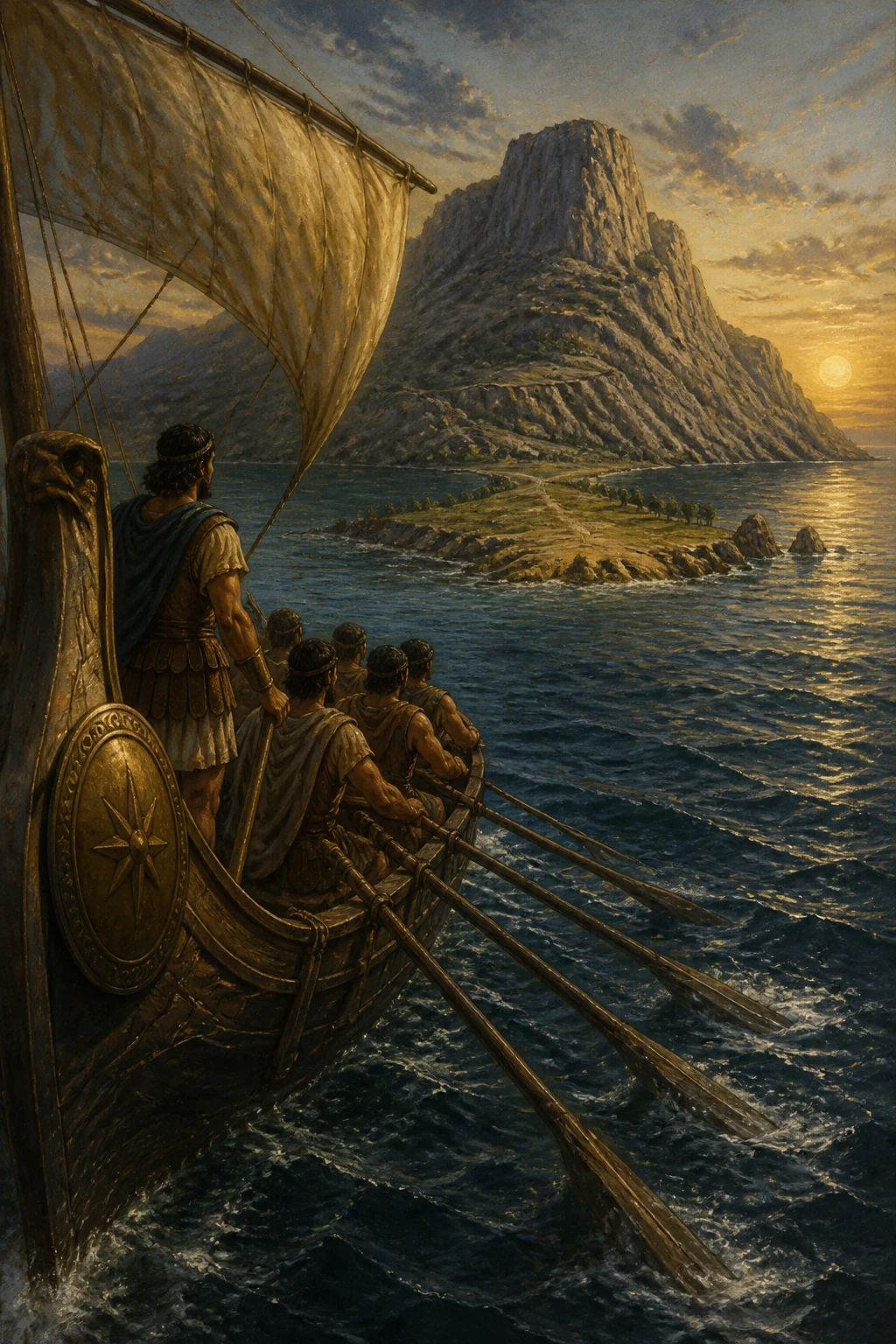
When the servants had made everything ready—all the stores that well-equipped ships carry when need drives men to voyage across the sea—the heroes went through the city toward the ship, to the shores called Magnesian Pagasae. A throng of people hurried along on every side, while they shone among them like bright stars amid clouds. And as the people watched them hastening by in their armor, one after another said: “Lord Zeus, what is Pelias thinking? Where is he sending so great a company of heroes, far beyond the land of all Achaea?
“They could burn the house of Aeetes to the ground in a single day, unless he willingly surrendered the fleece. Yet there is no escaping the voyage, and their toil will be fruitless.” So people spoke here and there throughout the city. And the women repeatedly raised their hands toward the immortals in heaven, praying that they would grant the voyagers the joy of a safe return.
One woman lamented to another through her tears: “Poor Alcimede, sorrow has come to you too, late though it is, and you have not reached the end of life in happiness. And Aeson—how bitterly unfortunate he is! Better for him if long ago he had been wrapped in his funeral shroud and laid beneath the earth, still knowing nothing of these cruel trials.
“If only the dark wave had swallowed Phrixus and the ram when the maiden Helle perished! But that monstrous creature even uttered a human voice, only to bring Alcimede grief and countless sorrows in the years to come.”
So the women spoke as the heroes passed along. Meanwhile, many servants, men and women alike, had gathered, and his mother had thrown her arms around him. Sharp grief pierced every woman’s heart. With them his father, worn down by cruel old age, lay wrapped in his bedclothes, groaning.
But he soothed their distress with words of courage, then told the servants to take up his weapons of war. They lifted them in silence, with downcast faces. His mother, who had flung her arms around her son at the first, still clung to him, weeping ever more bitterly. As a girl falls eagerly into the arms of her gray-haired nurse and weeps in her loneliness—a girl who has no other guardians left, but drags out a wretched life under a stepmother, who has just assailed her with a torrent of reproaches; grief knots her heart within her, and she cannot pour out all the lamentation that struggles to escape—so bitterly Alcimede wept, holding her son in her arms. In her anguish she said: “If only, on that day when I, poor woman, heard King Pelias proclaim his cruel command, I had given up my life at once and forgotten all my sorrows! Then you could have buried me with your own dear hands, my child. That was the one desire I still had of you; all the other rewards of raising you I have long enjoyed.
“But now I, once envied among the women of Achaea, shall be left like a slave in an empty house, wasting away in misery with longing for you. Once you were my great pride and glory, you for whom alone I loosened my maiden’s girdle, first and last. For the goddess Eileithyia grudged me any more children.
“Alas for my misery! Never, not even in a dream, did I imagine that Phrixus’s escape would bring me sorrow.” So she lamented with groans, while her attendant women stood around her weeping. But he comforted her and answered gently: “Mother, do not burden me with such bitter grief. Your tears will not hold misfortune back; you may only add sorrow to sorrow.
“The gods deal out unforeseen troubles to mortals. Though your heart is grieved, endure the share that falls to you. Take courage from Athena’s promises and from the oracles, for Phoebus has given us a most favorable answer; and trust, too, in the help of these brave men.
“But now stay here quietly at home with your attendants, and do not become an ill omen for the ship. My kinsmen and servants will accompany me there.” With these words he set out to leave the house.
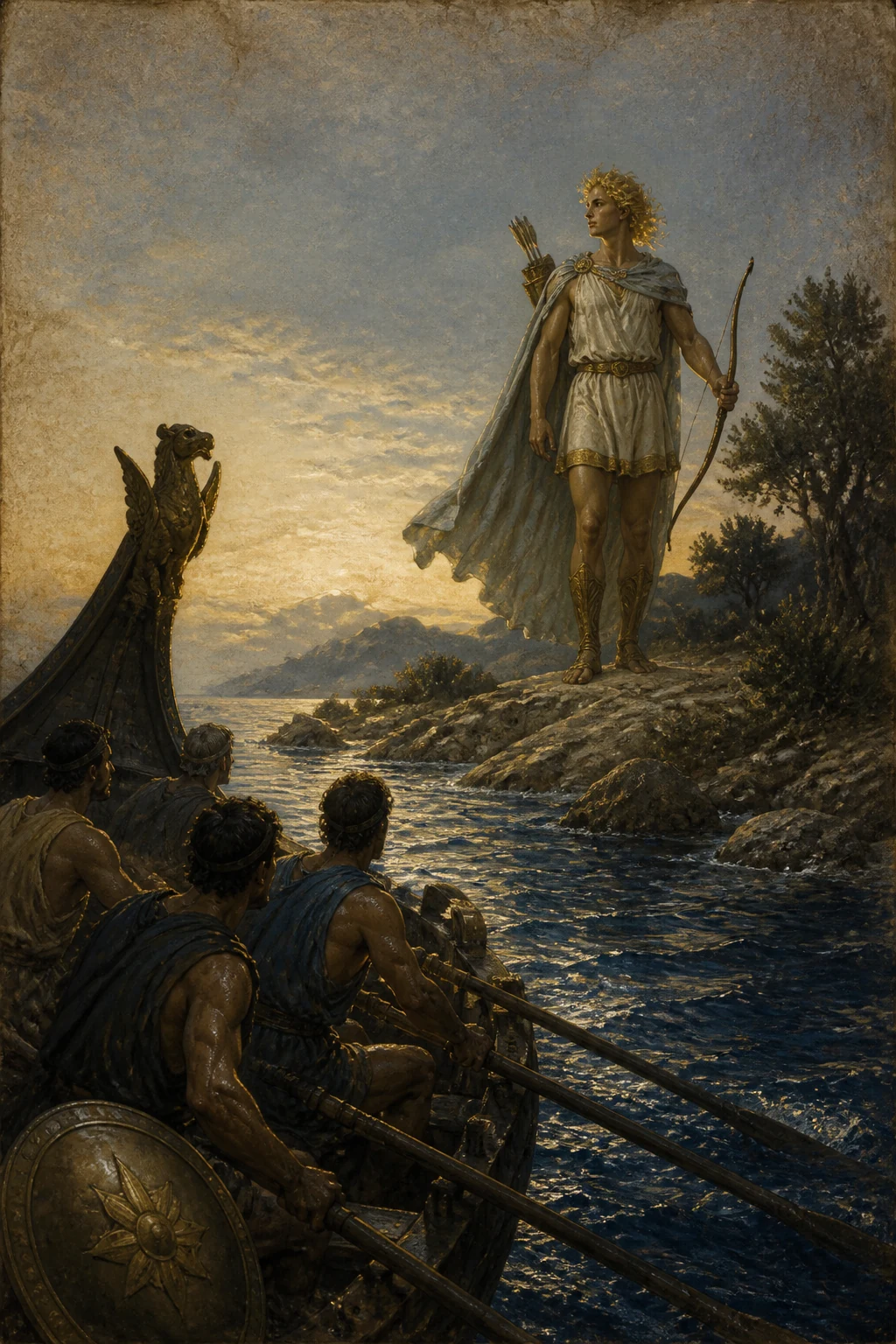
As Apollo comes forth from his fragrant temple and passes through holy Delos, or Claros, or Pytho, or broad Lycia beside the streams of Xanthus, so he went through the crowd, and a clamor rose as they hailed him together. Old Iphias, priestess of Artemis, guardian of the city, met him and kissed his right hand. She longed to speak, but could not, for the crowd was pressing forward. She was left standing aside, as the old are left behind by the young, while he passed on and was carried far away.
When he had left the city’s well-built streets and reached the shore of Pagasae, his companions welcomed him, waiting together beside the Argo. He halted before them, and they gathered to meet him.
Then they saw Acastus and Argus coming down together from the city, and all were astonished to see them hastening there against the will of Pelias. Argus, son of Arestor, wore over his shoulders a black-haired bull’s hide that reached to his feet; Acastus wore a splendid double cloak, a gift from his sister Pelopia.
Yet Jason refrained from questioning the two about everything, and instead called the company to sit down in assembly. They all took their places together, there on the folded sails and the mast that lay beside them.
Then Aeson’s son addressed them with goodwill: “All the stores a ship should carry are ready for our departure, everything duly in its place. We need not delay our voyage on that account, once the winds begin to blow.
“But, friends, since our journey to the house of Aeetes is shared by all, and our return to Greece is shared as well, choose now, without favor, the best man among us as our leader. Let him see to every matter, and take charge of disputes and treaties with strangers.”
So he spoke. The young men turned their eyes toward bold Heracles, seated in their midst, and with one voice they all called on him to lead them. But from where he sat he stretched out his right hand and said: “Let no one grant me this honor. I will not accept it, and I shall prevent any other man from rising to claim it.
“Let the man who gathered the company also be its leader.” Such was his high-minded answer, and they assented to what Heracles commanded. Then warlike Jason himself sprang up joyfully and spoke to the eager company: “If you entrust this honor to my care, let our voyage no longer be held back as it has been before.
“Now let us win Phoebus’s favor with sacrifice and prepare a feast here on the shore. While my servants, the overseers of the herds, go to choose the finest cattle and drive them here, we can launch the ship upon the sea. Then, when you have stowed all the gear aboard, draw lots for the rowing benches.
“Meanwhile, let us also build an altar on the shore to Apollo, Lord of Embarkation. When I sought his oracle, he promised to guide me and reveal the paths of the sea, if I began my labors for the king by offering sacrifice to him.”
So he spoke. η corrected diacritic error (η) in the source text. He was the first to turn to the work, and the others rose obediently. They took off their clothes and piled them together on a smooth ledge of rock, beyond the reach of the sea’s waves, though winter surf had washed it clean long before.
First, at Argus’s direction, they firmly girded the ship from within with a well-twisted cable, drawing it taut on either side so that the timbers would hold fast at their joints and withstand the force of the waves.
Quickly they dug a trench as wide as the space the ship occupied, extending it before the prow into the sea for as far as she would travel when hauled down by their hands. Ahead of the keel they dug it steadily deeper, and in the channel they laid smooth wooden rollers. Then they tilted the ship down onto the first rollers, so that she could glide along them.
They turned the oars upward on either side and lashed them to the tholepins, with a cubit’s length projecting. Then they took their places between them on both sides, setting their chests and hands against them together. Tiphys went aboard to call on the young men to haul at the right moment. He shouted his command loudly, and they put all their strength into one great thrust, heaving her from her resting place. Then they strained forward, driving with their feet, and the Pelian Argo moved swiftly after them, while on either side they rushed along with a shout.
The rollers groaned beneath the stout keel as they were worn by the friction, and dark smoke rose around them under the weight. The ship slid into the sea, but they hauled on the ropes and checked her forward course.
They fitted the oars to the tholepins, and stowed aboard her the mast, the finely woven sails, and the provisions. When they had carefully attended to everything, they first allotted the rowing benches by lot, two men to each. But the middle bench they chose for Heracles and, apart from all the other heroes, for Ancaeus, who dwelt in the city of Tegea.
For these two alone they reserved the middle bench without drawing lots. By common consent they entrusted Tiphys with the helm of the well-keeled ship. Then they hauled stones together close to the sea and built an altar there on the shore to Apollo, calling him Lord of the Shore and of Embarkation. Quickly they laid logs of dry olive wood upon it.
Meanwhile, the herdsmen of Aeson’s son brought two cattle down from the herd. The younger companions led them close to the altar, and the others provided water for washing the hands and barley for scattering. Then Jason prayed, calling on Apollo, god of his fathers: “Hear me, lord, who dwell in Pagasae and in the city of Aeson, named after my father. When I sought your oracle at Pytho, you promised to show me how to accomplish this voyage and reach its end; indeed, it was you yourself who brought these labors upon me. Now guide the ship with all her companions safe and sound, both on the outward journey and back again to Greece. When we return, we shall lay upon this altar glorious sacrifices of bulls, as many as the men who come home. And I shall bring countless other gifts to Pytho and to Ortygia.
“Come now, Far-Shooter, and accept this first sacrifice we offer you for the sake of our embarkation upon this ship. Through your wisdom, lord, may I loose her moorings under a harmless destiny, and may a gentle breeze arise, bearing us over a tranquil sea.”
As he prayed, he scattered the barley. Then mighty Ancaeus and Heracles girded themselves to slay the cattle. Heracles struck one with his club in the middle of the forehead, and it fell in a heap, crashing to the ground. Ancaeus struck the other across its broad neck with a bronze axe and severed the strong sinews; it toppled forward onto both its horns.
Their companions quickly cut the beasts’ throats, stripped off the hides, and cut up and divided the flesh. They cut out the sacred thighbones, wrapped them closely in fat, and burned them all together upon the split logs. Aeson’s son poured libations of unmixed wine. Idmon rejoiced as he watched the flame shining on every side of the sacrifice and the smoke rising in dark, auspicious spirals. At once he fearlessly declared the will of Leto’s son: “For you, the gods’ decree and oracle promise that you shall cross the sea and bring the fleece back here. Yet countless trials await you on the way, both going and returning.
“But for me it is ordained that, by a god’s cruel will, I shall die somewhere far away upon the mainland of Asia. Even before this, I learned my fate from ill-omened birds; yet I left my homeland to embark upon the ship, so that glory might remain in my house for having sailed.”
So he spoke. Hearing the prophecy, the young men rejoiced at their promised return, but sorrow seized them for Idmon’s fate. When the sun had passed the height of day, and the fields were just beginning to lie in the shadows of the cliffs as the sun sank toward the evening darkness, they all spread a deep bed of leaves on the sand beside the gray shore and reclined in rows. Countless dishes lay beside them, and sweet wine, which the cupbearers drew in pitchers. Then they talked with one another in turn, as young men delight in doing over food and wine, so long as reckless insolence is kept away.
But Aeson’s son, at a loss, turned every matter over in his mind, seeming downcast. Idas noticed him and rebuked him in a loud voice: “Son of Aeson, what plan are you turning over in your heart?
“Speak your mind before us all. Or is fear overcoming you—that fear which confounds cowardly men? Let my fierce spear bear witness, the spear through which I win glory beyond all others in battle—for Zeus helps me less than my own spear does—that no deadly disaster shall come upon us, nor any task remain unfinished, while Idas follows you, even if a god should stand against us.
“Such is the champion you are taking with you from Arene.” So he spoke, and lifting a brimming cup in both hands, he drank the sweet, unmixed wine. It drenched his lips and his dark beard. A murmur rose from all the company, and Idmon openly answered him: “Unhappy man, you were harboring ruinous thoughts before now.
“Or is the unmixed wine swelling your bold heart within your breast toward madness, and driving you to dishonor the gods? There are other, comforting words with which a man may hearten his companion. But what you have said is sheer recklessness. Such boasts, they say, the sons of Aloeus once hurled against the blessed gods—and you do not begin to equal them in valor. Yet mighty though they were, both were brought down by the swift arrows of Leto’s son.”
So he spoke. Idas, son of Aphareus, burst into loud laughter and answered him with a mocking glance: “Come now, tell me by your prophecies whether the gods will bring upon me the same destruction that your father dealt the sons of Aloeus.
“And consider how you will escape my hands unharmed if you are found to have uttered a worthless prophecy.” Angrily he taunted him, and the quarrel would have gone further had not their companions and Aeson’s son himself called out and restrained the wrangling men. Then Orpheus raised his lyre in his left hand and began to sing.
He sang how earth and heaven and sea, once joined together in a single form, were sundered from one another by deadly strife; how the stars and moon and the paths of the sun hold their appointed places forever in the sky; how the mountains rose, and how the sounding rivers, the nymphs themselves, and all living creatures came to be.
He sang how, in the beginning, Ophion and Eurynome, daughter of Ocean, ruled over snowy Olympus; how Ophion yielded his power to Cronus, and Eurynome to Rhea, overcome by force of arms, and how they fell into the waves of Ocean. Cronus and Rhea ruled meanwhile over the blessed Titan gods, while Zeus, still a child, still innocent in mind, dwelt beneath the Dictaean cave. The earthborn Cyclopes had not yet armed him with the thunderbolt, with thunder and lightning, for these are the things that give Zeus his glory.
Then he stilled his lyre and his divine voice together. But even when he had finished, they all remained leaning forward, motionless, their ears intent in unbroken enchantment. Such was the spell his song had left upon them.
Not long afterward they mixed libations for Zeus and, standing as custom required, poured them over the burning tongues of the victims. Then, in the gathering darkness, they turned their thoughts to sleep.