Prevod
Beginning with you, Phoebus, I shall recall the glorious deeds of men of old, who, at King Pelias’ command, drove the well-benched Argo through the mouth of the Pontus and between the Cyanean Rocks in quest of the Golden Fleece.
For Pelias had heard an oracle that a grim fate awaited him: he would be brought down by the designs of a man whom he should see coming from among the people wearing only one sandal. Not long afterward, in fulfilment of your prophecy, Jason, crossing on foot the swollen winter waters of the Anaurus, saved one sandal from the mud but left the other behind, caught in the river’s current.
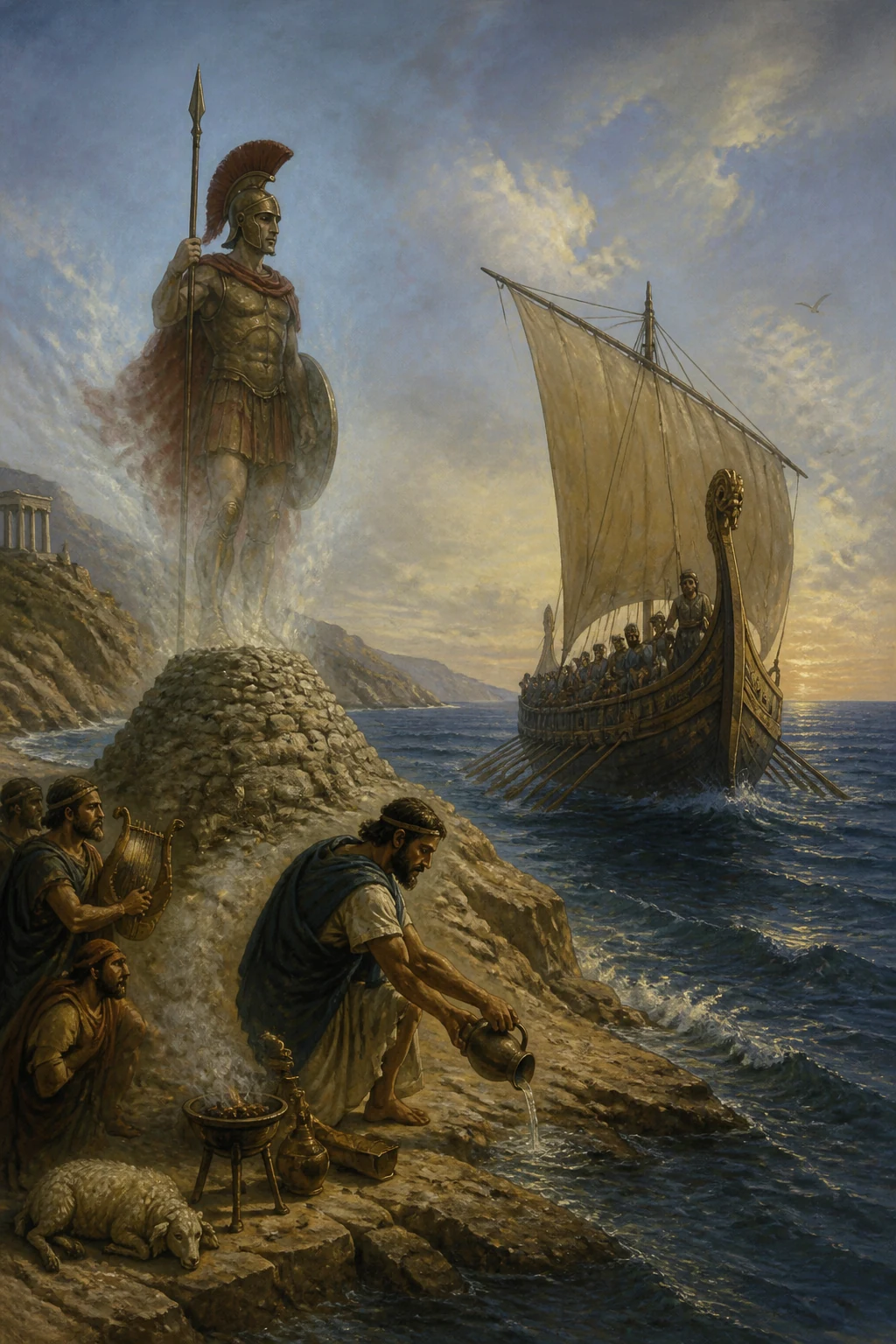
He came straight to Pelias to share in the feast the king was offering to his father Poseidon and the other gods; but to Pelasgian Hera he paid no heed. As soon as Pelias saw Jason, he understood, and devised for him the ordeal of a voyage fraught with sorrow, so that either at sea or among foreign peoples he might lose all hope of homecoming.
Now singers of earlier times tell how Argus built the ship under Athena’s guidance. But I shall recount the lineage and names of the heroes, their journeys over the vast sea, and all they accomplished in their wanderings. May the Muses inspire my song.
First let us remember Orpheus, whom Calliope herself, it is said, bore near the heights of Pimpleia after sharing the bed of Thracian Oeagrus. Men tell how the sound of his songs enchanted the unyielding rocks upon the mountains and the flowing rivers.
Wild oaks, still bearing witness to that music, flourish on the Thracian shore at Zone, standing close together in ordered ranks: these he once led down from Pieria, charmed by his lyre.
Such was the Orpheus whom Aeson’s son, obeying Chiron’s counsel, welcomed as a helper in his labours: he ruled in Bistonian Pieria. Next came Asterion, whom Cometes begot beside the swirling waters of the Apidanus. He lived at Peiresiae, near Mount Phylleius, where the mighty Apidanus and divine Enipeus meet, coming from far apart to mingle in one stream.
After them came Polyphemus, son of Eilatus, leaving Larissa. In earlier days, when the Lapiths armed themselves against the Centaurs, he had fought among the mighty Lapith warriors while still a young man. Now his limbs were already heavy with age, but his heart remained as warlike as before.
Nor did Iphiclus linger long in Phylace, for he was the uncle of Aeson’s son: Aeson had married his sister Alcimede, daughter of Phylacus. His kinship with her and his care for her urged him to join the company.
Nor did Admetus, lord of Pherae with its fine flocks, remain beneath the heights of Mount Chalcodonium. Nor did Hermes’ sons, Erytus and Echion, well versed in guile, remain in Alope, rich in corn. As they set out, their brother Aethalides joined them as a third. Eupolemeia of Phthia, daughter of Myrmidon, had borne him beside the streams of the Amphrysus; the other two were born of Antianeira, daughter of Menetes.
Coronus, son of Caeneus, came also, leaving wealthy Gyrton: a brave man, yet no better than his father. For singers still tell how Caeneus, though living, perished at the hands of the Centaurs, when, alone and apart from the other champions, he drove them before him. They rallied and charged, yet could neither force him back nor slay him. Unbroken and unbowed, he sank beneath the earth under the blows of massive fir trunks descending upon him.
Then came Mopsus of Titaresia, whom Leto’s son had taught above all others to read the omens of birds; and Eurydamas, son of Ctimenus, who lived in Dolopian Ctimene near Lake Xynias.
Actor also sent his son Menoetius from Opus to sail with the champions. Eurytion and valiant Erybotes followed, sons of Teleon and of Irus, Actor’s son: renowned Erybotes was Teleon’s son, and Eurytion the son of Irus. With them came a third, Oileus, outstanding in courage and skilled at pursuing enemies when he had broken their ranks.
From Euboea came Canthus, eagerly sent forth by his father Canethus, son of Abas. But he was not destined to return to Cerinthus. Fate decreed that he and Mopsus, skilled in divination, should wander to the borders of Libya and perish there. No place is too distant for mortals to meet with disaster: those two were buried in Libya, as far from Colchis as the setting of the sun appears to lie from its rising.
After him gathered Clytius and Iphitus, guardians of Oechalia, sons of ruthless Eurytus—Eurytus, to whom the Far-shooter gave a bow. Yet he gained no benefit from the gift, for he chose to challenge the giver himself.
After them came the sons of Aeacus, though not together or from the same place. They had left Aegina and settled far apart in exile after unwittingly killing their brother Phocus. Telamon made his home on the Attic island, while Peleus withdrew to dwell in Phthia.
Next came warlike Butes from the land of Cecrops, son of noble Teleon, and Phalerus, skilled with the spear. His father Alcon sent him forth, though he had no other sons to care for his old age and livelihood.
Yet dear as this only son was to him, he sent him so that he might distinguish himself among the daring heroes. But Theseus, who surpassed all the sons of Erechtheus, was held beneath the earth of Taenarus by unseen bonds, having followed Peirithous on their common venture. Surely those two would have made the fulfilment of the task easier for them all.
Tiphys, son of Hagnias, left Siphae, a town of the Thespians. He was skilled at foretelling the rising waves upon the open sea, skilled at judging the storms of wind and steering a course by sun and star.
Tritonian Athena herself urged him to join the company of heroes, and he came among them to their joy. For she herself had fashioned the swift ship, and with her Argus, son of Arestor, had built it under her direction.
Thus it proved the finest of all ships that ever ventured upon the sea under oars. After these came Phlias from Araethyrea, where, through the favour of his father Dionysus, he lived in wealth beside the springs of the Asopus.
From Argos came Talaus and Areius, sons of Bias, and mighty Leodocus, whom Pero, daughter of Neleus, bore. For her sake Melampus, son of Aeolus, had endured grievous hardship among the cattle stalls of Iphiclus.
Nor do we hear that mighty, stout-hearted Heracles disregarded the wishes of Aeson’s son. When he heard the news that the heroes were gathering, he was returning from Arcadia to Lyrceian Argos along the road by which he carried alive the boar that fed in the glens of Lampeia, beside the great Erymanthian marsh. At the entrance to the marketplace of Mycenae he lowered it from his broad back, struggling in its bonds. Then, of his own will and against Eurystheus’ wishes, he set forth. With him went Hylas, his faithful attendant, a youth just come of age, who carried his arrows and guarded his bow.
After him came Nauplius, a descendant of godlike Danaus. For he was the son of Clytoneus, son of Naubolus; Naubolus was the son of Lernus, and Lernus, we know, was the son of Proetus, son of Nauplius. And to Poseidon a maiden,
Amymone, daughter of Danaus, had once borne Nauplius after sharing his bed: he surpassed all men in seamanship. Idmon was the last of those who lived in Argos to join them. Though he had learned his own doom from the birds, he went so that his people might not begrudge him a share of glory.
He was not truly the son of Abas: Leto’s son himself had begotten him, to be numbered among the illustrious sons of Aeolus. The god himself had taught him prophecy, to heed the flight of birds and read the signs in burning sacrifices.
Aetolian Leda sent forth from Sparta mighty Polydeuces and Castor, skilled in handling swift-footed horses. These beloved sons she had borne in a single labour in the house of Tyndareus. She did not oppose their departure, for her thoughts were worthy of the bride of Zeus.
The sons of Aphareus, Lynceus and overbearing Idas, came from Arene, both trusting in their great strength. Lynceus was distinguished, too, by his piercing sight, if the tale is true that he could readily see even beneath the earth.
With them set forth Periclymenus, son of Neleus, the eldest of all the sons born to godlike Neleus at Pylos. Poseidon had given him boundless strength and the power to take whatever shape he wished while fighting in the press of battle.
Amphidamas and Cepheus came also from Arcadia, the two sons of Aleus who dwelt in Tegea and the domain of Apheidas. As they set out, Ancaeus followed as a third, sent by his father Lycurgus, the elder brother of the other two. Lycurgus himself remained in the city to tend the ageing Aleus, but sent his son with his own brothers.
Ancaeus went clad in the skin of a Maenalian bear, brandishing a great double-edged axe in his right hand. For his grandfather Aleus had hidden his armour deep within the house, hoping that even now he might prevent his departure.
Augeias went also, who was said to be a son of Helios. He ruled over the people of Elis, glorying in his wealth, and longed greatly to see the land of Colchis and Aeetes himself, the ruler of the Colchians.
Asterius and Amphion, sons of Hyperasius, came from Achaean Pellene, which their grandfather Pelles had once founded on the heights of Aegialus. After them came Euphemus, leaving Taenarus. Europa, daughter of mighty Tityus, had borne him to Poseidon, the swiftest of all men.
He could run even over the swell of the grey-blue sea without dipping his swift feet beneath it: only the tips of his toes were wet as he sped along the watery path. Two other sons of Poseidon also came: Erginus, who left the city of glorious Miletus, and mighty Ancaeus, who left Parthenia, the seat of Imbrasian Hera. Both boasted of their skill in seamanship and war.
After them came valiant Meleager, son of Oeneus, setting out from Calydon, and Laocoon, the brother of Oeneus, though not born of the same mother, for a serving woman had borne him. Oeneus sent him, now an old man, to watch over his son. Thus Meleager entered the bold company of heroes while still a boy. And I believe that, apart from Heracles, no other would have surpassed him, had he remained another year among the Aetolians and grown to manhood.
His mother’s brother, Iphiclus, son of Thestius, accompanied him on the same journey, skilled both in casting the javelin and in standing against an enemy at close quarters. With them came Palaemonius, son of Lernus of Olenus—Lernus’ son in name, but in truth the offspring of Hephaestus. For this reason he was lame in one foot; yet no one would have dared to scorn his physique or courage. So he too was numbered among all the champions, adding to Jason’s glory.
From the Phocians came Iphitus, son of Naubolus, son of Ornytus. He had been Jason’s host before, when Jason went to Pytho to seek an oracle concerning the voyage; for then he had welcomed him into his house.
Zetes and Calais, sons of Boreas, also came. Oreithyia, daughter of Erechtheus, had borne them to Boreas on the borders of wintry Thrace. Thither Thracian Boreas had carried her away from the land of Cecrops, as she whirled in a dance beside the Ilissus.
He bore her far away, to the place they call the rock of Sarpedon, beside the stream of the Erginus, and there, shrouding her in dark clouds, took her to his bed. When her sons rose into the air, dark wings fluttered on either side of their feet, a wonder to behold, gleaming with golden scales. Over their backs, streaming from their heads and necks on either side, their dark-blue hair tossed in the wind.
Nor did Acastus, the son of mighty Pelias himself, intend to remain in his father’s house, nor Argus, the servant of the goddess Athena. These two also were to join the company.
Such were the helpers who gathered around Aeson’s son. The neighbouring peoples called all these champions Minyans, since most of them, and the noblest, claimed descent from the daughters of Minyas. So too Jason himself was born of Alcimede, whose mother was Clymene, daughter of Minyas.