Prevod
But when radiant Dawn turned her shining eyes upon the steep peaks of Pelion, and the headlands emerged into calm from the wind-tossed sea, then Tiphys awoke. At once he roused his comrades to board the ship and make ready their oars.
The harbor of Pagasae rang out dreadfully, and the Argo herself, built of Pelian timber, cried aloud, urging them to depart. For a divine beam had been set within her: Athena had fitted it into the middle of her stem, an oak from Dodona.
They climbed aboard and took their places on the benches, one after another, each where he had earlier been allotted to row, and sat in good order beside his gear. In the middle sat Ancaeus and mighty Heracles. Beside him Heracles laid his club, and beneath his feet the ship’s keel sank deep into the water. Already the mooring ropes were being drawn in, and they poured wine upon the sea. But Jason turned his tearful eyes away from his native land.
As young men who have formed a dance for Phoebus, at Pytho or Ortygia or beside the waters of Ismenus, beat the ground with nimble feet in measured unison around the altar to the sound of the lyre, so, to the music of Orpheus’ lyre, they struck the sea’s surging water with their oars, and the waves broke over them. On either side the dark brine seethed with foam, roaring terribly beneath the strength of those mighty men.
As the ship sped on, their weapons flashed like fire in the sunlight. Behind them a long white track stretched continually, like a path seen across a green meadow. All the gods looked down from heaven that day upon the ship and the might of those half-divine men, the noblest then sailing the sea. From Pelion’s highest summits the nymphs gazed in wonder at the handiwork of Athena Itonis, and at the heroes themselves as they swung the oars in their hands.
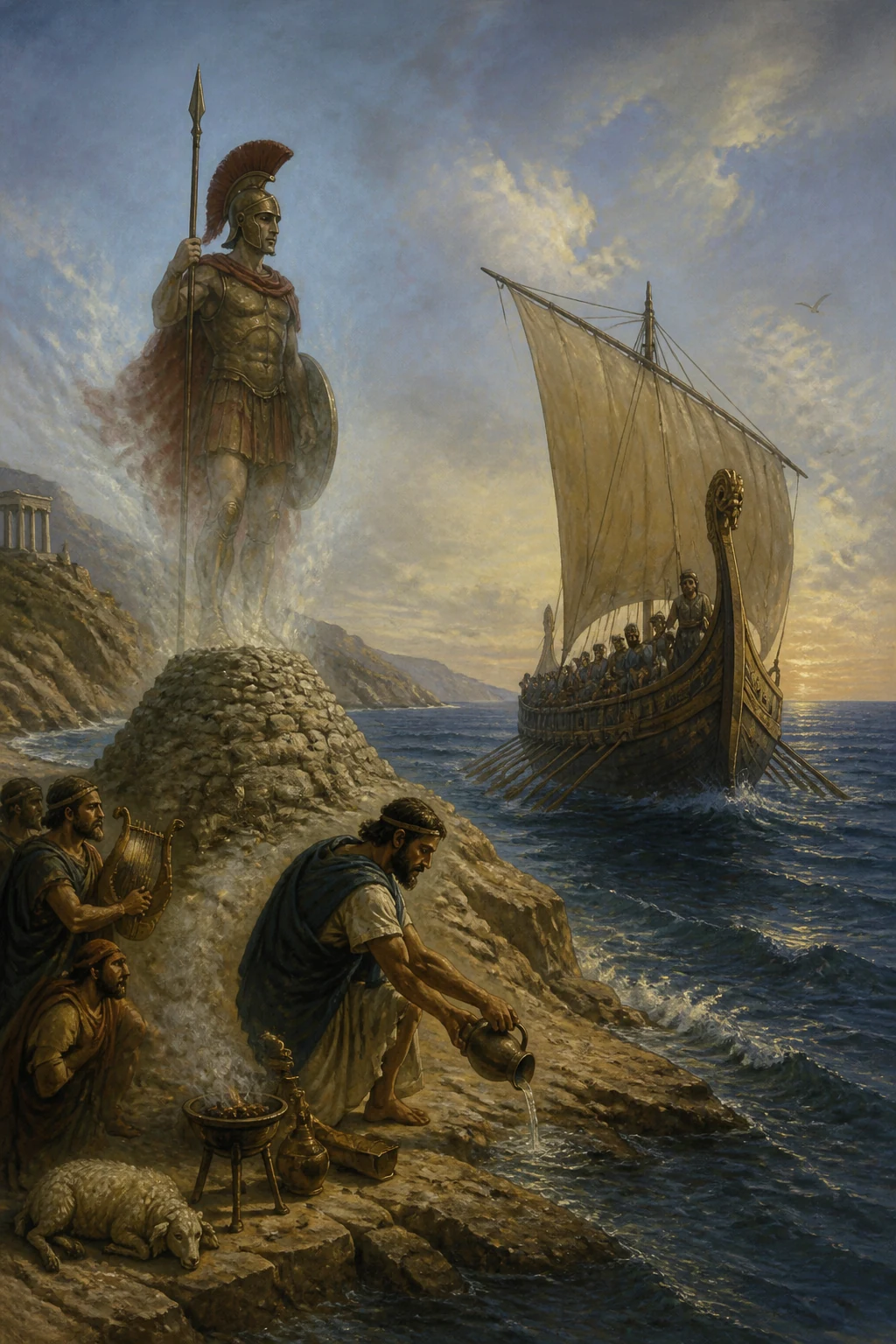
And Chiron, son of Philyra, came down from the mountain heights to the sea. He wetted his feet where the gray breakers burst, and, waving his great hand again and again, wished the departing men a safe return.
With him came his wife, carrying Peleus’ son Achilles in her arms, and she held him up for his dear father to see. When they had left the curving shore of the harbor, guided by the skill and wisdom of prudent Tiphys, son of Hagnias, who deftly handled the polished rudder to keep their course steady, they raised the great mast in its socket, secured it with forestays drawn taut on either side, and spread the sail upon it, hauling it up to the yard.
A keen wind fell upon it. They fastened the ropes separately around the polished pins along the deck, and ran at ease past the long headland of Tisaea. Playing his lyre, the son of Oeagrus sang them a well-ordered hymn to Artemis, noble daughter of a mighty father, guardian of ships, who watched over those heights above the sea and protected the land of Iolcus. Fish leaped from the deep sea, great and small together, countless in number, and followed, gamboling along the watery paths.
As countless sheep, their fill of grass eaten, follow their shepherd’s footsteps from the pasture to the fold, while he walks ahead, sweetly playing a pastoral tune upon his clear-toned pipe, so the fish kept them company. And all the while the wind bore the ship onward with gathering speed.
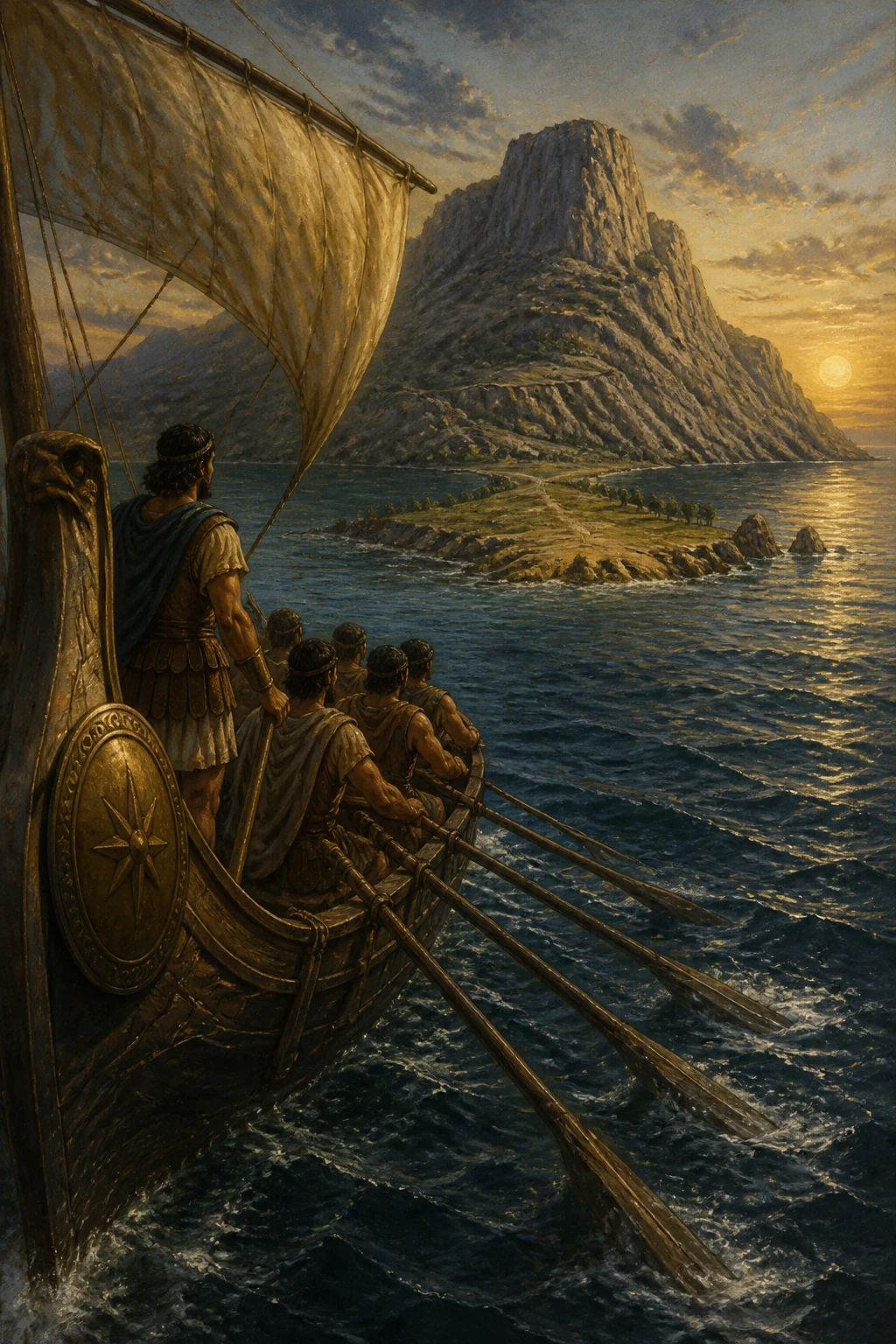
Soon the rich cornlands of the Pelasgians sank into the haze. Still racing onward, they passed the cliffs of Pelion; Cape Sepias vanished, and sea-girt Sciathos came into view. Far away appeared Peiresiae, the sheltered Magnesian coast of the mainland, and the tomb of Dolops. There, toward evening, a contrary wind drove them ashore. At dusk they honored him by burning sheep as offerings, while the sea rose in swelling waves. For two days they rested on the shore, but on the third they launched the ship, spreading their great sail high above.
That shore is still called the Launching Place of the Argo. From there they sped onward past Meliboea, looking out upon its rugged coast and wind-beaten beach. At dawn they sailed close by Homole, which slopes down toward the sea, and before long they were to leave the streams of the river Amyrus behind.
From there they saw Eurymenae and the wave-washed ravines of Ossa and Olympus. Then, running before the wind through the night, they passed Cape Canastra and reached the slopes of Pallene.
As they sailed on in the morning, the Thracian height of Athos rose before them. So lofty is its summit that it casts its shadow as far as Myrina on Lemnos, though the island lies as far away as a well-rigged merchant ship could sail before noon.
All that day and on into the dusk a strong wind blew for them, and the ship’s sails remained stretched taut.
But at sunset the wind failed, and they reached rocky Lemnos, the island of the Sintians, by rowing. There, in the year just past, the whole male population had been ruthlessly destroyed through the women’s outrageous deed.
For the men had come to hate and reject their wedded wives, and were seized by a violent passion for captive girls whom they themselves brought back from the opposite shore when they ravaged Thrace. Such was the terrible anger of Cypris pursuing them, because for a long time they had denied her the honors due to her.
Unhappy women, insatiable in their bitter jealousy! They slew not only their husbands and the girls who shared their beds, but every male as well, so that afterward none should exact vengeance for that dreadful murder.
Hypsipyle alone among them spared her aged father, Thoas, who ruled over the people. She set him afloat upon the sea in a hollow chest, hoping he might escape. Fishermen drew him ashore upon an island then called Oenoe, but later Sicinus, after Sicinus, the son whom the water-nymph Oenoe bore to Thoas when she lay with him.
Now all the women found it easier to tend herds of cattle, put on bronze armor, and plow the wheat-bearing fields than to perform the tasks of Athena with which they had always been occupied before. Yet even so, again and again they looked out over the broad sea in wretched fear, dreading the coming of the Thracians.
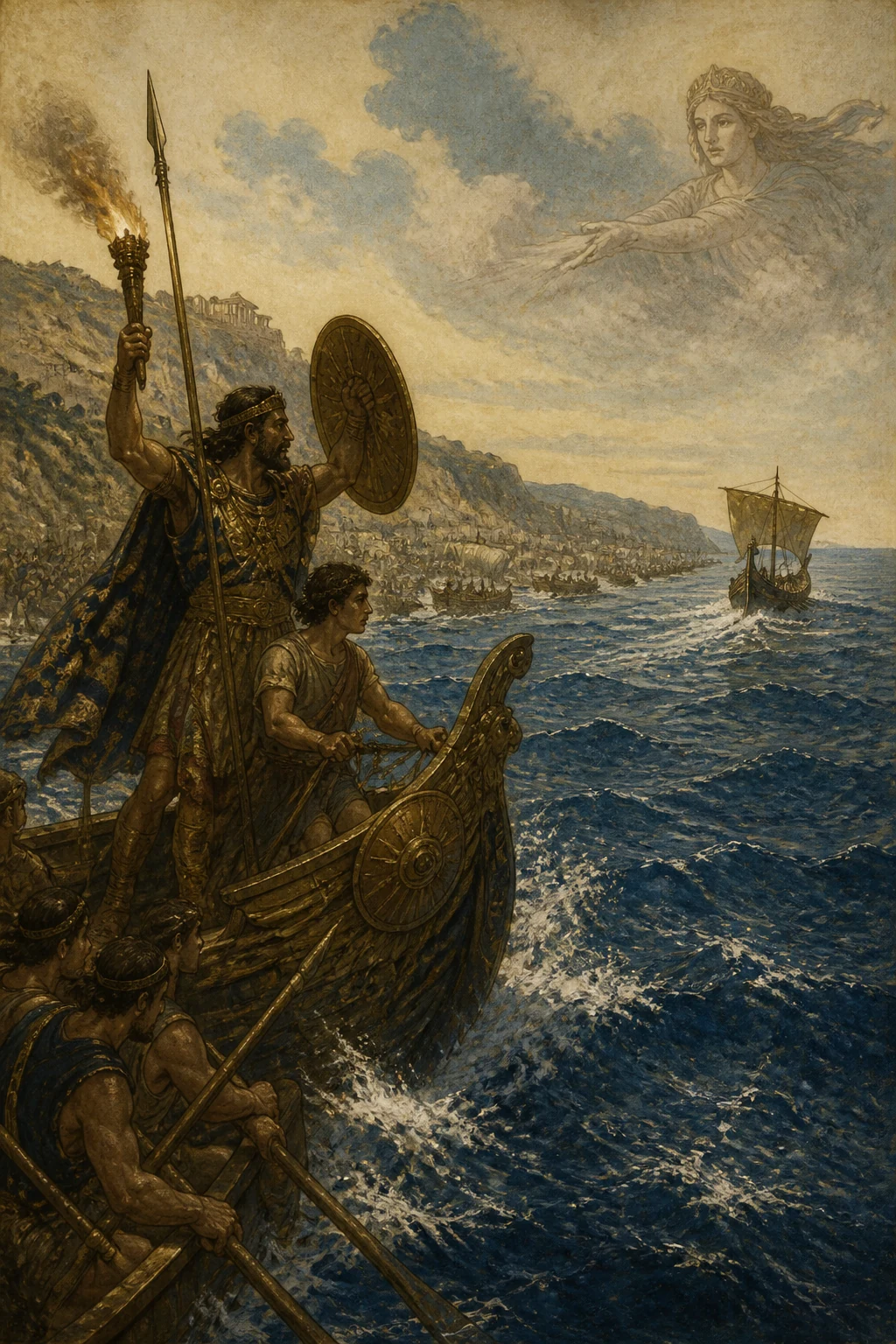
And so, when they saw the Argo being rowed close to the island, they at once put on their weapons and streamed together out through the gates of Myrina to the shore, like flesh-eating Maenads: they thought the Thracians had arrived. With them Thoas’ daughter Hypsipyle put on her father’s armor. Bewildered, they stood in silence, so great was the terror hanging over them.
Meanwhile the heroes sent the swift herald Aethalides from the ship. To him they entrusted their messages and the staff of Hermes, his own father, who had given him an unfailing memory of all things. Even now, though he has passed into the unspeakable eddies of Acheron, oblivion has not overtaken his soul. It is his abiding fate to pass alternately among the dwellers beneath the earth and into the sunlight among living men. But why must I tell the tale of Aethalides at length?
It was he who then persuaded Hypsipyle to receive them as they came through the darkness at the close of day. Nor did they loose the ship’s moorings at dawn, when the north wind blew. The women of Lemnos went through the city and took their seats in the assembly, for Hypsipyle herself had summoned them.
When they had all gathered in a throng, she at once rose among them and spoke in counsel: “My friends, let us give these men welcome gifts, provisions and sweet wine, such as are fitting for them to carry aboard their ship. Then they may remain outside our walls, and not come among us in search of supplies, learn the truth about us, and spread an evil report far and wide. For we have done a terrible deed, and it would certainly bring them no pleasure to hear of it.
“Such is the plan that has occurred to me. But if any of you can devise a better course, let her rise: that is why I have called you here.” So she spoke and sat down upon her father’s stone seat. Then her dear nurse Polyxo rose, limping on feet shriveled with age and leaning upon a staff, yet eager to speak.
Four unmarried girls sat close beside her, whose hair was white with age. She stood in the midst of the assembly and with difficulty raised her neck a little from her bowed back. Then she spoke: “Let us send gifts to the strangers, as Hypsipyle herself wishes, for it is best to give them.
“But what plan have you to preserve your lives if a Thracian army falls upon you, or some other enemy, as so often happens among mortals? Just so has this company arrived unexpectedly today.
“And even if one of the blessed gods should avert that danger, countless other sorrows, worse than war, await you hereafter, when the older women die away, and you younger ones reach hateful old age without children.
“How will you live then, unhappy creatures? Will oxen yoke themselves for you in the deep fields and draw the soil-cleaving plow through the fallow? Will they reap the ears of grain as soon as the season comes?
“As for me, though the spirits of death still shrink from me today, I think the earth will cover me before another year has passed, once I have received my due share of funeral honors, as custom demands, before this misery comes upon us.
“But I urge the younger women to consider these things earnestly. For now an easy means of escape lies at your very feet, if you will entrust your homes, all your possessions, and your splendid city to the care of these strangers.”
So she spoke, and the assembly filled with murmuring, for her words pleased them. Then Hypsipyle rose again beside her and answered: “If this purpose pleases you all, I will send a messenger to the ship at once.”
She spoke, and addressed Iphinoe, who stood nearby: “Go, Iphinoe, and ask the man who leads this expedition to come to our house, so that I may tell him something on behalf of our people that will please his heart. And bid the others too, if they wish, set foot upon our land and enter our city boldly, as friends.”
With that she dismissed the assembly and set out for home. Iphinoe went to the Minyans, and they asked what purpose had brought her. At once she answered them all as they questioned her: “The maiden Hypsipyle, daughter of Thoas, has sent me here to summon whoever is leader of your ship, so that she may tell him something on behalf of our people that will please his heart. And she invites you yourselves, if you wish, to set foot upon our land and enter our city at once, as friends.”
So she spoke, and her welcome message pleased them all. They supposed that Hypsipyle, the cherished daughter of the dead Thoas, ruled over the island. Quickly they sent Jason on his way, and themselves began preparing to go.
About his shoulders he fastened a double purple cloak, the work of the Tritonian goddess, which Pallas had given him when she first laid down the stocks for the Argo and taught him to measure the crossbeams with a rule.
More easily could you have gazed into the rising sun than looked upon that blazing splendor. For its middle was fashioned in glowing red, while all around the edges it was purple. Along each border many intricate designs had been finely worked, each distinct.
There were the Cyclopes, seated at their everlasting work, fashioning a thunderbolt for Zeus their king. Already it was almost complete in all its brilliance; only one ray was still lacking, and this they were beating out with iron hammers, a seething blast of furious fire.
There were the two sons of Antiope, daughter of Asopus, Amphion and Zethus. Nearby lay Thebes, still without towers, and they were eagerly laying its foundations. Zethus carried the summit of a lofty mountain upon his shoulders, looking as though he labored under the burden. Amphion walked beside him, making clear music upon a golden lyre, and a rock twice as large followed in his footsteps. Next was wrought Cytherea with her thick tresses, holding the swift war-god Ares’ shield. The fastening of her tunic had slipped from her shoulder down upon her left arm, below her breast, and her image appeared just as she stood, clearly reflected in the bronze shield.
There was a lush pasture for cattle, and around the herd the Teleboans fought with the sons of Electryon: the latter defending them, the Taphian raiders striving to drive them off. Their blood drenched the dewy meadow, and the many were overpowering the few herdsmen.
There were two chariots wrought in the midst of a race. Pelops drove the one in front, shaking the reins, with Hippodameia beside him. Behind, Myrtilus drove his horses in pursuit. With him Oenomaus, grasping his spear outstretched and lunging to strike Pelops in the back, was falling sideways as the axle broke within the wheel-hubs.
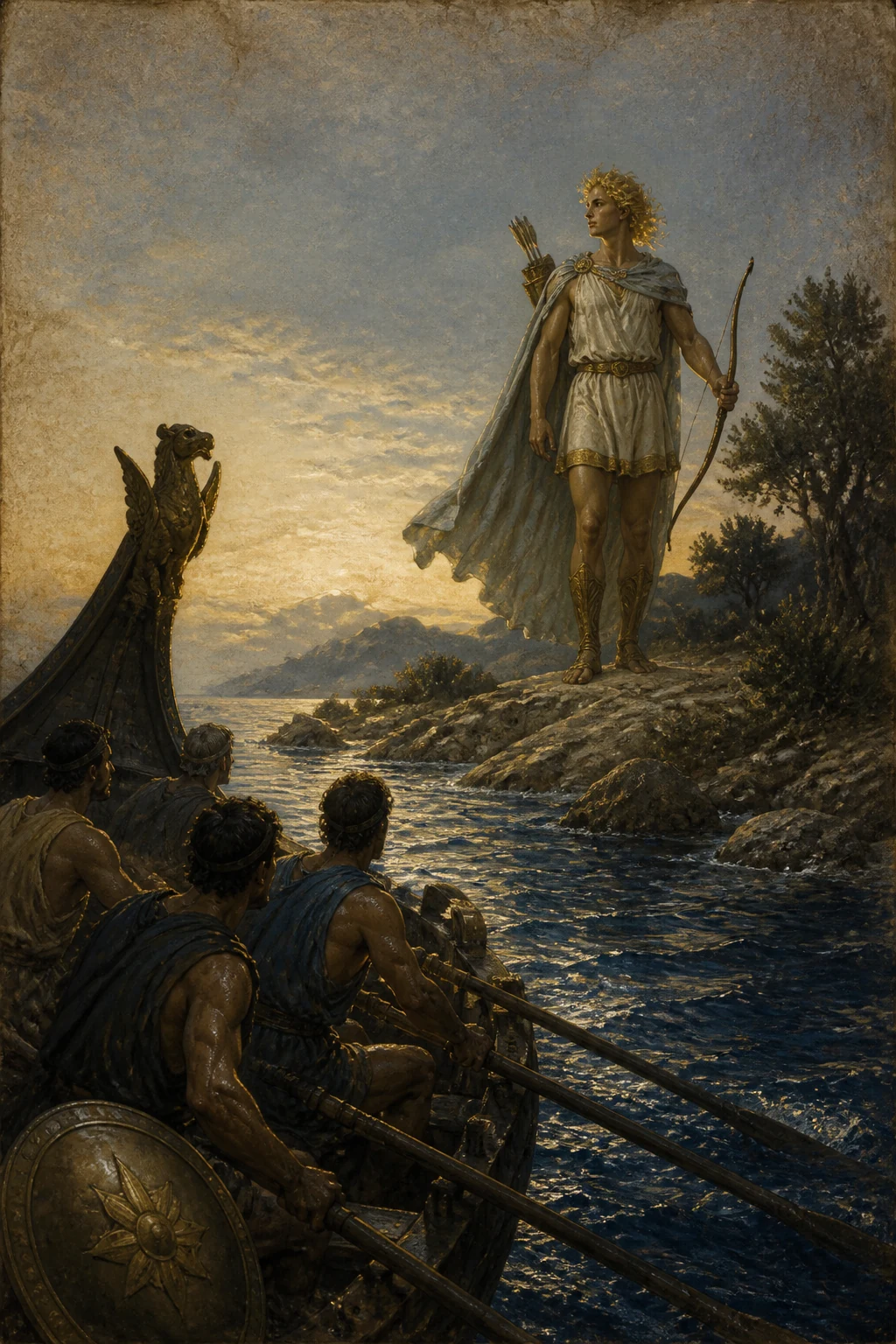
There too Phoebus Apollo was fashioned, still a young boy, not yet full-grown, shooting at the huge Tityus, who was boldly dragging his mother by her veil. Divine Elare had borne him, but Earth had nurtured him and brought him forth a second time.
There too was Phrixus the Minyan, seemingly listening in earnest to the ram, while the ram appeared to speak. Looking at them, you would fall silent and deceive your own heart, expecting to hear some wise utterance from their lips; and in that hope you might gaze for a long time.
Such was the gift of the Tritonian goddess Athena. In his right hand Jason took a far-casting spear, which Atalanta had once placed in his hands as a guest-gift on Maenalus, meeting him with goodwill. For she was eager to follow him on the voyage, but he himself had deliberately held the maiden back, fearing bitter quarrels over love.
He set out toward the city like a shining star, which young brides, shut away in their newly built chambers, behold rising above their homes. Glowing beautifully through the dark-blue air, it enchants their eyes; and a maiden rejoices at the sight as she longs for the young man who is far away among strangers, the man for whom her parents keep her as his promised bride. Like that star the hero walked along the path before the city.
When they had passed through the gates and entered the city, the women of the people crowded after them, rejoicing in the stranger. But he kept his eyes fixed upon the ground and walked steadily on until he reached Hypsipyle’s splendid house. As he appeared, the serving women opened the double doors, fitted with well-crafted panels.
There Iphinoe led him swiftly through a beautiful portico and seated him in a gleaming chair opposite her mistress. Hypsipyle lowered her eyes and a blush spread over her maiden cheeks. Yet, for all her shyness, she addressed him in winning words: “Stranger, why do you linger so long outside our walls? The city is not inhabited by men: they have gone to settle upon the Thracian mainland and plow its wheat-bearing fields. I will tell you the whole story of our troubles truthfully, so that you yourselves may understand.
“When my father Thoas ruled over the citizens, our people used to sail from here and raid the farms of the Thracians who dwell opposite. They brought back boundless plunder, and captive girls with it. But the ruinous purpose of the goddess Cypris was being fulfilled, for she cast into their hearts a soul-destroying madness.
“They came to loathe their wedded wives, and, yielding to their folly, drove them from their homes. Instead they slept beside the captives won by their spears, the cruel men! For a long time we endured it, hoping they might at last change their minds. But the evil grew steadily twice as grievous. Their lawful children were dishonored in the halls, while a brood of bastards sprang up.
“Unmarried girls and widowed mothers alike wandered neglected through the city. No father cared in the least for his daughter, even if he saw her with his own eyes being struck down by a wicked stepmother. Nor did sons any longer defend their mothers from shameful abuse as they once had done; nor did brothers cherish their sisters in their hearts.
“Only the captive girls mattered, in their homes, at dances, in the assembly, and at feasts, until some god put into us the fierce courage to refuse the men entry within our walls when they returned from Thrace. Either they must learn to think as they ought, or take their captives with them and depart elsewhere.
“So they gathered all the male children who remained in the city and went back to Thrace, where even now they dwell and till its snowy fields. Therefore you may move among our people freely. And if you should wish to remain here and find it pleasing, you could have the royal honors of my father Thoas. Nor, I think, would you find fault with our land, for its fields are richer than those of all the other islands that lie in the Aegean Sea.
“But go now to your ship and tell your comrades what I have said, and do not remain outside the city.” So she spoke, concealing the murderous fate that had overtaken the men. But he answered her: “Hypsipyle, we should gladly welcome the generous help you offer us in our need.
“I shall return through the city once I have told my comrades everything in due order. But the sovereignty and the island must remain your own. It is not from contempt that I decline: grievous labors press me onward.”
He spoke and touched her right hand, then quickly set out to return. On every side countless young women gathered joyfully around him, until he passed out through the gates. Afterward they drove down to the shore in smooth-running wagons, bringing many gifts of hospitality, when he had fully recounted all the words Hypsipyle had spoken when she summoned him. And readily they led the men to their own houses as guests. For Cypris stirred sweet desire in their hearts, to please resourceful Hephaestus, so that Lemnos might once again be peopled with men and flourish.
Then the son of Aeson went to Hypsipyle’s royal house, while the others went wherever chance led each of them, except for Heracles. Of his own free will he remained beside the ship, with a few chosen comrades.
At once the city rejoiced in dancing and feasting, filled with the fragrant smoke of sacrifice. Above all the other immortals they sought to please the glorious son of Hera and Cypris herself with songs and offerings.
From day to day they kept postponing their voyage. Long would they have lingered there, had not Heracles gathered his comrades away from the women and rebuked them in these words: “Madmen! Is it the blood of our own people that bars us from our homeland? Or did we come here from home for lack of wives, scorning the women of our own cities? Does it please us now to settle here and plow the rich fields of Lemnos?
“We shall win no glory by staying shut away so long with foreign women. Nor will some god take the fleece and hand it to us of his own accord, merely because we pray. Let us each return to our own homes, and leave him all day in Hypsipyle’s bed until he has filled Lemnos with sons and won himself a mighty name!”
So he rebuked the company. No one dared lift his eyes to meet him or answer a word. Without further speech they hurried from the gathering and began preparing to depart. When the women learned of it, they came running after them.
As bees pour from their rocky hive and hum about the lovely lilies, while all around them the dewy meadow glows, and they fly from flower to flower gathering sweet nectar, so the women streamed about the men, lamenting earnestly. With hands and words they greeted each one, praying to the blessed gods to grant them a safe return.
So too Hypsipyle prayed, holding the hands of Aeson’s son, while tears flowed at the sorrow of his departure: “Go, and may the gods bring you back with your comrades unharmed, carrying the golden fleece to the king, just as you wish and your heart desires. This island and my father’s scepter will await you, if ever, on your homeward journey, you should wish to come back here.
“Easily could you gather a countless host from other cities. Yet you will have no such purpose, nor do I myself expect it to come to pass. Still, remember Hypsipyle, both while you are far away and when you have returned home. And leave me some command that I may gladly fulfill, if the gods should grant that I bear a child.”
Then Aeson’s son answered her with admiration: “Hypsipyle, may the blessed gods bring all these things to a happy fulfillment. But cherish a better hope concerning me, for it is enough for me to dwell in my native land, if Pelias allows it. Only may the gods release me from my labors.
“But if it is not my destiny to reach the land of Greece after sailing so far, and you bear a son, send him when he is grown to Iolcus in the Pelasgian land, to comfort my father and mother in their sorrow, if he finds them still alive, so that, far from that king, they may be cared for beside the hearth of their own home.”