Prevod
Her daughter restored, her fears at rest, nurturing Ceres asks why you fled, Arethusa, and how you became a sacred spring. The waters fell silent; their goddess raised her head from the deep spring and, drying her green hair with her hand, told of the ancient love of the river god of Elis. “I was one of the nymphs who dwell in Achaea,” she said, “and none roamed the woodland glades more eagerly than I, nor was any more eager to set her hunting nets.
Yet though I never sought renown for beauty, though strength was my pride, I was known as beautiful. Nor did the lavish praise of my looks delight me; an untutored girl, I blushed at those gifts of the body that other women cherish, and thought it a fault to please. I was coming back, weary, from the Stymphalian woods—I remember. The day was hot, and my exertions had doubled the fierce heat.
I found a stream that flowed without eddy or murmur, clear to its bed, so that every pebble in its depths could be counted; you would scarcely have thought the water moved. Silvery willows and poplars nourished by the stream cast their freely growing shade upon the sloping banks. I approached and dipped first the soles of my feet, then waded knee-deep; not content with that, I undressed and laid my soft garments on a drooping willow, then plunged naked into the water. As I struck and drew it in a thousand swimming strokes, flinging out my arms, I heard some strange murmur deep within the stream and, frightened, stood upon the nearer bank.
“Where are you hurrying, Arethusa?” Alpheus called from his waters. “Where are you hurrying?” he called again in his hoarse voice. I fled just as I was, unclothed: the farther bank held my garments. All the more fiercely he pursued and burned, and because I was naked, he thought me readier to yield. So I ran, and so that savage creature pressed behind me, as doves flee a hawk on trembling wings, as a hawk pursues the frightened doves.
Past Orchomenus, Psophis, and Cyllene, the valleys of Maenalus, cold Erymanthus, and Elis, I kept on running; nor was he swifter than I. But, unequal to him in strength, I could not long endure the race, while he could bear the prolonged exertion. Still I ran across plains and over wooded mountains, over rocks and cliffs, and where there was no path. The sun was behind us: I saw a long shadow stretching before my feet—unless it was my fear that saw it.
But surely the sound of footsteps terrified me, and the great gusts of his panting breath blew on the ribbons in my hair. Worn out by my flight, I cried, “Diana, help your armour-bearer! I am caught—you have so often let me carry your bow and the arrows enclosed in your quiver.” The goddess was moved, and took one of the dense clouds and cast it over me. The river god searched for me, hidden in the darkness, and blindly prowled around the hollow cloud.
Twice, unknowing, he circled the spot where the goddess had hidden me, and twice he called, “Arethusa! Oh, Arethusa!” What did I feel then, poor wretch? What a lamb feels, hearing wolves growling around the shelter of its fold, or a hare that, hiding in the brambles, sees the hostile muzzles of the hounds and dares not stir a limb. Yet he would not leave: he could see no footprints leading farther on, and kept watch over the cloud and the place.
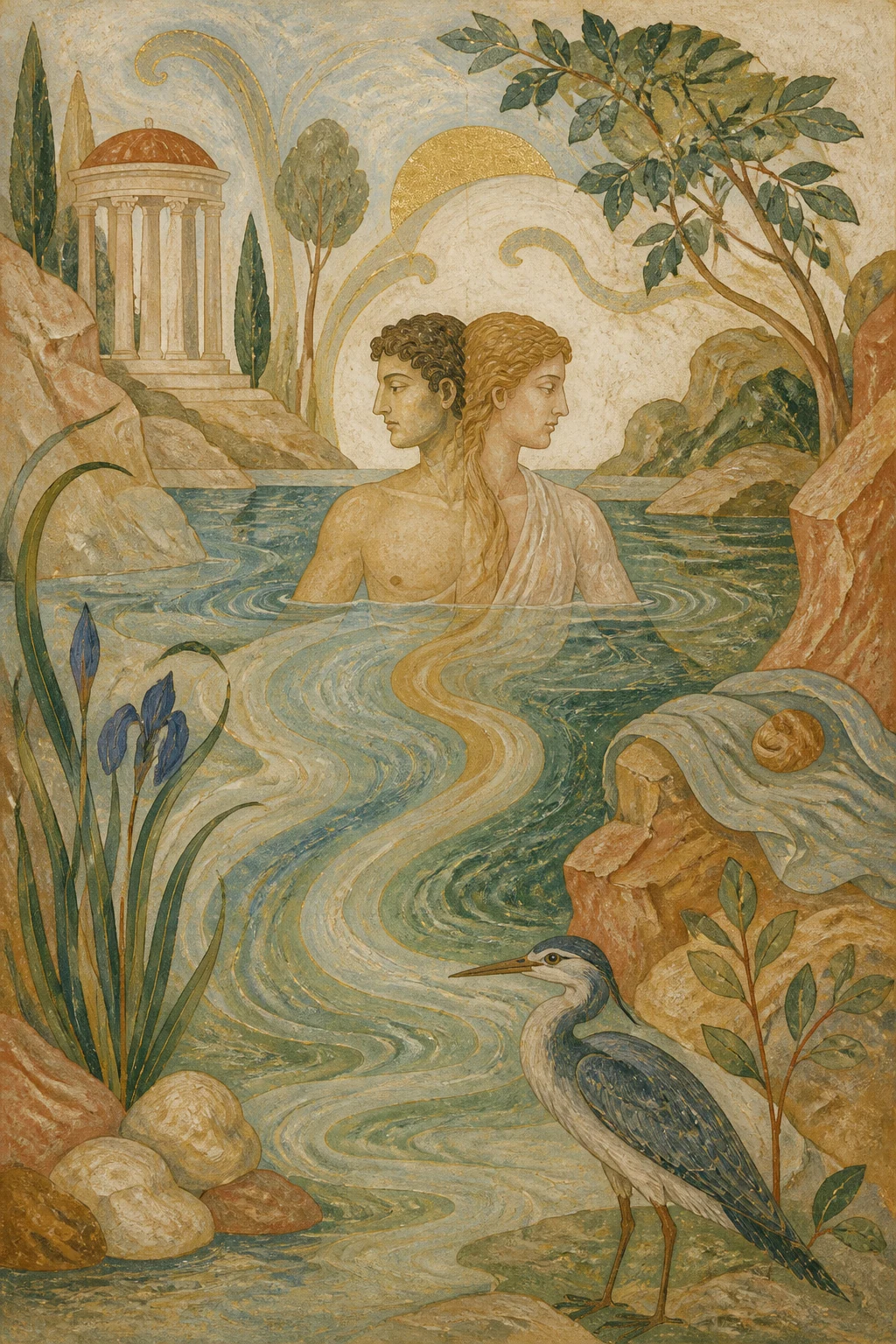
A cold sweat seized my beleaguered limbs, and blue drops fell from all my body; wherever I moved a foot, a pool welled up, and from my hair dew fell; and faster than I can now tell you the tale, I changed to flowing water. But the river god recognized the waters he loved and, casting off the human form he had assumed, returned to his own waves, to mingle himself with me.
The Delian goddess split the earth; I sank into its hidden caverns and was carried to Ortygia, dear to me for bearing my goddess’s name, which first brought me forth again into the upper air.”