Prevod
Once upon a time there were a man and a woman who had no children as long as they were rich, but when they had become poor, they had a little boy. They could find no godfather for him, so the man said he would go to another village and see whether he could find one there.
As he went along, he met another poor man, who asked him where he was going. The man replied that he was going to see whether he could find a godfather, but he was poor, and no one wanted to stand godfather to his child. “Oh,” said the poor man, “you are poor and I am poor. I will be your child’s godfather, though I have nothing to give him. But go and tell the midwife to bring the child to church.” When they came to the church together, the beggar was already inside. And he gave the child the name “Ferdinand the Faithful.”
When they came out of the church, the beggar said, “Now go home. I have nothing to give you, and you must give me nothing either.” But he gave the midwife a key and told her to give it to the father when she got home. The father was to keep it until the child was fourteen years old; then the boy was to go out onto the heath, where there would be a castle that the key would open. Everything inside it was to belong to him.
When the child was seven years old and had grown into a sturdy boy, he went out one day to play with some other boys. They began talking about what their godfathers had given them, each boasting of more than the last. But he had nothing at all to say. So he began to cry and went home and said to his father, “Didn’t my godfather give me anything at all?” “Oh yes,” said his father, “he gave you a key to a castle that will stand out on the heath. Then you are to go there and unlock it.” So the boy went, but there was neither sight nor sound of a castle. Seven years later, when he was fourteen, he went there again, and this time there really was a castle on the heath. When he unlocked it, there was nothing inside but a horse, a white one. The boy was so delighted to have a horse that he mounted it and galloped home to his father. “Now I have a white horse of my own, and now I shall go travelling too,” he said. So he set out, and as he went along, he saw a quill lying in the road. At first he meant to pick it up, but then he thought to himself, Oh, you might as well leave it. Wherever you go, you will find a quill if you need one. As he went on, a voice called behind him, “Ferdinand the Faithful, take it with you.” He looked round but saw no one, so he went back and picked it up. After riding for a while, he came to a stretch of water, where a fish lay on the bank gasping for air. “Wait, my dear fish,” he said, “I will help you back into the water.” He caught it by the tail and threw it in. Then the fish put its head out of the water and said, “Since you have rescued me from the mud, I will give you a flute. If ever you are in trouble, play it, and I will help you. And if ever you drop anything into the water, just play, and I will fetch it out for you.” He rode on, and presently a man came along and asked him where he was going. “Oh, to the next town.” And what was his name? “Ferdinand the Faithful.” “My name is almost the same,” said the other, “for I am called Ferdinand the Unfaithful.” So the two of them went together to the inn in the next town.
Now the trouble was that Ferdinand the Unfaithful knew everything anyone else had thought or intended to do; he learned it through all manner of wicked arts. At the inn there was a good-hearted girl with a bright face, and she was very pretty. She fell in love with Ferdinand the Faithful, for he was a handsome young man, and asked him where he was going. Oh, he was simply travelling about, Ferdinand the Faithful told her. Then she said he ought to stay, for there was a king in that country who could surely use a servant or an outrider, and he should enter his service. He replied that he could not simply go and offer himself. “Oh,” said the girl, “I will do that for you.” And she went straight to the king and told him she knew a handsome young man who would make a fine servant at his court. The king was well pleased, sent for him, and offered to make him a servant. But he would rather be an outrider, for wherever his horse was, he must be too; so the king made him an outrider. When Ferdinand the Unfaithful heard of this, he said to the girl, “You help him, but not me?” “Oh,” said the girl, “I will help you too.” She thought to herself, You must keep that one as a friend, for he is not to be trusted. She went to the king and offered him as a servant, and the king was content.
Whenever Ferdinand the Unfaithful dressed his master in the morning, the king would lament, “Oh, if only I had my beloved here with me.” Now Ferdinand the Unfaithful was always seeking to harm Ferdinand the Faithful, and when the king once again lamented in this way, he said, “You have your outrider. Send him; he must bring her here, and if he fails, his head must be struck off and laid at his feet.” So the king sent for Ferdinand the Faithful and told him that his beloved was in such-and-such a place, and he must bring her back; if he did not, he would have to die.
Ferdinand the Faithful went to his white horse in the stable and wept and lamented. “Oh, what an unhappy creature I am!” Then a voice called behind him, “Ferdinand the Faithful, why are you weeping?” He looked round but saw no one, and went on lamenting. “Oh, my dear white horse, I must leave you, and now I must die.” Again the voice called, “Ferdinand the Faithful, why are you weeping?” Only then did he realize that it was his little white horse speaking to him. “Is that you, my little white horse? Can you talk?” And he went on, “I have to go to such-and-such a place and fetch the bride. Do you know how I am to do it?” The little white horse replied, “Just go to the king and tell him that if he will give you what you need, you will bring the bride back. You will need a ship full of meat and a ship full of bread, for there are great giants on the water, and unless you bring them meat, they will tear you to pieces. And there are great birds too, who will peck the eyes out of your head unless you have bread for them.”
So the king ordered all the butchers in the land to slaughter and all the bakers to bake until the ships were full. When they were loaded, the little white horse said to Ferdinand the Faithful, “Now mount me and ride me to the ship. When the giants come, say:
Hush, hush, my dear little giants, I have thought of you today, And brought you something on my way. And when the birds come, say in turn:
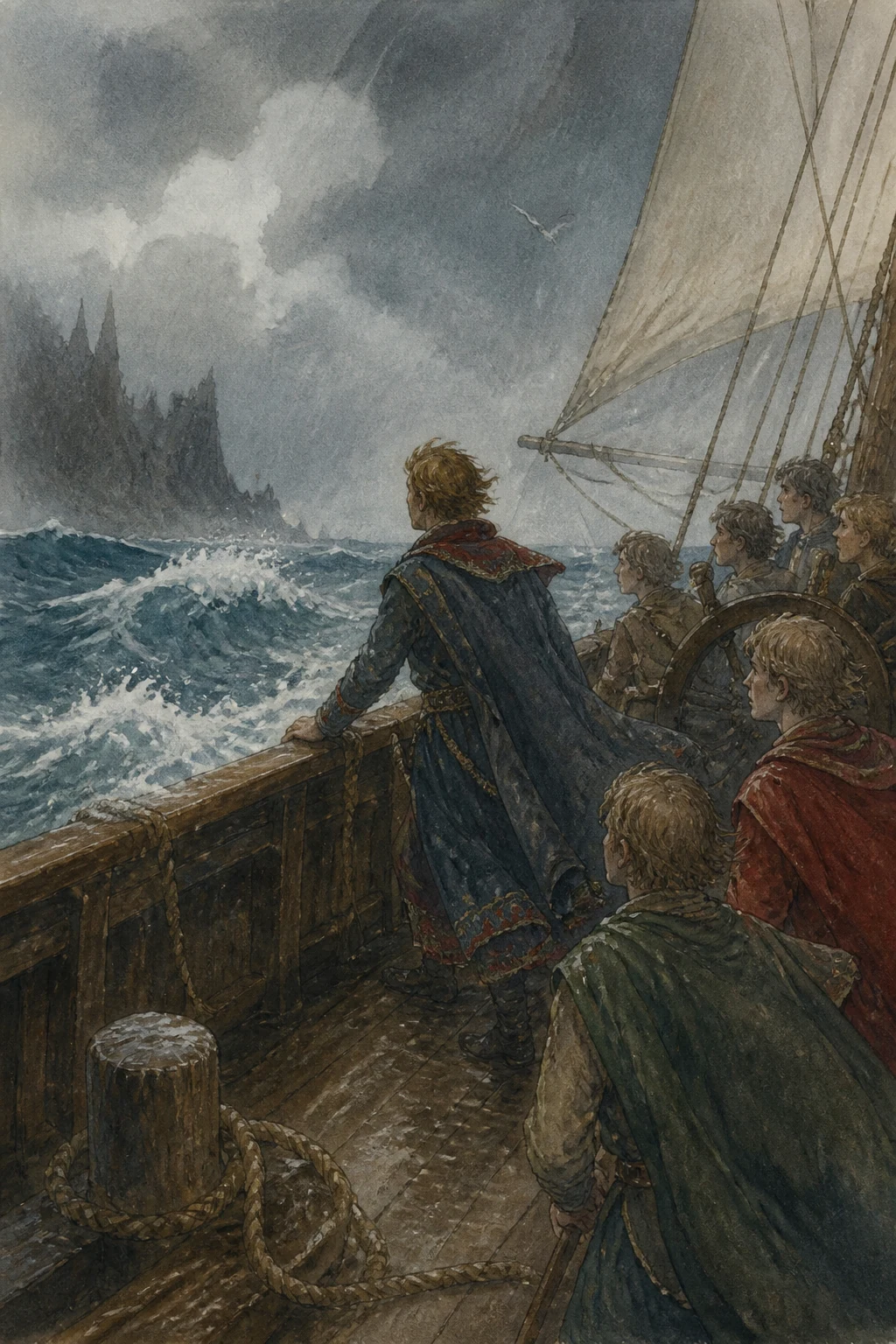
Hush, hush, my dear little birds, I have thought of you today, And brought you something on my way. Then they will do you no harm, and when you reach the castle, the giants will help you. Go up to the castle and take a few giants with you. The princess will be lying there asleep. You must not wake her; instead, the giants must carry her, bed and all, onto the ship.” Everything happened just as the little white horse had said. Ferdinand the Faithful gave the giants and the birds what he had brought for them, and in return the giants willingly carried the princess to the ship, which sailed at once to the king. When they reached him, the princess said she could not live without her writings, which had been left behind in the castle. So, at Ferdinand the Unfaithful’s instigation, Ferdinand the Faithful was summoned, and the king ordered him to fetch the writings from the castle, or else he must die. He went back to the stable and wept, saying, “Oh, my dear little white horse, now I must set out once more. How am I to manage it?” The white horse said they must load the ships again. Everything went as it had before, and the giants and the birds were fed and appeased with the meat. When they reached the castle again, the white horse told him to go inside; the writings were there in the princess’s bedchamber. Ferdinand the Faithful went in and fetched them. When they were out on the water again, he dropped his quill overboard. “Now I cannot help you,” said the white horse. Then he remembered his flute and began to play. The fish came with the quill in its mouth and held it out to him. So he brought the writings back to the palace, where the wedding was held.
The queen could not bear the king, because he had no nose, but she was very fond of Ferdinand the Faithful. One day, when all the gentlemen of the court were gathered together, the queen said that she too could perform feats of magic: she could cut off a head and put it back on again, and someone ought to let her try. But no one wanted to be the first. So Ferdinand the Faithful had to step forward, once again at Ferdinand the Unfaithful’s instigation. She cut off his head and put it back on, and it healed at once, though it looked as if he had a red thread round his neck. Then the king said to her, “My child, where did you learn that?” “Oh,” she said, “I know the art well. Shall I try it on you too?” “Oh yes,” he said. So she cut off his head, but did not put it back on. She pretended that she could not get it back into place and that it would not stay fast. So the king was buried, and she married Ferdinand the Faithful.
He still always rode his white horse, and one day, when he was once again on its back, the horse told him to ride to another heath, which it would show him, and gallop round it three times. When he had done so, the white horse reared up on its hind legs and turned into a prince.