Prevod
_Through the machinations of a Queen, Miuccio is sent into one peril after another, but with the help of an enchanted Bird he emerges honorably from them all. At last the Queen dies, and Miuccio, discovered to be the King’s son, has his mother set free, and she becomes the wife of that crowned head._ _The tale of the Seven Little Rinds so enriched the soup of the Prince’s pleasure that the fat fairly overflowed as he heard of Saporita’s ignorant cunning and cunning ignorance, which Tolla had served up with such relish. But Popa, unwilling to yield so much as a crumb to Tolla, embarked upon the sea of storytelling with the tale that follows._ Whoever seeks another’s harm finds his own hurt, and whoever sets out to catch this person or that by treachery and deceit often falls into the very snares he has laid, as you shall hear of a Queen who built with her own hands the trap that caught her by the foot.
Once upon a time, they say, there was a King of Auta Marina who, because of the cruelty and tyranny he practiced, had his royal throne seized by a certain sorceress while he was away with his wife at a little castle far from the city. He therefore had prayers offered to a wooden statue that gave certain oracular answers, and it replied that he would recover his kingdom when the sorceress lost her sight. But the sorceress was not only well guarded: she could sniff out the people he sent to harm her, and dealt with them like dogs. Driven to despair, and to spite the sorceress, he robbed every woman of that place whom he could get into his clutches first of her honor and then of her life. After hundreds upon hundreds, brought there by their ill fortune, had been stripped of their good names and cut short in their days, there came among the others a young woman named Porziella, the most exquisite creature to be seen anywhere on earth. Her hair was a pair of handcuffs for Love’s constables; her forehead a tablet displaying the prices in the shop of amorous delights; her eyes two beacons guiding the ships of desire safely into the harbor of contentment; her mouth a honeycomb between two hedges of roses. When she fell into the King’s hands, and he had put her through the usual drill, he meant to kill her like the rest;
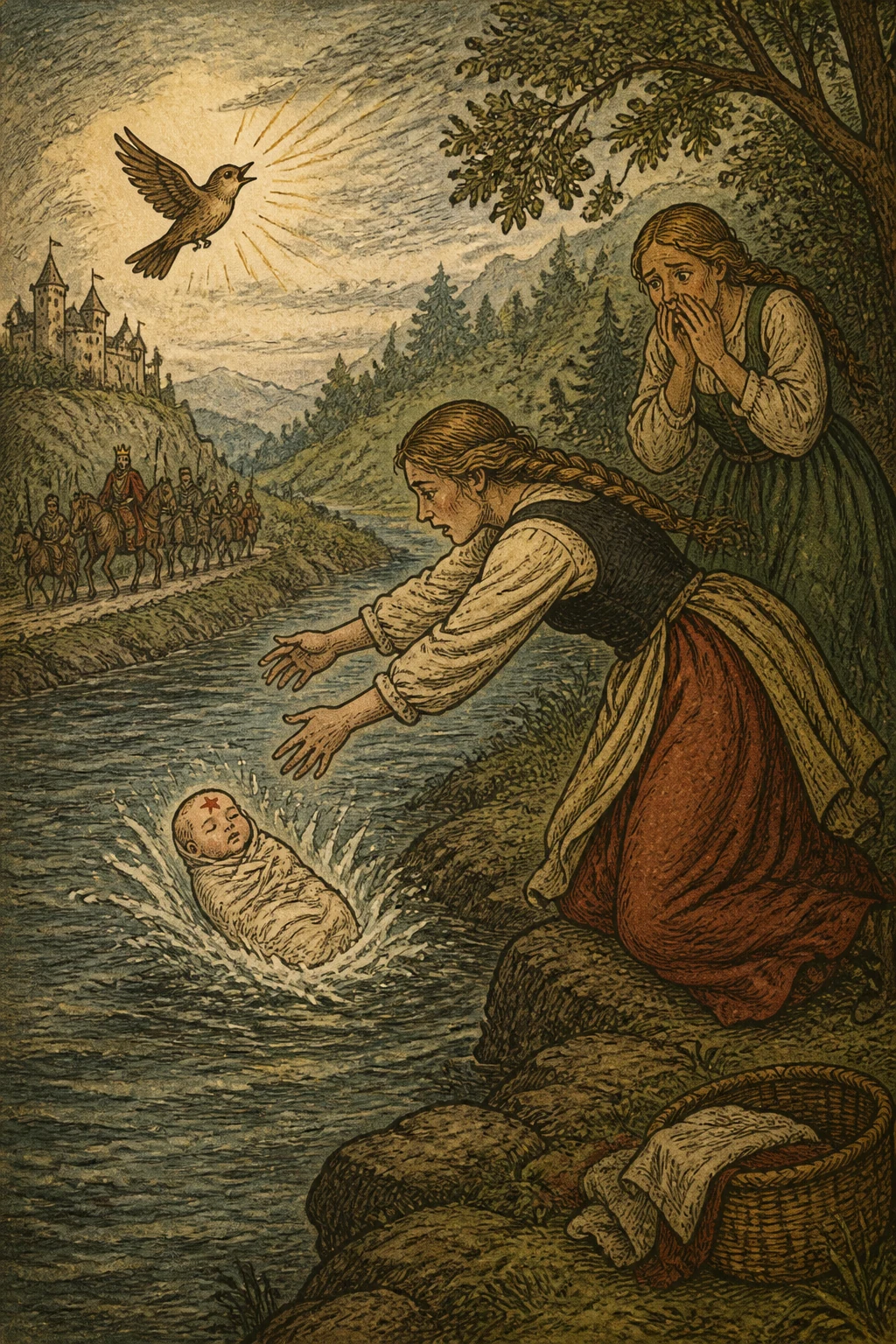
but at the very moment he raised his dagger, a bird dropped some root or other upon his arm, and such a trembling seized him that the weapon fell from his hand. This bird was a Fairy who, a few days before, had been sleeping in a wood, where beneath the awning of the shadows desire played for terror’s stakes. A certain Satyr was about to do vile things to her when Porziella woke her; and in gratitude for this kindness she had ever since followed the girl’s footsteps, seeking to repay her. Now, when the King saw what had happened, he imagined that the beauty of her face had laid this restraint upon his arm and cast this spell upon his dagger, preventing them from ripping her open as they had so many others. He decided that one madman in the house was enough, and that he would not stain his instrument of death with blood as he had stained his instrument of life. Instead, she should die walled up in an attic of his palace. And so he did indeed have the lovely, luckless girl shut in between four walls, leaving her neither food nor drink, so that she might waste away little by little. Seeing her in this plight, the Bird comforted her in human speech, telling her to take heart: in return for a kindness she had done it, it would help her with its own lifeblood. However much Porziella begged, it would never say who it was, only that it was in her debt and would leave nothing undone to serve her. Seeing that the poor girl was faint with hunger, it flew out and returned at once with a sharp-pointed knife stolen from the King’s pantry. It told her to make a hole, little by little, in one corner of the floor, which would open into the kitchen, from which it could always fetch something to keep her alive. Porziella worked away for some time, digging until she had made a passage for the Bird. Watching until the Cook went to fetch a bucket of water from a fountain, it slipped down through the hole, snatched up a fine chicken that was keeping warm, and carried it to Porziella. To relieve her thirst, not knowing how to bring her anything to drink, it flew to the storeroom, where bunches of grapes hung in abundance, and brought her a handsome cluster. This it continued to do day after day. Meanwhile Porziella, who had become pregnant, gave birth to a beautiful boy, whom she nursed and brought up with the Bird’s constant help. When he had grown, the Fairy advised his Mother to enlarge the hole, removing enough little floorboards to let Miuccio—for that was the boy’s name—pass through. Once she had lowered him with some cords the Bird brought her, she was to put the boards back in place, so that no one would see where he had come down. Porziella did as the Bird advised, and, bidding her Son never tell where he had come from or whose child he was, lowered him while the Cook was out. When the Cook returned and saw so handsome a boy, he asked him who he was, how he had got in, and what he had come to do. Miuccio, remembering his mother’s advice, said he had lost his way and was looking for a master. During this exchange the Steward arrived, and, seeing so spirited a Lad, thought he would make a good page for the King. He took him to the royal apartments, and the King, seeing him so handsome and engaging, like a precious jewel, took an instant liking to him, keeping him as a page in his service and as a son in his heart. He had him taught all the exercises befitting a Gentleman, until he grew into the most accomplished youth at Court. The King loved him far more than he loved his stepson, and for this reason the Queen began to dislike him and find him distasteful. Envy and malice gained ground all the faster as the favors and kindnesses the King bestowed on Miuccio smoothed their way. At last she resolved to smear so much soap upon the steps of his fortune that he would slip from top to bottom. One evening, after they had tuned their instruments together and were making their own private music, the Queen told the King that Miuccio had boasted he could build three castles in the air. The King, whether because his wits were muddled or because he wished to please his wife, sent for Miuccio next morning, when the Moon, schoolmistress of the shadows, gives her pupils a holiday for the festival of the Sun. He ordered him, whatever it took, to build the three castles in the air he had promised, or else he would have him dance in the air himself. Hearing this, Miuccio went to his room and began to lament bitterly, reflecting how brittle was the favor of princes, and how briefly their kindness lasted. While he was weeping floods of tears, along came the Bird, who said, “Take heart, Miuccio, and have no fear while you have this fellow beside you, for I can pull you out of the fire.” So saying, it told him to take cardboard and glue and make three great castles. Then it summoned three huge Griffins and fastened one castle to each. As they flew through the air, Miuccio called the King, who came running with the whole Court to see the spectacle. At the sight of Miuccio’s ingenuity, the King grew fonder of him than ever, and showered him with extraordinary caresses. This poured fresh fuel upon the Queen’s envy and fire upon her anger, for she saw that nothing was turning out as she wished. Not a waking day passed without her thinking, nor a sleeping night without her dreaming, of some way to remove this thorn from her eyes. And so, a few days later, she said to the King, “My husband, now is the time to return to our former grandeur and the pleasures of days gone by, for Miuccio has offered to blind the Fairy, and with one gouging of eyes win back your lost Kingdom.” The King, feeling himself touched upon his sorest spot, sent for Miuccio that instant and said, “I am greatly astonished that, when I love you so dearly and you can restore me to the throne from which I have fallen, you should remain so unconcerned and take no thought of rescuing me from my misery. You see me reduced from a Kingdom to a wood, from a City to a wretched little Castle, and from commanding so many people to being barely served by a handful of bread-gobblers, loaf-slicers, and broth-ladlers. Unless you want my displeasure, go this very moment and blind the Fairy who holds what is mine. By closing her shops you will reopen the warehouse of my greatness; by putting out those lanterns you will relight the lamps of my honor, which now stand dark and blackened.”
Hearing this proposal, Miuccio wanted to reply that the King had been misinformed and mistaken him for someone else, for he was neither a crow to peck out eyes nor a privy-cleaner to clear out holes. But the King cut him short: “No more words! Such is my will, and so it shall be done. Consider that, in the mint of this brain of mine, I have set up the scales: here is your reward if you do your duty, and here your punishment if you fail to do as I command.” Miuccio, who could not butt heads with a stone, and had to deal with a man—woe to the mother whose daughter fell into his hands!—went off into a corner to bewail his lot. There the Bird found him and said, “Is it possible, Miuccio, that you must always drown in a glass of water? If I had been killed, could you make any greater outcry?
“Do you not know that I care more for your life than for my own? So do not lose heart, but follow me, and you shall see what little Meniello can do.” It took wing and alighted in the wood, where it began to warble, and a flock of birds gathered round. It asked which of them felt able to take away the Sorceress’s sight: whoever did so would receive a safeguard against the talons of sparrowhawks and goshawks, and a pass exempting it from the guns, springes, crossbows, and snares of hunters. Among them was a swallow that had built its nest on a beam in the royal palace and hated the Sorceress, who, in performing her accursed spells, had often driven it from her chamber with her fumigations. Partly from a desire for revenge, partly to win the reward the Bird promised, it offered to undertake the task. Flying like a thunderbolt to the City and entering the palace, it found the Fairy stretched upon a couch, being cooled with a fan by two waiting-women. The Swallow swooped straight down upon the Fairy’s eyes and, dropping its dung into them, robbed her of her sight. Finding night upon her at midday, and knowing that with this closing of her customs house her trade in the Kingdom was ended, she screamed like a damned soul, renounced the scepter, and went to burrow in certain caves, where she spent the rest of her days battering her head against the walls. Once the Sorceress had gone, the Councilors sent ambassadors to the King, bidding him return to enjoy his own home, since the Sorceress’s blindness had allowed them to see this happy day. At the same time as they arrived, Miuccio also appeared, and, prompted by the Bird, said to the King, “I have paid you in good coin: the Sorceress is blind, and the kingdom is yours. If I deserve any payment for this service, I ask only that you leave me alone with my troubles, without exposing me to such dangers again.” The King embraced him most lovingly, bade him put on his cap, and seated him beside him. Heaven alone could tell you how the Queen swelled with rage; and the rainbow of colors that crossed her face foretold the storm of ruin she was brewing in her heart against poor Miuccio. Not far from this castle lived a most ferocious Dragon, born at the same birth as the Queen. Her Father had summoned the Astrologers to read the meaning of this event, and they declared that his daughter would live as long as the Dragon lived, and that when one died the other must necessarily die too. Only one thing could restore the Queen to life: her temples, the hollow of her breast, her nostrils, and her wrists must be anointed with the blood of that same Dragon. Now the Queen, knowing the creature’s fury and strength, resolved to send Miuccio into its claws, certain that it would make a single mouthful of him, and that he would be no more than a strawberry in a Bear’s throat. Turning to the King, she said, “Upon my word, Miuccio is the treasure of your household, and you would be ungrateful not to love him, all the more since he has let it be understood that he means to kill the Dragon. Though the creature is my brother, since he is so much your enemy I care more for one hair of a husband than for a hundred brothers.” The King, who hated the Dragon mortally and did not know how to rid himself of it, sent for Miuccio at once and said, “I know you can turn your hand to anything you please; and so, having done so much already, you must do me one more favor, and afterward turn me whichever way you wish. Go this very instant and kill the Dragon. You will render me a signal service, and I shall reward you handsomely.” At these words Miuccio nearly lost his senses, and when at last he could get the words out, he said to the King, “Now here is a fresh headache! Have you taken it into your head to wear me out? Is my life made of black goatskin, that you waste it so recklessly? This is no peeled pear to drop into my mouth: it is a Dragon, which tears with its claws, smashes with its head, shatters with its tail, shreds with its teeth, poisons with its eyes, and kills with its breath. How can you send me to my death? Is this the worthless office I am given for giving you a Kingdom? What accursed soul has thrown this die upon the table?
“What son of Hell has put you up to these tricks and stuffed you full of such talk?” But the King, who was as light as a ball when it came to being bounced about, yet harder than stone in holding to anything he had once said, dug in his heels. “You have done so much, and now you fail at the best of it! No more words. Go and rid my Kingdom of this plague, unless you wish me to rid you of your life.” Wretched Miuccio, who received now a favor, now a threat, now a stroke upon the cheek, now a kick in the backside, now heat and now cold, reflected how changeable were the fortunes of Court, and wished he had never so much as tasted the King’s acquaintance. But knowing that to argue with great men is folly, and as good as plucking a Lion’s beard, he withdrew to one side, cursing the fate that had brought him to Court only to cut short the hours of his life. As he sat on a doorstep with his face between his knees, washing his shoes with tears and warming his nether weights with sighs, along came the Bird with a herb in its beak. Dropping it into his lap, it said:
“Get up, Miuccio, and rest assured that you will not be playing a losing game with your own days, but sweeping the board of the Dragon’s life. Take this herb, and when you reach that ugly creature’s cave, throw it inside. At once such an overpowering sleep will seize him that he will nod off where he lies. Then take a good stout blade and, between one slash and the next, finish him off and come away. Things will turn out better than you think. Enough: I know very well what I have up my sleeve, and we have more time than money, and whoever has time has life.” At these words Miuccio rose, tucked a great wagoner’s knife beneath his clothes, took the herb, and set out for the Dragon’s court. It lay beneath a mountain so well grown that the three mountains the Giants used as a staircase would not have reached its waist. Arriving there, he threw the herb into the cavern, and the Dragon fell asleep at once. Miuccio began hacking it to pieces. At the very moment he was mincing the beast, the Queen felt her heart being minced, and, finding herself in a desperate state, recognized her mistake: she had bought her death with ready money. Calling her husband, she told him what the Astrologers had foretold, how her life hung upon the Dragon’s death, and how she feared Miuccio had killed it, since she felt herself slipping away little by little;
to which the King replied, “If you knew the Dragon’s life was the prop of your own and the root of your days, why did you make me send Miuccio there? Who is to blame? You have brought this harm upon yourself, and you may weep for it yourself. You broke the glass, and you must pay for it.” And the Queen answered, “I never imagined that such a little scrap of a boy would have the skill and strength to bring down a creature that thought nothing of an army. I meant him to leave his rags there;
“but since I have reckoned without the host, and the boat of my designs has gone aground, do me one favor, if you love me. As soon as I am dead, have a sponge soaked in the Dragon’s blood brought here, and anoint all the extremities of my body before burying me.” “That is a small thing beside the love I bear you,” replied the King, “and if the Dragon’s blood is not enough, I shall add my own to satisfy you”;
and as the Queen tried to thank him, her spirit departed with the words, for at that very moment Miuccio had finished chopping the Dragon into tuna steaks. No sooner had he appeared before the King to report what he had done than the King ordered him to go and fetch the Dragon’s blood. But, curious to see the feat Miuccio had accomplished, the King followed behind him. As Miuccio was leaving the palace gate, the Bird met him and said, “Where are you going?” Miuccio answered, “Wherever the King sends me. He keeps me going like a weaver’s shuttle and will not let me rest for an hour.” “To do what?” asked the Bird. “To fetch the Dragon’s blood,” said Miuccio. The Bird replied, “Oh, wretched boy! This Dragon’s blood will be bull’s blood to you, bursting you open inside. With this blood you will bring back to life the evil seed of all your troubles, for she is forever putting you in fresh danger so that you may lose your life;
“and the King, who lets an ugly harpy saddle him, sends you out like a castaway to risk your person, though you are his own blood, a sprout of his own plant. But the poor blind fool does not know you:
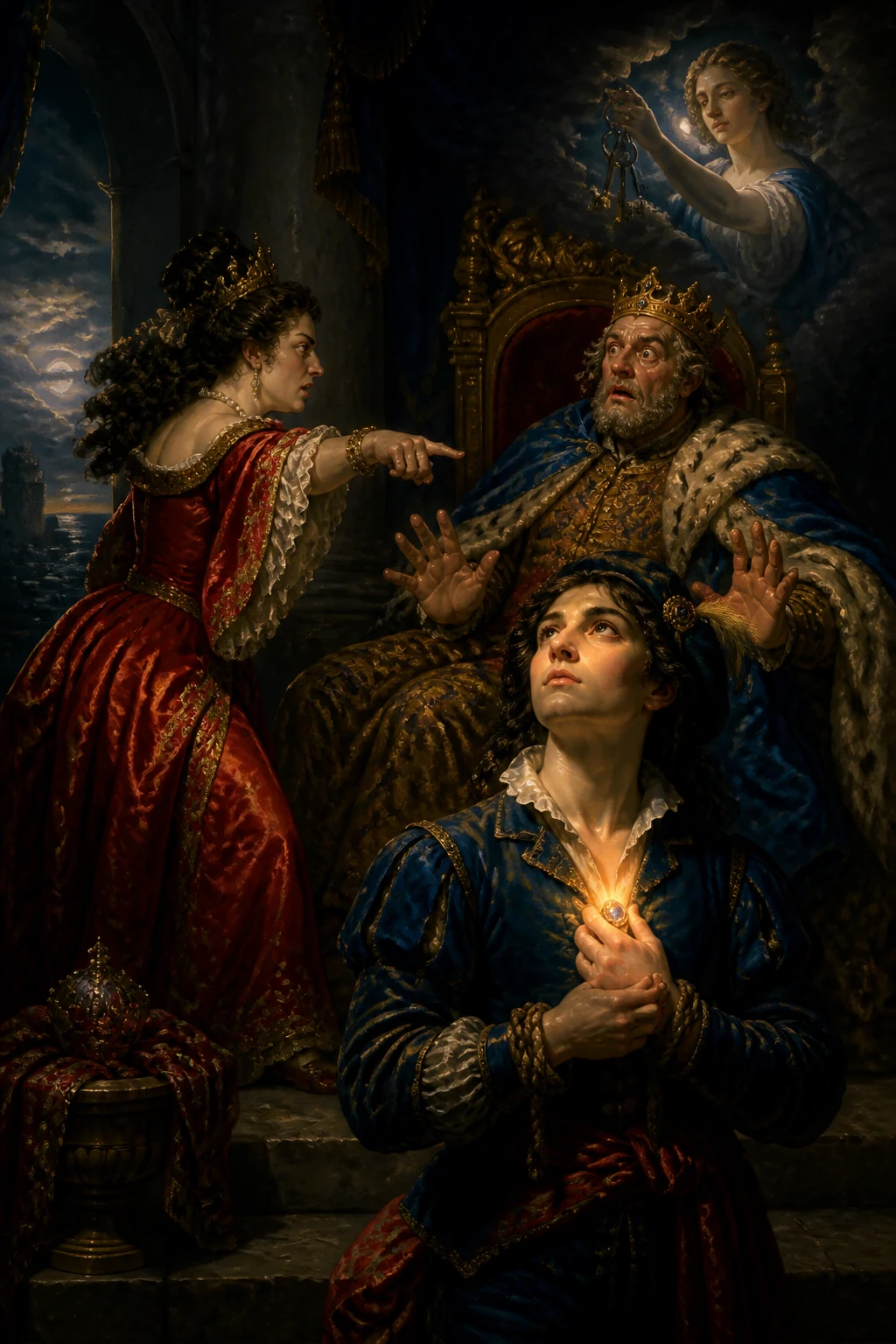
“yet the affection within him ought to betray this kinship, so that the services you have rendered this Lord, and his gain in finding so handsome an heir, might persuade him to restore to favor that unfortunate Porziella, your mother. For fourteen years now she has been buried alive in an attic, where a temple of beauty stands walled inside a little chamber.” While the Fairy was speaking thus, the King, who had heard everything, came forward to learn more. Hearing that Miuccio was the son of Porziella, who had conceived by him, and that Porziella was still alive in her chamber, he immediately ordered the wall broken open and her brought before him;
and when he saw her more beautiful than ever, thanks to the Bird’s good care, he embraced her with great love, unable to have enough of clasping now the mother, now the son. He begged her forgiveness for his cruel treatment, and the boy’s for the dangers to which he had exposed him. At once he had her dressed in the dead Queen’s richest garments and took her for his wife. When he learned that she owed her life to the food the Bird had brought, and that his son owed his escape from so many perils to its counsel, he offered it his kingdom and his life. But it said it wanted no reward for all its services except Miuccio for a husband. As it spoke, it became a most beautiful Maiden, who, to the great delight of the King and Porziella, was given to Miuccio as his wife. Thus, while the dead Queen was cast into a tomb, the bridal pair gathered happiness by the bushel. To make the festivities greater still, they set out for their Kingdom, where they were eagerly awaited, acknowledging that all their good fortune came from the Fairy, in return for the kindness Porziella had done her; for, when all is said and done, _A good deed is never lost._