O besedilu
Pinto Smauto
- Vir
- Pentameron
- Avtor
- Giambattista Basile
- Jezik branja
- English
- Jezik izvirnika
- Neapolitan
- Čas branja
- 12 min branja
- Obseg
- 10 strani
- Naslov izvirnika
- Jornata V III PINTO SMAUTO
O izvirniku
Pentameron
Baročna, divja starejša plast evropske pravljice, polna obratov in pretiravanj. Bralni jezik je English, izvirnik pa prihaja iz vira Pentameron v jeziku Neapolitan.
Besedilo
Pinto Smauto
_Betta refuses to take a husband; at last she kneads one with her own hands. When a Queen steals him, she finds him after a thousand trials and, recovering him by great ingenuity, brings him home._ _When Cecca had finished her tale, which delighted them all exceedingly, Meneca, who was poised to let fly with her own, saw that everyone had pricked up their ears to listen, and spoke as follows._ It has always been harder for a man to keep what he has gained than to gain something new, for in the latter fortune lends a hand, and often favours injustice, whereas the former calls for judgment. Thus we often see someone with a little shrewdness climb to a comfortable height, only to tumble down again for want of wit, as you will plainly see from the tale I am about to tell you, provided you have your wits about you.
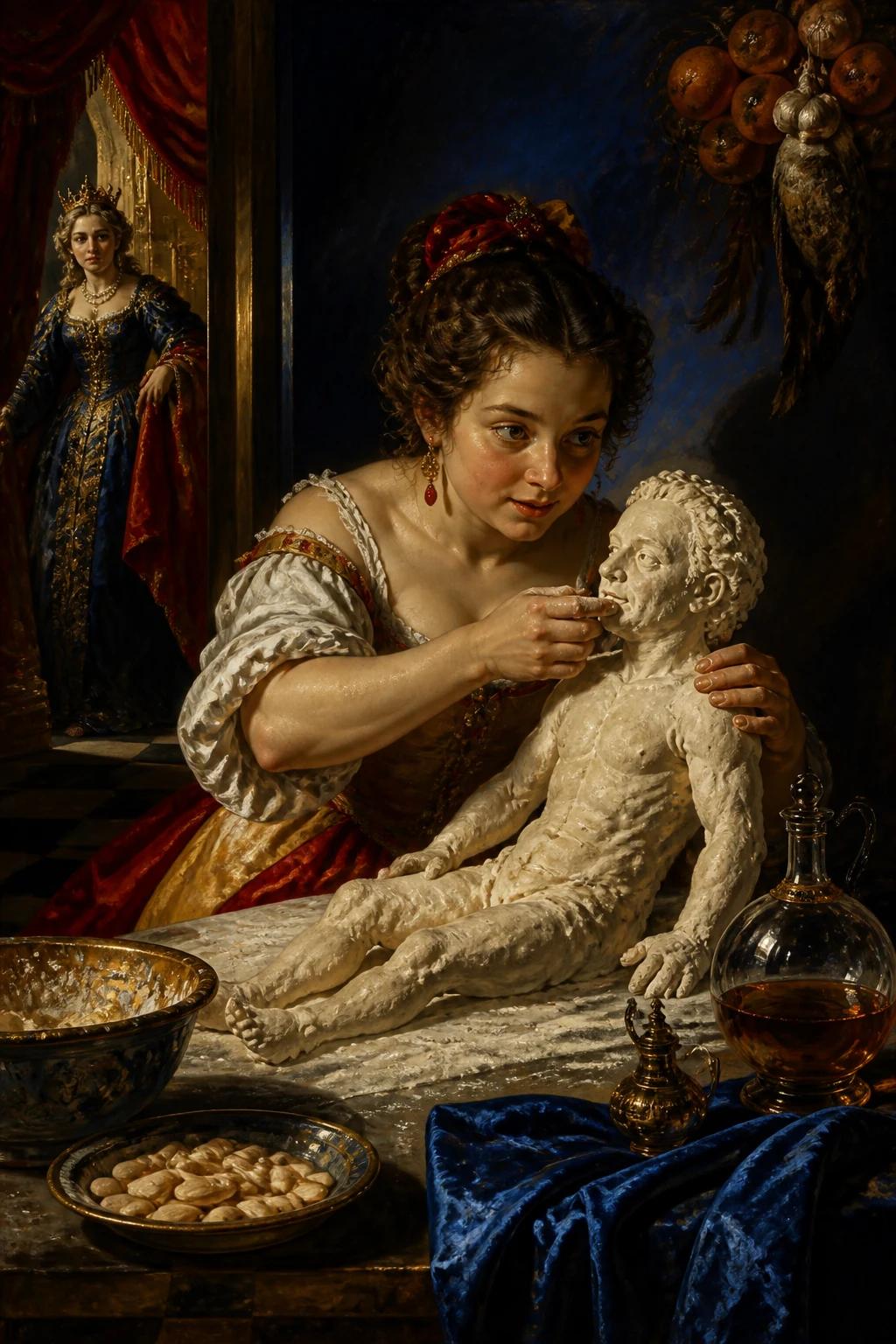
Once upon a time there was a merchant who had an only daughter, whom he longed to see married. But however often he plucked that lute, he found her a hundred miles away from his wishes, for this scatterbrained girl, like a female ape, hated a tail, and, like land already sold or a private hunting ground, denied every man the right of entry. She wanted her court always in recess, her schools always on holiday, and her bank always closed for a royal feast, so that her father was the most afflicted and despairing man in the world. Having occasion to go to a fair, he asked his daughter, whose name was Betta, what she would like him to bring her when he returned. She answered, “My dear father, if you love me, bring me half a hundredweight of Palermo sugar and as much of the finest sweet almonds, with four or six flasks of scented water, a little musk and ambergris, and also some forty pearls, two sapphires, a few small garnets and rubies, a little gold thread, and above all a mortar and a silver scraper.” Her father marvelled at this outlandish request; nevertheless, rather than cross his daughter, he went to the fair and returned with precisely everything she had asked for. Once she had these things, she shut herself in a room and began making a great quantity of almond-and-sugar paste, mixed with rosewater and perfume. From it she fashioned a most handsome young man, giving him hair of golden thread, eyes of sapphire, teeth of pearl, and lips of ruby, and making him so graceful that he lacked nothing but speech. When she had finished, remembering that another statue had come to life at the prayers of a certain King of Cyprus, she prayed so earnestly to the Goddess of Love that the statue began to open its eyes. As she redoubled her prayers, it began to breathe; after breath came words, and at last, loosening all its limbs, it began to walk. Betta, happier than if she had won a kingdom, embraced and kissed him, then took him by the hand and brought him before her father, saying, “My dear lord and father, you have always said how eager you were to see me married, and so, to please you, I have chosen a husband after my own heart.” Her father, seeing this handsome young man come out of his daughter’s room when he had never seen him go in, was astonished. And when he beheld such beauty that one might have charged a penny a head to look at him, he agreed to the marriage. A great feast was held, and among the guests there appeared a mighty, unknown Queen. At the sight of Pinto-Smauto’s beauty—for that was the name Betta had given him—she fell in love with him in earnest. Now Pinto-Smauto, who had opened his eyes to the wickedness of the world barely three hours before, did not know how to muddy the waters, and he escorted the strangers who had come to honour the wedding as far as the stairs, just as his bride had told him. When he did the same for this lady, she took him by the hand and led him gently on to the six-horse carriage waiting in the courtyard. Drawing him inside, she ordered the driver to make for her own country, where the simple Pinto-Smauto, not knowing what had happened to him, became her husband. Betta waited a while, and when he still did not return, she sent down to the courtyard to see whether he was talking to someone. She had someone go up to the roof terrace to see whether he had gone there for a breath of air, and peered into the privy to see whether he had gone to pay his first tribute to life’s necessities. But when he was nowhere to be found, she immediately guessed that his beauty had caused him to be stolen. She had the customary proclamations made, but when no one came forward with news, she resolved to search the whole world for him, disguised as a beggar woman. Setting out in this fashion, after some months she reached the house of a good old woman, who welcomed her most lovingly. Hearing of Betta’s misfortune, and seeing moreover that she was pregnant, the old woman took such pity on her that she taught her three spells. The first was _tricche varlacche, ca la Casa chiove_. The second, _anola tranola pizze fontanola_. The third, _tafare, e ttammurro, pizze ngongolo, e cemmino_. She told her to say them in her hour of greatest need, for they would bring her help. Betta, though she marvelled at this gift of so much chaff, nevertheless said to herself, “Whoever spits down your throat does not want to see you dead, and whoever takes what is offered will not wither away. Every little helps. Who knows what good fortune lies hidden in these words?” So, thanking the old woman, she set off again. After a long journey she reached a beautiful city called Monte Retunno, and went straight to the royal palace, where she begged, for the love of Heaven, for a little shelter in the stable, since she was near her time. The ladies-in-waiting heard her and had her given a little room halfway up the stairs. As the poor wretch sat there, she saw Pinto-Smauto pass by, and was so overcome with joy that she very nearly slipped from the tree of life. But finding herself in such dire need, she decided to try the first spell the old woman had taught her. No sooner had she said _tricche varlacche, ca la casa chiove_ than there appeared before her a beautiful little golden carriage, all encrusted with jewels, which moved about the room by itself, a wonder to behold. The ladies-in-waiting saw it and told the Queen, who lost no time in hurrying to Betta’s room. At the sight of this beautiful thing, she asked whether Betta would sell it, saying she would pay whatever she asked. Betta answered that, beggar though she was, she valued her own pleasure above all the gold in the world; therefore, if the Queen wanted the little carriage, she must let her sleep one night with her husband. The Queen was amazed at the folly of this beggar woman, who was crawling with lice yet would give away such riches for a mere whim. She resolved to gobble up this tasty morsel and, by drugging Pinto-Smauto, leave the poor woman satisfied with her bargain but ill paid. Night came, when the stars display themselves in heaven and the glow-worms on earth, and the Queen gave Pinto-Smauto the sleeping draught and had him lie beside Betta, for he did whatever he was told. No sooner had he been stretched upon the mattress than he began to sleep like a dormouse. Poor Betta, who had hoped that night to wipe out all her past sorrows, finding that she could get no hearing, began to lament beyond all measure, reproaching him with everything she had done for his sake. The sorrowing woman never closed her mouth, and the sleeper never opened his eyes, until the Sun came out with its parting acid to separate shadow from light. Then the Queen came downstairs and took Pinto-Smauto by the hand, saying to Betta, “Now you are satisfied.” “May you have such satisfaction all the days of your life,” Betta muttered under her breath, “for I have spent such a wretched night that I shall remember it for many a day.” But the poor woman could not bear to give up, and decided to try the second spell. Saying _anola tranola pizze fontanola_, she saw a golden cage appear, containing a beautiful bird made of gold and precious stones, which sang well enough to put a nightingale to shame. The ladies-in-waiting saw it and reported it to the Queen, who wished to see it and made the same offer she had made for the little carriage. Betta gave the same answer as before, and the Queen, who had now taken the fool’s measure and scented her weakness, promised to let her sleep with her husband. Taking the cage and bird, she waited until night, then gave Pinto-Smauto his usual sleeping draught and sent him to sleep with Betta in the same room, where she had had a handsome bed set up. Seeing him sleep like a slaughtered man, Betta began her lament all over again, saying things that would have moved a flint to pity. Lamenting, weeping, and tearing at herself, she passed another night quilted with torment. When day came, the Queen went down to fetch her husband and left poor Betta cold and numb, gnawing her hands in fury at the trick that had been played upon her. But that morning, as Pinto-Smauto went out to gather a few figs in a garden beyond the city gate, an old cobbler, whose room shared a wall with Betta’s, came up to him. He had not missed a word of what she had said, and recounted point by point the grief, the uproar, and the lamentations of the unfortunate beggar woman. Hearing this, the King, who was already beginning to acquire some sense, guessed how matters might stand, and resolved that if he should once more be sent to sleep with the poor woman, he would not drink whatever the Queen had given him. Now Betta decided to make the third trial, and said the third spell: _Tafaro, e tammurro, pizze ngongola, e cemmine_. There appeared a heap of silk and cloth-of-gold baby linen, embroidered swaddling bands, and a golden basin—finery so beautiful that the Queen herself could not have gathered its like. The ladies-in-waiting spied these things and informed their mistress, who bargained for them as she had for the others. Receiving the same answer from Betta—that if she wanted them she must let her husband sleep with her—the Queen said to herself, “What do I lose by pleasing this country wench, if I can carry off these lovely things from under her nose?” She took all the riches Betta offered her, and when Night appeared in the evening, having settled the account for her debt to sleep and repose, the Queen gave Pinto-Smauto his sleeping draught. He held it in his mouth, pretended he needed to empty his bladder, and spat it out in another room. Then he went to lie beside Betta, who began the same song once more. She told how she had kneaded him with her own hands out of sugar and almonds; how she had given him golden hair, and eyes and a mouth of pearls and precious stones; how he owed her the life the gods had granted him through her prayers; and finally how he had been stolen from her, and how, heavy with child, she had gone searching for him through hardships from which Heaven preserve every baptized soul. She told him, too, how she had slept beside him for two other nights, giving two treasures in exchange, without being able to get so much as a single word from him, so that this was the last night of her hopes and the final limit of her life. Pinto-Smauto, who was awake, heard these words, and, remembering as though in a dream all that had happened, embraced her. Since Night had come out in her black mask to lead the dance of the stars, he rose quietly and went into the Queen’s room, where she lay sunk in sleep. He took back everything she had wheedled out of Betta, together with all the jewels and money in her desk, to repay them for their past troubles. Returning to his wife, he set off with her that very hour, and they travelled until they were beyond the borders of that kingdom. There they rested at a comfortable inn, where Betta gave birth to a beautiful boy. Once she was up and about again, they set out for her father’s house, and found him alive and well. The joy of seeing his daughter again made him like a boy of fifteen. As for the Queen, finding neither her husband, nor the beggar woman, nor her jewels, she tore at herself and pulled out her hair by the fistful; nor was there any lack of someone to tell her, _Whoever cheats must not complain when cheated._
Izvirnik
Jornata V III PINTO SMAUTO
Naslednje strani prikazujejo izvirno besedilo za primerjavo.
_Betta recusa de volere marito: all’utemo se ne mpasta uno de mano soja, ed essennole arrobbato da na Regina, dapò mille travaglie lo trova, e co grann’arte recuperatolo, se lo reporta a la casa._ _Avenno scomputo lo cunto Cecca, che piacquette stremamente a ttutte, Meneca, che steva a ccavalletto pe sparare lo sujo, visto che stevano co l’aurecchie appezzute pe ssentire, accossì parlaje._ Fu sempre cchiù defficele all’ommo lo conservare l’acquistato, che l’acquistare de nuovo, perchè nell’uno concorre la fortuna, che spisse vote ajuta le ’njostizie, ma nell’autro nce vole sinno: perrò se vede pe lo cchiù, perzona, che n’ha trascurzo, saglire dov’è lo bene. Ma pe ccarestia de nciegno vrocciolarene a bascio, comme da lo cunto, che ve
dirraggio, si site comprennuoteche, porrite chiaramente vedere. Era na vota no mercante, che aveva na figlia uneca, e ssola, la quale desedderava grannemente de vedere mmaretata; ma pe quanto tastiava sto liuto, la trovava ciento miglia lontano da le rrecercate soje, pocca sta capo sbentata, comm’a scigna de le ffemmene, odiava la coda, e comm’a tterretorio vennuto, e ccaccia reservata, negava lo commerzio d’ogn’ommo, e boleva sempre feria a lo tribunale sujo, sempre vacanza a le scole, sempre feste de Corte a lo Banco; tanto che lo patre ne stava lo cchiù affritto, e desperato de lo Munno. Ed accorrenno de ire a na fera, disse a la figlia, che se chiammava Betta, che desedderava, che le portasse a lo retuorno? ed essa le decette: Tata mio, se me
vuoje bene, portame no miezo cantaro de zuccaro de Palermo, e mmiezo d’ammennole ambrosine, co quatto, o seje fiasche d’acque d’addore, e no poco de musco, e d’ambra, portannome porzì na quarantina de perne, duje zaffire, no poco de granatelle, e rrubine, co no poco d’oro filato, e sopra tutto na martora, e na rasola d’argiento. Lo patre se maravigliaje de sta addemmanna stravagante, puro pe non contradire a la Figlia, jette a la fera, e ttornaje, portannole puntualmente quanto aveva cercato; la quale avuto cheste ccose, se nchiuse drinto na cammara; e commenzaje a fare na gran quantetà de pasta d’ammennole, e zuccaro mmescata co acqua rosa, e sproffummo, e commenzaje a fare no bellissemo Giovene, a lo quale fece li capille de fila d’oro, l’uocchie
de zaffire, li diente de perne, le lavra de robine, e le dette tanta grazia, che no le mancava se no la parola. La quale cosa fatto avenno sentuto dicere, ca n’autra statua a li prieghe de no cierto Rrè di Cipro deventaje viva, tanto pregaje la Dea d’ammore, che la statua commenzaje ad aprire l’uocchie, e rrenforzanno le preghere, se mese a sciatare, e dapò lo sciato scettero le pparole, e scioglienno all’utemo tutte le miembre, commenzaje a ccammenare. Betta co n’allegrezza granne cchiù, che s’avesse guadagnato no Regno, l’abbracciaje, e basaje, e pigliatolo ne la mano lo portaje nnanze lo Patre, decennole: Tata gnore mio, sempre avite ditto, che stivevo goliuse de vedereme mmaretata, e io pe contentareve mme l’aggio sciveto secunno lo core mio. Lo patre,
che bedde scire da la cammara de la figlia sto bellissemo giovane, che n’aveva visto trasire, remmase attoneto, e bedenno tanta bellezza, che se poteva pagare no grano a ttesta a mmirarelo, se contentaje che se facesse sto matremmonio, facennose na festa granne, dove fra l’autre, che nce vennero, nce capitaje na gran Regina scanosciuta, la quale visto la bellezza de Pinto-Smauto (che accossì le deze nomme Betta) se ne ncrapicciaje d’autro, che de baja, e perchè Pinto-Smauto, che n’aveva tre ora, che aveva apierto l’uocchie a le mmalizie de lo munno, non sapeva ntrovolare l’acqua, accompagnaje pe fi a le scale le Fforastiere, ch’erano venute a nnorare le nnozze, che accossì l’aveva ditto la zita, e facenno lo stisso co chella Segnora, essa pigliatolo
pe la mano lo trasportaje chiano chiano fi a la carrozza a seje cavalle, che tteneva a lo cortiglio, dove tiratolo drinto, fece toccare a la vota de la Terra soja, dove lo nsemprece de Pinto-Smauto non sapenno, che l’era socciesso, le deventaje marito. Betta aspettatolo no piezzo, nè bedennolo chiù comparere, mannaje a bascio a lo cortiglio, si fosse a pparlare co quarche perzona; fece saglire all’astreco, si nche fosse juto a ppigliare airo, s’affacciaje a lo necessario, si fosse juto a dare lo primmo tributo a la necessetà de la vita, ma non trovannolo, subeto se mmagenaje ca ped’essere tanto bello, l’era stato arrobbato; e ffatto jettare li solite Banne, nè comparenno nesciuno a rrevelarelo, facette resoluzione de irelo cercanno pe ttutto lo
Munno stravestuta da poverella, e puostose de sta manera a cammenare, dapò quarche mese, arrivaje a la casa de na bona vecchia, che la recettaje co granne ammore: e ntiso la desgrazia de Betta, e bedenno de cchiù, ch’era prena, n’avette tanta compassione, che le mmezzaje tre parole: La primma _tricche varlacche, ca la Casa chiove_. La seconna _anola tranola pizze fontanola_. La terza _tafare, e ttammurro, pizze ngongolo, e cemmino_. Decennole, che le ghiesse decenno a ttiempo de lo chiù granne abbesuogno, ca ne cacciarria benefizio. Betta, si bè restaje maravigliata de sto presiento de vrenna, puro decette fra se stessa, chi te sputa ’n canna non te vò vedere muorto, e chi piglia non secca: ogne picca jova; chi sà, che bona fortuna se nchiude drinto
a ste pparole: e accossì decenno, rengraziata la Vecchia, se mese a cammenare; e dapò luongo viaggio arrivata a na bella Cetà chiammata Monte Retunno, se ne jeze deritto a lo Palazzo Riale, dove cercaje pe l’ammore de lo Cielo no poco de recietto a la Stalla ped’essere vecina a lo partoro: la quale sentuta da le Ddammecelle de Corte, le fecero dare na Cammarella ’n miezo le scale, dove stanno la negrecata, vedde passare Pinto-Smauto, pe la quale cosa appe tanta allegrezza, che fu ’n ponta ’n ponta a sciuliare da ll’arvolo de la vita. Ma perchè se trovava a ttanta necessetate, voze fare prova de la primma parola dettale da la Vecchia, e accossì decenno, _tricche varlacche, ca la casa chiove_, se vedde comparere nnante no bello Carruocciolo d’oro
ncrastato tutto de Gioje, lo quale jeva da se stisso pe la Cammara, ch’era no spanto a bedere: la quale cosa visto da le Dammecelle, lo ddissero a la Regina, che senza perdere tiempo, corze a la Cammara de Betta, e beduto sta bella cosa, le disse, si nce lo voleva vennere, che l’averria dato quanto sapeva addemmannare; la quale respose, che si bè era pezzente, stimava cchiù lo gusto sujo, che tutto l’oro de lo Munno; e perrò se voleva lo carruocciolo, l’avesse fatta dormire na notte co lo Marito. La Regina restaje maravigliata de la pazzia de sta poverella, che ghieva tutta perogliosa, e pe no crapiccio voleva dare tanta recchezza, fece preposito de zeppoliarene sto buono voccone, ed addobbianno Pinto-Smauto, facesse la poverella contenta, e mmale
pagata. E benuta la notte, quanno erano a ffare mostra le Stelle de lo Cielo, e le Lluciole de la Terra, la Regina dato l’adduobbio a Pinto-Smauto, lo fece corcare a canto a Betta, lo quale tanto faceva, quanto l’era ditto. Ne accossì priesto fu jettato ncoppa lo Matarazzo, che se mese a ddormire, comme a no Gliro; Betta negrecata, che penzava chella notte de scontare tutte l’affanne passate, vedenno ca non c’era audienza ped essa, commenzaje a llamentarese fore pe mesura, remproverannole tutto chello, che aveva fatto pe ccausa soja, e non chiuse maje vocca l’addolorata, e n’aperze maje uocchie l’addormentato, ficchè no scette lo Sole co l’acqua de spartire, a sseparare l’ombra da la luce, quanno la Regina scese a bascio, e se pigliaje pe mano
Pinto-Smauto, decenno a Betta: Già si ccontenta. Tale contento puozze avere tutto lo tiempo de la vita toja, respose sotto lengua Betta, pocca aggio passato accossì mmala notte, che mme l’allecordarraggio pe quarche ghiuorno. Ma non potenno resistere la negra, voze fare la seconna prova de le sseconne parole, e decenno _anola tranola pizze fontanola_, vedde comparire na Gajola d’Oro, co no bellissemo Auciello fatto de prete preziose, e d’oro, che cantava a ffacce de no Roscegnuolo, la quale cosa visto le Ddammecelle, e rreferutole a la Regina, lo voze vedere, e fattole la stessa addemanna, che l’aveva fatto de lo Carruocciolo, e respuostole Betta lo stisso, ch’aveva respuosto la primma vota, la Regina ch’aveva allommato, e annasato la
corriva, prommese de farela dormire co lo marito; e ppigliatose la gajola co l’auciello, e benuto la notte, dette lo soleto adduobio a Pinto-Smauto, e lo mannaje a ddormire co Betta a la stessa cammera, dove aveva fatto armare no bello lietto, la quale vedenno che dormeva comm’a scannato, commenzaje a ffare lo stisso lamiento, decenno cose, che averria muoppeto a compassione na preta selece, e llamentannose, e chiagnenno, e sciccannose tutta, passaje n’autra notte mmottonata de tormiento, e comme fu ghiuorno scese la Regina a pigliarese lo Marito, e llassaje la negrecata Betta fredda, e ghielata, che se magnaje le mmano a diente de la burla, che l’era stata fatta. Ma scenno la mattina Pinto-Smauto pe ghire a cogliere quatto fico a no giardino fore la
porta de la Cetate, se l’accostaje no scarpe-vecchie, che steva a mmuro a mmuro co la cammara de Betta, lo quale n’aveva perduto parola de quanto essa aveva ditto, e referette de punto ’n punto lo trivolo, lo sciabbacco, e le lamentaziune de la sfortunata pezzente, la quale cosa sentuto lo Rrè, che già commenzava a mmettere sinno, se ’mmagenaje comme potesse passare sto negozio, e penzaje, che si n’autra vota le venesse fatto d’essere mannato a dormire co la poverella, non s’averria vevuto chello, che le faceva dare la Regina. Ora volenno Betta fare la terza prova, e decenno le tterze parole; _Tafaro, e tammurro, pizze ngongola, e cemmine_, ne scettero na mano de panne de Seta, e d’Oro, e de fasce ragamate co na concola d’Oro, che la Regina stessa n’averria
potuto mettere ’nsiemme accossì belle galantarie; le quale cose allommate da le Ddammecelle, ne fecero avisata la Patrona, la quale trattaje d’averele comm’avea fatto dell’autre, e avuto la medesima resposta da Betta, che si le boleva, avesse fatto dormire lo Marito cod’essa, la Regina decenno fra se stessa, che nce perdo a ccontentare sta pacchiana pe ccarriarele da sotta ste belle cose, e pigliatose tutte ste ricchezze, che l’afferze Betta, comme la notte comparze de sera essennole liquidato lo strommiento pe lo debeto contratto co lo suonno, e lo repuoso, dette l’adduobbio a Pinto-Smauto, ed isso tenennolo ’n vocca, e fatto fenta de ire a scarrecare la vessica, lo ghiettaje drinto a na Cammara, e ghiutose a ccorcare a canto a Betta,
essa commenzaje a fare la stessa Canzone: decenno comme l’avea mpastato co le mmano soje de zuccaro, e ammennole, comme l’avea fatto li capille d’oro, e l’uocchie, e la vocca de perne, e prete preziose, e comme l’era debetore de la vita datale da li Deje pe le ppreghere soje, e utemamente comme l’era stato arrobbato, e essa grossa prena ll’era juta cercanno co ttanta stiente, che lo Cielo nne guarde ogne carne vattiata, e de chiù comme avea dormuto duje autre notte cod’isso, e dato ncagno duje tresore, e n’aveva potuto avere na parola schitto, tale, che chesta era l’utema notte de le speranze soje, e ll’utemo termene de la vita. Pinto-Smauto, che steva scetato, sentuto ste pparole, e allecordatose comme no suonno de chello ch’era passato,
l’abbracciaje, e perchè la notte era sciuta co la mascara negra a pportare lo ballo de le Stelle, s’auzaje chiano chiano, e trasuto drinto la cammara de la Regina, che steva sprofonnata nne lo suonno, se pigliaje tutte le cose che n’avea zeppoliato a Betta, e tutte le gioje, e ttornise ch’erano drinto lo Screttorio, pe ssodesfarese de li travaglie passate, e tornato a la Mogliere, se nne partettero all’ora stessa, e ttanto camminaro, ficche scettero da li confine de chillo Regno, dove se reposaje tanto a no buono alloggiamiento, che Betta scette a lluce co no bello mascolo, e llevata che fu da lo lietto, s’abbiaro a la vota de la casa de lo Patre, dove lo trovaro sano, e bivo, ch’a lo gusto de revedere la Figlia, deventaje comme figliulo de
quinnece anne, e la Regina non trovanno nè lo marito, nè la pezzente, nè le gioje, se sciccaje tutta, a pilo mmierzo, a la quale non mancaje chi disse, _Chi gabba, non se doglia, s’è gabbato._
Nadaljuj z branjem