Prevod
_Marchetta is snatched away by the wind and carried to an ogress’s house. After various adventures, she receives a slap and leaves dressed as a man. She comes to a king’s palace, where the queen falls in love with her; enraged at finding her advances unreturned, the queen accuses her to her husband of attempting to dishonor her. Condemned to be hanged, Marchetta is freed by the power of a ring the ogress gave her; her accuser is put to death, and she becomes queen._ _Popa’s tale delighted everyone, and there was no one who did not rejoice in Porziella’s good fortune. Yet no one envied her a destiny bought with so much suffering, for to attain her royal estate she had very nearly lost her mortal one. But Tolla, seeing that Porziella’s troubles had clouded the spirits of the princes, wished to cheer them a little, and began as follows._ Truth, my lords, always rises to the top like oil, and a lie is a fire that cannot remain hidden; indeed, it is a modern musket that kills whoever fires it. Nor is it without reason that a man false to his word is called a liar, for his lies scorch and burn not only all the virtues and good things he carries in his breast, but the very purse that holds them, as you will be obliged to acknowledge from the tale you are about to hear.
Once upon a time there was a king of Valletescuosse who could have no children, and at all hours, wherever he happened to be, he would say, “O Heaven, send me an heir to my kingdom, so that my house may not be left desolate.” Among the many times he uttered this plea, once, finding himself in a garden and crying the same words aloud, he heard a voice coming from among the branches, which said:
_“King, which would you rather have: a daughter who will flee from you?_ _Or a son who will bring you to ruin?”_ Bewildered by this choice, the king could not decide what to answer. Resolving to consult the wise men of his court, he went straight to his chambers, summoned his counselors, and ordered them to discuss the matter. One replied that honor should be valued more highly than life;
another, that life should be esteemed more highly, being an intrinsic good, whereas honor was an outward thing and therefore of lesser worth;
one said that life was water flowing past, and little was lost by losing it; the same was true of riches, those pillars of life set upon fortune’s glassy wheel. Honor, however, was an enduring thing, leaving footprints of fame and tokens of glory, and ought to be jealously guarded and tenderly cherished. Another argued that life, by which the human race was preserved, and wealth, by which the greatness of a house was maintained, should be held dearer than honor, since honor was an opinion founded upon virtue; to lose a daughter through the fault of fortune rather than one’s own shortcomings did no injury to a father’s virtue and brought no stain upon his house. Above all, there were some who concluded that honor did not reside in a woman’s petticoats; moreover, as a just prince, he ought to consider the common good before his private interest. A runaway girl brought only a little shame upon her father’s house, while a wicked son set both his own house and the whole kingdom ablaze. Therefore, since he desired children and these were the two choices offered him, he should ask for the girl, who would endanger neither his life nor his kingdom. This opinion pleased the king. He returned to the garden and cried out as usual; on hearing the same voice, he answered, “A girl! A girl!” That evening he returned home, just as the sun was inviting the hours of the day to take a look at the antics of the Antipodes, and lay with his wife. Nine months later he had a beautiful daughter, whom he immediately had shut up in a fortified palace under strong guard, determined not to neglect any possible precaution that might avert the unhappy mishap foretold for her. He had her brought up with all the accomplishments befitting royal blood, and when she was fully grown he arranged to marry her to the king of Pierdesinno. The marriage was agreed upon, and she was brought out of the house she had never before left, to be sent to her husband. But such a mighty wind arose that it lifted her bodily into the air, and she vanished from sight. After carrying her some distance through the sky, it set her down before an ogress’s house in a wood that had banished the sun as plague-stricken, because he had killed the infected Python. There she found a little old woman whom the ogress had left to watch over her belongings. “Oh, poor unhappy creature,” the old woman said, “where have you set foot? Woe betide you if the ogress who owns this house comes home! I would not give three pennies for your skin, for she feeds on nothing but human flesh. My own life is safe only because she needs my services, and because this wretched old hide of mine, full of fainting fits, heart troubles, flatulence, and gravel, disgusts her fangs. But do you know what you must do? Here are the keys to the house. Go inside, tidy the rooms, and clean everything; then, when the ogress comes, hide where she cannot see you, and I will make sure you have enough to eat. Meanwhile, who knows? Heaven lends a hand:
time may bring great things. Only have sense and patience, and you will cross every gulf and weather every storm.” Marchetta, for that was the girl’s name, made a virtue of necessity. She took the keys, went into the ogress’s room, and first of all laid hands on a broom, making the house so clean that you could have eaten macaroni off the floor. Then she took a pork rind and rubbed the walnut chests until they shone so brightly you could see yourself in them. After making the bed, as soon as she heard the ogress coming she hid inside a barrel that had once held grain. Finding everything so unusually neat, the ogress was greatly pleased. She called the old woman and asked, “Who has done all this lovely tidying?” When the old woman answered that she had done it herself, the ogress replied, “Whoever does for you what they have never done before has either cheated you already or means to cheat you.
“Truly, you may put a peg in the wall to mark this day, for you have done something quite out of the ordinary, and you deserve a rich bowl of soup.” With that she ate, and went out again. When she returned, she found all the cobwebs swept from the beams, all the copperware polished and hung in handsome order on the wall, and all the dirty linen washed in hot water. She was so delighted that she blessed the old woman a thousand times, saying, “May Heaven always prosper you, my dear Madam Pentatola! May you always flourish and go forward, for you gladden my heart with all this beautiful housework, giving me a house fit for a lady and a bed fit for a bride.”
The old woman was in seventh heaven at having won such a good opinion, and kept passing generous morsels to Marchetta, fattening her like a crammed capon. When the ogress went out again, the old woman said to Marchetta:
“Keep quiet: we shall catch this limping hare yet, and put your luck to the test. Make something good with your own hands, something that will please the ogress’s palate. If she swears by all seven heavens, do not trust her; but if she happens to swear by her three crowns, show yourself. Then everything will turn out to a hair’s breadth, and you will know that my advice was a mother’s advice.”
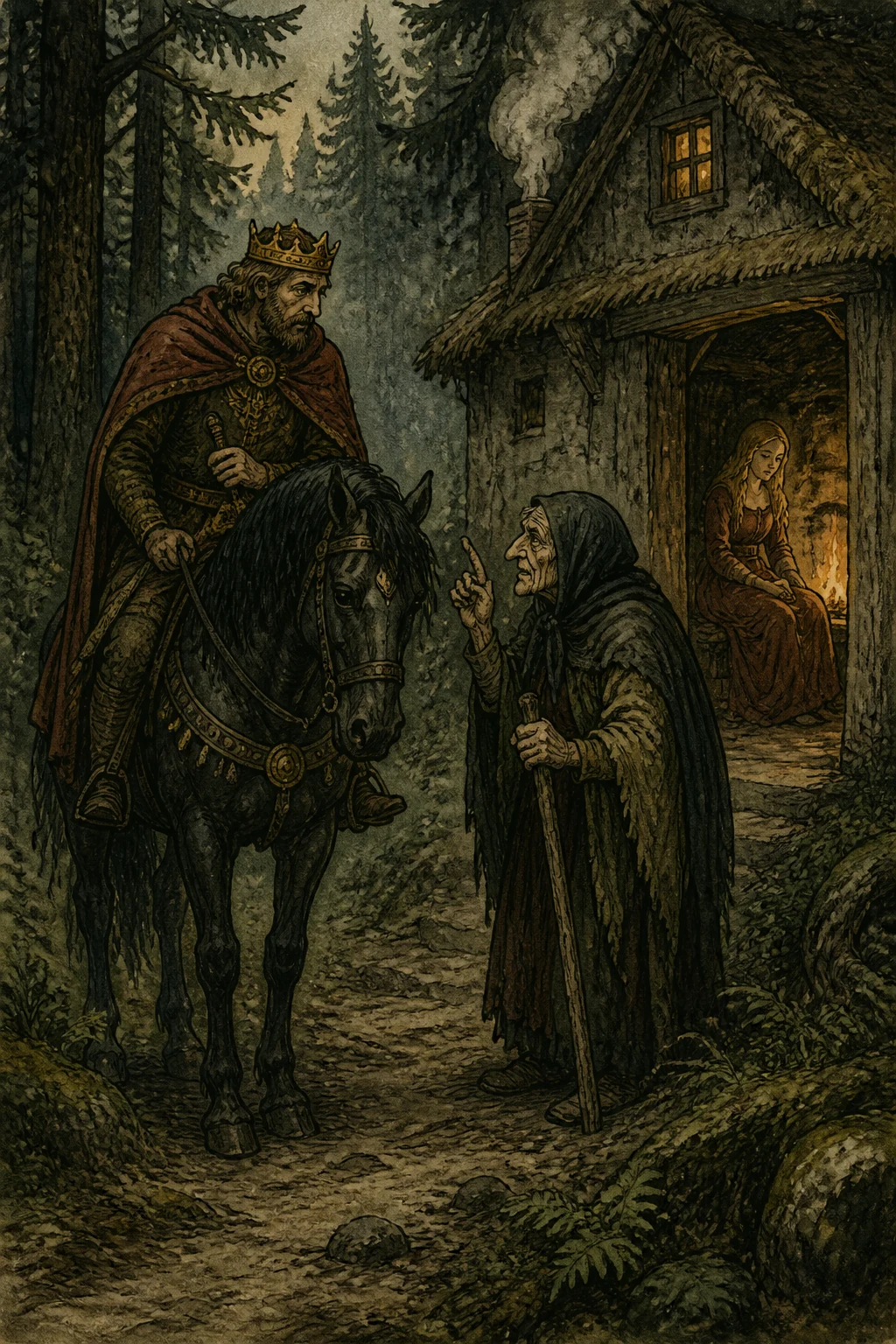
On hearing this, Marchetta killed a fine goose and made a tasty stew of its giblets. She larded the bird well, seasoned it with oregano and garlic, and put it on a spit; then she made a few priest-stranglers at the bottom of the kneading basket and laid a table strewn with roses and orange leaves. When the ogress came home and found this feast prepared, she nearly jumped out of her skin. Calling the old woman, she asked, “Who has done me this good service?” “Eat,” answered the old woman, “and ask no more. It is enough that you have someone to serve and please you.” As the ogress ate, these delicious morsels warmed her to the very marrow of her bones, and she began to say, “I swear by the three watchwords of Naples, if I knew who the cook was, I would give them my very lips to kiss!” Then she went on: “I swear by three bows and three arrows, if I knew who it was, I would keep them here in my heart! I swear by the three candles lit when a deed is drawn up at night; by the three witnesses who get a man hanged; by the three spans of rope that swing a hanged man round; by the three things that drive a man from his house—stench, smoke, and a wicked woman; by the three things that eat a household out of house and home—fritters, hot bread, and macaroni; by three women and a goose, which make a marketplace; by the three F’s of fish—fried, frigid, and firm; by the three chief singers of Naples—Gio’ de la Carrejola, Compa Junno, and the King of Music; by the three S’s a lover needs—solitude, solicitude, and secrecy; by the three things a merchant needs—credit, courage, and good fortune; by the three sorts of men a whore keeps about her—braggarts, handsome young fellows, and gulls; by the three things a thief needs—eyes to spot, claws to snatch, and feet to flee; by the three things that ruin youth—gambling, women, and taverns; by the three chief virtues of a constable—spotting, pursuing, and seizing; by the three things useful to a courtier—dissimulation, patience, and luck; by the three things a pimp must have—a stout heart, plenty of chatter, and little shame; by the three things a doctor examines—the pulse, the face, and the chamber pot!” But she might have gone on from today till tomorrow: Marchetta, who knew the trick, did not utter a peep. At last, however, she heard her say, “By my three crowns, if I knew who the good housekeeper was who has done me so many fine services, I would heap more caresses and kindnesses upon her than she could ever imagine!” Out she came and said, “Here I am.” At the sight of her, the ogress replied, “Give me a kick! You have proved cleverer than I am. You have played your hand like a master and saved yourself a fine baking inside this belly. But since you have been so clever and pleased me so well, I shall cherish you more than a daughter. Here are the keys to the rooms: be mistress and commander of everything. Only one thing I reserve to myself: you must on no account open the last room, which this key fits, or you will really send the mustard up my nose. Serve me faithfully, and lucky you shall be, for I promise by my three crowns to marry you off rich, rich indeed!” Marchetta kissed her hands in gratitude for such kindness and promised to serve her more faithfully than a slave. But once the ogress had gone, she felt an irresistible itch of curiosity to see what was inside the forbidden room. She opened it and found three girls dressed all in gold, seated on three imperial chairs, who seemed to be asleep. These were all the fairy’s daughters, enchanted by their mother because she knew they would face a terrible danger unless a king’s daughter came to wake them. She had therefore shut them in there to remove them from the peril threatened by the stars. When Marchetta entered, the sound of her footsteps roused them as though from sleep, and they asked her for something to eat. Once they had recovered their strength, they wished to leave the room and take the air outside the hall. Just then the ogress arrived, and was so distressed that she gave Marchetta a slap. Marchetta took such offense that she immediately asked leave to depart and wander, lost and forlorn, through the world in search of her fortune. However much the ogress tried to soothe her with kind words, saying she had only been joking and would never do it again, nothing could turn her from her purpose. At last she was forced to let her go. She gave her a ring, telling her to wear it with the stone turned inward against her palm, and never to look at it unless, finding herself in great danger, she heard the ogress’s name repeated by the echo. She also gave her a handsome man’s outfit, which Marchetta had requested. Dressed in this way, the girl set out. She came to a wood where she gathered firewood at night to warm herself after the day’s bitter cold, and there encountered a king out hunting. Seeing this handsome youth, as she appeared to be, he asked where she came from and what she was doing. She answered that she was a merchant’s son and that, after her mother’s death, she had run away because of her stepmother’s cruelty.
The king, pleased by Marchetta’s ready answers and good manners, took her into his service as a page and brought her to his palace. The queen had scarcely seen her before all her desires were set aflutter by such a wealth of charms. For several days, partly from fear and partly from pride, which has always gone hand in hand with beauty, she tried to conceal the flame and to force love’s pricks beneath the tail of desire. Yet she was too unsteady on her feet to withstand the assaults of her unbridled longings. One day, therefore, she called Marchetta aside and began to reveal her sufferings;
she told her what a crushing burden of anguish had been laid upon her shoulders ever since she had seen her beauty, and declared that unless she resolved to water the fields of her desire, her life would wither away along with her hopes. First she praised the beauties of her face, pointing out that only a poor pupil in the school of love would make a cruel blot in a book so full of grace, and that she would earn a sound whipping of remorse for it. To her praises she added entreaties, begging her by all seven heavens not to leave in a furnace of sighs and a swamp of tears a woman who had hung that lovely image as the sign above the shop of her thoughts. After this came offers: she promised to pay for every inch of pleasure with yards of benefits, and to keep the warehouse of her gratitude open to every wish of so handsome a companion. Finally she reminded her that she was a queen, and that since she had already stepped into the boat, she ought not to be abandoned without help in the midst of such a gulf, lest she strike a rock and bring disaster upon them both. Hearing these blandishments and flatteries, these promises and threats, these brazen advances and shameless overtures, Marchetta longed to say that she lacked the key to open the door to the queen’s contentment; she wished to reveal that, to grant her the peace she desired, she was no Mercury bearing a caduceus. But, unwilling to unmask herself, she replied that she could not believe the queen truly wished to wrong so worthy a king as her husband. Even if the queen were prepared to cast aside the reputation of her house, she herself neither could nor would do such an injury to a master who loved her so well. When the queen heard this first reply to the declaration of her desires, she said, “Come now, think carefully and plow a straight furrow. Women of my rank command when they plead, and when they kneel, they set their heels upon your throat. Reckon your accounts well, then, and see how this bargain may turn out for you. Enough: I shall leave you with just one thing to remember. When a woman of my standing is scorned, she seeks to wash the blush from her face with the blood of the person who offended her.” With that she turned her back, her face sour enough to wring out, leaving poor Marchetta bewildered and chilled to the bone. For several days the queen continued her assaults upon this beautiful fortress. At last, seeing that she was laboring in vain, toiling to no purpose and sweating for nothing, casting words to the wind and sighs into empty air, she changed her tune, turning love into hatred and the wish to enjoy her beloved into a thirst for revenge.
Accordingly, with counterfeit tears trembling in her eyes, she went to her husband and said, “Who would ever have told us, my husband, that we were nursing a snake in our sleeve? Who could have imagined that a miserable little stripling would have so much boldness? But it is all the fault of the excessive favors you have shown him. Give a churl a finger and he takes your whole hand. In short, everyone wants to piss in the same pot! Unless you punish him as he deserves, I shall go home to my father, and I never want to see you again or even hear your name.” “What has he done to you?” the king asked. “Oh, a mere trifle!” replied the queen. “The little scoundrel wanted to collect the marriage debt I owe to you. Without respect, without fear, without shame, he had the face to come before me and the tongue to ask free passage through the field where you have sown your honor.” On hearing this, the king sought no other witnesses, lest he cast doubt upon his wife’s word and authority. He immediately had the page seized by his officers and, then and there, without allowing any opportunity for a defense, condemned him to find out how much his neck would weigh upon the hangman’s scales. Carried bodily to the place of execution, Marchetta, who did not know what had happened to her and was conscious of no wrongdoing, began to cry:
“O Heaven, what have I done to deserve the funeral of this wretched neck before the burial of this unhappy body? Who could have foretold that, without ever enlisting beneath the banner of thieves and cutthroats, I should come to stand guard at this palace of death with three lengths of match cord round my throat? Alas, who will comfort me in this extremity? Who will help me in such danger? Who will save me from the gallows—from this forca?” “_Orca!_” answered the echo. Hearing this reply, Marchetta remembered the ring upon her finger and the words the ogress had spoken when she left. She glanced at the stone, which she had never yet looked upon, and at once a voice rang through the air three times: _“Let her go: she is a woman!”_ It was so terrible that not a constable or bailiff remained at the place of execution;
and the king, hearing these words, which shook his palace to its foundations, had Marchetta brought before him. He ordered her to tell him truthfully who she was and how she had come to that country. Necessity compelled her to relate the whole story of her life: how she had been born, how she had been shut inside that palace, how the wind had carried her away, how she had come to the ogress’s house, how she had wished to leave, what the ogress had told her and given her, what had passed between herself and the queen, and how, knowing of no wrong she had done, she had found herself in danger of rowing with her feet aboard the three-timbered galley of the gallows.
Having heard her story, the king compared it with what he had once discussed with his friend the king of Valletescuosse, and recognized Marchetta for who she was. At the same time he understood the wickedness of his wife, who had brought this vile accusation against her. He therefore ordered the queen to be thrown into the sea at once with a heavy stone tied to her, and, sending for Marchetta’s father and mother, took her for his wife. Thus she gave clear proof that _For a vessel past all hope,_ _God finds a harbor._