Prevod
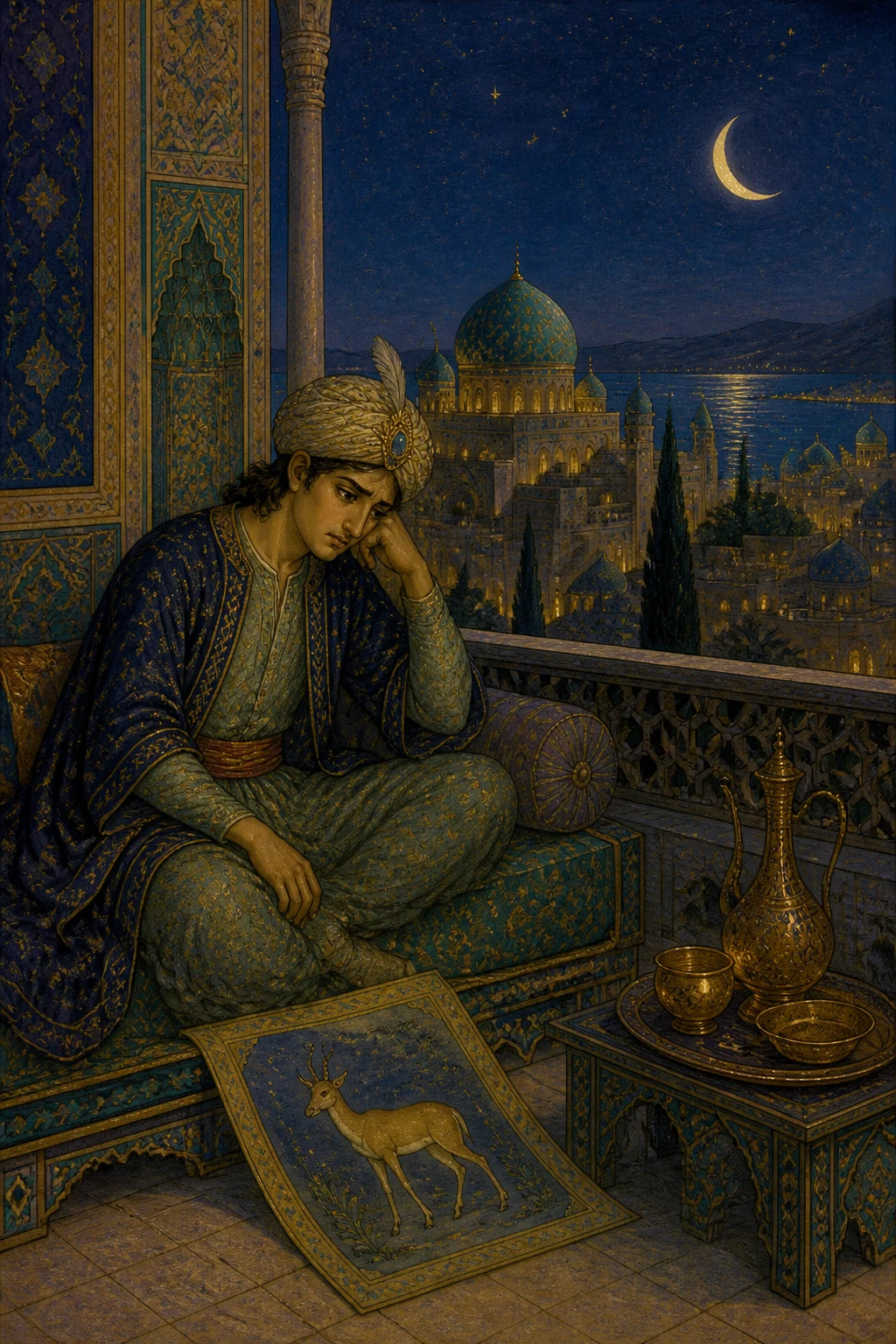
She said: It has reached me, O fortunate King, that there was once a goldsmith much given to women and wine. One day he went to visit a friend, and on a wall of his house he saw the painted likeness of a young woman, fairer, lovelier, and more graceful than any eye had ever beheld. The goldsmith gazed long at it, marvelling at its beauty, and love for the portrait took possession of his heart until he fell ill and came near to death. One of his friends came to visit him and, sitting beside him, asked how he fared and what ailed him. “My brother,” he replied, “all my sickness and suffering come from love. I have fallen in love with a portrait painted on the wall of our friend So-and-so’s house.” His friend reproached him, saying, “This shows how little sense you have! How can you love a picture on a wall, which can neither harm nor help, neither see nor hear, neither give nor withhold?” The goldsmith answered, “The painter can only have painted it after some beautiful woman.” “Perhaps,” said his friend, “the painter invented her out of his own head.” “In any case,” he replied, “I am dying of love for her. And if there is anyone in the world who resembles this portrait, I pray Almighty God to spare my life until I see her.” When those present rose to leave, they made inquiries about the painter and learned that he had travelled to another country. They wrote him a letter describing their friend’s plight and asking about the portrait and how he had come to paint it: had he invented it, or had he seen someone in the world who resembled it? He sent them this reply: “I painted that portrait after a singing girl belonging to one of the viziers. She lives in the city of Kashmir, in the land of India.”
When the goldsmith, who was then in Persia, heard this news, he made ready and set out for India. After great hardship he reached the city, and once he had settled there, he went one day to a seller of perfumes. The perfumer was a shrewd, discerning, intelligent man, and the goldsmith questioned him about their king and his conduct. “Our king,” the perfumer replied, “is just and upright, generous to the people of his realm and fair to his subjects. There is nothing in this world he hates but sorcerers. Whenever a sorcerer or sorceress falls into his hands, he has them cast outside the city and left to starve to death.” Then the goldsmith asked about the viziers, and the perfumer told him of each one’s character and conduct, until the talk came round to the singing girl. “She belongs to such-and-such a vizier,” he said. The goldsmith waited a few days, then began to devise a stratagem. One night, amid rain and thunder and raging winds, he took a band of thieves with him and went to the house of the vizier who owned the girl. They set ladders against it, securing them with hooks, and he climbed to the roof of the palace. From there he descended into the courtyard, where he saw all the slave girls asleep, each on her own couch. Then he spied a marble couch on which lay a girl like the full moon shining on its fourteenth night. He went to her, sat beside her head, and drew aside the curtain. She lay beneath a coverlet of cloth of gold, with a candle at her head and another at her feet, each set in a candlestick of gleaming gold. Both candles were made of ambergris, and beneath the pillow at her head lay a covered silver casket containing all her jewels. He drew a knife and struck her on the buttock, leaving a clear wound. She awoke in terror, but at the sight of him she dared not cry out and lay silent, thinking that he wanted her wealth. “Take the casket and all that is in it,” she said. “There is nothing to be gained by killing me. I place myself under your protection and trust to your honour.” The man took the casket and its contents and went away. And dawn overtook Shahrazad, and she ceased her permitted tale.
Then, when it was the five hundred and eighty-seventh night,
She said: It has reached me, O fortunate King, that when the goldsmith climbed into the vizier’s palace, he wounded the girl on the buttock, took the casket containing her jewels, and departed. When morning came, he dressed, took the casket of jewels with him, and went before the king of that city. He kissed the ground before him and said, “O King, I am a man who wishes you well. I come from the land of Khurasan, and I have journeyed to your court because the fame of your good conduct and your justice towards your subjects has spread abroad, and I wished to live beneath your banner. I reached this city at the close of day and found the gate shut, so I slept outside it. As I lay between sleep and waking, I saw four women, one riding a broom and another a fan. I knew, O King, that they were sorceresses making their way into your city. One of them approached, kicked me, and struck me with a fox’s tail she held in her hand. The blow hurt me, and in my anger I struck at her with a knife I carried, catching her on the buttock as she turned to flee. When I wounded her, she fled before me and dropped this casket with all its contents. I picked it up and opened it, and found these precious jewels inside. Take them, for I have no need of them. I am a wanderer in the mountains; I have cast the world out of my heart and renounced it and all it holds, seeking only the countenance of Almighty God.” Then he left the casket before the king and withdrew.
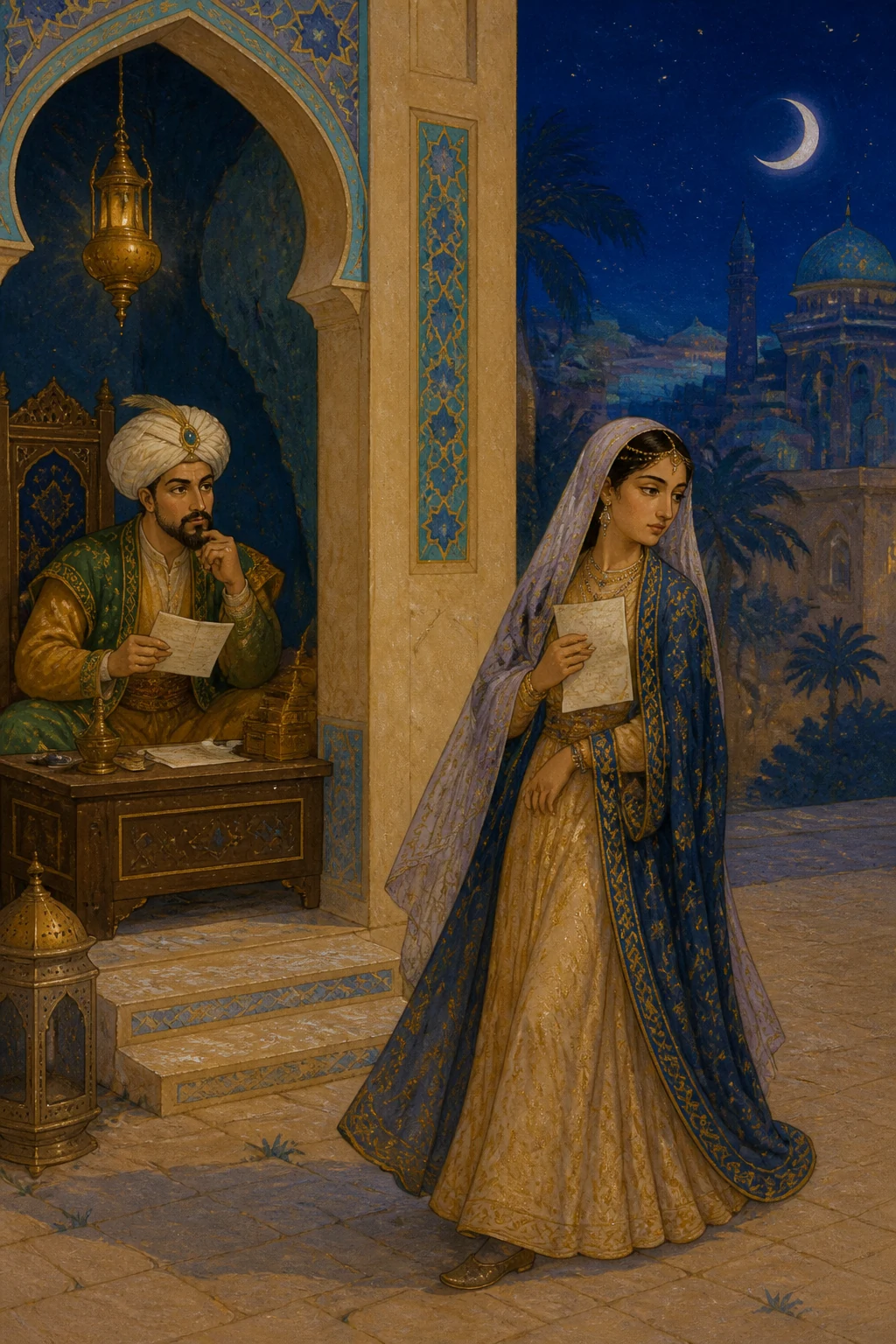
When he had gone, the king opened the casket and took out all the jewels. As he turned them over in his hands, he found among them a necklace he had bestowed upon the vizier who owned the girl. He summoned the vizier and, when he appeared before him, asked, “Is this the necklace I gave you?” The vizier recognized it and replied, “Yes, and I gave it to a singing girl of mine.” “Bring the girl to me this instant,” said the king. The vizier brought her, and when she stood before the king, he said to him, “Uncover her buttock and see whether there is a wound on it.” The vizier uncovered it and saw the knife wound. “Yes, my lord,” he said, “she has a wound.” The king said to the vizier, “She is a sorceress, beyond all doubt, just as that holy man told me.” Then he ordered her to be cast into the sorcerers’ pit, and she was taken there that very day. When night came and the goldsmith learned that his scheme had succeeded, he went to the keeper of the pit with a purse containing a thousand dinars. He sat talking with the keeper until the first third of the night had passed, then broached the matter. “Know, my brother,” he said, “that this girl is innocent of the charge they have brought against her. It was I who brought this calamity upon her.” He told him the whole story from beginning to end, then said, “My brother, take this purse, which holds a thousand dinars, and give me the girl so that I may take her away to my own country. These dinars will do you more good than keeping her imprisoned. Earn the reward of helping us, and we shall both pray for your well-being and safety.” When the keeper heard his story, he marvelled exceedingly at the stratagem and how it had succeeded. Then he took the purse and its contents and surrendered the girl to him, on condition that he did not remain with her in the city for a single hour. The goldsmith took her away at once and set out, pressing on until he reached his own country, having gained his desire. “See, then, O King, the cunning of men and the tricks they devise! Yet your viziers would turn you aside from granting me justice. Tomorrow you and I shall stand before a just Judge, and He will exact my due from you, O King.”
When the king heard her words, he ordered his son to be put to death. But the fifth vizier entered, kissed the ground before him, and said, “O mighty King, be patient, and do not hasten to kill your son. Many a hasty deed has brought repentance in its wake, and I fear you may repent as bitterly as the man who never laughed again for the rest of his life.” “And how was that, O Vizier?” asked the king.