Prevod
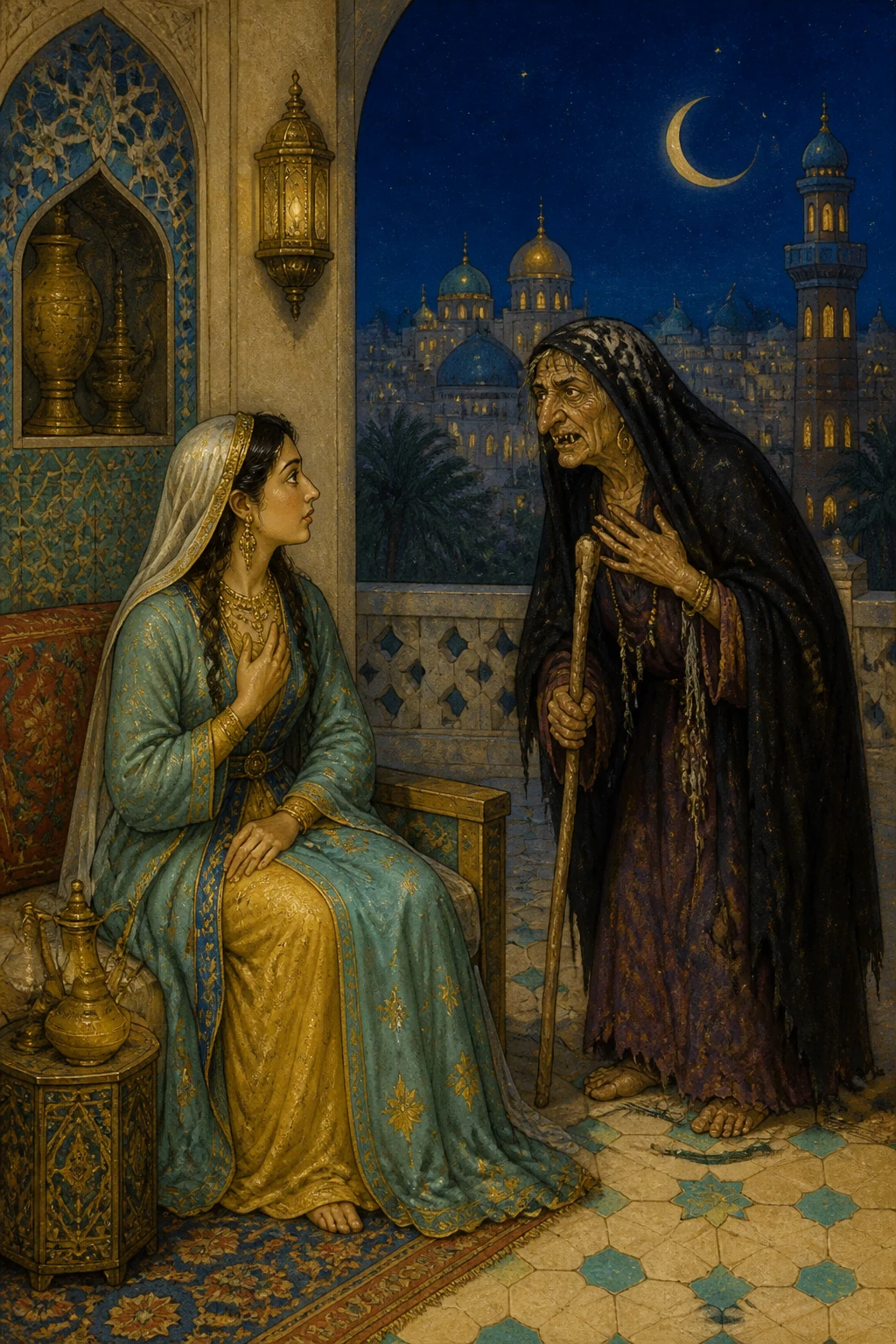
“I have also heard another tale, O King, of the wiles of women.” The king asked him, “And what have you heard?” He replied, “I have heard, O King, that there was once a woman of matchless beauty and grace, radiant and perfect in every charm. Some dissolute young men caught sight of her, and one of them became enamoured of her and loved her passionately. But she was a chaste woman, with no desire for adultery. It happened one day that her husband travelled to another country, whereupon the young man began sending messages to her many times each day, but she gave him no answer. So he sought out an old woman who lived nearby, greeted her, and sat down to complain of the love that afflicted him and his passion for the woman, telling her that he longed to enjoy her favours. The old woman said, ‘I will undertake this for you. Have no fear: God Most High willing, I shall bring you what you desire.’ When the young man heard her words, he gave her a dinar and went his way. The next morning the old woman visited the woman and renewed her acquaintance with her. She began calling on her every day, eating her midday and evening meals with her and taking some food home to her children. She amused her with playful talk and made herself so familiar that at last she corrupted her judgment, and the woman could no longer bear to be parted from her for a single hour. Now, for several days, whenever the old woman left the woman’s house, she would take some bread, put fat and pepper in it, and feed it to a bitch. The bitch began following her because of her kindness and charity. Then one day she gave it a great deal of pepper and fat, and when it had eaten, its eyes began to water from the heat of the pepper. It followed her, weeping, and the young woman marvelled greatly at it. ‘Mother,’ she asked the old woman, ‘why is this bitch weeping?’ She answered, ‘Daughter, hers is a strange tale. She was once a young woman, a friend and companion of mine, endowed with beauty and grace, radiance and perfection. A young man in the neighbourhood fell in love with her, and his love and longing grew so intense that he took to his bed. He sent her message after message, hoping she would soften towards him and have pity on him, but she refused. I counselled her, saying, “Daughter, grant him all he asks, have mercy on him, and take pity on him.” But she would not heed my advice. At last, when the young man’s patience was exhausted, he complained to some friends of his, and they cast a spell on her, changing her from a human being into a dog. When she saw what had befallen her, the plight she was in, and how her form had changed, and found no one in all creation who would pity her but me, she came to my house and began pleading with me, kissing my hands and feet, weeping and sobbing. I recognized her and said, “How often I counselled you, yet my counsel did you no good!”’” And dawn overtook Shahrazad, and she ceased her permitted tale.
When it was the five hundred and eighty-fifth night,
She said: “I have heard, O fortunate King, that the old woman went on telling the woman the bitch’s story and explaining its plight, using deceit and cunning to make her comply with her purpose. She said, ‘When this enchanted bitch came to me and wept, I told her, “How often I counselled you!” But, daughter, when I saw her in such a state, I pitied her and kept her with me. She has remained like this ever since, and whenever she remembers her former life, she weeps for herself.’ When the young woman heard the old woman’s words, she was greatly frightened and said, ‘Mother, by God, you have terrified me with this tale!’ The old woman asked, ‘What have you to fear?’ She replied, ‘There is a handsome young man who is in love with me. He has sent me messages many times, but I have refused him, and now I fear that what befell this bitch may befall me.’ The old woman said, ‘Beware, daughter, of denying him, for I fear greatly for you. If you do not know where he lives, describe him to me and I will bring him to you. Do not let anyone’s heart turn against you.’ So she described him, while the old woman feigned ignorance and pretended not to know him. ‘Let me go and ask after him,’ she said. On leaving her, she went straight to the young man and said, ‘Be of good cheer! I have turned the girl’s head. Come tomorrow at noon and wait for me at the entrance to the lane. I shall come and fetch you and take you to her house, where you may enjoy yourself with her for the rest of the day and all night long.’ The young man rejoiced exceedingly, gave her two dinars, and said, ‘When I have had my desire, I will give you ten dinars.’ She returned to the young woman and said, ‘I found him and spoke to him about the matter. He was very angry with you and determined to do you harm, but I kept pleading with him until he agreed to come tomorrow at the call to the noon prayer.’ The young woman was overjoyed and said, ‘Mother, if he relents and comes to me at noon, I will give you ten dinars.’ The old woman replied, ‘You shall hear of his arrival from no one but me.’
“When morning came, the old woman said to her, ‘Prepare the meal, adorn yourself, and put on your finest clothes, while I go and bring him to you.’ So she began dressing herself and preparing the food. As for the old woman, she went out to wait for the young man, but he did not come. She went about looking for him, but could find no trace of him. ‘What am I to do?’ she said to herself. ‘Is all the food she has prepared to go to waste, and am I to lose the money she promised me? I will not let this trick come to nothing. I shall find her another man and bring him to her.’ As she wandered about the street, she caught sight of a handsome young man whose face bore the marks of travel. She approached him, greeted him, and said, ‘Would you care for food and drink, and a young woman ready to receive you?’ ‘Where is all this?’ he asked. ‘At my house,’ she replied. The man went with her, and the old woman, not knowing that he was the young woman’s husband, brought him to the house and knocked at the door. The young woman opened it, then hurried inside to make herself ready with fine clothes and incense. The old woman, full of scheming, showed him into the reception room. When the wife entered and her eyes fell upon him, with the old woman sitting beside him, she at once resorted to guile and devised a trick on the spot. Pulling the slipper from her foot, she said to her husband, ‘Was this the pledge between us? How can you betray me and treat me so? When I heard of your arrival, I put you to the test through this old woman, and caught you doing the very thing I had warned you against. Now I know the truth about you: you have broken the pledge between us! Until now I thought you a virtuous man, but I have seen you with my own eyes in the company of this old woman, and I know that you consort with loose women!’ She began beating him over the head with her slipper, while he protested his innocence and swore that he had never betrayed her in all his life, nor done any of the things she accused him of. He kept swearing oaths to her by God Most High, while she beat him, wept, and cried out, ‘Come to my aid, O Muslims!’ He put his hand over her mouth, but she bit him. He humbled himself before her and kissed her hands and feet, yet she would neither forgive him nor stop slapping him. Then she winked at the old woman to restrain her hand. The old woman came over and began kissing her hands and feet until at last she made them both sit down. Once they were seated, the husband began kissing the old woman’s hand and saying, ‘May God Most High reward you with every blessing for saving me from her!’ The old woman marvelled at the wife’s cunning and guile. Such, O King, is but one example of women’s deceit, their tricks, and their wiles.” When the king heard the tale, he took its lesson to heart and gave up his resolve to kill his son. And dawn overtook Shahrazad, and she ceased her permitted tale.
When it was the five hundred and eighty-sixth night,
She said: “I have heard, O fortunate King, that when the fourth vizier told the king his tale, he gave up his resolve to kill his son. On the fifth day, the slave-girl came before the king with a cup of poison in her hand. Crying out for help and beating her cheeks and face, she said, ‘O King, either grant me justice and exact redress for me from your son, or I shall drink this cup of poison and die, and the guilt of my death shall cling to you until the Day of Resurrection. These viziers of yours accuse me of cunning and deceit, yet there are none in the world more deceitful than they. Have you not heard, O King, the tale of the goldsmith and the slave-girl?’ The king asked her, ‘What happened between them, girl?’”