Prevod
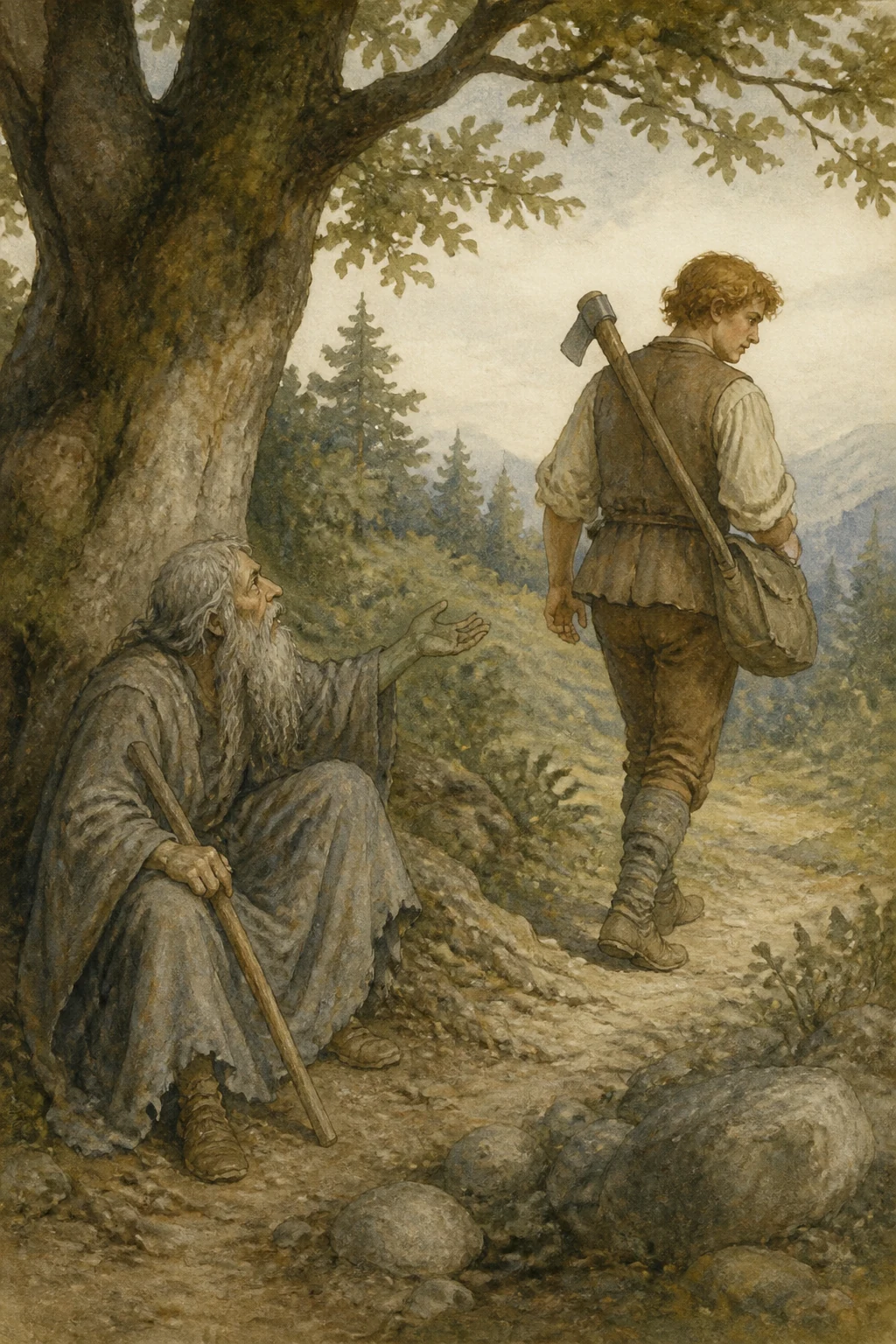
There was once a man who had three sons. The youngest was called Simpleton, and he was despised, mocked, and slighted at every turn. One day the eldest son decided to go into the forest to chop wood, and before he left, his mother gave him a fine pancake and a bottle of wine so that he would not go hungry or thirsty. When he reached the forest, he met a little old grey man, who wished him good day and said, "Give me a piece of the cake in your bag, and let me have a sip of your wine. I am so hungry and thirsty." But the clever son replied, "If I give you my cake and my wine, I shall have nothing left for myself. Be off with you!" He left the little man standing there and went on his way. When he began to chop down a tree, it was not long before he missed his stroke and the axe cut into his arm, so that he had to go home and have it bandaged. This, however, was the little grey man's doing.
Then the second son went into the forest, and his mother gave him a pancake and a bottle of wine, just as she had given the eldest. He too met the little old grey man, who asked for a piece of cake and a drink of wine. But the second son also answered quite sensibly, "Whatever I give you, I shall have to do without myself. Be off with you!" He left the little man standing there and went on his way. His punishment was not long in coming: after only a few strokes at the tree, he cut himself in the leg and had to be carried home.
Then Simpleton said, "Father, let me go out and chop wood for once!" His father answered, "Your brothers have hurt themselves doing that. Leave it alone; you know nothing about it." But Simpleton kept begging until at last his father said, "Go, then. A little misfortune will teach you some sense." His mother gave him a cake made with water and baked in the ashes, and a bottle of sour beer to go with it. When he reached the forest, he too met the little old grey man, who greeted him and said, "Give me a piece of your cake and a drink from your bottle. I am so hungry and thirsty." Simpleton answered, "I have only ash-cake and sour beer, but if that will do, let us sit down and eat." So they sat down, and when Simpleton took out his ash-cake, it had become a fine pancake, and the sour beer had turned into good wine. They ate and drank, and afterwards the little man said, "Because you have a kind heart and gladly share what you have, I shall bring you good fortune. Over there stands an old tree. Cut it down, and you will find something among its roots." Then the little man took his leave.
Simpleton went and cut down the tree, and when it fell, there among its roots sat a goose with feathers of pure gold. He lifted it out, took it with him, and went to an inn, where he intended to spend the night. Now the innkeeper had three daughters, who saw the goose and were curious to know what sort of wonderful bird it was. They would dearly have liked one of its golden feathers. The eldest thought, "There is bound to be a chance for me to pluck out a feather." And when Simpleton had gone out for a while, she seized the goose by the wing, but her fingers and hand stuck fast to it. Soon afterwards the second daughter came in, thinking of nothing but getting a golden feather for herself; yet scarcely had she touched her sister than she too was stuck fast. At last the third came with the same intention. The others cried, "Keep away! For heaven's sake, keep away!" But she could not understand why she should stay away, and thought, "If they are there, I can join them." She hurried over, and as soon as she touched her sister, she stuck fast to her. And so they had to spend the night beside the goose.
The next morning Simpleton took the goose under his arm and went on his way, paying no heed to the three girls clinging to it. They had to keep running after him, to the left or the right, wherever his feet happened to lead him. In the middle of the fields they met the parson, and when he saw the procession, he said, "Shame on you, you wicked girls! What do you mean by running after that young fellow across the fields? Is that proper behaviour?" With that he took the youngest by the hand and tried to pull her back, but the moment he touched her, he too stuck fast and had to run along behind them. Before long the sexton came by and saw the parson following close on the heels of three girls. Astonished, he called out, "Why, Parson, where are you off to in such a hurry? Do not forget that we have a christening today." He ran up and caught him by the sleeve, but he too stuck fast. As the five of them trotted along in a line, two peasants came from the fields with their hoes. The parson called to them and begged them to free him and the sexton. But scarcely had they touched the sexton than they too were stuck fast, and now there were seven of them running after Simpleton and his goose.
At last he came to a town ruled by a king whose daughter was so solemn that no one could make her laugh. The king had therefore decreed that whoever could make her laugh should have her hand in marriage. When Simpleton heard this, he went before the princess with his goose and all its followers, and when she saw the seven people running along one behind the other, she burst out laughing and could not stop.
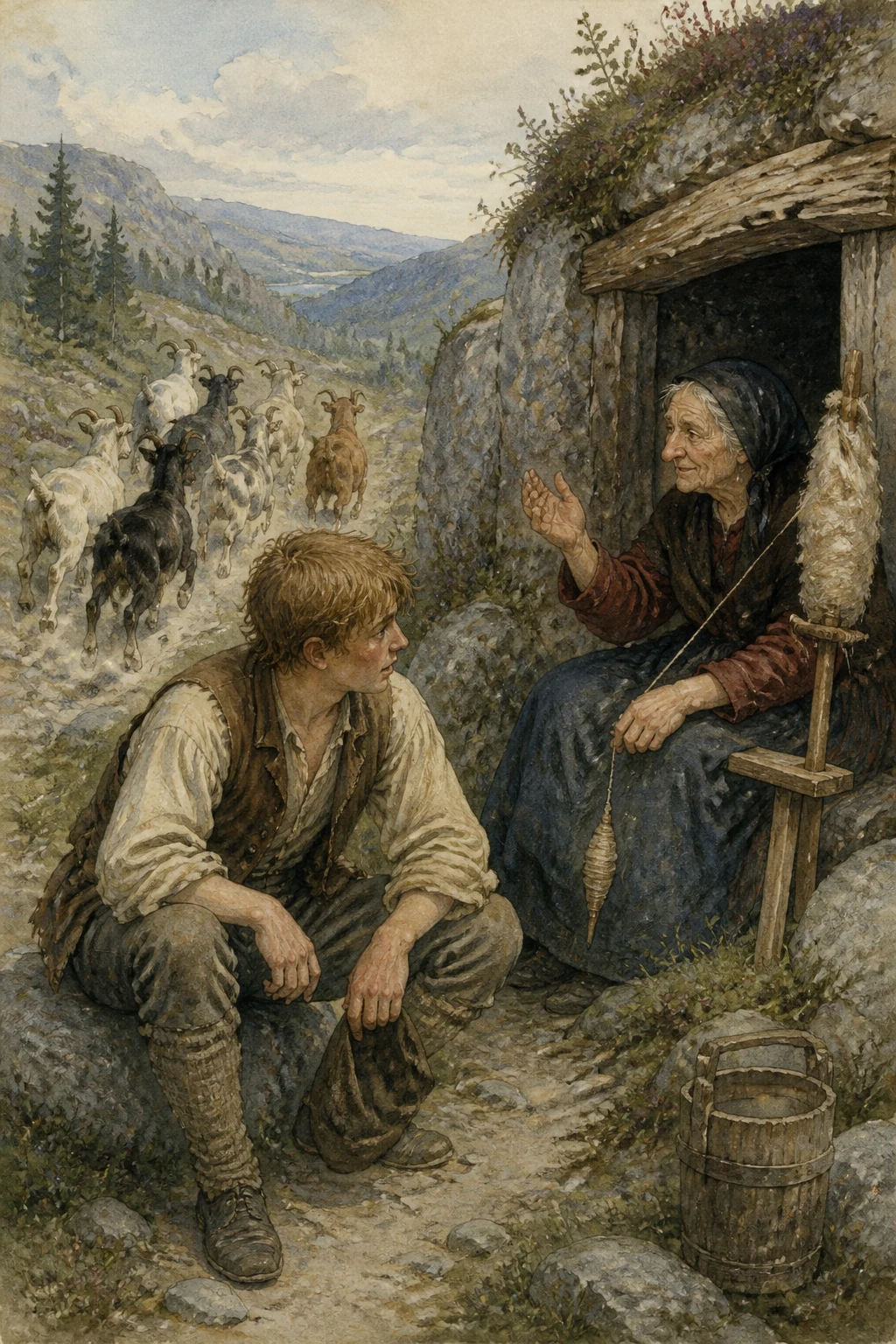
Then Simpleton asked for her as his bride, but the king did not like the prospect of such a son-in-law. He raised all manner of objections and said that Simpleton must first bring him a man who could drink a whole cellarful of wine. Simpleton thought of the little grey man, who might be able to help him, and went out into the forest. On the very spot where he had cut down the tree, he saw a man sitting with a most sorrowful face. Simpleton asked what was troubling him so deeply. The man answered, "I am so thirsty, and I cannot quench my thirst. I cannot bear cold water, and though I have emptied a whole barrel of wine, what is that but a drop on a hot stone?" "I can help you there," said Simpleton. "Just come with me, and you shall have all you want!" He led him to the king's cellar, and the man set to work on the great barrels, drinking and drinking until his sides ached. Before the day was out, he had drunk the whole cellar dry.
Simpleton asked once more for his bride, but the king was angry that a lowly fellow whom everyone called Simpleton should carry off his daughter, and he set a new condition: Simpleton must first find a man who could eat a mountain of bread. Simpleton did not hesitate, but went straight out into the forest. There, in the same place, sat a man tightening a strap around his waist. He wore a wretched expression and said, "I have eaten a whole ovenful of coarse bread, but what good is that when you are as hungry as I am? My stomach is still empty, and I must bind it tight if I am not to starve to death." Simpleton was delighted and said, "Get up and come with me. You shall have your fill!" He led him to the king's court, where the king had ordered all the flour in the kingdom to be brought together and made into an enormous mountain. The man from the forest stood before it and began to eat, and in a single day the whole mountain had vanished. For the third time, Simpleton demanded his bride. But the king sought yet another way out and demanded a ship that could travel both on land and on water. "As soon as you come sailing in it," he said, "you shall have my daughter for your wife." Simpleton went straight into the forest, and there sat the little old grey man with whom he had shared his cake. The little man said, "I have drunk and eaten for you, and I shall give you the ship as well. All this I do because you showed me kindness." Then he gave him the ship that could travel both on land and on water, and when the king saw it, he could no longer refuse him his daughter.
The wedding was celebrated, and after the king's death Simpleton inherited the kingdom and lived happily with his wife for many years.
Izvirnik
Ein Märchen der Brüder Grimm
Es war ein Mann, der hatte drei Söhne, davon hieß der jüngste der Dummling und wurde verachtet und verspottet und bei jeder Gelegenheit zurückgesetzt. Es geschah, daß der älteste in den Wald gehen wollte, Holz hauen, und eh' er ging, gab ihm noch seine Mutter einen schönen feinen Eierkuchen und eine Flasche Wein mit, damit er nicht Hunger und Durst litte. Als er in den Wald kam, begegnete ihm ein altes, graues Männlein, das bot ihm einen guten Tag und sprach: "Gib mir doch ein Stück Kuchen aus deiner Tasche und laß mich einen Schluck von deinem Wein trinken! Ich bin so hungrig und durstig." Der kluge Sohn aber antwortete: "Geb ich dir meinen Kuchen und meinen Wein, so hab ich selber nichts, pack dich deiner Wege!" ließ das Männlein stehen und ging fort. Als er nun anfing, einen Baum zu behauen, dauerte es nicht lange, so hieb er fehl, und die Axt fuhr ihm in den Arm, daß er mußte heimgehen und sich verbinden lassen. Das war aber von dem grauen Männchen gekommen.
Darauf ging der zweite Sohn in den Wald, und die Mutter gab ihm, wie dem ältesten, einen Eierkuchen und eine Flasche Wein. Dem begegnete gleichfalls das alte, graue Männchen und hielt um ein Stückchen Kuchen und einen Trunk Wein an. Aber der zweite Sohn sprach auch ganz verständig: "Was ich dir gebe, das geht mir selber ab, pack dich deiner Wege!" ließ das Männlein stehen und ging fort. Die Strafe blieb nicht aus, als er ein paar Hiebe am Baum getan, hieb er sich ins Bein, daß er mußte nach Haus getragen werden.
Da sagte der Dummling: "Vater, laß mich einmal hinausgehen und Holz hauen!" Antwortete der Vater: "Deine Brüder haben sich Schaden dabei getan, laß dich davon, du verstehst nichts davon." Der Dummling aber bat so lange, bis er endlich sagte: "Geh nur hin, durch Schaden wirst du klug werden." Die Mutter gab ihm einen Kuchen, der war mit Wasser in der Asche gebacken, und dazu eine Flasche saures Bier. Als er in den Wald kam, begegnete ihm gleichfalls das alte, graue Männchen, grüßte ihn und sprach: "Gib mir ein Stück von deinem Kuchen und einen Trunk aus deiner Flasche, ich bin so hungrig und durstig." Antwortet der Dummling: " Ich habe nur Aschenkuchen und saures Bier, wenn dir das recht ist, so wollen wir uns setzen und essen." Da setzten sie sich, und als der Dummling seinen Aschenkuchen herausholte, so war's ein feiner Eierkuchen, und das saure Bier war ein guter Wein. Nun aßen und tranken sie, und danach sprach das Männlein: "Weil du ein gutes Herz hast und von dem deinigen gerne mitteilst, so will ich dir Glück bescheren. Dort steht ein alter Baum, den hau ab, so wirst du in den Wurzeln etwas finden." Darauf nahm das Männlein Abschied.
Der Dummling ging hin und hieb den Baum um, und wie er fiel, saß in den Wurzeln eine Gans, die hatte Federn von reinem Gold. Er hob sie heraus, nahm sie mit sich und ging in ein Wirtshaus, da wollte er übernachten. Der Wirt hatte aber drei Töchter, die sahen die Gans, waren neugierig, was das für ein wunderlicher Vogel wäre, und hätten gar gern eine von seinen goldenen Federn gehabt. Die älteste dachte: Es wird sich schon eine Gelegenheit finden, wo ich mir eine Feder ausziehen kann. Und als der Dummling einmal hinaus gegangen war, faßte sie die Gans beim Flügel aber Finger und Hand blieben ihr daran fest hängen. Bald hernach kam die zweite und hatte keinen andern Gedanken, als sich eine goldene Feder zu holen, kaum aber hatte sie ihre Schwester angerührt, so blieb sie fest hängen. Endlich kam auch die dritte in der gleichen Absicht. Da schrien die andern: "Bleib weg, um Himmels Willen bleib weg!" Aber sie begriff nicht, warum sie wegbleiben sollte, dachte: Sind die dabei so kann ich auch dabeisein und sprang hinzu, und wie sie ihre Schwester angerührt hatte, so blieb sie an ihr hängen. So mußten sie die Nacht bei der Ganz zubringen.
Am anderen Morgen nahm der Dummling die Gans in den Arm ging fort und kümmerte sich nicht um die drei Mädchen, die daran hingen. Sie mußten immer hinter im dreinlaufen, links und rechts, wie's ihm in die Beine kam. Mitten auf dem Felde begegnete ihnen der Pfarrer, und als er den Aufzug sah, sprach er: "Schämt euch, ihr garstigen Mädchen, was lauft ihr dem jungen Bursch durchs Feld nach, schickt sich das?" Damit faßte er die jüngste an der Hand und wollte sie zurückziehen, wie er sie aber anrührte, blieb er gleichfalls hängen und mußte selber hinterdreinlaufen. Nicht lange, so kam der Küster daher und sah den Herrn Pfarrer, der drei Mädchen auf dem Fuß folgte. Da verwunderte er sich und rief: "Ei, Herr Pfarrer, wohinaus so geschwind? vergeßt nicht, daß wir heute noch eine Kindtaufe haben." Lief auf ihn zu und faßte ihn am Ärmel, blieb aber auch fest hängen. Wie die fünf so hintereinander hertrabten, kamen zwei Bauern mit ihren Hacken vom Felde. Da rief der Pfarrer sie an und bat, sie möchten ihn und den Küster losmachen. Kaum aber hatten sie den Küster angerührt, so blieben sie hängen, und waren ihrer nun siebene, die dem Dummling mit der Gans nachliefen.
Er kam darauf in eine Stadt; da herrschte ein König, der hatte eine Tochter, die war so ernsthaft, daß sie niemand zum Lachen bringen konnte. Darum hatte er ein Gesetz gegeben, wer sie könnte zum Lachen bringen, der sollte sie heiraten. Der Dummling, als er das hörte, ging mit seiner Gans und ihrem Anhang vor die Königstochter, und als diese die sieben Menschen immer hintereinander herlaufen sah, fing sie überlaut an zu lachen und wollte gar nicht wieder aufhören.
Da verlangte sie der Dummling zur Braut, aber dem König gefiel der Schwiegersohn nicht, er machte allerlei Einwendungen und sagte, er müßte ihm erst einen Mann bringen, der einen Keller voll Wein austrinken könne. Der Dummling dachte an das graue Männchen, das könnte ihm wohl helfen, ging hinaus in den Wald, und auf der Stelle, wo er den Baum abgehauen hatte, sah er einen Mann sitzen, der machte ein ganz betrübtes Gesicht. Der Dummling fragte, was er sich so sehr zu Herzen nähme. Da antwortete er: "Ich habe so großen Durst und kann ihn nicht löschen, das kalte Wasser vertrage ich nicht, ein Faß Wein habe ich zwar ausgeleert, aber was ist ein Tropfen auf einen heißen Stein?" - "Da kann ich dir helfen," sagte der Dummling, "komm nur mit mir, du sollst satt haben!" Er führte ihn darauf in des Königs Keller, und der Mann machte sich über die großen Fässer, trank und trank, daß ihm die Hüften weh taten, und ehe ein Tag herum war, hatte er den ganzen Keller ausgetrunken.
Der Dummling verlangte abermals seine Braut, der König aber ärgerte sich, daß ein schlechter Bursch, den jedermann einen Dummling nannte, seine Tochter davontragen sollte, und machte neue Bedingungen: Er müßte erst einen Mann schaffen, der einen Berg voll Brot aufessen könnte. Der Dummling besann sich nicht lange, sondern ging gleich hinaus in den Wald. Da saß auf demselben Platz ein Mann, der schnürte sich den Leib mit einem Riemen zusammen, machte ein grämliches Gesicht und sagte: "Ich habe einen ganzen Backofen voll Raspelbrot gegessen, aber was hilft das, wenn man so großen Hunger hat wie ich. Mein Magen bleibt leer, und ich muß ihn zuschnüren, wenn ich nicht Hungers sterben soll." Der Dummling war froh darüber und sprach: "Mach dich auf und geh mit mir, du sollst dich satt essen!" Er führte ihn an den Hof des Königs, der hatte alles Mehl aus dem ganzen Reich zusammenfahren und einen ungeheuren Berg davon bauen lassen; der Mann aber aus dem Walde stellte sich davor, fing an zu essen, und in einem Tag war der ganze Berg verschwunden. Der Dummling forderte zum drittenmal seine Braut. Der König aber suchte noch einmal Ausflucht und verlangte ein Schiff, das zu Land und zu Wasser fahren könnt. "Sowie du aber damit angesegelt kommst," sagte er, "sollst du gleich meine Tochter zur Gemahlin haben." Der Dummling ging geraden Weges in den Wald, da saß das alte, graue Männchen, dem er seinen Kuchen gegeben hatte, und sagte: "Ich habe für dich getrunken und gegessen, ich will dir auch das Schiff geben; das alles tu ich, weil du barmherzig gegen mich gewesen bist" Da gab er ihm das Schiff, das zu Land und zu Wasser fuhr, und als der König das sah, konnte er ihm seine Tochter nicht länger vorenthalten.
Die Hochzeit ward gefeiert; nach des Königs Tod erbte der Dummling das Reich und lebte lange Zeit vergnügt mit seiner Gemahlin.