Prevod
He said to them, “My cousins, everything this fellow has said is nonsense. I will tell you why my testicles were cut off—and I deserved worse, for I had slept with my mistress and my master’s son. But mine is a long story, and this is no time to tell it. Dawn is near, my cousins, and if daylight catches us with this chest, we shall be exposed before everyone and lose our lives. Let us get the door open; once we are inside our own quarters, I will tell you why I was castrated.” Then he clambered down the wall and opened the door. They went in, set down their candles, and dug a hole large enough for the chest between four graves. Kafur did the digging while Sawab carried away the earth in baskets, until they had dug to half a man’s height. Then they lowered the chest into the hole, heaped the earth over it, left the burial ground, closed the door, and vanished from Ghanim ibn Ayyub’s sight.
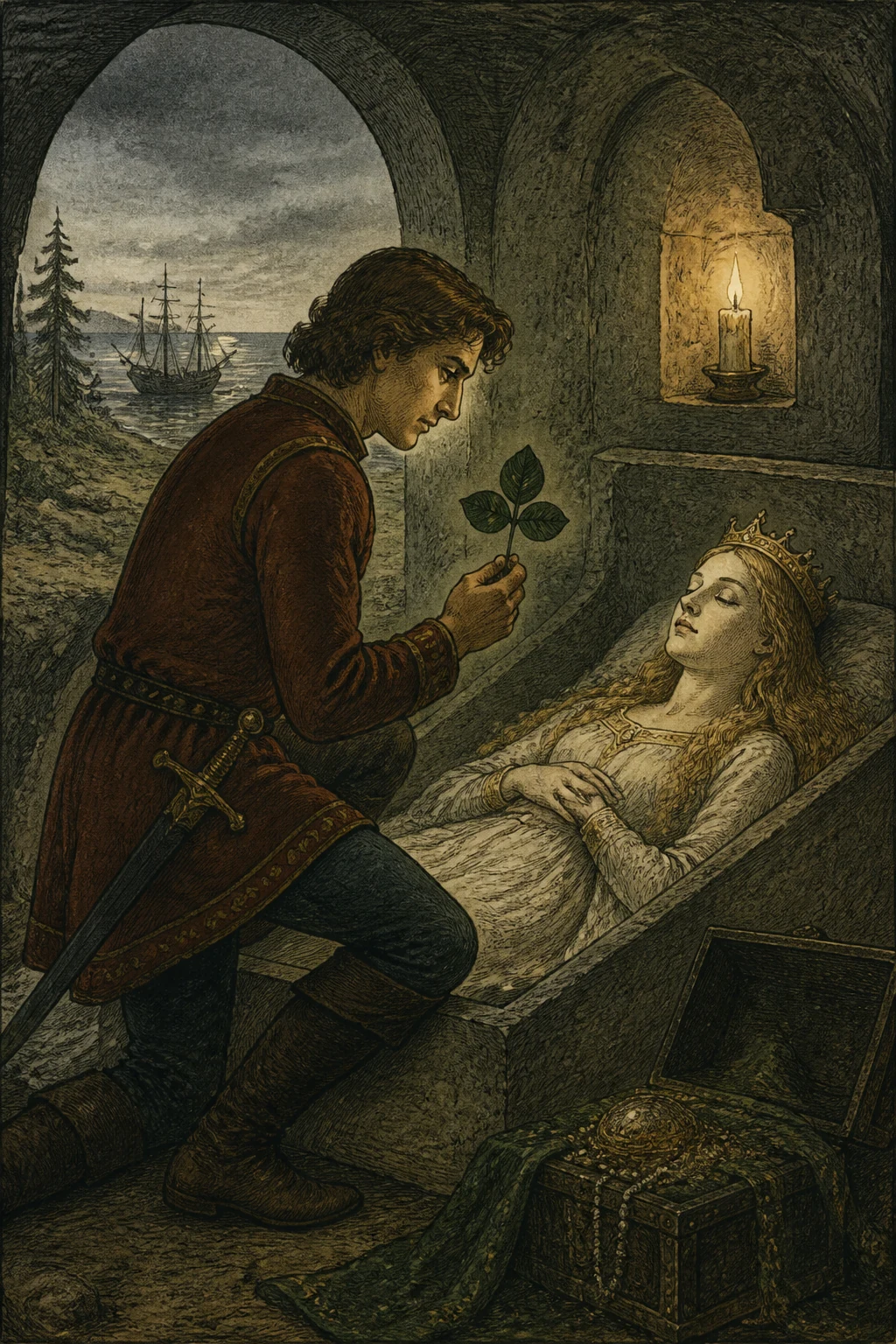
When Ghanim had the place to himself and knew he was alone, curiosity about the chest took hold of him. “What can there be inside?” he wondered. He waited until dawn flashed and its light spread clear, then climbed down from the palm tree and scraped away the earth with his hands until he had uncovered and freed the chest. Taking a stone, he struck the lock, broke it, and lifted the lid. Inside he saw a young woman lying asleep under the influence of a drug, her breath rising and falling. She was exquisitely beautiful, adorned with gold ornaments and necklaces of precious stones whose price would have exhausted the sultan’s treasury. When Ghanim ibn Ayyub saw her, he understood that they had plotted against her. Once he was certain of this, he struggled to lift her from the chest and laid her on her back. As she breathed the fresh air and it entered her nostrils and lungs, she sneezed, choked, and coughed, and a pellet of henbane fell from her throat: an elephant need only have smelled it to sleep from one night to the next. She opened her eyes, looked about her, and said in a clear, graceful voice, “Woe to you, breeze! You bring no relief to the thirsty, no comfort to the satisfied. Where is Zahr al-Bustan?” No one answered. She turned and called, “Sabiha! Shajarat al-Durr! Nur al-Huda! Najmat al-Subh! Ant! Shahr! Nuzha! Hilwa! Zarifa! Speak!” Still no one answered. Her eyes roamed about, and she cried, “Alas, I have been laid among the graves! O You who know what lies within men’s breasts and requite them on the Day of Resurrection, who has brought me from behind my curtains and secluded chambers and laid me between four graves?”
All this while Ghanim stood beside her. He said, “My lady, there are no secluded chambers here, no palaces, and no graves to fear. There is only your servant Ghanim ibn Ayyub, whom the Sovereign who knows all hidden things has led to you, to deliver you from this distress and grant your heart’s desire.” He fell silent. When she understood what had happened, she said, “I bear witness that there is no god but God, and I bear witness that Muhammad is the Messenger of God.” Then, laying her hands upon her breast, she turned to Ghanim and said sweetly, “Blessed young man, now that I have come to my senses, tell me who brought me here.” “My lady,” he answered, “three eunuchs came carrying this chest.” He told her everything that had happened, and how night had overtaken him and thus brought about her deliverance, for otherwise she would have died choking. Then he asked her to tell him her story. “Young man,” she said, “praise be to God, who has cast me into the care of one such as you. Now put me back into the chest and go out to the road. If you find a muleteer with a mule, hire him to carry the chest and take me to your house. Once I am there, all will be well: I will tell you my story and explain what has happened to me, and you shall prosper through me.” Delighted, he went out into the open country. Daylight was spreading, the sun had risen in radiance, and people were abroad. He hired a man with a mule and brought him to the burial ground. After placing the young woman inside, he had the chest loaded onto the mule. Love for her had entered his heart, and he went away rejoicing, for she was a slave girl worth ten thousand dinars, and her jewels and robes were worth a great fortune. He could scarcely wait to reach his house, where he had the chest set down and opened it. But morning overtook Shahrazad, and she fell silent, leaving her tale untold.
When it was the fortieth night
She said, “It has reached me, O fortunate king, that Ghanim ibn Ayyub arrived at his house with the chest, opened it, and helped the young woman out. Looking about, she found herself in a handsome room furnished with richly colored carpets and other pleasing things. She saw bundles of cloth, bales of merchandise, and much besides, and knew that he was a wealthy merchant. Then she unveiled her face and looked at him. Seeing that he was a handsome young man, she fell in love with him and said, ‘Bring us something to eat.’ ‘Upon my head and eyes,’ Ghanim replied. He went down to the market and bought a roast lamb, a dish of sweets, dried fruits and nuts, candles, wine, and the flowers and fragrant herbs they would need. He brought his purchases home, and when the girl saw him she laughed, kissed him, embraced him, and began to caress him. His love grew until it possessed his whole heart. They ate and drank until nightfall, each in love with the other, for they were alike in age and beauty.
When night came, Ghanim ibn Ayyub, the love-stricken and dispossessed, rose and lit the candles and lamps until the room shone. He brought out the drinking vessels, arranged their gathering, and sat down with her. He filled a cup and gave it to her, and she filled one and gave it to him. They laughed, sported, and recited verses, their delight increasing and their hearts ever more closely bound in love. Glory be to Him who joins hearts together! They remained so until near dawn, when sleep overcame them and each slept where they lay until morning. Then Ghanim ibn Ayyub rose, went to the market, bought vegetables, meat, wine, and everything else they needed, and returned home. They sat down together and ate their fill, then brought out the wine and drank and played together until their cheeks flushed and their eyes grew dark and lustrous. Ghanim ibn Ayyub longed to kiss the girl and lie with her. ‘My lady,’ he said, ‘grant me a kiss from your lips; perhaps it will quench the fire in my heart.’ ‘Ghanim,’ she replied, ‘wait until I am drunk and lose my senses. Then I shall let you steal one, so that I do not feel you kiss me.’ She rose, took off some of her clothes, and sat down in a fine shift and a headscarf. At this Ghanim’s desire was stirred, and he said, ‘My lady, will you not grant what I asked?’ ‘By God, you may not,’ she answered, ‘for on the drawstring of my trousers there are stern words written.’ Ghanim ibn Ayyub was disheartened, and his passion grew fiercer because his desire was denied. He recited these verses:
I asked the one who made me ill for a kiss to cure my pain. ‘No, no, never,’ came the answer. ‘Yes, yes,’ I said again. ‘Take it willingly and lawfully,’ my beloved said, and smiled. ‘By force, then?’ ‘No—unless upon a banner’s lofty height.’ Ask nothing of what happened next; seek God’s forgiveness, sleep. Think what you will of both of us: suspicion makes love sweet. After this I do not care whether my love speaks out or keeps our secret. His love grew greater still, and fire swept through his heart, while she continued to deny him, saying, ‘You shall not have me.’ They went on loving and keeping one another company, Ghanim ibn Ayyub drowning in passion while she grew ever more unyielding, until darkness fell and night let down its trailing veil of sleep. Ghanim rose, lit the lamps and candles, and made the room more splendid still. Then he took her feet and kissed them. Finding them soft as fresh butter, he pressed his face against them and said, ‘My lady, have mercy on the captive of your love, the man your eyes have slain. My heart would have been sound but for you.’ He wept a little, and she said, ‘My lord and light of my eyes, by God, I love you and trust you, but I know that you cannot possess me.’ ‘What prevents it?’ he asked. ‘Tonight,’ she replied, ‘I will tell you my story, so that you may accept my excuse.’
Then she flung herself upon him, clasped her arms around his neck, and began kissing and caressing him. She promised to yield to him, and they continued laughing and playing until their love had taken firm possession of them both. They remained in this state, sleeping every night in a single bed; yet whenever he asked her to yield, she withheld herself. A whole month passed in this way, and each had so possessed the other’s heart that they could no longer bear to be apart. One night, as they lay together, both drunk, he stretched out his hand and stroked her body, passing his hand over her belly and down to her navel. She woke, sat up, and checked her trousers. Finding them tied, she lay down again. He stroked her once more, moving his hand down to her trousers and their drawstring, and tugged at it. She woke and sat up, and Ghanim sat beside her. ‘What do you want?’ she asked. ‘I want to lie with you,’ he answered, ‘and for us to give ourselves wholly to each other.’ Then she said, ‘Now I will explain my situation, so that you may know my station, discover my secret, and understand my excuse.’ ‘Yes,’ he said. She tore open the hem of her shift, reached for the drawstring of her trousers, and said, ‘My lord, read what is written on this end.’ He took the end in his hand and looked at it. There he found these words embroidered in gold: ‘I am yours and you are mine, O cousin of the Prophet.’
When he had read it, he snatched his hand away and said, ‘Tell me your story.’ ‘Yes,’ she replied. ‘Know that I am the favorite of the Commander of the Faithful, and my name is Qut al-Qulub. The Commander of the Faithful brought me up in his palace. When I had grown, he observed my qualities and the beauty God had bestowed upon me, and came to love me dearly. He took me for himself, lodged me in a private apartment, and appointed ten slave girls to serve me. He also gave me the jewels you see with me. One day the caliph set out on a journey to another province. Lady Zubayda went to one of the girls who served me and said, “When your mistress Qut al-Qulub is asleep, put this pellet of henbane into her nose or her drink, and I will give you enough money to satisfy you.” “With love and honor,” the girl replied. She took the drug gladly for the sake of the money, and because she had originally belonged to Zubayda. She came to me and made me swallow it. I fell to the ground, my head at my feet, and found myself in another world. Once her scheme had succeeded, she put me into that chest, secretly summoned the slaves, rewarded them and the doorkeepers, and sent me away with the slaves on the night when you were sleeping in the palm tree. They did what you saw, and my deliverance came at your hands. You brought me here and treated me with the utmost kindness. That is my story. I do not know what has happened to the caliph during my absence, so remember my station and do not make my affairs known.’ When Ghanim ibn Ayyub heard Qut al-Qulub’s words and realized that she was the caliph’s favorite, he drew back in dread of the caliph’s majesty. He sat alone in a corner, reproaching himself and pondering his plight, bewildered by his love for one he could never possess. He wept with passion and the anguish of longing, complaining of time and its cruelties. Glory be to Him who fills noble hearts with love, yet gives the base not so much as a grain of it! He recited these two verses:
The lover’s heart is wearied for the ones he loves; his reason is stolen by wondrous beauty. Someone asked me, ‘What is love?’ I answered, ‘Love is sweet, but there is torment in it.’ Then Qut al-Qulub went to him, embraced him, and kissed him. His love had taken firm hold of her heart, and she confessed her secret and the passion she felt for him. She clasped her arms around his neck and kissed him, while he resisted her for fear of the caliph. They talked for a while, both drowning in the sea of their love, until daylight came. Ghanim rose, dressed, and went to the market as usual to buy what they needed. When he returned, he found Qut al-Qulub weeping. At the sight of him she stopped crying, smiled, and said, ‘I have missed you, beloved of my heart. By God, the hour you were away seemed like a year. I cannot bear to be parted from you. I have told you my circumstances only because of my great love for you. Come now, let us forget what is past, and take your pleasure with me.’ ‘God forbid!’ he answered. ‘That can never be. How can a dog sit in a lion’s place? What belongs to my master is forbidden to me.’ He drew away and sat in a corner. His resistance only increased her love. She sat beside him, drank with him, and teased him. They became drunk, and she was so carried away by love that she cared nothing for concealing it. She sang these verses:
The lover’s heart is almost torn to pieces. How long will this coldness last—how long? You turn from me though I have done no wrong; yet gazelles are wont to turn and look behind them. Rebuff, estrangement, and ever-growing longing—a young heart cannot bear all this. Ghanim ibn Ayyub wept, and she wept to see his tears. They went on drinking until night, when Ghanim rose and made up two beds, each in a separate place. ‘Who is this second bed for?’ Qut al-Qulub asked. ‘This one is mine and the other yours,’ he replied. ‘From tonight onward, this is how we must sleep. Everything belonging to the master is forbidden to the slave.’ ‘My lord,’ she said, ‘leave that aside. Everything happens by fate and divine decree.’ But he refused. Fire blazed in her heart, and her love grew stronger. ‘By God,’ she said, ‘we shall sleep only together.’ ‘God forbid!’ he answered. He prevailed and slept alone until morning. Her passion and longing increased, and her anguish grew more intense. They remained so for three long months. Whenever she approached him, he drew away, saying, ‘Whatever is reserved for the master is forbidden to the slave.’ When this long delay with Ghanim ibn Ayyub, the love-stricken and dispossessed, had multiplied her sorrows and distress, she recited these verses:
O wondrous beauty, how long will you wrong me? Who has persuaded you to turn away? You possess every grace of slenderness, every art of loveliness. You have set passion flowing into every heart and appointed sleeplessness to guard each eye. Before you, I knew branches to be plucked; O branch of the arak tree, I see you plucking hearts. I knew gazelles as creatures to be hunted; why do I see you hunting shield-bearing men? The strangest thing I tell of you is this: I am bewitched, while you know nothing of my plight. Yet do not grant me union, for I am jealous of you even with yourself—how much more, then, with me! And while I live I shall not cease to say: O wondrous beauty, how long will you wrong me? They remained like this for a time, fear keeping Ghanim from her. Such was the case of Ghanim ibn Ayyub, the love-stricken and dispossessed. As for Zubayda, after doing this to Qut al-Qulub during the caliph’s absence, she was at a loss. ‘What shall I tell the caliph when he returns and asks about her?’ she wondered. ‘What answer can I give him?’ She summoned an old woman in her service, confided her secret, and said, ‘What am I to do, now that what has happened to Qut al-Qulub cannot be undone?’ When the old woman understood the situation, she said, ‘My lady, the caliph will soon return. Send for a carpenter and order him to make a wooden figure in the shape of a dead body. Have a grave dug for it, light candles and lamps around it, and order everyone in the palace to wear black. Tell your slave girls and servants that when they hear the caliph has returned from his journey, they are to fill the entrance hall with mourning. When he comes in and asks what has happened, they must say, “Qut al-Qulub is dead. May God richly reward your patience in her loss. Our lady loved her so dearly that she buried her in her own palace.” When he hears this, he will weep and grieve for her, and the reciters will keep vigil at her grave, reading the whole Quran. If he thinks to himself, “My cousin Zubayda has contrived Qut al-Qulub’s death out of jealousy,” or if longing overwhelms him and he orders her taken from the grave, do not be afraid. Even if they dig up the human-shaped figure and bring it out in its fine shrouds, and the caliph wishes to remove them and look at her, you must stop him. Another woman must also restrain him, saying, “It is forbidden to look upon her nakedness.” Then he will believe she is dead, return her to her resting place, and thank you for what you have done. Thus, God willing, you will escape this predicament.’
Lady Zubayda heard her words and thought the counsel sound. She bestowed a robe of honor upon her, gave her a large sum of money, and ordered her to carry out the plan. The old woman set to work and had the carpenter make the figure as we have described. When it was finished, she brought it to Lady Zubayda, who shrouded it, lit the candles and lamps, and spread carpets around the grave. She dressed in black and ordered the slave girls to do likewise, and word spread through the palace that Qut al-Qulub was dead. After a time, the caliph returned from his travels and went up to his palace, thinking of nothing but Qut al-Qulub. When he saw the pages, servants, and slave girls all dressed in black, his heart trembled. Entering Lady Zubayda’s rooms, he found her also in black and asked the reason. They told him that Qut al-Qulub was dead, and he fell unconscious. When he recovered, he asked where her grave was. ‘Commander of the Faithful,’ Lady Zubayda said, ‘I loved her so dearly that I buried her in my own palace.’ Still in his traveling clothes, the caliph went into the palace to visit Qut al-Qulub’s grave. He found the carpets spread and the candles and lamps burning, and thanked Zubayda for what she had done. Yet he remained troubled, wavering between belief and disbelief. At last his doubts overcame him, and he ordered the grave opened and the body brought out. When he saw the shroud, he wished to remove it and look at her, but fear of Almighty God restrained him. ‘Return her to her resting place,’ said the old woman. The caliph at once ordered jurists and Quran reciters to be brought, and they read the entire Quran over her grave. He sat beside it, weeping until he fainted, and remained at her grave for a whole month. But morning overtook Shahrazad, and she fell silent, leaving her tale untold.
When it was the forty-first night
She said, “It has reached me, O fortunate king, that the caliph continued visiting her grave for a month. One day, after the emirs and viziers had left his presence and gone home, he entered the women’s quarters and lay down to sleep for a while. A slave girl sat at his head and another at his feet. After he had fallen asleep, he stirred and opened his eyes. He heard the girl at his head say to the one at his feet, ‘Woe to you, Khayzuran!’ ‘Why, Qadib?’ the other asked. ‘Our master knows nothing of what has happened. He even keeps vigil over a grave containing nothing but a piece of wood fashioned by a carpenter.’ ‘Then what happened to Qut al-Qulub?’ the other asked. ‘You must know that Lady Zubayda sent a girl with henbane to drug her. Once the drug had taken full effect, she put her in a chest and sent her away with Sawab and Kafur, ordering them to throw her into the burial ground.’ ‘Woe to you, Qadib!’ said Khayzuran. ‘Is Lady Qut al-Qulub not dead?’ ‘May her youth be spared from death! I heard Lady Zubayda say that Qut al-Qulub is with a young merchant named Ghanim of Damascus, and that today she has been with him for four months. All the while our master weeps and spends his nights beside a grave with no dead person in it.’
They went on talking while the caliph listened. When the two girls had finished and he understood the truth—that the grave was a deception and Qut al-Qulub had been with Ghanim ibn Ayyub for four months—he flew into a terrible rage. He rose and summoned the officers of his court. The vizier Ja‘far al-Barmaki came and kissed the ground before him. ‘Go down, Ja‘far,’ the caliph said furiously, ‘with a company of men, inquire after the house of Ghanim ibn Ayyub, raid it, and bring me my slave girl Qut al-Qulub. As for him, I shall certainly punish him.’ Ja‘far answered, ‘I hear and obey.’ Then he set out with his followers and the governor of police, and they proceeded to Ghanim’s house. Ghanim had just gone out and returned with a pot of meat, and was about to begin eating with Qut al-Qulub. She happened to glance outside and saw calamity surrounding the house: the vizier, the governor, the officers, and the mamluks with drawn swords had encircled it as the dark rim encircles the eye. She knew then that news of her had reached her master the caliph, and she felt certain of their destruction. Her face turned pale and her beauty altered. Looking at Ghanim, she said, ‘My beloved, save yourself! Flee!’ ‘What can I do?’ he asked. ‘Where can I go? My wealth and livelihood are all in this house.’ ‘Do not stay,’ she said, ‘or you will lose both your life and your wealth.’ ‘My beloved and light of my eyes,’ he answered, ‘how can I escape when they have surrounded the house?’ ‘Do not be afraid,’ she said. She stripped off his clothes and dressed him in worn-out rags. Taking the pot that had held the meat, she put some bread and a bowl of food inside it and set it on his head. ‘Go out disguised like this,’ she said, ‘and do not worry about me. I know where I stand with the caliph.’
Ghanim followed Qut al-Qulub’s advice and went out through their midst carrying the pot. The Veiler covered him with His protection, and by the blessing of his good intentions he escaped their plots and harm. When the vizier Ja‘far reached the house, he dismounted and went inside. There he found Qut al-Qulub dressed and adorned in all her finery. She had filled a chest with gold, ornaments, jewels, and precious objects—things light to carry and costly to buy. When Ja‘far entered, she rose, kissed the ground before him, and said, ‘My lord, the pen has written what God decreed.’ Seeing her thus, Ja‘far said, ‘By God, my lady, he commanded me only to seize Ghanim ibn Ayyub.’ ‘He has packed his merchandise and taken it to Damascus,’ she replied. ‘I know nothing more. I ask you to safeguard this chest for me and have it taken to the palace of the Commander of the Faithful.’ ‘I hear and obey,’ said Ja‘far. He took charge of the chest and ordered it carried away, and Qut al-Qulub accompanied them to the caliph’s palace, treated with all honor and respect.
After plundering Ghanim’s house, they went before the caliph, and Ja‘far told him everything that had happened. The caliph ordered Qut al-Qulub confined in a dark room, with an old woman assigned to attend to her needs, for he believed that Ghanim had lain with her. Then he wrote a letter to Emir Muhammad ibn Sulayman al-Zayni, his deputy in Damascus, saying, ‘The moment this letter reaches your hands, seize Ghanim ibn Ayyub and send him to me.’ When the decree arrived, the emir kissed it and laid it upon his head. He had it proclaimed in the markets, ‘Whoever wishes to plunder, let him go to the house of Ghanim ibn Ayyub!’ They went to the house and found Ghanim’s mother and sister, who had made a grave for him and sat beside it weeping. They seized the two women and looted the house, while the women knew nothing of the reason. When they were brought before the ruler, he questioned them about Ghanim ibn Ayyub. ‘We have had no news of him for a year,’ they said. He sent them back to their dwelling.
Such was their case. As for Ghanim ibn Ayyub, the love-stricken and dispossessed, when his good fortune was stripped from him, he was bewildered and wept over his fate until his heart nearly broke. He walked on until the end of the day, growing ever hungrier and more exhausted, until he reached a town. Entering the mosque, he sat down on a mat, leaned his back against the wall, and collapsed, overcome by hunger and weariness. He stayed there until morning, his heart fluttering with hunger. Lice crawled over his skin, his smell grew foul, and his condition was utterly changed. The townspeople came to perform the dawn prayer and found him lying there, weak with hunger, though traces of former prosperity were still plain upon him. When they approached, they found him cold and starving, so they dressed him in an old robe with worn-out sleeves and asked, ‘Where are you from, stranger, and what has brought you so low?’ He opened his eyes, looked at them, and wept, but gave no answer. One of them realized how hungry he was and went to fetch a small bowl of honey and two loaves of bread. Ghanim ate, and they sat with him until sunrise, then went about their work.
He remained among them in this condition for a month, growing weaker and more ill. They took pity on him and consulted one another, finally agreeing to send him to the hospital in Baghdad. While they were discussing this, two beggar women came in to him. They were his mother and sister. When he saw them, he gave them the bread lying beside his head, and they spent that night near him, but he did not recognize them. The next day the villagers brought a camel and said to its owner, ‘Carry this sick man on your camel. When you reach Baghdad, set him down at the hospital gate. Perhaps he will recover, and you will earn your reward from God.’ ‘I hear and obey,’ the man replied. They carried Ghanim ibn Ayyub out of the mosque on the bedding where he lay and lifted him onto the camel. His mother and sister came with the crowd to watch, not knowing who he was. They looked closely at him and said, ‘He resembles our Ghanim. Can this sick man be he, or not?’ Ghanim did not regain consciousness until he was being carried on the camel, and he began to weep and lament. The villagers watched his mother and sister crying over him, though neither recognized him. Then the two women traveled on until they reached Baghdad. The camel driver, meanwhile, continued on his way, set Ghanim down at the hospital gate, and returned with his camel. Ghanim lay there until morning. When people began passing along the road, they saw that he had grown as thin as a toothpick. They gathered to stare at him until the head of the market arrived and drove them away. ‘I shall earn Paradise through this poor man,’ he said, ‘for if they take him into the hospital, they will kill him in a single day.’ He ordered his assistants to carry him home, prepared fresh bedding and a new pillow for him, and said to his wife, ‘Care for him faithfully.’ ‘Upon my head,’ she replied. She tucked up her sleeves, heated water, washed his hands, feet, and body, and dressed him in a robe belonging to one of her slave girls. She gave him a cup of cordial and sprinkled him with rosewater. He revived, remembered his beloved Qut al-Qulub, and his distress grew greater still.
Such was his case. As for Qut al-Qulub, when the caliph grew angry with her … But morning overtook Shahrazad, and she fell silent, leaving her tale untold.
When it was the forty-second night
She said, “It has reached me, O fortunate king, that when the caliph grew angry with Qut al-Qulub and confined her in a dark room, she remained there in that condition for eighty days. One day the caliph happened to pass the place and heard her reciting poetry. When she had finished, she said, ‘My beloved Ghanim, how good you are, and how chaste your soul! You showed kindness to one who wronged you, respected the honor of one who violated yours, and sheltered his woman, while he made captives of you and your family. You and the Commander of the Faithful must one day stand before a just Judge, and you shall have redress against him on the day when God is the Judge and the angels are the witnesses.’
When the caliph heard her words and understood her complaint, he knew that she had been wronged. He entered his palace and sent a servant to fetch her. When she stood before him, she lowered her head, her eyes full of tears and her heart full of sorrow. ‘Qut al-Qulub,’ he said, ‘I hear you complaining of me, accusing me of injustice, and saying that I have wronged one who treated me well. Who is this man who respected my honor while I violated his, and sheltered my woman while I took his women captive?’ ‘Ghanim ibn Ayyub,’ she answered. ‘By all the favors you have bestowed upon me, Commander of the Faithful, he never touched me in sin.’ ‘There is no power and no might save in God,’ said the caliph. ‘Qut al-Qulub, ask a favor of me, and I will grant your wish.’ ‘I ask you for my beloved Ghanim ibn Ayyub,’ she said. ‘God willing,’ he replied, ‘I will have him brought here with honor.’ ‘Commander of the Faithful,’ she asked, ‘if you bring him here, will you give me to him?’ ‘If I bring him here,’ he answered, ‘I shall give you to him with the generosity of one who never takes back his gift.’ ‘Commander of the Faithful, allow me to search for him,’ she said. ‘Perhaps God will reunite us.’ ‘Do as you wish,’ he replied.
She rejoiced and went out with a thousand dinars, visiting holy men and giving alms on Ghanim’s behalf. The next day she went to the merchants’ market, gave money to the market head, and said, ‘Distribute this among strangers in need.’ On the following Friday she went out with another thousand dinars and entered the goldsmiths’ and jewelers’ markets. She sent for the market head, and when he came, she handed him the thousand dinars and said, ‘Give this in charity to strangers.’ The man, who was the chief of the market, looked at her and said, ‘Would you care to come to my house and see a young stranger there? How graceful and accomplished he is!’ This was Ghanim ibn Ayyub, the love-stricken and dispossessed, but the market head did not know him. He supposed him to be some poor debtor stripped of his prosperity, or a lover parted from those he loved. When she heard his words, her heart fluttered and her whole being was drawn toward him. ‘Send someone to show me the way to your house,’ she said. He sent a young boy with her, who brought her to the house where the stranger lay, and she thanked him. When she entered and greeted the market head’s wife, the woman rose and kissed the ground before her, for she recognized her. ‘Where is the sick man you are caring for?’ Qut al-Qulub asked. The woman wept and said, ‘Here he is, my lady. He is plainly wellborn, and the signs of former prosperity are upon him.’ Qut al-Qulub turned toward the bed where he lay and studied him. He looked like Ghanim himself, but his condition had changed and he had wasted away until he was as thin as a toothpick. She was uncertain and could not be sure that it was he. Yet pity overcame her, and she began to weep, saying, ‘Strangers are wretched, even if they are princes in their own lands.’ She arranged for him to have medicines and restorative drinks, sat by his head for a while, then mounted and returned to her palace. Afterward she continued visiting every market in search of Ghanim.
Then the market head brought Ghanim’s mother and his sister Fitna to Qut al-Qulub. ‘O lady of beneficence,’ he said, ‘a woman and a girl entered our city today. They are people of standing, and traces of prosperity are plain upon them, yet they wear garments of haircloth, each with a beggar’s bag hanging from her neck. Their eyes are full of tears and their hearts full of sorrow. I have brought them to you so that you may shelter them and spare them the humiliation of begging, for they are not people who should have to ask favors of the base. God willing, through them we may enter Paradise.’ ‘By God, my lord,’ she said, ‘you have made me long to see them. Where are they?’ He bade them enter, and Fitna and her mother came before Qut al-Qulub. Seeing their beauty, she wept for them and said, ‘By God, they were born to prosperity; the marks of wealth are still upon them.’ ‘My lady,’ said the market head, ‘we love the poor and needy for the sake of God’s reward. Perhaps tyrants have wronged these women, stripped them of their wealth, and laid waste their home.’ The two women burst into bitter tears. Remembering Ghanim ibn Ayyub, the love-stricken and dispossessed, they sobbed all the more, and Qut al-Qulub wept with them. Then his mother said, ‘We ask God to reunite us with the one we seek, my son Ghanim ibn Ayyub.’ Hearing this, Qut al-Qulub knew that the woman was her beloved’s mother and the other his sister. She wept until she fainted. When she recovered, she went to them and said, ‘Do not be afraid. This day marks the beginning of your happiness and the end of your misery. Grieve no more.’ But morning overtook Shahrazad, and she fell silent, leaving her tale untold.
When it was the forty-third night
She said: It has reached me, O fortunate King, that Qut al-Qulub said to the two women, “Do not grieve.” Then she told the headman to take them to his house and have his wife take them to the bath, dress them in fine clothes, and tend them with the utmost care and kindness; and she gave him a large sum of money. The next day Qut al-Qulub rode to the headman’s house and went in to his wife, who rose to greet her, kissed her hands, and thanked her for her generosity. There she saw Ghanim’s mother and sister: the headman’s wife had taken them to the bath and removed their old clothes, and the signs of their former prosperity were now plain to see. She sat talking with them for a while, then asked the headman’s wife about the sick man in her care. “He is as he was,” she replied. “Come,” said Qut al-Qulub, “let us go and see him.” So she, the headman’s wife, and Ghanim’s mother and sister rose and went in to sit beside him. When Ghanim ibn Ayyub, the love-stricken and despoiled, heard them mention Qut al-Qulub—though his body was wasted and his bones were frail—his spirit revived. He raised his head from the pillow and cried, “O Qut al-Qulub!” She looked closely at him, recognized him, and cried, “Yes, my beloved!” “Come close to me,” he said. She asked, “Can you be Ghanim ibn Ayyub, the love-stricken and despoiled?” “Yes, I am he,” he replied. At this she fell in a swoon. When his sister and mother heard their words, they cried, “Oh, what joy!” and both fainted too. When they had recovered, Qut al-Qulub said to him, “Praise be to God, who has reunited us with you and with your mother and sister!” She drew near and told him all that had passed between her and the Caliph, saying, “I told him, ‘I have made the truth plain to you, Commander of the Faithful.’ He believed my words and is no longer angry with you. Now he longs to see you.” Then she said to Ghanim, “The Caliph has given me to you.” At this his joy knew no bounds. “Stay here until I return,” Qut al-Qulub told them.
She rose at once and went to her palace, where she fetched the chest she had taken from Ghanim’s house. Taking dinars from it, she gave them to the headman and said, “Take these dinars and buy each of them four complete outfits of the finest cloth, twenty kerchiefs, and whatever else they need.” Then she took the two women and Ghanim to the bath and ordered that they be washed. When they came out and put on their clothes, she had broths, galangal water, and apple water prepared for them. She stayed with them for three days, feeding them chicken and broths and giving them drinks sweetened with refined sugar. After three days their spirits revived. She sent them to the bath once more, and when they came out she gave them fresh clothes. Leaving them in the headman’s house, she went to the Caliph, kissed the ground before him, and told him the whole story: her master Ghanim ibn Ayyub, the love-stricken and despoiled, had been found, and his mother and sister had arrived as well. When the Caliph heard Qut al-Qulub’s words, he said to his servants, “Bring me Ghanim.” Ja‘far went down to fetch him, but Qut al-Qulub had gone ahead and entered Ghanim’s room. “The Caliph has sent for you to appear before him,” she said, “so be eloquent of tongue, steadfast of heart, and gracious in your speech.” She dressed him in a splendid robe and gave him a great many dinars, saying, “Be generous to the Caliph’s attendants as you go in to him.” Just then Ja‘far arrived on his mule. Ghanim rose to meet him, greeted him, and kissed the ground before him; for the star of his good fortune had risen, and his glory was in the ascendant. Ja‘far took him along, and they continued on their way until they entered the presence of the Commander of the Faithful. Standing before him, Ghanim looked upon the viziers, emirs, chamberlains, deputies, officers of state, and men of power. Now Ghanim was eloquent of tongue and steadfast of heart, graceful in expression and elegant in gesture. He bowed his head toward the ground, then looked up at the Caliph and recited these verses:
“My life be your ransom, O king of exalted renown, whose gracious deeds and favours follow without end! Your resolve blazes like fire, your bounty pours in floods: speak, then, of the deluge and the flames! Neither Caesar in his seat nor the lord of the palace speaks of anyone but you. Kings lay the jewels of their crowns upon the dust of your threshold when they come to greet you; and when their eyes are raised to you, they fall upon their faces in awe. That audience, with your favour, bestows on them high rank and sovereign majesty. The wastes and deserts cannot hold your army: pitch your tents upon the heights of Saturn! Feast the stars with your kindness and bounty, for the fortune of the fortunate brings happiness to mankind. You have taken lofty fortresses by force, through wise counsel and steadfast courage, and spread your justice over all the earth, until the farthest and the nearest share alike.” When he had finished his poem, the Caliph delighted in its beauty and splendour, and admired his eloquent tongue and gracious speech. But dawn overtook Shahrazad, and she fell silent, leaving her tale untold.
Then, when it was the forty-fourth night,
She said: It has reached me, O fortunate King, that when Ghanim ibn Ayyub had delighted the Caliph with his eloquence, his verse, and the sweetness of his speech, the Caliph said to him, “Come closer.” He drew near, and the Caliph said, “Tell me your story, and let me know the truth of all that befell you.” So he sat down and related everything that had happened to him from beginning to end, though there is no profit in repeating it here. When the Caliph knew that he had spoken the truth, he bestowed a robe of honour upon him, drew him close, and said, “Absolve me of my wrong toward you.” Ghanim absolved him, saying, “O Commander of the Faithful, the slave and all that his hands possess belong to his master.” The Caliph was pleased by this, and ordered that a palace be set apart for him, assigning him ample salaries and allowances. Ghanim moved his mother and sister into it. When the Caliph heard that his sister Fitna was as bewitching in beauty as her name, he asked Ghanim for her hand. Ghanim replied, “She is your handmaid, and I am your slave.” The Caliph thanked him and gave him a hundred thousand dinars. Then he summoned the judge and the witnesses, and the marriage contracts were drawn up. He and Ghanim consummated their marriages on the same day: the Caliph with Fitna, and Ghanim ibn Ayyub with Qut al-Qulub. When morning came, the Caliph ordered that everything that had happened to Ghanim, from first to last, be set down in the chronicles and entered in the records, so that those who came after him might read it, marvel at the workings of fate, and entrust their affairs to the Creator of night and day.