Waltey
Tempelj
Cuentos de la Patria
Cuentos de Navidad, de la patria y antiguos · Emilia Pardo BazánO besedilu
Tempelj
- Vir
- Cuentos de Navidad, de la patria y antiguos
- Avtor
- Emilia Pardo Bazán
- Jezik branja
- English
- Jezik izvirnika
- Español
- Čas branja
- 8 min branja
- Obseg
- 6 strani
- Naslov izvirnika
- 026 El Templo
O izvirniku
Cuentos de Navidad, de la patria y antiguos
Sedemintrideset avtorskih zgodb v treh zgodovinskih knjižnih skupinah. Bralni jezik je English, izvirnik pa prihaja iz vira Cuentos de Navidad, de la patria y antiguos v jeziku Español.
Besedilo
Tempelj
The events I am about to relate took place in the most modern times of China, in the seventh century of our era, during the reign of the Empress Vu. Chinese historiographers do not include this lady in their list of sovereigns, alleging that Vu was a usurper, no less than the present empress, who so troubles cultivated Europe.
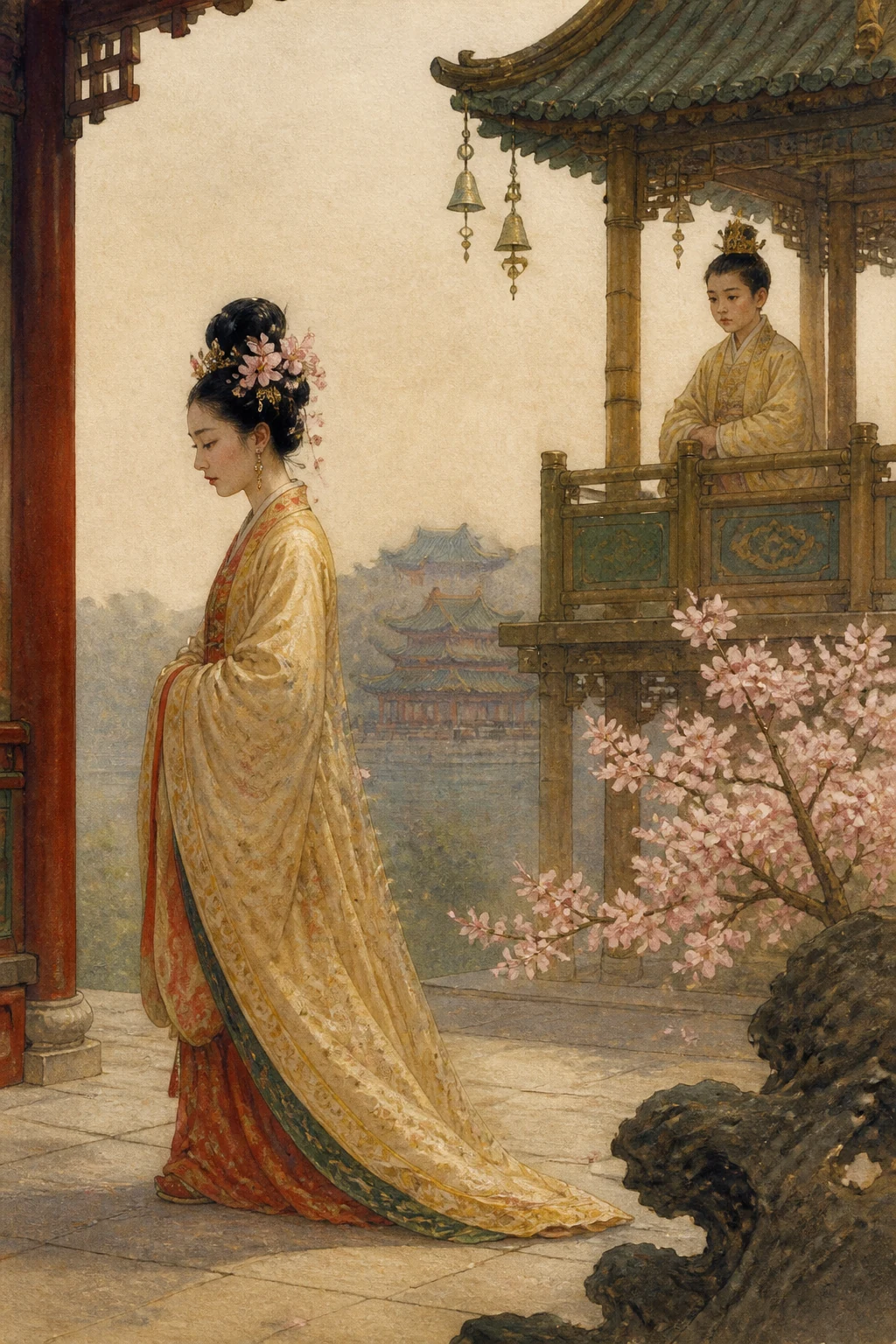
The daughter of a prince of Mingrelia, Vu was brought to Tai-Sung’s women’s quarters with twenty other noble maidens, charged with making tea and folding the emperor’s silken robes, which they stored in boxes of Eastern sandalwood. The eunuchs examined her; they satisfied themselves that her breath was sweet, her teeth even and complete, her body unblemished and graceful, and that she knew how to trace the intricate characters of the alphabet with a brush, strum the guitar, and recite from memory the teachings of the woman of letters Pan-hoei-pan, which command a woman to be no more than an echo and a shadow in her own home. Once assured that Vu deserved the honor of diverting the glorious sovereign, they dressed her in embroidered fabrics, perfumed her with civet, scattered cherry blossoms through her black hair, arranged in elaborate, gleaming coils, and presented her to Tai-Sung. He scarcely glanced at her; lofty designs, heroic plans, and wise maxims occupied his mind. He was preparing the instructions he would give the crown prince Kao-Sung, among which was this counsel: “Rule yourself and master your passions.” And the crown prince—leaning out over the little balcony of a bamboo pavilion adorned with enamel plaques, whose scaly roof was fringed with little silver bells—saw his father’s new slave pass by and coveted her with a reckless passion.
A month later, the emperor drank a cup of tea served by Vu, and, dissolved in the golden infusion, a powerful dose of opium offered the mortal man eternal rest. After the solemn burial of the illustrious warrior and lawgiver, Kao-Sung repudiated his lawful wives, the empresses of the West and the East, and seated Vu beside him on the throne, bestowing upon her the new and unheard-of title of Heavenly Queen.
Never had so grave and scandalous a deed been committed. Filial piety is the Chinese virtue above all others, and Confucius says in the Y-King, or Book of Books, that the father is to the son what the sun is to the world. But the days when the authority of the law outweighed respect for the monarch were past, and no one dared utter a word. Only one man of letters—in that country, men of letters spoke for the public conscience—had the courage to announce to Kao-Sung that the Spirits, or shades of his ancestors, would avenge the offense; for which the scholar was painstakingly cut into ten thousand little pieces, a punishment reserved for the gravest offenders.
No doubt the Spirits wished to vindicate the scholar, for Kao-Sung soon died, consumed by the fire in his veins, by desperate, frenzied love. His son Shun-Sung succeeded him; but a few days later the empress had him seized in his bed and carried by palanquin to a frontier fortress, one of those defending the Great Wall. Then, seizing the throne, she gave free rein to her boundless pride. She ordered an immense palace built, and there assembled an innumerable household, which included dancing girls, athletes, astrologers, highly skilled archers, and Tartar grooms of exceptional ability. Every night the gardens were illuminated with thousands of little lanterns, and boats decked with flags, shaped like dragons or swans, filled with musicians and with tables laid for banqueting, glided over the ponds and lakes; in the most sumptuous of these vessels, the empress, surrounded by her court, abandoned herself to the frenzy of the orgy. She even indulged the whim of creating a lake of red wine and watching the courtiers, already drunk, bathe in it. Amid her extravagant life, Vu thought of enlarging her empire, and veteran generals won brilliant victories for her armies. The men of letters, unwilling to be sawn apart or cut into ten thousand pieces, sang the glory of the exalted Vu, and the whole empire, prostrate at her almost invisible feet, paid her homage in fear, for her proscriptions had set many an illustrious head swaying at the end of a bent bamboo pole.
Anyone would have thought that Vu, amid such splendid triumph, envied no one on earth. And yet, after three years on the throne, she showed unmistakable signs of weariness and even melancholy, so that the palace physicians and astrologers did not know which saint to turn to, for the empress, shut away in her apartments, refused to see anyone, and there were even days when she refused all food. A thousand stories circulated about the empress’s incomprehensible affliction—for no one could suspect that Vu, ambitious, capricious Vu, was hopelessly in love with a young bonze, a priest of Fo (whom in India they call the Buddha).
Not all the wisdom of the great Confucius and Lao-Seu, the philosopher of the white eyebrows, could have explained the secret cause of the empress’s love and suffering. Just as the statuesque sons of Korea, or Kaolin (the land whose clay the Spirit used to fashion the first man), the men of the Indian Himalayas, with their dark gazelle eyes and golden skin, the blue-eyed Siberians, and the Kirghiz mountaineers of proud bearing had reclined upon the silken cushions of her private chamber, nothing could have been easier for the Heavenly Empress than to seize the young bonze Hoay and shut him up there, amid gardens of flowering dwarf shrubs that invited languor. But that was not what Vu desired. She had seen the bonze while she was fishing for brightly colored fish in a little pond. As she pulled in her line and drew out a silvery carp with crimson fins, the Buddhist, who was passing with downcast eyes, had raised his voice and exclaimed sternly: “Woman, why do you hurt living, harmless creatures? If you wish to sate your cruelty, drive the hook into me.” And from that moment, Vu saw constantly before her the grave face, the intense, fiery gaze, the ascetic figure of the bonze Hoay; and for his sake, no living creature was harmed in the immense palace. Vu ate candied fruit and boiled vegetables, and the birds nested peacefully in the overlapping eaves of the pleasure pavilions.
One day, in despair, feeling that sorrow was consuming her to the very marrow of her bones, Vu had herself taken to the monastery where the bonze lived, and, throwing herself at his feet, without pride or any display of power, explained her affliction and begged him for the cure. “I shall be healed if you guide me; I shall be healed if you are beside me.” Hoay raised the Heavenly Empress from the ground and soothed her with brotherly words: “Begin,” he told her, “by raising one temple to the Light and another to Heaven... and then summon me.” Vu erected two towering temples, which exhausted her treasury; when the work was finished, she sent word to the bonze, who came and, armed with a torch, set fire to the marvelous buildings. Nothing remained of them but ashes. Then he said to the dismayed empress: “Now, woman, raise a temple higher still, higher still, within yourself, in your heart, to Heaven and to the Light... and when it is built, summon me again.” Vu did not know how to go about raising a temple within her heart; nevertheless, guided by the instinct of love—an infallible instinct—she adopted a life unlike her former one: she opened the prisons, forbade torture, lowered taxes, heard just grievances, rewarded filial piety, fostered agriculture, and established such virtue in her palace that its walls might have been made of glass. The bonze, satisfied, came to visit her every afternoon, and, peacefully holding hands, they talked of the four sublime virtues and the liberation of final blessedness. Vu was happier than she had ever been in her life.
Yet the veteran generals, the eunuchs who directed the festivities, the potbellied mandarins, and even the men of letters, envious of Hoay’s favored position, saw that no more tortures were being ordered and began to conspire. And Vu, that empress who, in the words of the historian Father Amiot, had undertaken and carried out with impunity the most extraordinary acts, the most contrary to the principles and customs of China, was taken by surprise in her pavilion and secretly strangled, in punishment for having conceived a love unlike other loves, and for having, at the prompting of that strange feeling, raised within her heart a lofty temple to Heaven and to the Light.
Izvirnik
026 El Templo
Naslednje strani prikazujejo izvirno besedilo za primerjavo.
Sucedía lo que voy á referir en los tiempos modernísimos de la China, séptimo siglo de nuestra era, reinando la emperatriz Vu. No incluyen los historiógrafos sinenses á esta dama en la lista de los soberanos, alegando que Vu era una usurpadora, ni más ni menos que la actual emperatriz, que tanto preocupa á la Europa culta.
Hija de un príncipe de Mingrelia, Vu fue llevada al gineceo de Tai-Sung con otras veinte doncellas nobles, encargadas de hacer el té y plegar, guardándolos en cajas de sándalo oriental, los ropajes de seda del emperador. La reconocieron los eunucos; se cercioraron de que tenía el aliento sano, la dentadura pareja y completa, el cuerpo puro y gentil, y sabía trazar con el pincel los caracteres complicados del alfabeto, rasguear la guitarra y recitar de memoria las enseñanzas de la literatura Pan-hoei-pan, que ordenan á la mujer ser en su casa nada más que un eco y una sombra. Seguros ya de que Vu merecía el honor de divertir al glorioso soberano, la vistieron de bordadas telas, la perfumaron con algalia, salpicaron de flores de cerezo su negra cabellera, peinada en complicadas y relucientes cocas, y la presentaron á Tai-Sung. Este apenas la miró; altos designios, planes heroicos, sabias máximas ocupaban su mente. Estaba disponiendo las instrucciones que había de dar al príncipe heredero Kao-Sung, entre las cuales figuraba este consejo: «Reina sobre ti mismo y sujeta tus pasiones.» Y el príncipe heredero--asomado al balconcillo de un pabellón de bambú que adornaban placas de esmalte y cuyo techo escamoso guarnecían campanillitas de plata,--vió pasar á la nueva esclava de su padre y la codició en su corazón de un modo insensato.
Un mes más tarde, el emperador bebía una taza de té servida por Vu, y disuelta en la rubia efusión, fuerte dosis de opio ofrecía al mortal reposo eterno. Después del solemne entierro del ilustre guerrero y legislador, Kao-Sung repudió á sus legítimas esposas, emperatrices del Poniente y del Levante, y sentó á su lado, en el trono, á Vu, dándola el título nuevo é inaudito de reina celestial.
Jamás se había cometido tan grave y escandalosa acción. La piedad filial es la virtud china por excelencia, y Confucio dice en el Y-King ó Libro de los libros que el padre es al hijo lo que el sol al mundo. Pero habían pasado los tiempos en que el prestigio de la ley podía más que el respeto al Monarca, y nadie se atrevió á chistar. Solamente un literato--en aquel país los literatos llevaban la voz de la conciencia pública--tuvo valor para anunciar á Kao-Sung que los Espíritus ó manes de los antepasados tomarían venganza de la ofensa; por lo cual el literato fue esmeradamente cortado en diez mil pedacitos, suplicio que se reserva á los grandes culpables.
Sin duda los Espíritus quisieron dejar bien al literato, pues Kao-Sung murió pronto, consumido por el incendio de sus venas, por el amor desesperado y loco. Sucedíale su hijo Shun-Sung; pero á los pocos días la emperatriz le hizo sorprender en su lecho y trasladar en palanquín á una fortaleza fronteriza, de las que defendían la Gran Muralla. Y apoderándose del trono, dió rienda suelta á su soberbia infinita. Mandó construir un palacio desmesurado, y en él reunió servidumbre innumerable, entre la cual había bailarinas, atletas, astrólogos, arqueros muy diestros y palafreneros tártaros de suma habilidad. Todas las noches los jardines se iluminaban con millares de farolillos, y barcas empavesadas, de figura de dragones ó cisnes, llenas de músicos, con mesas dispuestas para el banquete, recorrían los estanques y lagos; en la más suntuosa de las embarcaciones, la emperatriz, rodeada de su corte, se entregaba á los delirios de la orgía. Hasta tuvo el capricho de hacer un lago de vino rojo y ver cómo se bañaban en él, ebrios ya, los cortesanos. En medio de su desatinada vida, Vu pensaba en agrandar su Imperio, y veteranos generales consiguieron para sus armas brillantes victorias. Los literatos, no queriendo ser aserrados ó cortados en diez mil trozos, cantaban la gloria de la excelsa Vu, y el Imperio entero, postrado á sus casi invisibles pies, la reverenciaba acobardado, pues las proscripciones habían hecho oscilar, al extremo de un bambú corvo, muchas y muy ilustres cabezas.
Cualquiera pensaría que Vu, en tal esplendor de triunfo, no envidiaba á nadie en la tierra. Y sin embargo, á los tres años de reinar, dió marcadas señales de cansancio y hasta de melancolía, por lo cual los médicos y astrólogos de palacio no sabían á qué santo encomendarse, pues la Emperatriz, encerrada en sus habitaciones, se negaba á ver á nadie, y hasta hubo días en que rehusaba el alimento. Mil versiones corrían acerca del padecimiento incomprensible de la Emperatriz,--y es que nadie podía sospechar que Vu, la ambiciosa, la caprichosa, estaba perdidamente enamorada de un joven bonzo, sacerdote de Fo (á quien en la India llaman el Buda).
Ni toda la ciencia del gran Confucio y de Lao-Seu, el filósofo de las blancas cejas, alcanzaría á explicar la secreta razón del enamoramiento y del sufrimiento de la Emperatriz. Así como se habían reclinado en los cojines de seda de su gabinete los esculturales hijos de Corea ó Kaolín (la tierra cuyo barro sirvió al Espíritu para modelar al primer hombre), los indianos del Himalaya, de negros ojos de gacela y dorada piel; los siberianos, de azules pupilas, y los montañeses Kirguizos, de arrogante apostura, nada más fácil para la celeste Emperatriz que prender al joven bonzo Hoay y encerrarle allí, entre jardines de arbustos enanos en flor, que convidan á la molicie. Mas no era eso lo que Vu deseaba. Había visto al bonzo en ocasión de hallarse ella pescando en un estanquito peces de colores. Al tirar de la cuerda y sacar un plateado ciprino de aletas de carmín, el budista, que pasaba con los ojos bajos, había alzado la voz, exclamando severamente: «Mujer, ¿por qué haces daño á los seres vivos é inofensivos? Si quieres saciar tu crueldad, clávame el anzuelo á mí.» Y desde aquel instante, Vu veía siempre el grave rostro, la mirada intensa, de fuego, la figura penitente del bonzo Hoay; y en memoria suya, á ningún sér viviente se hacía mal en el inmenso palacio. Vu comía frutas confitadas, legumbres cocidas, y las aves anidaban pacíficamente en el imbricado reborde de los pabellones de recreo.
Un día, ya desesperada, sintiendo que la tristeza la consumía hasta la médula de los huesos, Vu se hizo conducir al monasterio donde habitaba el bonzo, y arrojándose á sus pies, sin orgullo ni alarde de poderío, le explicó su mal y le pidió el remedio. «Yo sanaré si tú me guías; yo sanaré si tú estás á mi lado.» Hoay levantó del suelo á la Emperatriz celeste, y con palabras fraternales la calmó: «Empieza--la dijo--por elevar un templo á la Luz y otro al Cielo..., y después llámame.» Vu erigió dos templos altísimos, que agotaron su tesoro; terminadas las obras, avisó al bonzo, el cual acudió, y, armado de una antorcha, incendió los maravillosos edificios. No quedó de ellos más que ceniza. Después dijo á la consternada Emperatriz: «Ahora, mujer, eleva un templo más alto, más alto, dentro de ti, en tu corazón, al Cielo y á la Luz... y cuando esté erigido vuélveme á llamar.» Vu ignoraba cómo arreglárselas para elevar un templo dentro de su corazón; no obstante, por instinto del querer--instinto infalible,--adoptó vida distinta de la anterior: abrió las prisiones, prohibió los suplicios, rebajó los impuestos, oyó las quejas justas, dió premios á la piedad filial, amparó la agricultura, y en su palacio estableció tal moralidad, que podrían ser de vidrio las paredes. El bonzo, satisfecho, venía á visitarla todas las tardes, y cogidos de las manos, apaciblemente, conversaban sobre las cuatro virtudes sublimes y la liberación de la bienaventuranza final. Vu era dichosa como en su vida lo había sido.
Sin embargo, los veteranos generales, los eunucos directores de las fiestas, los panzudos mandarines y hasta los literatos, envidiosos de la privanza de Hoay, al ver que ya no se ordenaban suplicios, conspiraron. Y Vu, aquella Emperatriz que (según el dicho del historiador Padre Amiot) emprendió y ejecutó impunemente las cosas más extraordinarias y más opuestas al criterio y costumbres de la China, fue sorprendida en su pabellón y secretamente estrangulada, en castigo de haber concebido un amor diferente de otros amores, y de haber, á impulsos de ese extraño sentimiento, elevado en su corazón un templo muy alto al Cielo y á la Luz.
Nadaljuj z branjem