O besedilu
Golobica
- Vir
- Pentameron
- Avtor
- Giambattista Basile
- Jezik branja
- English
- Jezik izvirnika
- Neapolitan
- Čas branja
- 21 min branja
- Obseg
- 17 strani
- Naslov izvirnika
- Jornata II VII LA PALOMMA
O izvirniku
Pentameron
Baročna, divja starejša plast evropske pravljice, polna obratov in pretiravanj. Bralni jezik je English, izvirnik pa prihaja iz vira Pentameron v jeziku Neapolitan.
Besedilo
Golobica
_A prince, cursed by an old woman, suffers great hardships, made still worse by an ogress’s curse. In the end, through the ingenuity of the ogress’s daughter, he escapes every danger, and the two are married._ _When Antonella’s tale had reached its clattering conclusion, and everyone had loudly praised its beauty, charm, and excellent lesson for an honorable daughter, Ciulla, whose turn it was to follow, began in this fashion._ Whoever is born a prince should not behave like a scoundrel. A great man must not set a bad example to his inferiors, for the little ass learns to eat straw from the big one. No wonder, then, if Heaven sends such men trouble by the bushel, as happened to a prince who, by ill-treating a poor woman, brought such misfortunes upon himself that he very nearly lost his life.
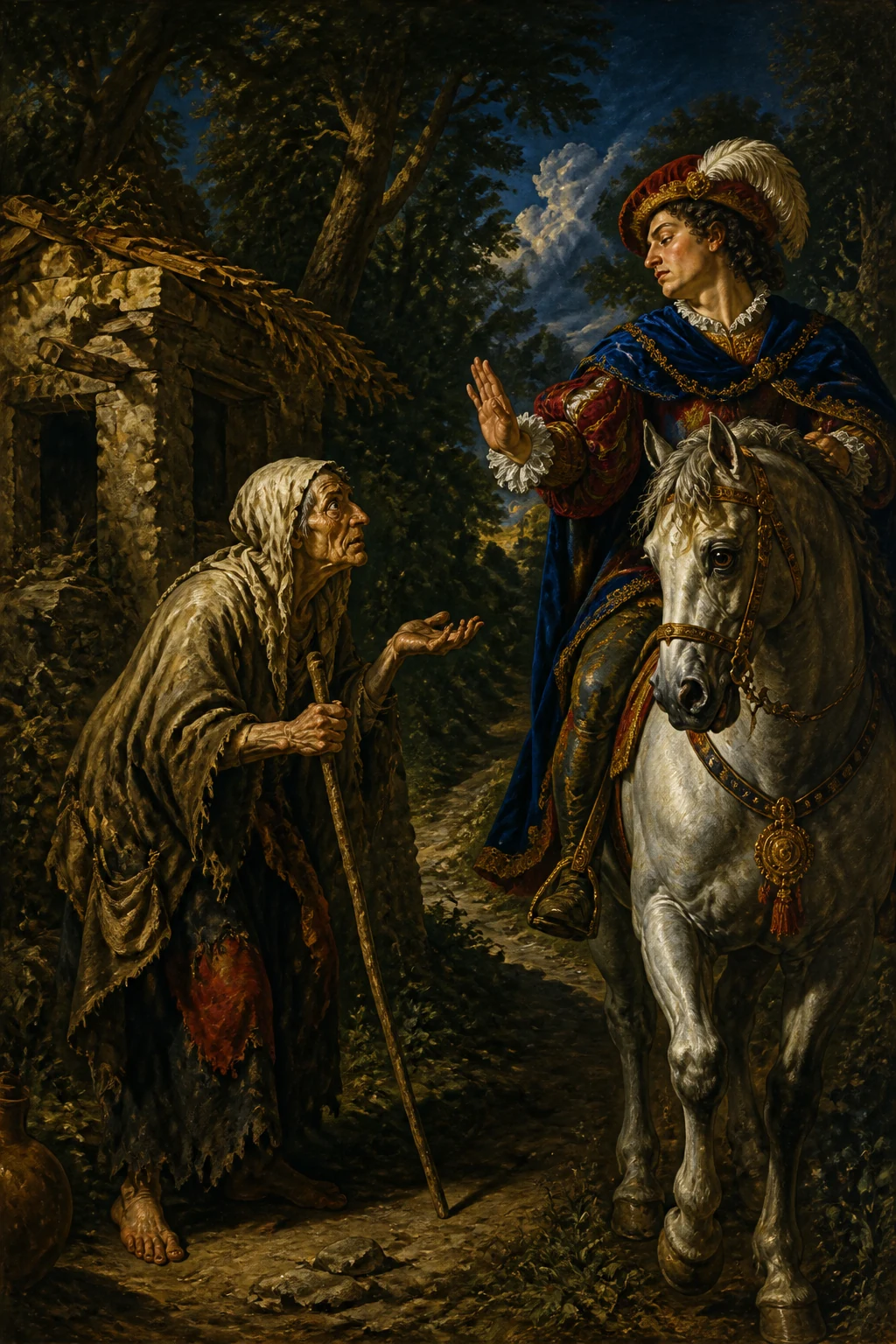
Once upon a time, eight miles from Naples, toward Astruni, there was a wood of fig trees and poplars so dense that the arrows of the sun could not pierce it. Within it stood a little half-ruined house, inhabited by an old woman as poor in teeth as she was rich in years, as high in the hump as she was low in fortune. She had a hundred wrinkles on her face, but not a wrinkle in her purse; and though her head was laden with silver, she could not find a single coin, even of the kind worth a hundred and twenty to the carlino, to revive her spirits. So she went begging among the cottages round about to keep herself alive. But since nowadays people would sooner give a purse of copper coins to some greedy informer than three farthings to a needy pauper, she toiled through a whole harvest before obtaining enough beans for a meal, though food was so plentiful in that country that they almost measured it with the doors shut to keep it from spilling out. Yet an old kettle gets dents or holes, God sends flies to a lean horse, and everyone takes an axe to a fallen tree. The poor old woman, having gone out and cleaned her beans, put them into a pot, set it outside the window, and went to gather a few sticks in the wood to cook them;
but while she was away, Nard’Aniello, the king’s son, passed the house on his way to hunt. Seeing the pot on the little windowsill, he felt an itch to play a fine prank, and laid a wager with his servants as to who could take the truest aim and strike it squarely with a stone. They began bombarding the innocent pot, and at the third or fourth shot the prince hit it dead center and finished it off. The old woman returned just after they had left, and when she discovered this bitter disaster she began cursing furiously, crying, “Let him stretch out his arm and boast of himself, that Foggia ram who has butted my pot!
“That son of a cow, who has broken the very trough for his own flesh! That thick-skinned clodhopper, who has sown my beans out of season! Even if he had not one drop of pity for my misery, he ought to have had some regard for his own interests, instead of throwing his family’s coat of arms on the ground and trampling underfoot what belongs on his head! But let him go! On my bare knees, from the very depths of my heart, I pray Heaven that he may fall in love with an ogress’s daughter, and that she may boil him and cook him badly! May his mother-in-law give him such a drubbing that he will see himself alive and mourn himself as dead! And, caught between the daughter’s beauty and the mother’s enchantments, may he never be able to pack his bags, but remain subject, though it kill him, to that foul harpy’s torments! May she order him about at the flick of a stick and give him his bread from a crossbow, until more than four times he sighs for the beans he spilled!” The old woman’s curses sprouted wings and flew straight up to Heaven. Although the proverbs say, “A woman’s curse is sown in a backside,” and “A cursed horse has a glossy coat,” hers struck the prince so squarely on the nose that he nearly lost his hide. Not two hours later, having become separated from his followers in the wood, he met a beautiful girl gathering snails and amusing herself by singing, “Come out, come out, little horns, or your mother will give you scorn; on the roof she’ll scold you so, where the baby boys all grow.” When the prince saw this cabinet of nature’s most precious treasures appear before him, this bank holding Heaven’s richest deposits, this arsenal of Love’s most overwhelming forces, he hardly knew what had happened to him. From that round, crystalline face, the rays of her eyes struck the tinder of his heart and set it so thoroughly ablaze that it became a limekiln, where the stones of his designs were being fired to build the house of his hopes.
Filadoro—for that was the girl’s name—was not sitting there peeling medlars either. The prince was such a handsome young fellow that he pierced her heart clean through at once. Each begged mercy of the other with their eyes; and while their tongues had the pip, their glances were the trumpeters of the Vicaria, proclaiming the secrets of their souls. For a long while both stood with gravel in their throats, unable to squeeze out a single blessed word. At last the prince cleared the channel of his voice and said, “From what meadow has this flower of beauty sprung? From what heaven has this dew of grace fallen? From what mine has this treasure of loveliness been drawn? O happy groves, O fortunate woods, inhabited by such splendor, lit by these illuminations for Love’s festivities! O woods and groves, where no one cuts broom handles, gallows beams, or chamber-pot lids, but doors for the Temple of Beauty, rafters for the house of the Graces, and shafts for Love’s arrows!”
“Lower your hands, my knight,” Filadoro replied. “Spare me such an overwhelming favor! That epitaph of praise you have bestowed on me is due to your own goodness, not to any merit of mine. I am a woman who takes her own measure, and I need no one else to serve as my yardstick. But whatever I am—pretty or ugly, swarthy or fair, scarred or smooth, pockmarked or freckled, a grouper or a fairy, a little pepper or a great cucumber—I am entirely at your command. For that fine figure of yours has sliced my heart, that handsome, noble face has run me through from side to side, and I give myself to you as your little slave, chained from this moment forever.” These were not words but a trumpet call, summoning the prince to the table of amorous delights; indeed, they sounded “To horse!” and roused him to Love’s battle. Given a finger of affection, he took the whole hand, kissing the ivory grappling hook that had caught his heart;
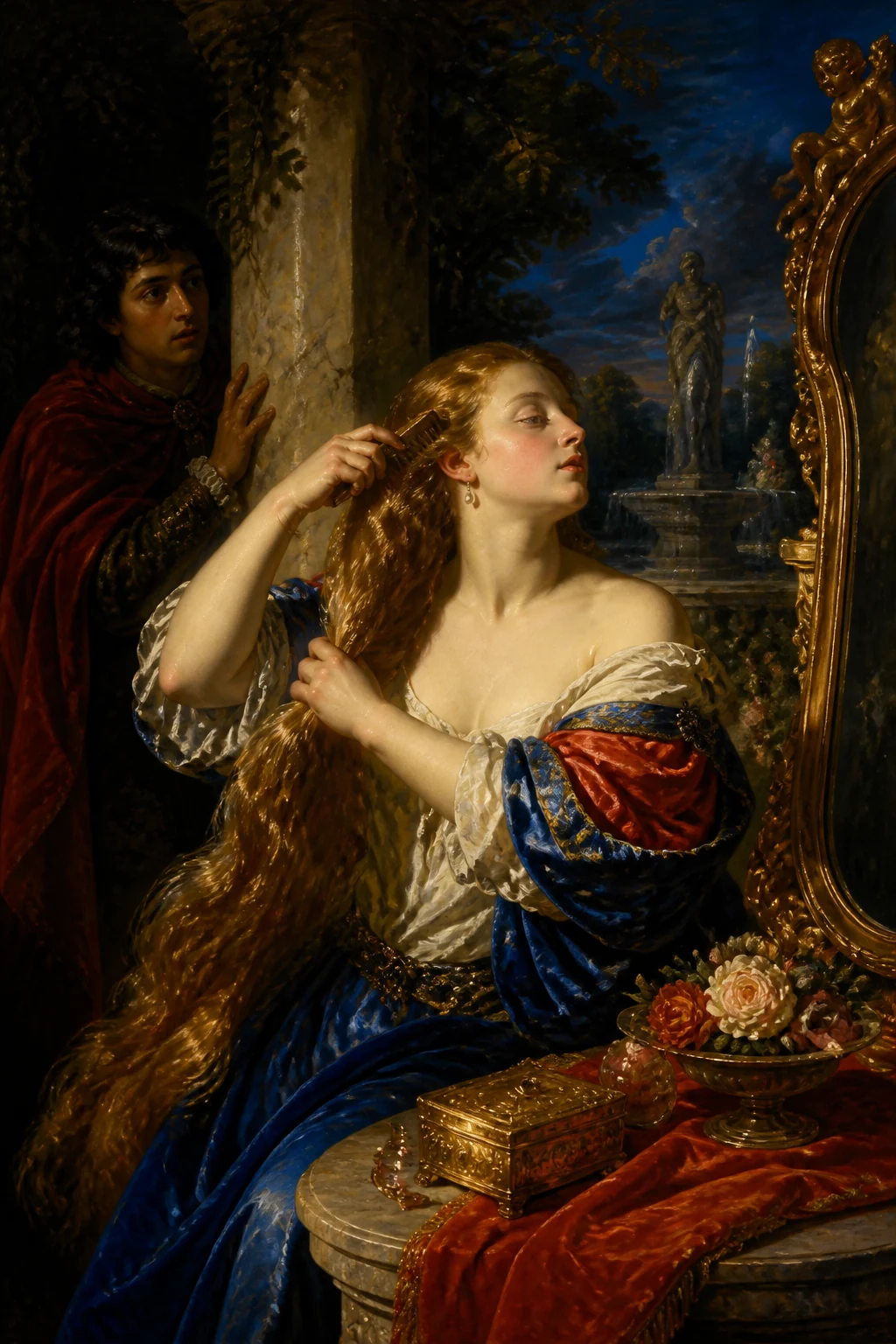
at this ceremony of the prince’s, Filadoro put on a marquis’s countenance—or rather, her face became a painter’s palette, where one could see a mixture of the red lead of shame, the cherry-red of fear, the verdigris of hope, and the vermilion of desire. But just as Nard’Aniello was about to follow up his advantage, his speech was cut short. For in this wretched life there is no wine of satisfaction without the lees of displeasure, no rich broth of contentment without the scum of misfortune. At the sweetest moment, who should suddenly appear but Filadoro’s mother, an ogress so ugly that nature had made her as a model for grotesques. Her hair was like a broom of butcher’s broom, made not to sweep soot and cobwebs from houses, but to blacken and smoke men’s hearts. Her forehead was a Genoese whetstone for sharpening the knife of fear that cut open their breasts. Her eyes were comets foretelling trembling legs, writhing hearts, convulsed spirits, fainting souls, and loosened bowels; for she carried terror in her face, fright in her gaze, panic in her footsteps, and the shits in her words. Her mouth was tusked like a pig’s, wide as a scorpion fish’s, twisted like that of a man in a fit, and slobbering like a mule’s. In short, from head to foot she was a distillation of ugliness, a hospital of deformities. The prince must surely have had some tale of Marco and Sciorella sewn into his doublet to keep him from giving up the ghost at the sight. Grabbing Nard’Aniello by the scruff, she said:
“Up with you, courtier! Here, little bird, into the iron sleeve!” “Witness that yourself!” replied the prince. “Stand back, you brute!” He tried to draw his sword, which was an old she-wolf of a blade; but he was left like a sheep that has seen the wolf, unable to move or utter a peep. So he was led by the halter like a donkey to the ogress’s house. As soon as they arrived, she said, “Mind you work like a dog unless you want to die like a pig! And for your first task, see that this acre of ground on the level of this room is dug and sown before the day is out. Keep your wits about you: if I come back this evening and find the work unfinished, I’ll swallow you!” Then, telling her daughter to look after the house, she went off to make merry with the other ogresses in the wood. Nard’Aniello, finding himself reduced to this miserable condition, began flooding his breast with tears;
he cursed the fortune that had dragged him into such a plight. Filadoro, meanwhile, comforted him, telling him to take heart, for she would shed her own blood to help him. He ought not call his fate wicked when it had brought him to a house where she loved him so tenderly; and he showed little return for her affection by despairing so over what had happened. The prince replied, “It does not trouble me to have come down from a horse to an ass, nor to have exchanged the royal palace for this hovel, sumptuous banquets for a crust of bread, a retinue of servants for drudgery, a scepter for a hoe, and the power to terrify armies for the terror of an ugly old slut. With you beside me, with the sight of you before my eyes, I would count every misfortune a blessing. But what pierces my heart is that I must dig and spit on my hands a hundred times, when I used to disdain to spit even on a comb; and, worse still, I must do so much that a pair of oxen could not manage it in a whole day. If I have not finished the business by tonight, your mother will gulp me down. Yet leaving this wretched body will torment me less than being torn from your lovely presence.” As he spoke he heaved sobs by the basketful and shed tears by the bundle. But Filadoro dried his eyes and said, “Do not imagine, my life, that you will have to cultivate any ground but Love’s garden. Never fear that my mother will touch a single hair of your head. You have Filadoro: be afraid of nothing! For, if you do not know it, I am a fairy, and I can curdle water and darken the sun.
“Enough said! So keep cheerful, for this evening the ground will be dug and sown without your striking it a single blow.” Hearing this, Nard’Aniello said, “If you are a fairy, as you say, O beauty of the world, why do we not leave this country? I will keep you like a queen in my father’s house.” Filadoro answered, “A certain little matter of the stars stands in our way; but this hindrance will soon pass, and we shall be happy.” With these and a thousand other sweet conversations, the day went by. When the ogress returned, she called to her daughter from the street, saying, “Filadoro, let down your hair!” For the house had no stairs, and she always climbed up by her daughter’s braids. Hearing her mother’s voice, Filadoro unbound her hair and lowered it, making a golden ladder for a heart of iron. As soon as the ogress had climbed up, she hurried to the garden, and finding it properly tended, was beside herself with astonishment: it seemed impossible that a delicate young man could have done such dog’s work. But next morning, scarcely had the sun come out to dry himself after his dip in the river of India, when the old woman climbed down again, leaving orders for Nard’Aniello to have six cords of wood, stored in a great chamber, split into quarters by evening. Otherwise she would chop him like bacon and make a mince of him for her supper. Hearing this decree pronounced, the poor prince nearly died of fright. Filadoro, seeing him pale and lifeless, said, “What a shit-your-breeches you are, bless the year! You would foul yourself at your own shadow!”
“And do you think it a mere trifle,” Nard’Aniello answered, “to split six cords of wood into quarters between now and tonight? Alas! I shall be split down the middle first, to fill that cursed old woman’s gullet.” “Never fear,” Filadoro replied. “Without any trouble to you, the wood will be split, and properly. But meanwhile keep cheerful, and do not split my soul with all these lamentations.”
When the sun closed his shop of rays, unwilling to sell light to the shadows, back came the old woman. Having had the usual ladder lowered, she climbed up and found the wood split. She began to suspect that her daughter was playing this checkmate upon her. So, on the third day, to make a third trial, she told the prince to clean out a cistern holding a thousand barrels of water, as she wished to fill it afresh. It must be done by evening, or she would make him into pickled meat or salted strips. As soon as the old woman had gone, Nard’Aniello began his lamentations again. Filadoro, seeing his troubles growing worse, and how the old woman treated the poor fellow like a donkey, loading him with so many woes and calamities, said, “Be quiet! The hour that held my magic captive has passed. Before the sun says, ‘I’m off to rest,’ we shall say to this house, ‘Look after yourself!’ Enough that tonight my mother will find we have cleared out. I am going with you, alive or dead.” At this news the prince, who had been ready to burst, breathed freely again. Embracing Filadoro, he said, “Are you the north star of this storm-tossed boat, my soul? Are you the prop of all my hopes?” Toward evening, Filadoro made a hole beneath the garden, where there was a great drain, and they escaped through it, heading toward Naples. But when they reached the grotto of Pozzuoli, Nard’Aniello said to Filadoro:
“My darling, it would not be fitting for you to come to my palace on foot and dressed like this. Wait for me at this inn, and I will return at once with horses, carriages, attendants, clothes, and all the other trimmings.” So Filadoro remained there, and he set off for the city. Meanwhile the ogress returned; and when Filadoro did not answer her usual calls, she grew suspicious, hurried into the wood, cut herself a long pole, and propped it against the window. Clambering up like a cat, she entered the house and searched it inside and out, upstairs and down. Finding no one, she noticed the hole, and when she saw that it led out to the street, she left not a hair on her head untorn, cursing her daughter and the prince, and praying Heaven that the first kiss her daughter’s lover received might make him forget her. But let us leave the old woman saying her savage paternosters and return to the prince. When he reached the palace, where he had been given up for dead, the whole household burst into an uproar. Everyone ran to meet him, crying, “Welcome home! Here he is at last! Safe and sound! How handsome he looks back among us!” and a thousand other affectionate things. As he went upstairs, his mother met him halfway, embraced and kissed him, saying:
“My son, my jewel, apple of my eye! Where have you been? Why have you stayed away so long and left us all half dead with worry?” The prince did not know what to answer. He would have told her his misfortunes, but scarcely had his mother kissed him with her poppy lips than, through the ogress’s curse, everything he had undergone vanished from his memory;
the queen went on to say that, to stop him going hunting and wearing out his life in the woods, she would find him a wife. “With all my heart,” the prince replied. “Here I am, ready and willing to do whatever my lady mother wishes.” “That is how dutiful sons behave,” replied the queen. They therefore agreed that in four days’ time the bride should be brought home: she was a lady of rank who had come to that city from the region of Ioannina. Great festivities and banquets were ordered. Meanwhile Filadoro, seeing that her husband was far too slow in returning, and somehow getting wind of the celebration being proclaimed everywhere, watched for the innkeeper’s boy to go to bed. That evening she took his clothes from the head of his straw mattress and, leaving her own behind, disguised herself as a man and went to the king’s court. The cooks had so much to do that they needed help and took her on as a kitchen boy. On the appointed morning, when the sun displays upon the counter of the sky the privileges granted him by nature, sealed with light, and sells his secret remedies for clearing the sight, the bride arrived to the sound of pipes and cornets. The tables were laid, and everyone sat down. As the dishes poured forth, the carver cut into a great English pie that Filadoro had made with her own hands. Out flew a dove so beautiful that the guests forgot to chew and stared at this lovely creature in amazement. In a plaintive voice it said, “Have you eaten cat’s brains, Prince, that you have utterly forgotten Filadoro’s love?
“Have the services she did you slipped so completely from your memory, you thankless man? Is this how you repay her kindness, you ingrate—her rescue of you from the ogress’s claws, her gift to you of your life and of herself? Is this the great reward you offer that unhappy girl for the tender love she showed you? Tell her to turn around and be off! Tell her to pick this bone until the roast comes! O wretched woman who lets herself be filled too full with men’s words! They always bring ingratitude with their promises, thanklessness for benefits, and forgetfulness for debts. The poor girl imagined she was to share a wedding cake with you, and now she finds herself left to divide the leftovers. She thought you would cling fast to her, and now you are running for your life. She hoped to drink a glass with you, and now she has smashed the chamber pot. Go on, never mind, you debt-denying face! The curses that poor unhappy girl sends from the depths of her heart will strike you squarely. You will learn what it means to deceive a young girl, make a fool of a maiden, and cheat a poor innocent with this pretty little trick: putting her on the back of the page while she kept you deep inside her heart; thrusting her beneath your backside while she set you above her head; and, while she did you so many services, keeping her where they administer enemas! But unless Heaven has blindfolded itself, unless the gods have plugged their ears with bungs, they will see the wrong you have done her. When you least expect it, you will get the vigil and the feast, the lightning and the thunder, the fever and the flux! Enough: attend to your dinner, enjoy yourself, splash out, and triumph with your new bride. Poor Filadoro will spin her thread fine, and leave you a clear field to enjoy your new wife.”
With these words the dove darted out through the windows and was carried away by the wind. Hearing this dovish rebuke, the prince remained stupefied for a while. At last he asked where the pie had come from, and the carver told him that it had been made by a kitchen boy hired to help with the feast. The prince had the boy brought before him. Filadoro threw herself at Nard’Aniello’s feet and, weeping a torrent of tears, could say nothing but, “What have I done to you?” Through the power of Filadoro’s beauty and the virtue of her enchantment, the prince now remembered the bond he had entered into with her before Love’s tribunal. At once he raised her up and seated her beside him, telling his mother how greatly he was indebted to this beautiful girl, all she had done for him, and the promise he had given her, which she must therefore forgive him for keeping. His mother, who had no treasure but this son, said:
“Do whatever pleases you, provided the honor and wishes of this young lady whom you have chosen for your wife are respected.” “Do not trouble yourselves about that,” replied the bride. “To tell you the plain truth, I was unwilling to remain in this country. But since Heaven has turned matters to my advantage, with your gracious permission I shall go back to my own Ioannina, rather than discover the dregs at the bottom of the cups they serve in Naples. Thinking to light a proper lamp, I very nearly put out the lantern of my life!” With great joy the prince offered her a ship and an escort. Then he had Filadoro dressed as a princess, and when the tables were cleared, the musicians struck up and the dancing began, lasting until evening. When the earth had put on mourning for the sun’s funeral, torches were brought, and suddenly a great jingling of bells was heard upon the stairs. The prince said to his mother, “This must be some fine masquerade to honor the festivities. Upon my word, the gentlemen of Naples are most obliging: when the occasion calls for it, they spare neither the cooked nor the raw!” While they were making these conjectures, an ugly masked figure appeared in the middle of the hall, no more than three spans tall but broader than a barrel. Coming before the prince, it said, “Know, Nard’Aniello, that your whims and wicked behavior brought upon you all the misfortunes you have suffered. I am the ghost of the old woman whose pot you broke; I died of hunger on a privy. I cursed you to fall into the clutches of an ogress, and my prayers were heard. But through the power of this beautiful fairy you escaped that short measure, and received another curse from the ogress: that at the first kiss anyone gave you, you should forget Filadoro. Your mother kissed you, and she vanished from your mind. Now I curse you again: in remembrance of the wrong you did me, may you always have before you the beans you spilled, and may the proverb come true that whoever sows beans reaps horns!” Having said this, she vanished like quicksilver, without leaving so much as a wisp of smoke. The fairy, seeing the prince turn pale at these words, encouraged him, saying, “Never fear, my husband! Scat and away, let no spell hold sway! I shall pull you out of the fire.” So, when the festivities were over, they went to bed; and to confirm the deed of their newly pledged faith, she had two witnesses set their hands to it. Their past troubles made their present pleasures all the sweeter, proving in the crucible of worldly events that _He who stumbles but does not fall_ _Has made some progress after all._
Izvirnik
Jornata II VII LA PALOMMA
Naslednje strani prikazujejo izvirno besedilo za primerjavo.
_No Prencepe pe na jastemma datale da na vecchia corze gran travaglio, lo quale se fece cchiù ppeo pe la mmardezzione de n’Orca: a la fine pe nnustria de la figlia de l’Orca passa tutte li pericole, e se accasano ’nsiemme._ _Arrivate a lo rumme, e busse sto cunto d’Antonella, che fu a biva voce laudato pe bello, e graziuso, e de granne assempio pe na figlia nnorata, Ciulla, a chi veneva la beneficiata d’asseconnare, cossì decette._ Chi nasce da Prencepe, non deve fare cose de verrillo. L’ommo granne non deve dare male asempio a li cchiù basce, che dall’Aseno cchiù gruosso mpara de mangiare la paglia lo picciolo: che non è maraviglia po se lo Cielo le manna li travaglie a ttommola, comme soccesse a no
Prencepe, ch’appe li cruosche, danno desgusto a na poverella, che nne fu vecino a perdere malamente la vita. Era na vota lontano otto miglia da Napole vierzo l’Astrune no vosco de fico, e de chiuppe, dove ’mborzavano le ssajette de lo Sole, che non lo potevano sperciare, dinto a lo quale nc’era na casarella meza scarropata, che nce abetava na vecchia, la quale era tanto sbriscia de diente, quanto carreca d’anne, cossì auta de scartiello comme vascia de fortuna. Aveva ciento crespe a la facce, ma era totalemente screspata, che si be aveva la capo carreca d’argiento, non se trovava uno de ciento vinte a ccarrino de sorzetarese lo spirito, tanto che ghieva cercanno, pe le ppagliare de lo contuorno quarche lemmosena pe mmantenere la vita. Ma perchè a lo tiempo d’oje se darria cchiù priesto
na vorza de tornise a no spione magna magna, che treccalle a no povero abbesognuso; stentaje tutta na scogna pe avere na cocenata de fasule, a ttiempo che ce n’era tanta grassa a chille paise, che poco case non se ne chiudono le ttommola; ma perchè a caudaro viecchio, vrogniolo, o pertose, e a ccavallo magro Dio manna mosche, e ad arvolo caduto accetta accetta, sciuta la negra Vecchia, e annettate li fasule, e schiaffatole dinto a na pignata, la mese fora la fenestra, ed essa jette a buscare quatto sproccola a lo vosco pe se le ccocenare; ma fra sto tiempo, che ghiette, e benette, passaje da chella casa Nard’Aniello, lo figlio de lo Rrè, che ghieva a ccaccia, lo quale visto la pignata a lo fenestriello, le venne golio de fare no bello
cuorpo, e ffacette ’nguaggio co li serveture suoje, a chi cecanno cchiù dderitto, le cogliesse mmiezo co na savorra; e commenzanno a berzagliare chella pignata ’nnozente, a le ttre, o quatto pantosche, lo Prencepe ’nzertanno a ppilo, nne fece la festa. Jonze la Vecchia a ttiempo, che s’erano partute, e ttrovato st’amaro desastro, commenzaje a fare cose ’mmardette: gridanno; di che se stira lo vraccio, e che se ne vaga vantanno lo caparrone de Foggia ch’ave tozzato co sta Pignata: lo figlio de vacca, c’ha rotta la fossa de la carne soja, lo Villano cotecone, c’ha semmenato contra stagione li fasule mieje; e puro si non ave avuto na stizza de compassione de le mmiserie meje, deveva avere quarche respetto a lo ’nteresse proprio, e non ghiettare ’nterra l’arme
de la casata soja; ne fare ire pe li piede le ccose, che se teneno ’ncoppa la capo: ma va, che prego lo Cielo a ddenocchie scoperte, co le bisciole de lo core, che se pozza nnammorare de la figlia de quarche Orca, che lo faccia vollere, e mmale cocere; la Sogra nce ne dia tanto pe le ccegne, che se vea vivo, e se chiagna muorto, e che trovannose mpastorato e da le bellezze de la figlia, e da li percante de la mamma, non se ne pozza cogliere maje le bertole, ma stia, anche nne crepa, soggetto a li strazie de chella brutt’arpia; la quale l’aggia da commannare li servizie a bacchetta, e le dia lo ppane co la valesta, tanto, che cchiù de quatto vote venga a sospirare li fasule, che m’ha jettato. Mesero le mmardezzione de ssa Vecchia l’ascelle,
che sagliettero subeto ’n cielo, tanto, che se bè se sole dicere pe proverbio; jastemma de femmena pe cculo se semmena, ed a cavallo jastemmato luce lo pilo: tanta vote deze a lo naso de lo Prencepe, che nce appe a llassare lo cuoiro, che non passaro doje ora, che stanno dinto a lo vosco sperduto da le gente soje, scontraje na bella fegliola, che ghieva cogliendo maruzze, e pigliannose gusto, deceva, jesce jesce corna, ca mammata te scorna, te scorna, ncoppa l’astreco, che fa lo figlio mascolo. Lo Prencepe, che se vedde comparere nnante sso screttorio de le ccose cchiù preziose de la natura, sto banco de li cchiù rricche deposete de lo Cielo, st’arzenale de le cchiù spotestate forze d’ammore, non sapeva, che l’era socciesso, e da chella facce
tonna de cristallo trapassanno li ragge dell’uocchie a l’esca de lo core sujo, allommaje tutto de manera, che deventaje na carcara, dove se cocevano le pprete de li designe pe ffravecare la casa de le speranze. Filadoro (che cossì se chiammava la giovane) non monnava nespole, che ped’essere lo Prencepe bravo mostaccio de giovane, le sperciaje subeto da parte a pparte lo core; tanto che l’uno all’autro cercava meserecordia coll’uocchie, e dove le llengue lloro avevano la pepitola, li sguarde erano trommette de la Vicaria, che spobrecavano lo secreto dell’arma, e stato no buono piezzo ll’uno, e ll’autro co l’arenella a lo cannarone, che non poteva schizzare na parola mmardetta, all’utemo lo Prencepe, spilato lo connutto de la voce, cossì le disse: Da
quale prato è sguigliato sto sciore de bellezza: da quale cielo è cchioppeta sta rosata de grazia? da qual minera è benuto sto tresoro de bellezzetudene cose. O serve felice, o vuosche fortunate, abetate da sto sfuorgio, allustrate da sta lommenaria de le ffeste d’ammore, o vuosche, e serve, dove non se tagliano mazze de scope, travierze de forca, nè ccopierchie de cantaro, ma porte de lo Tempio de la bellezza, trave de la casa de le grazie, e aste da fare le ffrezze d’ammore.
Vascia sse mmano, Cavaliere mio, respose Filadoro, non tanta desgrazia, ca so le bertute voste, no li mierete mieje, sto spetaffio de laude, che m’avite dato; ca io so ffemmena che mme mesuro, nè boglio che autro mme serva de meza canna, ma tale quale songo, o bella, o brutta, o nnizzola, o janca, o sfrisata, o chiantuta, o proveceta, o pecosa, o cernia, o fata, o pipatella, o votracone, io songo tutta a lo commanno vuostro, pocca sso bello taglio d’ommo m’ha fellato lo core, ssa bella cera de Conte m’ha passato dall’uno all’autro canto, e mme te dò pe schiavottella ncatenata da mò pe ssempre. Non foro parole cheste, ma sonata de trommetta, che chiammaje lo Prencepe tutte a tavola de li contiente ammoruse, anze le scetaje co no tutte a cavallo a la
vattaglia d’ammore; e bedennose dato no dito d’amorosanza, se pigliaje la mano, vasanno la vorpara d’avolio che l’aveva ncroccato lo core: Filadoro a sta zeremonia de lo Prencepe, fece na facce de Marchese, anze fece na facce de tavolozza de pettore; dove se vedde na mmesca de minio de vergogna, de ceraso de paura, de verderammo de speranze, e de cenabro de desedderio: ma tanno voleva Nard’Aniello asseconnare, quanno le fu zoccato lo ddire, perchè a sta negra vita non c’è vino de sfazione senza feccia de desgusto, non c’è bruodo grasso de contento, senza scumma de desgrazia, che mentre stava a lo mmeglio, eccote de vrocca la mamma de Filadoro, la quale era n’Orca accossì brutta, che la fece la natura pe lo modiello de li scurce. Aveva li capille comme
a na scopa de vrusco, non già ped’annettare le ccase de folinie, e ragnatele, ma pe annegrecare, ed affommare li core: la fronte era de preta de Genova, pe dare lo taglio a lo cortiello de la paura, che sbennegnava li piette; l’uocchie erano Comete, che predecavano tremmolicce de gamme, vermenare de core, jajo de spirete, filatorie d’arme, e cacarelle de cuorpo; pocca portava lo terrore ne la facce, lo spaviento ne l’occhiatura, lo schianto de li passe, la cacavessa ne le pparole. Era la vocca sannuta comm’a ppuorco, granne comm’a scorfano, steva comm’a che patute de descenzo, vavosa comm’a mmulo, ’nsomma da la capo a lo pede vedive no destellato de bruttezza, no spetale de struppie: tanto che lo Prencepe deveva cierto portare quarche storia
de Marco, e Sciorella cosuta a lo jeppone, che no spiritaje a sta vista: la quale dato de mano a lo cozzetto de Nard’Aniello, disse: auza la corte, auciello auciello, maneca de fierro: testemmonia vostra, respose lo Prencepe: arreto canaglia, e boze mettere mano a la spata, ch’era na lopa vecchia, ma restaje comm’a na pecora, quanno ha visto lo lupo, che non se potte movere, nè pipitare, de manera che fu carriato comm’aseno pe ccapezza a la casa de ll’Orca, la quale subito che fu arrevata, le disse: Attienne buono a ffaticare, comm’a no cane, si non vuoje morire comm’a no puorco; e pe lo primmo servizio, fa che pe tutt’oje sia zappato, e semmenato sto muojo de terreno nchiano de sta cammara; e stà ’n cellevriello, ca si torno sta sera, e non
truovo fornuto lo lavore, io mme te gliotto; e ditto a la figlia, che attennesse a la casa, se nne jette a scommersazione co l’autre Orche dinto a lo vosco. Nard’Aniello, che se vedde arreddutto a sto male termene, accommenzaje ad allavaniarese lo pietto de chianto: mmardecenno la fortuna soja, che l’aveva strascenato a sto male passe. Filadoro dall’autra parte lo consolava, decennole, che stesse de buon’armo, ca essa ’nce averria puosto lo proprio sango pe l’ajutare, e che non deveva chiammare marvasa la sciorta, che l’aveva connutto a cchella casa, dove era cossì sbisciolatamente da essa amato, e che mostrava poco scagno a l’amore sujo, mentre stava accossì desperato de sto socciesso: a la quale responnette lo Prencepe. Non me spiace
l’essere sciso da lo cavallo all’aseno, ne l’avere cagnato lo Palazzo Riale co sto cafuorchio, li banchette vannute co no tuozzo de pane, lo cortiggio de serveture co sservire a staglio, lo scettro co na zappa, lo ffare atterrire l’aserzete, co bedereme atterruto da na brutta cajorda, perchè tutte le desgrazie meje stimarria a bentura co starece tu presente, e schiuderete co st’occhie: ma chello, che mme spercia lo core, e che aggio da zappare, e sputareme ciento vote la mmano, dove sdegnava de sputarme na petinia, e cot-pejo, aggio da fare tanto, che non ce vastarria tutto no juorno no paro de vuoje, e si no scompo sta sera lo fattofesta, sarraggio cannariato da mammata, e io non tanto averraggio tormento de scrastareme da sto nigro cuorpo, quanto de
scantoniareme da ssa bella perzona. Cossì decenno jettava li selluzze a ccuofano, e le llagreme a botta fascio: ma Filadoro asciucannole l’uocchie le disse: non credere vita mia, ch’agge da lavorare autro terretorio, che l’uorto d’ammore, non dubetare che mammama te tocche no pilo schitto de ssa perzona, agge Filadoro, e non dubetare, ca si no lo ssaje, io so ffatata, e pozzo quagliare l’acqua, e scurare lo Sole: vasta, e zuffece: perzò stamme allegramente, ca stasera se trovarrà zappato, e semmenato lo terreno senza che nce dinghe no cuorpo.
Sentenno chesto Nard’Aniello, disse si tu si ffatata (comme dice) o bellezza de lo munno, perchè non ce ne sfrattammo da sto pajese, ca te voglio tenere comme na Reggina a la casa de patremo; e Filadoro rispose: na certa chelleta de stelle sconceca sto juoco: ma passarà fra poco sto ’nfruscio, e starrimmo felice. Tra chiste, e mmille autre duce raggionamiente, passaje lo juorno, e benenno l’Orca de fora, chiammaje da la strada la figlia, decenno; Filadoro cala sti capille, perchè essenno, senza scala la casa, sempre se nne saglieva pe le trezze de la figlia; e Filadoro sentuto la voce de la mamma, guastannose la capo, calaje li capille, facenno scala d’oro a no core de fierro, che ssubeto sagliuta ’ncoppa, corze all’uorto, e trovatolo covernato, restaje fora
de li panne, parennole ’mpossibele, che no giovane dellecato avesse fatto sta fatica de cane; ma non fu cossì priesto l’autra matina sciuto lo Sole a sciauriarese pe ll’ummeto pigliato a lo sciummo dell’Innia, che la vecchia tornaje a scenneresenne, lassanno ditto a Nard’Aniello, che le facesse trovare la sera spaccate seje canne de legna a quatto pe ppiezzo, ch’erano dinto a no cammarone, si non l’averria adacciato comm’a llardo, e fattone un piccatiglio de colazione; e la sera lo nigro Prencepe sentuto sta ’ntimazione de decreto, appe a mmorire spantecato; e Filadoro vedennolo muorto, e spalleto, le disse; comme si ccacasotta, ben aggia aguanno, tu te cacarrisse de ll’ombra toja.
E che te pare cosa de no lippolo (respose Nard’Aniello) spaccare seje canne de legna quatto pe ppiezzo da ccà a sta sera? ohimè! ca ’nnanze sarraggio spaccato da miezzo a mmiezzo pe ’nchire lo cannarone de sta negra vecchia. Non dubetare, leprecaje Filadoro, ca senza pigliarete fatica, le llegne se trovaranno spaccate, e bone; ma fra sto miezzo stamme de bona voglia, e no mme spaccare st’arma co ttante lamiente; ma comme lo Sole chiuse la poteca de li ragge pe non vennere luce all’ombra, eccote tornare la vecchia, e ffatto calare la soleta scala, se nne sagliette, e ttrovato spaccate le llegna, trasette ’n sospetto de la figlia, che non le desse sto schiacco matto, e lo terzo juorno pe ffare la terza prova, le disse, che l’avesse annettato na cesterna de
mille vutte d’acqua: perchè la voleva ’nchire de nuovo, e fosse fatto pe la sera, autramente n’averria fatto scapace, o mesesca. Partuta la vecchia, Nard’Aniello commenzaje de nuovo a fare lo trivolo, e Filadoro vedenno ca le ddoglie jevano ’ncauzanno, e che la vecchia aveva dell’aseno a ccarrecare sto pover’ommo de tante guaje, e catalaje, le disse, stà zitto, ch’essenno passato lo punto, che sequestrava l’arte mia, nnante che lo Sole dica m’arrequaquilio, nuje volimmo dire a sta casa, covernamette; vasta ca sta sera mammama trovarrà sfrattato lo pajese; e io voglio veniremenne co ttico o viva, o morta. Lo Prencepe sentenno sta nova, spaporaje, ch’era adesa crepato, e abbraccianno Filadoro, le disse: Tu si la tramontana de sta travagliata varca,
arma mia? tu si la pontella de le speranze meje. Ora essenno verzo la sera, fatto Filadoro no pertuso pe ssotta l’uorto dov’era no gran connutto, se ne scettero fora toccanno a la vota de Napole. Ma comme foro arrivate a la grotta de Pozzulo, disse Nard’Aniello a Filadoro. Bene mio, non convene de farete venire a lo Palazzo mio a ppede, e bestuta de sta manera, perzò aspetta a sta Taverna, ca torno subeto co ccavalle, carrozze, gente, e bestite, e d’autre fruscole. Cossì restanno Filadoro, isso s’abbiaje a la vota de la Cetate; e ttornanno fra sto miezzo l’Orca da fore, nè responnenno Filadoro a le solete chiammate, trasuta ’n sospetto, corze a lo vosco, e fatto no gran pertecone, l’appojaje a la fenestra, ed arrampinatase comm’a gatta,
sagliette a la casa, la quale cercata tutta dinto, e ffore ’ncoppa, e abbascio, nè ttrovato nesciuno, s’addonaje de lo pertuso, e bisto ca jeva a sboccare a la chiazza, non se lassaje zervola sana, jastemmanno la figlia, e lo Prencepe, e ppreganno lo Cielo, che lo primmo vaso, che recevesse lo ’nnammorato sujo, se scordasse d’essa. Ma lassammo la vecchia dire paternuostre sarvateche, e ttornammo a lo Prencepe, che arrivato a lo palazzo, dove se teneva pe mmuorto, mese a remmore la casa tutta, corrennole ’ncontra, e decennole a la bon’ora, sinche lo buono arrivato: eccolo a ssarvamiento; comme nce pare bello a sti paise, e mmille autre parole d’ammore: ma sagliuto ad auto, e scontratolo a mezza scala la mamma, l’abbracciaje, e basaje decennole:
Figlio mio, giojello mio, popella dell’uocchie mieje, e ddove si stato, comm’aje tardato tanto pe ffarece tutte stennerire? lo Prencepe non sapeva, che responnere, perchè averria contato le ddesgrazie soje, ma non tanto priesto co le lavra de papagne l’appe vasato la mamma, che pe la jastemma dell’Orca le scette de mammoria quanto aveva passato; ma leprecanno la Regina, che pe levarele st’accasione de ire a caccia, e conzomare la vita pe li vuosche l’averria nzorato. Sia co la bonora (le respose lo Prencepe) eccome prunto, e pparato a fare tutto chello, che bole mamma gnora mia. Cossì fanno li figlie beneditte (leprecaje la Reggina) e cossì appontato fra quattro juorne de portarene la Zita a la casa, la quale era na signora de ciappa, che da le pparte de
Sciannena era capetata a chella Cetate. Ordenaro addonca gran festa, e banchette; ma fra sto miezo vedenno Filadoro ca lo marito tricava troppo, e fiscannole non saccio comme l’aurecchie de sta festa, che se jeva spubrecanno pe ttutto, abbistanno lo garzone de lo tavernaro, ch’era corcato la sera, le levaje li vestite da capo lo saccone, e lassate l’abete suoje stravestutase da ommo, se ne venne a la Corte de lo Rrè, dove li cuoche tanto ch’avevano de fare, besognannole ajuto, lo pigliaro pe guattaro, e benuto la matina de ll’appontamiento, quanno lo sole sopra lo banco de lo cielo mostra li privilegie fattele da la natura, sigillate de luce, e benne secrete de schiarire la vista, venne la Zita a suono de ciaramelle, e ccornette; e apparecchiato le ttavole,
e puostose a ssedere, mentre scioccavano le bivanne, tagliato lo scarco na grossa mpanata ngrese, ch’aveva fatto de mano soja Filadoro, nne scette na palomma accossì bella, che li commitate scordannose de mazzecare, se mesero spantecate a mmirare sta bellezza cosa; la quale co na voce pietosa le disse: Aje magnato cellevriello de gatta o Prencepe, che te si scordato nnitto nfatto l’affrezione de Filadoro?
Cossì t’è sciuto de mammoria li servizie recevute, o scannoscente? Cossì paghe li beneficie, che t’ha fatto, o sgrato, l’averete levato da le granfe dell’Orca, l’averete dato la vita, e se stessa; e chesta è la gran merzè che daje a chella sfortunata figlia de lo sbisciolato ammore, che t’ha mostrato? dì, che se dia na vota, e levase; di che spolleche st’uosso, fichè bene l’arrusto; o negra chella femmena, che troppo se ’mprena de parole d’uommene, che portano sempre co le pparole la sgratetudene, co li beneficie la scanoscenza, e co li debete lo scordamiento. Ecco la scura se ’mmagenava de fare la pizza dinto a lo donato co ttico, e mo se vede pazziare a sparte casatiello; credeva de fare co ttico serra serra, e mo tu faje sarva sarva. Penzava de potere
rompere no bicchiere co ttico, e mo ha rrutto lo cantaro; va non te curare, facce de nega debete, ca te coglieno pe deritto le ghiastemme de tutto core, che te manna chella negrecata; tu t’addonarraje quanto mporta mpapocchiare na peccerella, coffiare na figliola, nzavagliare na povera ’nnocente, facennole sto bello trucco mucco, portannola folio a tergo, mentre te portava intus vero; mettendola sotta a la codola, mentre te metteva sopra la capo; e mentre essa te faceva tanta servetù, tenerela dove se faceno li serviziale: ma si lo Cielo non s’ha posta la pezza all’uocchie, si li Deje non s’hanno chiavato lo mafaro all’aurecchie, vederanno lo tuorto, che l’aje fatto, e quanno manco te cride, te venerrà la vigilia, e la festa, lo lampo, e lo truono,
la freve, e la cacarella; vasta, attienne buono a mmagnare, datte spasso, squazza, e ttrionfa co la Zita novella; ca la scura Filadoro, filanno sottile, te lassarà campo franco da gauderete la nova mogliere. Dette ste pparole, sparaje a bolare fora de le ffenestre, che se la pigliaje lo viento. Lo Prencepe sentuto sta mbrosoliata Palommesca, restaje pe no piezzo attassato: all’utemo demmannato da dove era venuta la ’mpanata, e sentuto da lo scarco, ca l’aveva lavorata no guattaro de cocina, pegliato pe sto abbesuogno; lo Prencepe lo fece venire ’nnanze ad isso, la quale jettatose a li piede de Nard’Aniello, e facenno na lava de chianto, autro non diceva, si no, che t’aggio fatto io? lo Prencepe, che pe la forza de la bellezza de Filadoro,
e pe la vertute de la fatazione, ch’aveva se venne ad allecordare l’obbrecanza, ch’aveva stipolata a facce soja a la curia d’Ammore, subeto la facette auzare, e ssedere a canto ad isso; contanno a la mamma l’obbrego granne ch’aveva a sta bella giovane, e quanto aveva fatto ped isso, e la parola datale, che era necessario, che l’avesse compatuta. La Mamma, che n’aveva autro bene, che sto figlio, le disse: fa chello, che te piace, puro che ’nce sia lo nore, e lo gusto de sta signorella, che t’aje pigliato pe mmogliere: e no ve pigliate sti fastidie, respose la Zita, ca io pe ve la dicere comme stà, restava de mala voglia a sto pajese; ma pocca lo Cielo me l’ha mannata bona, io co vostra bona lecienzia, mme ne voglio tornare a la vota de Sciannena
mia, a ttrovare li vave de li becchiere, che s’usano a Nnapole, dove penzanno d’allommare na lampa pe dderitto, s’era quase stotata la lanterna de sta vita: lo Prencepe co n’allegrezza granne l’offerze vasciello, e ccompagnia; e ffatto vestire da Prencepessa a Ffiladoro, levate, che fforo le ttavole, vennero li votta fuoche, e s’accomenzaje lo ballo, che duraje pe fi a la sera: ma essenno la terra coperta de lutto pe l’assequia de lo Sole, venettero le ’ntorce, ed ecco pe le scale se ’ntese no gran fracasso de campanelle; pe la quale cosa lo Prencepe decette a la mamma, chesta sarrà quarche bella mascarata pe nnorare la festa, affè ca li Cavaliere Napoletane so ccomprite assaje, e dove abbesogna nne frosciano lo ccuotto, e lo ccrudo; ma ’ntanto che
facevano sto jodizio, compare mmiezo la sala no brutto mascarone, che non passava tre parme d’autezza, ma era grosso cchiù de na votte, la quale arrivata ’nnante lo Prencepe, disse: Sacce, Nard’Aniello, ca li vierre, e lo mmale procedere tujo t’hanno redutto a ttante desgrazie ch’aje passato: io so ll’ombra de chella vecchia, a la quale rompiste lo pignato, che pe la famme so mmorta cessa; te jastemmaje che fusse ’ncappato a li strazie de n’Orca, e fforo esaudute li prieghe mieje; ma pe la forza de chesta bella fata scappaste da chelle rrotola scarze, ed aviste n’autra mmardizzione dall’Orca, ch’a lo primmo vaso, che te fosse dato te scordasse de Filadoro, te vasaje mammata, e essa te scette da mente; ma mò te torno a mmardicere, che pe mmemoria de lo
danno che mme faciste, te puozze trovare sempre nnante li fasule che mme jettaste, e se faccia vero lo proverbio, chi semmena fasule le nasceno corne; e ditto chesso squagliaje comm’argiento vivo, che non se ne vedde ffummo: la Fata, che bedde lo Prencepe spalleduto a ste pparole, le dette armo, decennole, non dubetare, marito mio, sciatola, e matola, s’è fattura non vaglia; ca io te caccio da lo ffuoco; e cossì decenno, e scomputa la festa, jettero a ccorcarese, e pe confermare lo stromiento fatto de la nova fede promessa, nce fece fermare duje testemmonie, e li travaglie passate fecero cchiù saporite li guste presente, vedennose a la ccopella de li socciesse de lo munno, che _Chi ntroppoca, e non cade_ _Avanza de cammino._
Nadaljuj z branjem