Prevod
When the feast was done and generous Bacchus’s gift had eased their hearts, Lyncides asked about the customs and origins of the land, and the character and spirit of its people. Abantiades asked; at once, in answer, Lyncides told him of the people’s character and spirit. When he had explained these things, he said, “Now, bravest of men, tell us, Perseus, I beg you, with what courage and what arts you severed that head with its hair of snakes.”
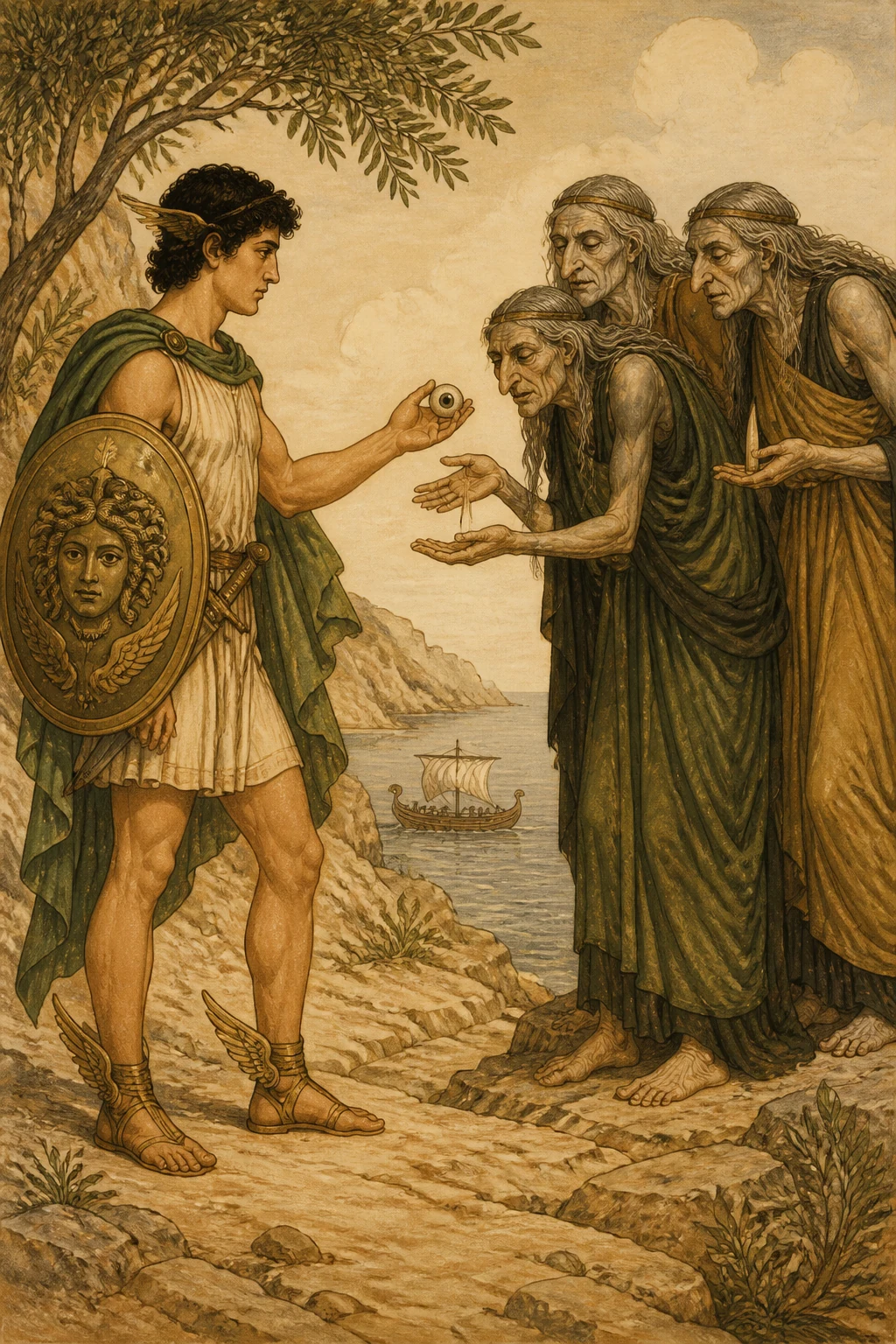
Agenorides told how beneath cold Atlas lay a place protected by a massive rocky bulwark; at its entrance lived two sisters, the daughters of Phorcys, who shared the use of a single eye. With cunning stealth, as they passed it between them, he had slipped his hand beneath and caught it; then, through remote and pathless places, over rocks bristling with tangled woods, he had reached the Gorgons’ home, and everywhere in fields and along the roads had seen the shapes of men and beasts turned from living flesh to stone at the sight of Medusa.
He himself, however, had looked upon dreadful Medusa’s form reflected in the bronze of the shield he bore on his left arm, and while deep sleep held both her and her serpents, had cut her head from her neck. He added that swift-winged Pegasus and his brother had sprung from their mother’s blood, and told of the very real dangers of his long flight, the seas and lands he had seen beneath him from on high, and the stars he had reached with beating wings.
Yet he fell silent sooner than they wished. One of the assembled nobles then asked why she alone of the sisters had worn snakes entwined among her locks. The guest replied: “Since what you ask deserves a telling, hear the reason. She was famed for her beauty, the envied hope of many suitors, and nothing about her was more glorious than her hair. I have met someone who said he had seen her.
The ruler of the sea is said to have violated her in Minerva’s temple. Jupiter’s daughter turned away and covered her chaste face with her aegis; and lest the deed go unpunished, she changed the Gorgon’s hair into hideous snakes. Even now, to strike her enemies numb with terror, she wears upon her breast the snakes she made.”
Izvirnik
Source ID: ovid_metamorphoses_story_032 Citation: Ovid, Metamorphoses 4.765-4.803 Original language: Latin Source: PerseusDL canonical-latinLit Source URL: https://github.com/PerseusDL/canonical-latinLit/blob/master/data/phi0959/phi006/phi0959.phi006.perseus-lat2.xml Segmentation certainty: medium 765: Postquam epulis functi generosi munere Bacchi 766: diffudere animos, cultusque genusque locorum 767: quaerit Lyncides moresque animumque virorum.
767: quaerit Abantiades: quaerenti protinus unus 768: narrat Lyncides moresque animumque virorum 769: Quae simul edocuit, “nunc, o fortissime,” dixit 770: “fare, precor, Perseu, quanta virtute quibusque 771: artibus abstuleris crinita draconibus ora.” 772: Narrat Agenorides gelido sub Atlante iacentem 773: esse locum solidae tutum munimine molis; 774: cuius in introitu geminas habitasse sorores 775: Phorcidas, unius partitas luminis usum.
776: Id se sollerti furtim, dum traditur, astu 777: supposita cepisse manu perque abdita longe 778: deviaque et silvis horrentia saxa fragosis 779: Gorgoneas tetigisse domos, passimque per agros 780: perque vias vidisse hominum simulacra ferarumque 781: in silicem ex ipsis visa conversa Medusa. 782: Se tamen horrendae clipei, quem laeva gerebat, 783: aere repercusso formam adspexisse Medusae, 784: dumque gravis somnus colubrasque ipsamque tenebat, 785: eripuisse caput collo; pennisque fugacem 786: Pegason et fratrem matris de sanguine natos 787: addidit et longi non falsa pericula cursus,
788: quae freta, quas terras sub se vidisset ab alto 789: et quae iactatis tetigisset sidera pennis. 790: Ante exspectatum tacuit tamen. Excipit unus 791: ex numero procerum quaerens, cur sola sororum 792: gesserit alternis inmixtos crinibus angues. 793: Hospes ait: “Quoniam scitaris digna relatu, 794: accipe quaesiti causam. Clarissima forma 795: multorumque fuit spes invidiosa procorum 796: illa: neque in tota conspectior ulla capillis 797: pars fuit. Inveni, qui se vidisse referret.
798: Hanc pelagi rector templo vitiasse Minervae 799: dicitur. Aversa est et castos aegide vultus 800: nata Iovis texit; neve hoc inpune fuisset, 801: Gorgoneum crinem turpes mutavit in hydros. 802: Nunc quoque, ut attonitos formidine terreat hostes, 803: pectore in adverso, quos fecit, sustinet angues.”