O besedilu
Perzej in Finej
- Vir
- Ovidove preobrazbe
- Avtor
- Ovid
- Jezik branja
- English
- Jezik izvirnika
- Latin
- Čas branja
- 13 min branja
- Obseg
- 10 strani
- Naslov izvirnika
- Perseus and Phineus
O izvirniku
Ovidove preobrazbe
Pesniški tok antičnih preobrazb, kjer bogovi, ljudje in narava stalno menjavajo obliko. Bralni jezik je English, izvirnik pa prihaja iz vira Ovidove preobrazbe v jeziku Latin.
Besedilo
Perzej in Finej
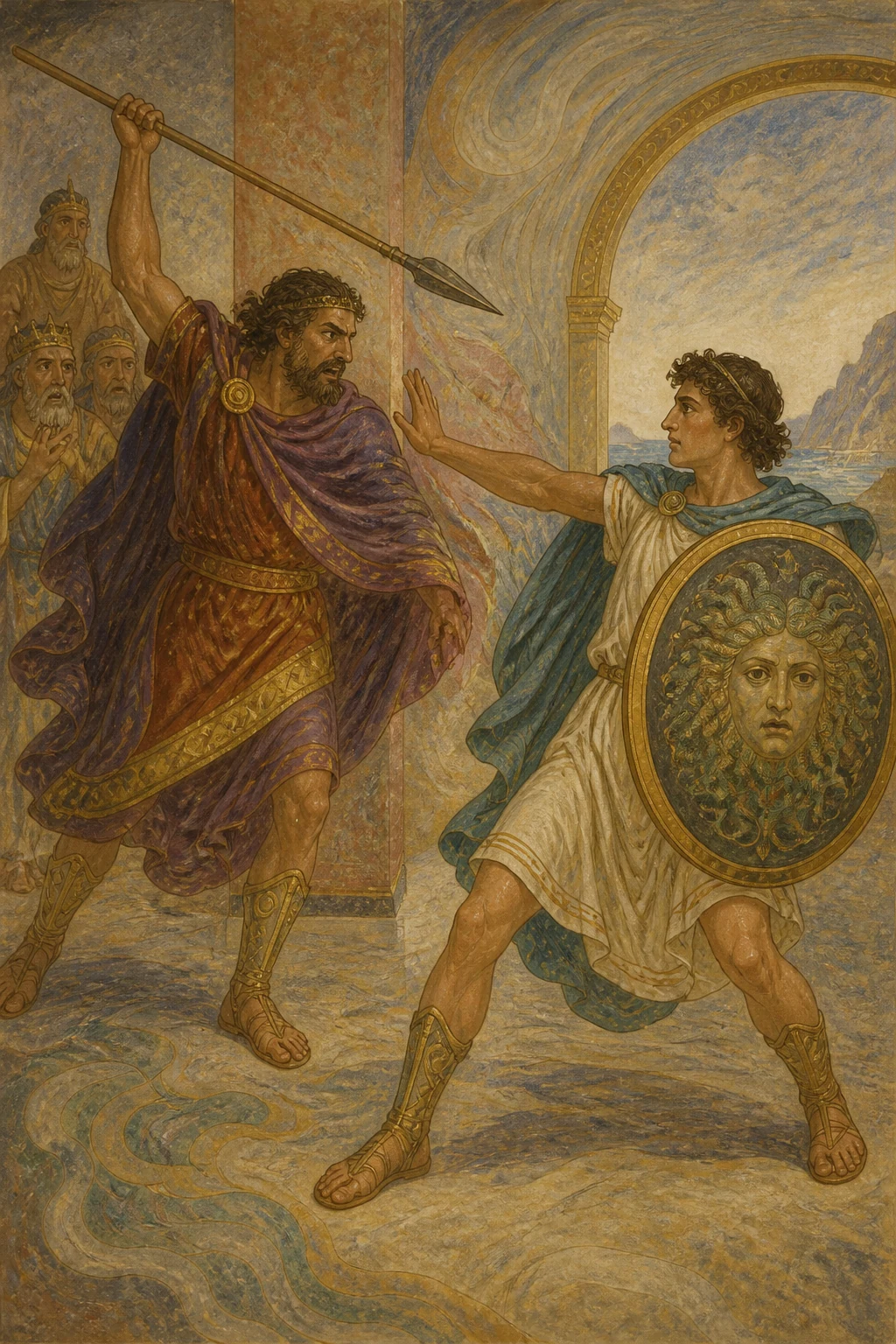
While the hero, Danaë’s son, was telling these things amid the Ethiopians, a clamorous throng filled the royal halls: no cries were these to celebrate a wedding feast, but to proclaim savage war. You might have likened the banquet, turned to sudden turmoil, to a tranquil sea whose waves are stirred and roughened by the winds’ wild fury. Foremost was Phineus, reckless instigator of the fighting, brandishing an ash spear tipped with bronze.
“Look!” he cried. “Here I stand, avenger of my stolen bride! Neither your wings nor Jupiter, transformed to counterfeit gold, shall snatch you from me.” As he prepared to throw, Cepheus cried out, “What are you doing, brother? What madness drives you to this crime? Is this your thanks for such great service? Is this the dowry you pay for her rescued life? It was not Perseus who took her from you, if you seek the truth, but the Nereids’ dreadful power, but horned Ammon, but the monster that came from the sea to gorge itself upon my flesh and blood. She was lost to you the moment she was doomed to die—unless, in your cruelty, you insist upon her death, and our grief will ease your heart.
Is it not enough that she was chained before your eyes, and you, her uncle and her promised husband, gave no help? Must you also grieve that someone rescued her, and rob him of his reward? If you think that prize so great, you should have sought it on the rocks where she was bound. Now let the man who sought it, who saved my old age from bereavement, take what his deeds have earned and my word has promised.
Understand that he was chosen not over you, but over certain death!” Phineus made no answer. His eyes moved from Cepheus to Perseus, unsure which to attack; then, after a brief pause, with all the strength his anger gave him, he hurled his spear at Perseus, but in vain. When it stuck in the couch, only then did Perseus spring from the cushions. Fiercely he hurled the weapon back, and would have pierced his enemy’s breast had Phineus not slipped behind the altar: shamefully, the altar sheltered a criminal.
Yet the spear did not fly fruitlessly: it lodged in Rhoetus’ forehead. When he had fallen and the iron was torn from the bone, he thrashed his heels and spattered the laden tables with blood. Then indeed the crowd blazed with ungovernable fury, hurling weapons; some declared that Cepheus too must die beside his son-in-law. But Cepheus had crossed the threshold and left the palace, calling justice, good faith, and the gods of hospitality to witness that this violence defied his will.
Warrior Pallas came, shielding her brother with her aegis and giving him courage. There was an Indian, Athis, whom Limnaee, a daughter of the Ganges, was believed to have borne beneath its glassy waters. His beauty was exceptional, enhanced by splendid dress; still untouched, he was only sixteen, and wore a Tyrian cloak bordered with gold. Golden necklaces adorned his neck, and a curved circlet held his myrrh-soaked hair.
He was skilled at striking distant targets with a thrown javelin, but still more skilled with the bow. Even as his hand bent its yielding horns, Perseus seized a log that lay smoking upon the altar and struck him, crushing his face into its shattered bones. When Assyrian Lycabas saw that once-admired face writhing in blood—Lycabas, his closest companion, who made no secret of his true love— he mourned for Athis, breathing out his life through that cruel wound, then seized the bow the boy had bent and said, “Now you must fight with me!
You shall not rejoice long in the boy’s death, which brings you more disgrace than glory.” Before he had finished speaking, the piercing arrow leapt from the string; but Perseus dodged it, and it hung caught in his garment’s folds. The descendant of Acrisius turned on him the curved blade already proven in Medusa’s slaughter, and drove it into his breast. Dying, his eyes swimming beneath black night, Lycabas looked about for Athis, then sank down beside him and carried to the shades the comfort of their united death.
Now Phorbas of Syene, Metion’s son, and Libyan Amphimedon, eager to join the battle, had slipped and fallen in the blood that soaked the warm earth far and wide. As they rose, the sword met them, driven through one man’s ribs and Phorbas’ throat. But against Erytus, Actor’s son, whose weapon was a broad double axe, Perseus did not use his hooked sword. Instead, with both hands he lifted a huge mixing bowl, heavy with solid metal and embossed with figures in high relief, and dashed it against the man. He spewed bright blood and fell backward, his dying head beating the ground.
Next he struck down Polydegmon, of Semiramis’ blood, and Abaris of the Caucasus, Lycetus, son of Sperchion, long-haired Helices, Phlegyas, and Clytus, and trod upon the heaped bodies of the dying. Not daring to face his enemy at close quarters, Phineus hurled a javelin. It strayed and struck Idas, who had kept clear of battle and taken neither side, in vain. Glaring fiercely at merciless Phineus, he said, “Since I am dragged into this quarrel, Phineus, face the enemy you have made, and pay wound for wound!”
He had already drawn the weapon from his flesh to throw it back when his limbs failed him, drained of blood, and he collapsed. Here too Hodites, foremost among the Ethiopians after their king, fell by Clymenus’ sword; Hypseus struck down Prothoenor, and Lynceus’ descendant struck down Hypseus. Among them was aged Emathion, a lover of justice, reverent toward the gods.
Since his years forbade him to fight, he battled with words, denouncing and cursing their impious weapons. As he clasped the altar with trembling hands, Chromis struck off his head. It fell straight upon the altar, and there its half-living tongue still uttered curses, and breathed its life out in the midst of the flames. Then the twin brothers Broteas and Ammon, unbeaten with boxing gloves—if gloves could overcome swords— fell by Phineus’ hand, as did Ampycus, priest of Ceres, whose temples were bound with a white fillet.
You too, Lampetus’ son, were summoned for no such service, but to join your voice to the lyre in the work of peace, and celebrate the feast and festival with song. Seeing him standing apart, holding his harmless plectrum, Pettalus mocked him: “Sing the rest to the shades of Styx!” And he drove his blade through his left temple. He fell, and with dying fingers touched once more the lyre’s strings: chance made a mournful song.
Fierce Lycormas would not let his death go unavenged. He tore the stout crossbar from the right-hand doorpost and smashed it into the bones at the nape of Pettalus’ neck. The man pitched forward like a slaughtered bullock. Pelates of the Cinyps tried to tear away the timbers of the left-hand doorpost too; but as he tried, Corythus of Marmarica pinned his right hand to the wood with a spear.
As he hung there, Abas pierced his side. He did not fall: his hand held fast, he hung dying from the post. Menelaus, who had joined Perseus’ side, was also slain, and Dorylas, richest in the lands of the Nasamonians— Dorylas, rich in estates: no other owned wider lands or gathered so many heaps of frankincense. A weapon struck him slantwise in the groin, a deadly place. When the man who dealt the wound, Halcyoneus of Bactria, saw him gasp out his life and roll his eyes, he said, “Of all your lands, keep this, the earth you lie upon,” and left the bloodless corpse.
The descendant of Abas avenged him, tearing the spear from the warm wound and hurling it at his killer. It entered the middle of his nose and passed through his neck, jutting out on either side. While Fortune favored his hand, he struck down Clytius and Clanis, sons of one mother, with different wounds: for the heavy ash spear, hurled by his arm, pierced both Clytius’ thighs, while Clanis bit upon a javelin.
Celadon of Mendes died; Astraeus died, born of a Palestinian mother and an uncertain father; and Aethion, once skilled at foreseeing the future (but now deceived by a false omen from a bird), and Thoactes, the king’s armor-bearer, and Agyrtes, infamous for killing his father. Yet more remained to do than had been done: all were determined to overwhelm one man, and on every side their allied ranks fought for a cause that attacked both merit and good faith.
In vain his loyal father-in-law, his new bride, and her mother took his part, filling the halls with cries. The clash of weapons and the groans of the fallen drowned them out, and Bellona drenched the household, once defiled, in floods of blood, stirring fresh fighting. Phineus and the thousand men who followed him surrounded one lone man. Missiles flew thicker than winter hail past both his sides, past his eyes and ears.
He set his shoulders against the stone of a great column, and with his back protected, facing the enemy ranks, held off their assault. On his left pressed Molpeus of Chaonia, on his right Echemmon the Nabataean. As a tiger, goaded by hunger, hears two herds lowing in separate valleys and cannot choose which to attack, eager to rush at both, so Perseus hesitated whether to strike right or left, then drove Molpeus off with a wound through the leg, content to let him flee: Echemmon gave him no time, but raged and, leaping to wound him in the neck, swung his sword with reckless force
and broke it against the edge of the column. The blade shattered, and a fragment lodged in its master’s throat. Yet that wound was not enough to kill him. As he trembled, vainly stretching out his defenseless arms, Perseus stabbed him with Mercury’s curved blade. But when he saw his courage overwhelmed by numbers, “Since you yourselves compel me,” Perseus said, “I shall seek help from an enemy. Turn away your faces, any friends who are here!” And he raised the Gorgon’s head.
“Find someone else to frighten with your marvels,” said Thescelus; and as his hand prepared to throw a deadly javelin, he froze in that pose, a marble statue. Beside him Ampyx thrust his sword at the valiant breast of Lynceus’ descendant; but in the very act his right hand stiffened and moved neither forward nor back. Then Nileus, who falsely claimed descent from the seven-mouthed Nile, and had engraved those seven streams upon his shield, some in silver, some in gold, said, “Look, Perseus, upon the source of my lineage!
You shall carry to the silent shades this great consolation for your death: that you fell to so great a man.” The last words were checked halfway through their utterance; you might think his open mouth still wished to speak, but it offered words no passage. Eryx rebuked them: “It is your cowardice, not the Gorgon’s power, that freezes you! Charge with me, and strike down this youth who wields enchanted weapons!”
He was about to charge: the earth held his feet fast, and he remained motionless flint, an armed statue. These men, however, suffered as they deserved. But there was one, Aconteus, a soldier of Perseus, who, while fighting for him, saw the Gorgon and hardened into stone. Thinking him still alive, Astyages struck him with his long sword; the blade rang with a piercing clang.
As Astyages stood astonished, he took on the same nature, and his look of wonder still remains upon his marble face. It would take too long to name the common soldiers: two hundred bodies still remained in the battle; two hundred bodies stiffened at the sight of the Gorgon. Only then did Phineus regret his unjust war. But what could he do? He saw statues in varied poses, recognized his men, called each by name and begged for help. Scarcely trusting his eyes, he touched the bodies nearest him: they were marble. He turned away, and, stretching out his hands in surrender, his arms held sideways, he pleaded, “You have won, Perseus. Remove your monster;
take away the stone-making face of your Medusa, whatever she may be—take it away, I beg you! Neither hatred nor hunger for a kingdom drove us to war: we took up arms for a bride. Your claim was better in merit, mine in being earlier. I do not begrudge my defeat. Bravest of men, grant me nothing but my life: let all the rest be yours.” As he spoke, not daring to look at the man he begged, Perseus answered, “Most cowardly Phineus, I shall grant what I can grant, a great gift to a craven— put aside your fear: no steel shall harm you.
Indeed, I shall give you a memorial that will endure forever, and you shall always be on view in my father-in-law’s house, so that my wife may console herself with the likeness of her betrothed.” He spoke, and moved Phorcys’ daughter toward the side to which Phineus had turned his frightened face. Even as he tried to turn his eyes away, his neck grew rigid, and the moisture in his eyes hardened to stone.
Yet in the marble his frightened expression remained, his pleading face, his lowered hands, his abject look. Victorious, the descendant of Abas entered his ancestral city with his wife, and, champion and avenger of his wronged grandfather, attacked Proetus: for Proetus had driven his brother away by force and seized Acrisius’ stronghold. But neither strength of arms nor the fortress he had wrongfully taken could save him from the grim eyes of the snake-haired monster.
Yet you, Polydectes, ruler of little Seriphos, were softened neither by the young man’s courage, proven through so many trials, nor by his sufferings. Harshly you persisted in implacable hatred, and your unjust anger knew no end. You even disparaged his glory, claiming that Medusa’s death was an invention. “We shall give you proof of the truth. Protect your eyes!” said Perseus, and with Medusa’s face he turned the king’s face to bloodless stone.
Izvirnik
Perseus and Phineus
Naslednje strani prikazujejo izvirno besedilo za primerjavo.
Source ID: ovid_metamorphoses_story_033 Citation: Ovid, Metamorphoses 5.1-5.249 Original language: Latin Source: PerseusDL canonical-latinLit Source URL: https://github.com/PerseusDL/canonical-latinLit/blob/master/data/phi0959/phi006/phi0959.phi006.perseus-lat2.xml Segmentation certainty: medium 1: Dumque ea Cephenum medio Danaeius heros 2: agmine commemorat, fremida regalia turba 3: atria complentur: nec coniugialia festa 4: qui canat est clamor, sed qui fera nuntiet arma.
5: Inque repentinos convivia versa tumultus 6: adsimilare freto possis, quod saeva quietum 7: ventorum rabies motis exasperat undis. 8: Primus in his Phineus, belli temerarius auctor, 9: fraxineam quatiens aeratae cuspidis hastam, 10: “en” ait, “en adsum praereptae coniugis ultor, 11: nec mihi te pennae, nec falsum versus in aurum 12: Iuppiter eripiet.” Conanti mittere Cepheus 13: “quid facis?” exclamat, “quae te, germane, furentem 14: mens agit in facinus? meritisne haec gratia tantis 15: redditur? hac vitam servatae dote rependis?
16: Quam tibi non Perseus, verum si quaeris, ademit, 17: sed grave Nereidum numen, sed corniger Ammon, 18: sed quae visceribus veniebat belua ponti 19: exsaturanda meis. Illo tibi tempore rapta est, 20: quo peritura fuit: nisi si crudelis id ipsum 21: exigis, ut pereat, luctuque levabere nostro. 22: Scilicet haud satis est, quod te spectante revincta est 23: et nullam quod opem patruus sponsusve tulisti: 24: insuper, a quoquam quod sit servata, dolebis 25: praemiaque eripies? Quae si tibi magna videntur, 26: ex illis scopulis, ubi erant adfixa, petisses.
27: Nunc sine, qui petiit, per quem haec non orba senectus, 28: ferre quod et meritis et voce est pactus, eumque 29: non tibi, sed certae praelatum intellege morti!” 30: Ille nihil contra: sed et hunc et Persea vultu 31: alterno spectans petat hunc ignorat, an illum, 32: cunctatusque brevi contortam viribus hastam, 33: quantas ira dabat, nequiquam in Persea misit.
34: Ut stetit illa toro, stratis tunc denique Perseus 35: exsiluit; teloque ferox inimica remisso 36: pectora rupisset, nisi post altaria Phineus 37: isset: et (indignum!) scelerato profuit ara. 38: Fronte tamen Rhoeti non inrita cuspis adhaesit. 39: Qui postquam cecidit ferrumque ex osse revulsum est, 40: calcitrat et positas adspergit sanguine mensas. 41: Tum vero indomitas ardescit vulgus in iras, 42: telaque coniciunt, et sunt, qui Cephea dicunt 43: cum genero debere mori. Sed limine tecti 44: exierat Cepheus, testatus iusque fidemque 45: hospitiique deos, ea se prohibente moveri.
46: Bellica Pallas adest et protegit aegide fratrem 47: datque animos. Erat Indus Athis, quem flumine Gange 48: edita Limnaee vitreis peperisse sub undis 49: creditur, egregius forma, quam divite cultu 50: augebat, bis adhuc octonis integer annis, 51: indutus chlamydem Tyriam, quam limbus obibat 52: aureus; ornabant aurata monilia collum 53: et madidos murra curvum crinale capillos.
54: Ille quidem iaculo quamvis distantia misso 55: figere doctus erat, sed tendere doctior arcus. 56: Tunc quoque lenta manu flectentem cornua Perseus 57: stipite, qui media positus fumabat in ara, 58: perculit et fractis confudit in ossibus ora. 59: Hunc ubi laudatos iactantem in sanguine vultus 60: Assyrius vidit Lycabas, iunctissimus illi 61: et comes et veri non dissimulator amoris, 62: postquam exhalantem sub acerbo vulnere vitam 63: deploravit Athin, quos ille tetenderat arcus 64: arripit et “mecum tibi sint certamina” dixit: 65: “nec longum pueri fato laetabere, quo plus
66: invidiae, quam laudis habes.” Haec omnia nondum 67: dixerat, emicuit nervo penetrabile telum 68: vitatumque tamen sinuosa veste pependit. 69: Vertit in hunc harpen spectatam caede Medusae 70: Acrisioniades adigitque in pectus: at ille 71: iam moriens, oculis sub nocte natantibus atra 72: circumspexit Athin seque acclinavit ad illum 73: et tulit ad manes iunctae solacia mortis.
74: Ecce Syenites, genitus Metione, Phorbas 75: et Libys Amphimedon, avidi committere pugnam, 76: sanguine, quo late tellus madefacta tepebat, 77: conciderant lapsi: surgentibus obstitit ensis, 78: alterius costis, iugulo Phorbantis adactus. 79: At non Actoriden Erytum, cui lata bipennis 80: telum erat, hamato Perseus petit ense, sed altis 81: exstantem signis multaeque in pondere massae 82: ingentem manibus tollit cratera duabus 83: infligitque viro; rutilum vomit ille cruorem 84: et resupinus humum moribundo vertice pulsat.
85: Inde Semiramio Polydegmona sanguine cretum 86: Caucasiumque Abarin Sperchionidenque Lycetum 87: intonsumque comas Helicen Phlegyanque Clytumque 88: sternit et exstructos morientum calcat acervos. 89: Nec Phineus ausus concurrere comminus hosti, 90: intorquet iaculum: quod detulit error in Idan, 91: expertem frustra belli et neutra arma secutum. 92: Ille tuens oculis inmitem Phinea torvis 93: “quandoquidem in partes” ait “abstrahor, accipe, Phineu, 94: quem fecisti hostem pensaque hoc vulnere vulnus”; 95: iamque remissurus tractum de vulnere telum 96: sanguine defectos cecidit conlapsus in artus.
97: Hic quoque Cephenum post regem primus Hodites 98: ense iacet Clymeni; Prothoenora percutit Hypseus, 99: Hypsea Lyncides. Fuit et grandaevus in illis 100: Emathion, aequi cultor timidusque deorum; 101: qui, quoniam prohibent anni bellare, loquendo 102: pugnat et incessit scelerataque devovet arma. 103: Huic Chromis amplexo tremulis altaria palmis 104: decutit ense caput; quod protinus incidit arae 105: atque ibi semianimi verba exsecrantia lingua 106: edidit, et medios animam exspiravit in ignes.
107: Hinc gemini fratres Broteasque et caestibus Ammon 108: invicti, vinci si possent caestibus enses, 109: Phinea cecidere manu, Cererisque sacerdos 110: Ampycus, albenti velatus tempora vitta. 111: Tu quoque, Lampetide, non hos adhibendus ad usus, 112: sed qui, pacis opus, citharam cum voce moveres, 113: iussus eras celebrare dapes festumque canendo. 114: Quem procul adstantem plectrumque imbelle tenentem 115: Pettalus inridens “Stygiis cane cetera” dixit 116: “manibus” et laevo mucronem tempore fixit.
117: Concidit et digitis morientibus ille retemptat 118: fila lyrae, casuque fuit miserabile carmen. 119: Nec sinit hunc impune ferox cecidisse Lycormas 120: raptaque de dextro robusta repagula posti 121: ossibus inlisit mediae cervicis: at ille 122: procubuit terrae mactati more iuvenci. 123: Demere temptabat laevi quoque robora postis 124: Cinyphius Pelates: temptanti dextera fixa est 125: cuspide Marmaridae Corythi lignoque cohaesit.
126: Haerenti latus hausit Abas: nec corruit ille, 127: sed retinente manum moriens e poste pependit. 128: Sternitur et Menaleus, Perseia castra secutus, 129: et Nasamoniaci Dorylas ditissimus agri, 130: dives agri Dorylas, quo non possederat alter 131: latius aut totidem tollebat turis acervos. 132: Huius in obliquo missum stetit inguine ferrum: 133: letifer ille locus. Quem postquam vulneris auctor 134: singultantem animam et versantem lumina vidit 135: Bactrius Halcyoneus “hoc, quod premis” inquit, “habeto 136: de tot agris terrae” corpusque exsangue reliquit.
137: Torquet in hunc hastam calido de vulnere raptam 138: ultor Abantiades; media quae nare recepta 139: cervice exacta est in partesque eminet ambas. 140: Dumque manum Fortuna iuvat, Clytiumque Claninque, 141: matre satos una, diverso vulnere fudit: 142: nam Clytii per utrumque gravis librata lacerto 143: fraxinus acta femur, iaculum Clanis ore momordit. 144: Occidit et Celadon Mendesius, occidit Astreus, 145: matre Palaestina, dubio genitore creatus, 146: Aethionque sagax quondam ventura videre 147: (tunc ave deceptus falsa), regisque Thoactes 148: armiger et caeso genitore infamis Agyrtes.
149: Plus tamen exhausto superest: namque omnibus unum 150: opprimere est animus, coniurata undique pugnant 151: agmina pro causa meritum impugnante fidemque: 152: hac pro parte socer frustra pius et nova coniunx 153: cum genetrice favent ululatuque atria complent. 154: Sed sonus armorum superat gemitusque cadentum, 155: pollutosque semel multo Bellona penates 156: sanguine perfundit renovataque proelia miscet.
157: Circueunt unum Phineus et mille secuti 158: Phinea: tela volant hiberna grandine plura 159: praeter utrumque latus praeterque et lumen et aures. 160: Applicat hic umeros ad magnae saxa columnae, 161: tutaque terga gerens adversaque in agmina versus 162: sustinet instantes. Instabat parte sinistra 163: Chaonius Molpeus, dextra Nabataeus Echemmon. 164: Tigris ut auditis diversa valle duorum 165: exstimulata fame mugitibus armentorum 166: nescit, utro potius ruat, et ruere ardet utroque, 167: sic dubius Perseus, dextra laevane feratur, 168: Molpea traiecti submovit vulnere cruris,
169: contentusque fuga est: neque enim dat tempus Echemmon, 170: sed furit et, cupiens saltu dare vulnera collo, 171: non circumspectis exactum viribus ensem 172: fregit, et extrema percussae parte columnae 173: lammina dissiluit dominique in gutture fixa est. 174: Non tamen ad letum causas satis illa valentes 175: plaga dedit: trepidum Perseus et inermia frustra 176: bracchia tendentem Cyllenide confodit harpe.
177: Verum ubi virtutem turbae succumbere vidit, 178: “auxilium” Perseus “quoniam sic cogitis ipsi” 179: dixit “ab hoste petam. Vultus avertite vestros, 180: siquis amicus adest!” et Gorgonis extulit ora. 181: “Quaere alium, tua quem moveant miracula” dixit 182: Thescelus; utque manu iaculum fatale parabat 183: mittere, in hoc haesit signum de marmore gestu. 184: Proximus huic Ampyx animi plenissima magni 185: pectora Lyncidae gladio petit; inque petendo 186: dextera deriguit nec citra mota nec ultra est.
187: At Nileus, qui se genitum septemplice Nilo 188: ementitus erat, clipeo quoque flumina septem 189: argento partim, partim caelaverat auro, 190: “adspice” ait, “Perseu, nostrae primordia gentis: 191: magna feres tacitas solacia mortis ad umbras, 192: a tanto cecidisse viro”: pars ultima vocis 193: in medio suppressa sono est, adapertaque velle 194: ora loqui credas, nec sunt ea pervia verbis.
195: Increpat hos “vitio” que “animi, non viribus” inquit 196: “Gorgoneis torpetis” Eryx: “incurrite mecum 197: et prosternite humi iuvenem magica arma moventem!” 198: Incursurus erat: tenuit vestigia tellus, 199: inmotusque silex armataque mansit imago. 200: Hi tamen ex merito poenas subiere; sed unus 201: miles erat Persei, pro quo dum pugnat, Aconteus, 202: Gorgone conspecta saxo concrevit oborto.
203: Quem ratus Astyages etiamnum vivere, longo 204: ense ferit: sonuit tinnitibus ensis acutis. 205: Dum stupet Astyages, naturam traxit eandem, 206: marmoreoque manet vultus mirantis in ore. 207: Nomina longa mora est media de plebe virorum 208: dicere: bis centum restabant corpora pugnae, 209: Gorgone bis centum riguerunt corpora visa. 210: Paenitet iniusti tunc denique Phinea belli.
211: Sed quid agat? simulacra videt diversa figuris 212: agnoscitque suos et nomine quemque vocatum 213: poscit opem, credensque parum sibi proxima tangit 214: corpora: marmor erant. Avertitur, atque ita supplex 215: confessasque manus obliquaque bracchia tendens, 216: “vincis” ait, “Perseu. Remove tua monstra tuaeque 217: saxificos vultus, quaecumque ea, tolle Medusae, 218: tolle, precor. Non nos odium regnique cupido 219: compulit ad bellum: pro coniuge movimus arma.
220: Causa fuit meritis melior tua, tempore nostra. 221: Non cessisse piget. Nihil, o fortissime, praeter 222: hanc animam concede mihi: tua cetera sunto.” 223: Talia dicenti neque eum, quem voce rogabat 224: respicere audenti “quod” ait, “timidissime Phineu, 225: et possum tribuisse et magnum est munus inerti, 226: (pone metum) tribuam: nullo violabere ferro. 227: Quin etiam mansura dabo monimenta per aevum, 228: inque domo soceri semper spectabere nostri, 229: ut mea se sponsi soletur imagine coniunx?”
230: Dixit et in partem Phorcynida transtulit illam, 231: ad quam se trepido Phineus obverterat ore. 232: Tunc quoque conanti sua vertere lumina cervix 233: deriguit, saxoque oculorum induruit umor. 234: Sed tamen os timidum vultusque in marmore supplex 235: submissaeque manus faciesque obnoxia mansit. 236: Victor Abantiades patrios cum coniuge muros 237: intrat et inmeriti vindex ultorque parentis 238: adgreditur Proetum: nam fratre per arma fugato 239: Acrisioneas Proetus possederat arces.
240: Sed nec ope armorum, nec, quam male ceperat, arce 241: torva colubriferi superavit lumina monstri. 242: Te tamen, o parvae rector, Polydecta, Seriphi, 243: nec iuvenis virtus per tot spectata labores 244: nec mala mollierant, sed inexorabile durus 245: exerces odium, nec iniqua finis in ira est. 246: Detrectas etiam laudem fictamque Medusae 247: arguis esse necem. “Dabimus tibi pignera veri.
248: Parcite luminibus!” Perseus ait oraque regis 249: ore Medusaeo silicem sine sanguine fecit.
Nadaljuj z branjem