O besedilu
Perzej in Meduzina glava
- Vir
- Apolodorjeva knjižnica
- Avtor
- Apolodor
- Jezik branja
- English
- Jezik izvirnika
- Ancient Greek
- Čas branja
- 14 min branja
- Obseg
- 11 strani
- Naslov izvirnika
- Book 2 chapter 4
O izvirniku
Apolodorjeva knjižnica
Strnjen zemljevid grških mitov, rodov, junakov in pošasti. Bralni jezik je English, izvirnik pa prihaja iz vira Apolodorjeva knjižnica v jeziku Ancient Greek.
Besedilo
Perzej in Meduzina glava
1. When Acrisius consulted the oracle about the birth of male children, the god told him that his daughter would bear a son who would kill him. Fearing this, Acrisius built a bronze chamber underground and kept Danae confined there. Some say that Proetus seduced her, and that this was the cause of the quarrel between the brothers. Others say that Zeus changed himself into gold and streamed through the roof into Danae’s lap, and so lay with her. When Acrisius later learned that she had given birth to Perseus, he refused to believe that Zeus had seduced her, and put his daughter and the child into a chest and cast it into the sea. The chest washed ashore on Seriphos, where Dictys took up the child and reared him.
2. Polydectes, the brother of Dictys, was king of Seriphos. He fell in love with Danae, but since Perseus was now grown to manhood, he could not lie with her. So he summoned his friends, Perseus among them, saying that he was collecting contributions toward his marriage to Hippodamia, the daughter of Oenomaus.
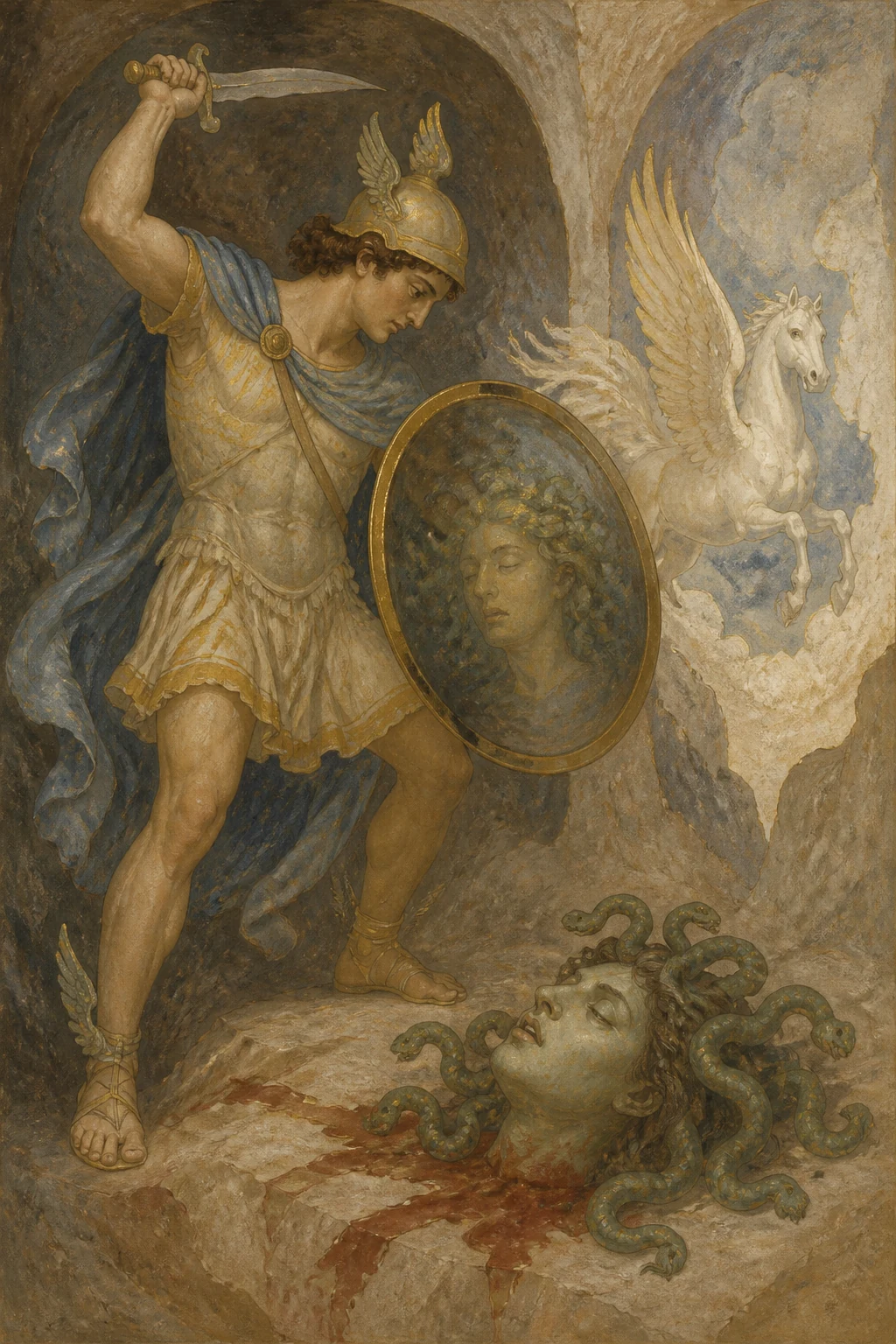
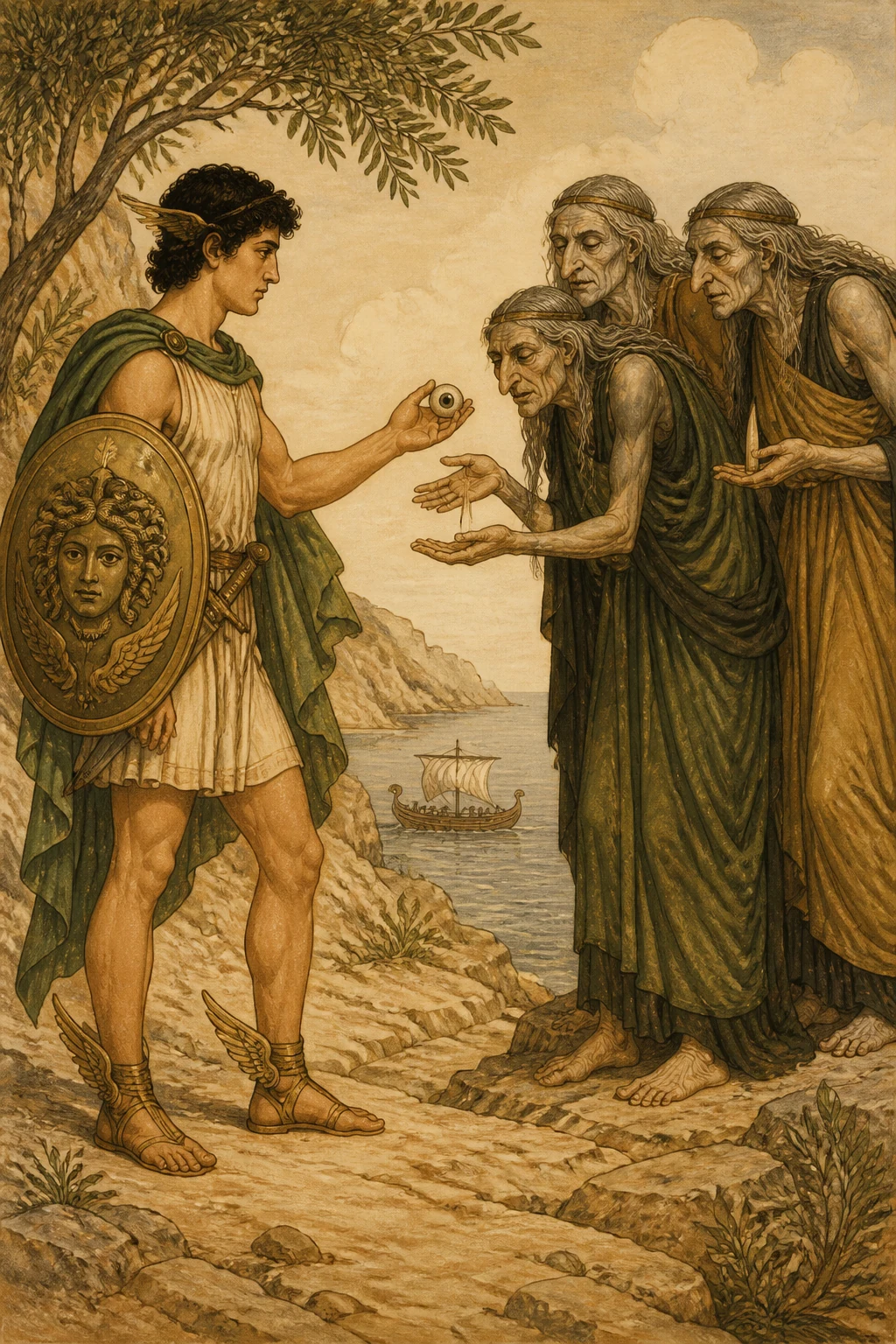
Perseus declared that he would not refuse even the Gorgon’s head. Polydectes asked the others for horses, but would not accept horses from Perseus, and ordered him instead to bring the Gorgon’s head. Guided by Hermes and Athena, Perseus went to the daughters of Phorcus: Enyo, Pephredo, and Deino. These were the daughters of Ceto and Phorcus, sisters of the Gorgons, and old women from birth. The three had only one eye and one tooth, which they passed from one to another in turn. Perseus seized these, and when they demanded them back, he said that he would return them if they showed him the way to the nymphs. These nymphs possessed winged sandals and the kibisis, which is said to be a pouch. Pindar mentions it, as does Hesiod in the Shield, speaking of Perseus: “Across his whole back lay the head of the dreadful monster, the Gorgon, and around it ran the kibisis.” Hesiod, Shield of Heracles, 223–224. It is so called because clothing and provisions are stored in it. The nymphs also possessed the cap of Hades. When the daughters of Phorcus had shown him the way, Perseus returned their tooth and eye, went to the nymphs, and obtained what he sought. He slung the pouch about him, fitted the sandals to his ankles, and put the cap on his head. Wearing it, he could see whomever he wished, but could not be seen by others. He also received an adamantine sickle from Hermes, and flew to Ocean, where he found the Gorgons asleep. They were Stheno, Euryale, and Medusa. Medusa alone was mortal, and for this reason Perseus had been sent to fetch her head. The Gorgons had heads wreathed in the scaly coils of serpents, great tusks like those of swine, bronze hands, and golden wings with which they flew. They turned those who looked upon them to stone.
Perseus stood over them as they slept. With Athena guiding his hand, he turned his face away and looked into a bronze shield, in which he could see the Gorgon’s reflection, and cut off her head. When the head was severed, Pegasus, the winged horse, sprang from the Gorgon, along with Chrysaor, the father of Geryon;
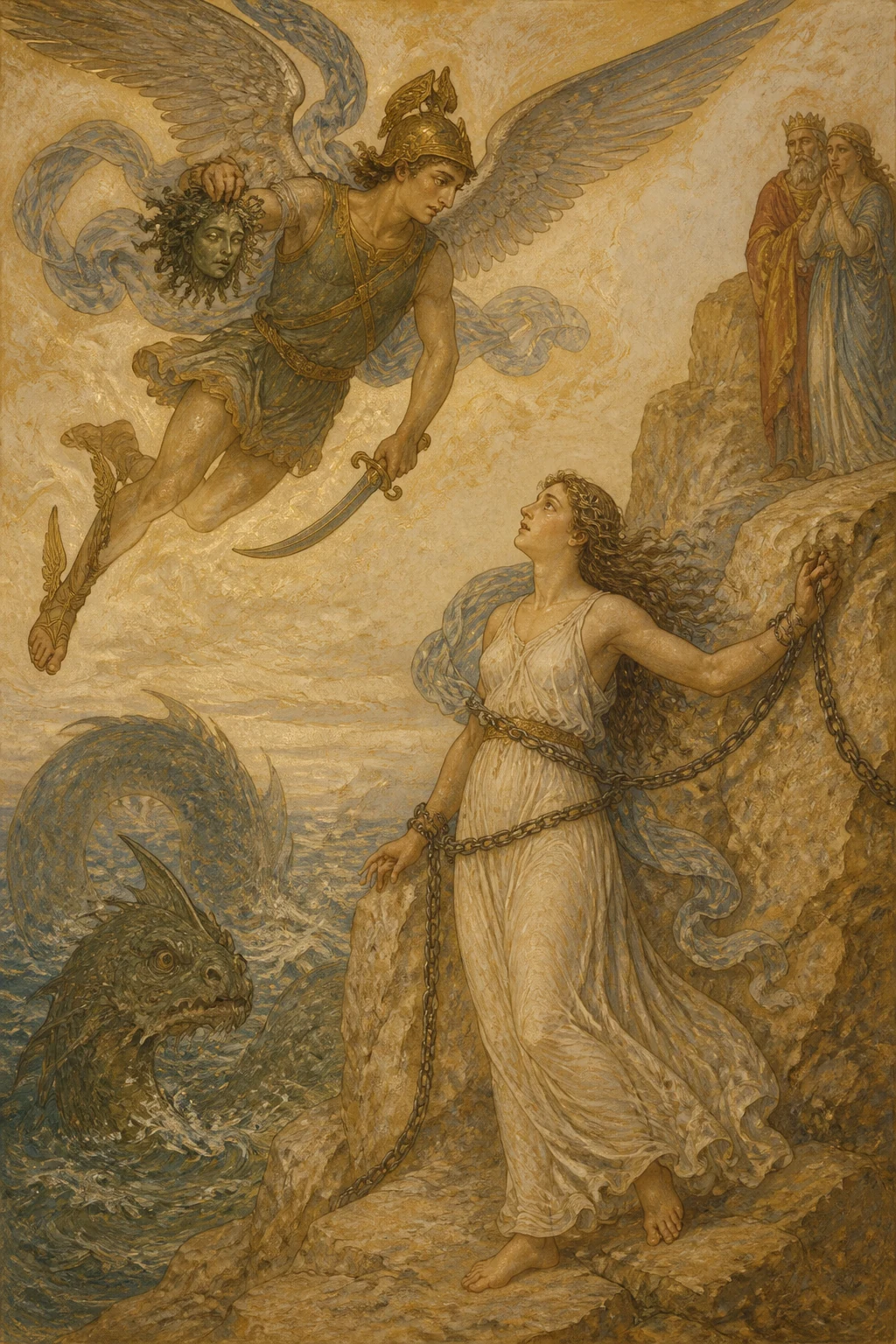
3. she had conceived them by Poseidon. Perseus put Medusa’s head into the pouch and set off on his return. The Gorgons rose from their sleep and pursued him, but could not see him because of the cap, which concealed him. On reaching Ethiopia, where Cepheus was king, he found the king’s daughter Andromeda exposed as prey for a sea monster. For Cassiopeia, the wife of Cepheus, had vied with the Nereids in beauty and boasted that she surpassed them all. The Nereids were enraged, and Poseidon, sharing their anger, sent a flood and a sea monster against the land. Ammon declared through his oracle that they would be freed from the calamity if Cassiopeia’s daughter Andromeda were exposed as prey for the monster. Compelled by the Ethiopians, Cepheus did so and bound his daughter to a rock. When Perseus saw her, he fell in love and promised Cepheus that he would kill the monster if the king would give her to him in marriage once she was saved. Oaths were sworn on these terms, and Perseus faced the monster, killed it, and freed Andromeda. But Phineus, the brother of Cepheus, to whom Andromeda had first been betrothed, plotted against him. Learning of the plot, Perseus showed him the Gorgon’s head and instantly turned him and his fellow conspirators to stone. When he reached Seriphos, he found that his mother and Dictys had taken refuge at the altars from the violence of Polydectes. He entered the palace, where Polydectes had assembled his friends, and, turning his own face away, showed them the Gorgon’s head. All who saw it were turned to stone in whatever posture they happened to be. After making Dictys king of Seriphos, he gave the sandals, pouch, and cap back to Hermes, and the Gorgon’s head to Athena. Hermes returned these objects to the nymphs, while Athena set the Gorgon’s head in the middle of her shield. Some say that Medusa was beheaded because of Athena, for they claim that the Gorgon had wished to rival her in beauty.
4. Perseus hurried to Argos with Danae and Andromeda to see Acrisius. But when Acrisius learned of this, he feared the oracle and left Argos for the land of the Pelasgians.
Teutamides, king of Larissa, was holding athletic games in honor of his dead father, and Perseus came to compete. While taking part in the pentathlon, he threw the discus and struck Acrisius on the foot, killing him instantly. Realizing that the oracle had been fulfilled, he buried Acrisius outside the city. Ashamed to return to Argos and take the inheritance of the man whose death he had caused, he went to Tiryns and exchanged kingdoms with Megapenthes, the son of Proetus, handing Argos over to him. Thus Megapenthes ruled the Argives, and Perseus ruled Tiryns, also fortifying Midea and Mycenae.
5. By Andromeda he had the following children: before he came to Greece, Perses, whom he left with Cepheus, and from whom the kings of Persia are said to descend; and in Mycenae, Alcaeus, Sthenelus, Heleius, Mestor, and Electryon, as well as a daughter, Gorgophone, whom Perieres married. Alcaeus and Astydamia, the daughter of Pelops—or, as some say, Laonome, the daughter of Guneus, or, according to others, Hipponome, the daughter of Menoeceus—had a son, Amphitryon, and a daughter, Anaxo. Mestor and Lysidice, the daughter of Pelops, had a daughter, Hippothoe. Poseidon carried her off to the Echinadian Islands and lay with her, and she bore Taphius. He founded Taphos and called its people Teleboans because he had gone far from his native land. Taphius had a son, Pterelaus. Poseidon made him immortal by placing a golden hair on his head. Pterelaus had sons: Chromius, Tyrannus, Antiochus, Chersidamas, Mestor, and Eueres. Electryon married Anaxo, the daughter of Alcaeus, and had a daughter, Alcmene, and sons: Stratobates, Gorgophonus, Phylonomus, Celaeneus, Amphimachus, Lysinomus, Cheirimachus, Anactor, and Archelaus. After these he also had an illegitimate son, Licymnius, by a Phrygian woman named Midea. Sthenelus and Nicippe, the daughter of Pelops, had Alcyone and Medusa, and later Eurystheus, who also became king of Mycenae. For when Heracles was about to be born, Zeus declared among the gods that the descendant of Perseus who was then to be born would reign over Mycenae. But Hera, out of jealousy, persuaded the Eileithyias to delay Alcmene’s delivery and arranged for Eurystheus, the son of Sthenelus, to be born at seven months.
6. While Electryon was king of Mycenae, the sons of Pterelaus came with the Taphians and laid claim to the kingdom of their maternal grandfather Mestor. When Electryon paid no heed, they drove off his cattle. Electryon’s sons fought to defend them, and in the ensuing combat they killed one another. Of Electryon’s sons, Licymnius survived because he was still young; of Pterelaus’s sons, Eueres survived because he was guarding the ships. The Taphians who escaped sailed away with the stolen cattle and entrusted them to Polyxenus, king of the Eleans. Amphitryon ransomed the cattle from Polyxenus and brought them back to Mycenae. Wishing to avenge the death of his sons, Electryon planned a campaign against the Teleboans. He entrusted his kingdom and his daughter Alcmene to Amphitryon, binding him by oath to keep her a virgin until his return. But as he was receiving the cattle back, one of them broke away, and Amphitryon hurled at it the club he held in his hand. The club glanced off its horns, struck Electryon on the head, and killed him. Seizing on this as a pretext, Sthenelus banished Amphitryon from the whole of Argos and took possession of the kingdoms of Mycenae and Tiryns himself. He summoned Atreus and Thyestes, the sons of Pelops, and entrusted Midea to them. Amphitryon went to Thebes with Alcmene and Licymnius, was purified by Creon, and gave his sister Perimede to Licymnius in marriage. Alcmene said that she would marry him when he had avenged her brothers’ death, and Amphitryon promised to do so and prepared a campaign against the Teleboans. He asked Creon to join him. Creon said that he would take part if Amphitryon first rid the land of Cadmus of the fox, for a savage fox was ravaging it. Amphitryon undertook the task, although it was fated that no one should ever catch the beast.
7. As the country was being laid waste, the Thebans exposed one citizen’s child to the fox each month, for otherwise it would carry off many. Amphitryon therefore went to Athens to see Cephalus, the son of Deioneus, and persuaded him, in return for a share of the spoils from the Teleboans, to bring to the hunt the hound that Procris had brought from Crete, having received it from Minos. This hound was destined to catch whatever it pursued. So, while the hound was chasing the fox, Zeus turned both of them to stone. With Cephalus from Thoricus in Attica, Panopeus from Phocis, Heleius the son of Perseus from Helos in Argos, and Creon from Thebes as his allies, Amphitryon ravaged the islands of the Taphians. As long as Pterelaus lived, he could not capture Taphos. But Pterelaus’s daughter Comaetho fell in love with Amphitryon and plucked the golden hair from her father’s head. Pterelaus died, and Amphitryon subdued all the islands. He killed Comaetho and sailed back to Thebes with the spoils, giving the islands to Heleius and Cephalus. They founded cities named after themselves and settled there.
8. Before Amphitryon reached Thebes, Zeus came by night, made that single night three times its normal length, and, taking the likeness of Amphitryon, lay with Alcmene and told her what had happened in the war against the Teleboans. When Amphitryon returned and saw that his wife showed him no warmth, he asked the reason. She said that he had come the night before and slept with her, and Amphitryon learned from Tiresias that Zeus had lain with her. Alcmene bore two sons: Heracles to Zeus, the elder by one night, and Iphicles to Amphitryon.
When the child was eight months old, Hera sent two enormous serpents to his bed, wishing to destroy the infant. Alcmene cried out to Amphitryon, but Heracles sat up, seized a serpent in each hand, and strangled them both. Pherecydes, however, says that Amphitryon put the serpents into the bed because he wanted to discover which of the children was his own. When Iphicles fled and Heracles stood his ground, he knew that Iphicles was his son.
9. Heracles was taught chariot-driving by Amphitryon, wrestling by Autolycus, archery by Eurytus, armed combat by Castor, and singing to the lyre by Linus. Linus was the brother of Orpheus. He came to Thebes and became a Theban citizen, but died when Heracles struck him with the lyre: Linus had reprimanded him, and Heracles killed him in anger. When some brought a charge of murder against him, he cited a law of Rhadamanthys which declared that anyone who defended himself against an unjust assault was innocent, and he was acquitted. Fearing that he might do such a thing again, Amphitryon sent him away to tend the cattle. Growing up there, he surpassed everyone in size and strength. His very appearance made it plain that he was a son of Zeus: he stood four cubits tall, and a fiery gleam shone from his eyes. He never missed his mark with either bow or javelin. While living among the herds, at the age of eighteen, he killed the lion of Cithaeron.
This lion used to come down from Cithaeron and destroy the cattle of Amphitryon and Thespius.
10. Thespius was king of Thespiae, and Heracles went to him with the intention of killing the lion. The king entertained him for fifty days, and each night gave him one of his daughters to sleep with, while he went out hunting by day. He had fifty daughters by Megamede, the daughter of Arneus, and was eager for all of them to bear children by Heracles. Heracles, believing that it was always the same daughter who slept with him, lay with them all. When he had overcome the lion, he clothed himself in its skin and used its gaping jaws as a helmet.
11. As he was returning from the hunt, he met heralds sent by Erginus to collect tribute from the Thebans. The Thebans paid Erginus tribute for the following reason. Clymenus, king of the Minyans, had been struck and wounded by a stone thrown by Perieres, the charioteer of Menoeceus, in the sacred precinct of Poseidon at Onchestus. He was carried back half-dead to Orchomenus, and as he lay dying he charged his son Erginus to avenge his death. Erginus marched against Thebes, killed many of its people, and concluded a treaty, confirmed by oaths, under which the Thebans were to send him a hundred cattle each year for twenty years. It was while these heralds were on their way to Thebes to collect this tribute that Heracles met and mutilated them. He cut off their ears and noses, bound their hands with cords and hung them from their necks, and told them to carry this tribute to Erginus and the Minyans. Outraged at this, Erginus marched against Thebes. Heracles received arms from Athena and took command of the army. He killed Erginus, routed the Minyans, and forced them to pay the Thebans twice the tribute. In the battle Amphitryon died fighting bravely. As a reward for his valor, Heracles received from Creon his eldest daughter, Megara, by whom he had three sons: Therimachus, Creontiades, and Deicoon. Creon gave his younger daughter to Iphicles, who already had a son, Iolaus, by Automedusa, the daughter of Alcathous. After Amphitryon’s death, Alcmene married Rhadamanthys, the son of Zeus, who was living in exile at Ocaleae in Boeotia. Having already learned archery from Eurytus, Heracles received a sword from Hermes, a bow from Apollo, a golden breastplate from Hephaestus, and a robe from Athena. His club he cut for himself at Nemea.
12. After the battle against the Minyans, Hera’s jealousy drove him mad, and he threw into the fire his own children by Megara, along with two of Iphicles’ children. He therefore condemned himself to exile and was purified by Thespius. Then he went to Delphi and asked the god where he should live. It was then that the Pythia first called him Heracles; until that time he had been called Alcides. She told him to live in Tiryns, serving Eurystheus for twelve years, and to perform the ten labors imposed upon him. When those labors were completed, she said, he would become immortal.
Izvirnik
Book 2 chapter 4
Naslednje strani prikazujejo izvirno besedilo za primerjavo.
Source ID: apollodorus_bib_2_4 Citation: Apollodorus, Bibliotheca 2.4 1. Ἀκρισίῳ δὲ περὶ παίδων γενέσεως ἀρρένων χρηστηριαζομένῳ ὁ θεὸς ἔφη γενέσθαι παῖδα ἐκ τῆς θυγατρός, ὃς αὐτὸν ἀποκτενεῖ. δείσας δὲ ὁ Ἀκρίσιος τοῦτο, ὑπὸ γῆν θάλαμον κατασκευάσας χάλκεον τὴν Δανάην ἐφρούρει. ταύτην μέν, ὡς ἔνιοι λέγουσιν, ἔφθειρε Προῖτος, ὅθεν αὐτοῖς καὶ ἡ στάσις ἐκινήθη· ὡς δὲ ἔνιοί φασι, Ζεὺς μεταμορφωθεὶς εἰς χρυσὸν καὶ διὰ τῆς ὀροφῆς εἰς τοὺς Δανάης εἰσρυεὶς κόλπους συνῆλθεν. αἰσθόμενος δὲ Ἀκρίσιος ὕστερον ἐξ αὐτῆς γεγεννημένον Περσέα, μὴ πιστεύσας ὑπὸ Διὸς ἐφθάρθαι, τὴν θυγατέρα μετὰ τοῦ παιδὸς εἰς λάρνακα βαλὼν ἔρριψεν εἰς θάλασσαν. προσενεχθείσης δὲ τῆς λάρνακος Σερίφῳ Δίκτυς ἄρας
ἀνέτρεφε τοῦτον. 2. βασιλεύων δὲ τῆς Σερίφου Πολυδέκτης ἀδελφὸς Δίκτυος, Δανάης ἐρασθείς, καὶ ἠνδρωμένου Περσέως μὴ δυνάμενος αὐτῇ συνελθεῖν, συνεκάλει τοὺς φίλους, μεθʼ ὧν καὶ Περσέα, λέγων ἔρανον συνάγειν ἐπὶ τοὺς Ἱπποδαμείας τῆς Οἰνομάου γάμους. τοῦ δὲ Περσέως εἰπόντος καὶ ἐπὶ τῇ κεφαλῇ τῆς Γοργόνος οὐκ ἀντερεῖν, παρὰ μὲν τῶν λοιπῶν ᾔτησεν ἵππους, παρὰ δὲ τοῦ Περσέως οὐ λαβὼν τοὺς ἵππους, ἐπέταξε τῆς Γοργόνος κομίζειν τὴν κεφαλήν. ὁ δὲ Ἑρμοῦ καὶ Ἀθηνᾶς προκαθηγουμένων ἐπὶ τὰς Φόρκου παραγίνεται θυγατέρας, Ἐνυὼ καὶ Πεφρηδὼ καὶ Δεινώ· ἦσαν δὲ αὗται Κητοῦς τε καὶ Φόρκου, Γοργόνων ἀδελφαί, γραῖαι ἐκ γενετῆς. ἕνα τε ὀφθαλμὸν αἱ τρεῖς καὶ ἕνα ὀδόντα εἶχον, καὶ ταῦτα παρὰ μέρος ἤμειβον ἀλλήλαις. ὧν
κυριεύσας ὁ Περσεύς, ὡς ἀπῄτουν, ἔφη δώσειν ἂν ὑφηγήσωνται τὴν ὁδὸν τὴν ἐπὶ τὰς νύμφας φέρουσαν. αὗται δὲ αἱ νύμφαι πτηνὰ εἶχον πέδιλα καὶ τὴν κίβισιν, ἥν φασιν εἶναι πήραν· Πίνδαρος δὲ καὶ Ἡσίοδος ἐν Ἀσπίδι ἐπὶ τοῦ Περσέως· πᾶν δὲ μετάφρενον εἶχε κάρα δεινοῖο πελώρου Γοργοῦς , ἀμφὶ δέ μιν κίβισις θέε . ηεσιοδ, σηιελδ οφ ηερξυλες, 223-4. εἴρηται δὲ παρὰ τὸ κεῖσθαι ἐκεῖ ἐσθῆτα καὶ τὴν τροφήν. εἶχον δὲ καὶ τὴν Ἄϊδος κυνῆν. ὑφηγησαμένων δὲ τῶν Φορκίδων, ἀποδοὺς τόν τε ὀδόντα καὶ τὸν ὀφθαλμὸν αὐταῖς, καὶ παραγενόμενος πρὸς τὰς νύμφας, καὶ τυχὼν ὧν ἐσπούδαζε, τὴν μὲν κίβισιν περιεβάλετο, τὰ δὲ πέδιλα τοῖς σφυροῖς προσήρμοσε, τὴν δὲ κυνῆν τῇ κεφαλῇ ἐπέθετο. ταύτην ἔχων αὐτὸς μὲν οὓς ἤθελεν ἔβλεπεν, ὑπὸ ἄλλων δὲ οὐχ ἑωρᾶτο. λαβὼν δὲ καὶ παρὰ Ἑρμοῦ
ἀδαμαντίνην ἅρπην, πετόμενος εἰς τὸν Ὠκεανὸν ἧκε καὶ κατέλαβε τὰς Γοργόνας κοιμωμένας. ἦσαν δὲ αὗται Σθενὼ Εὐρυάλη Μέδουσα. μόνη δὲ ἦν θνητὴ Μέδουσα· διὰ τοῦτο ἐπὶ τὴν ταύτης κεφαλὴν Περσεὺς ἐπέμφθη. εἶχον δὲ αἱ Γοργόνες κεφαλὰς μὲν περιεσπειραμένας φολίσι δρακόντων, ὀδόντας δὲ μεγάλους ὡς συῶν, καὶ χεῖρας χαλκᾶς, καὶ πτέρυγας χρυσᾶς, διʼ ὧν ἐπέτοντο. τοὺς δὲ ἰδόντας λίθους ἐποίουν.
ἐπιστὰς οὖν αὐταῖς ὁ Περσεὺς κοιμωμέναις, κατευθυνούσης τὴν χεῖρα Ἀθηνᾶς, ἀπεστραμμένος καὶ βλέπων εἰς ἀσπίδα χαλκῆν, διʼ ἧς τὴν εἰκόνα τῆς Γοργόνος ἔβλεπεν, ἐκαρατόμησεν αὐτήν. ἀποτμηθείσης δὲ τῆς κεφαλῆς, ἐκ τῆς Γοργόνος ἐξέθορε Πήγασος πτηνὸς ἵππος, καὶ Χρυσάωρ ὁ Γηρυόνου πατήρ· 3. τούτους δὲ ἐγέννησεν ἐκ Ποσειδῶνος. ὁ μὲν οὖν Περσεὺς ἐνθέμενος εἰς τὴν κίβισιν τὴν κεφαλὴν τῆς Μεδούσης ὀπίσω πάλιν ἐχώρει, αἱ δὲ Γοργόνες ἐκ τῆς κοίτης ἀναστᾶσαι τὸν Περσέα ἐδίωκον, καὶ συνιδεῖν αὐτὸν οὐκ ἠδύναντο διὰ τὴν κυνῆν. ἀπεκρύπτετο γὰρ ὑπʼ αὐτῆς. παραγενόμενος δὲ εἰς Αἰθιοπίαν, ἧς ἐβασίλευε Κηφεύς, εὗρε τὴν τούτου θυγατέρα Ἀνδρομέδαν παρακειμένην βορὰν θαλασσίῳ κήτει. Κασσιέπεια γὰρ ἡ Κηφέως γυνὴ Νηρηίσιν ἤρισε περὶ κάλλους, καὶ πασῶν εἶναι κρείσσων ηὔχησεν· ὅθεν αἱ Νηρηίδες
ἐμήνισαν, καὶ Ποσειδῶν αὐταῖς συνοργισθεὶς πλήμμυράν τε ἐπὶ τὴν χώραν ἔπεμψε καὶ κῆτος. Ἄμμωνος δὲ χρήσαντος τὴν ἀπαλλαγὴν τῆς συμφορᾶς, ἐὰν ἡ Κασσιεπείας θυγάτηρ Ἀνδρομέδα προτεθῇ τῷ κήτει βορά, τοῦτο ἀναγκασθεὶς ὁ Κηφεὺς ὑπὸ τῶν Αἰθιόπων ἔπραξε, καὶ προσέδησε τὴν θυγατέρα πέτρᾳ. ταύτην θεασάμενος ὁ Περσεὺς καὶ ἐρασθεὶς ἀναιρήσειν ὑπέσχετο Κηφεῖ τὸ κῆτος, εἰ μέλλει σωθεῖσαν αὐτὴν αὐτῷ δώσειν γυναῖκα. ἐπὶ τούτοις γενομένων ὅρκων, ὑποστὰς τὸ κῆτος ἔκτεινε καὶ τὴν Ἀνδρομέδαν ἔλυσεν. ἐπιβουλεύοντος δὲ αὐτῷ Φινέως, ὃς ἦν ἀδελφὸς τοῦ Κηφέως ἐγγεγυημένος πρῶτος τὴν Ἀνδρομέδαν, μαθὼν τὴν ἐπιβουλήν, τὴν Γοργόνα δείξας μετὰ τῶν συνεπιβουλευόντων αὐτὸν ἐλίθωσε παραχρῆμα. παραγενόμενος δὲ εἰς Σέριφον, καὶ καταλαβὼν προσπεφευγυῖαν τοῖς βωμοῖς μετὰ τοῦ Δίκτυος
τὴν μητέρα διὰ τὴν Πολυδέκτου βίαν, εἰσελθὼν εἰς τὰ βασίλεια, συγκαλέσαντος τοῦ Πολυδέκτου τοὺς φίλους ἀπεστραμμένος τὴν κεφαλὴν τῆς Γοργόνος ἔδειξε· τῶν δὲ ἰδόντων, ὁποῖον ἕκαστος ἔτυχε σχῆμα ἔχων, ἀπελιθώθη. καταστήσας δὲ τῆς Σερίφου Δίκτυν βασιλέα, ἀπέδωκε τὰ μὲν πέδιλα καὶ τὴν κίβισιν καὶ τὴν κυνῆν Ἑρμῇ, τὴν δὲ κεφαλὴν τῆς Γοργόνος Ἀθηνᾷ. Ἑρμῆς μὲν οὖν τὰ προειρημένα πάλιν ἀπέδωκε ταῖς νύμφαις, Ἀθηνᾶ δὲ ἐν μέσῃ τῇ ἀσπίδι τῆς Γοργόνος τὴν κεφαλὴν ἐνέθηκε. λέγεται δὲ ὑπʼ ἐνίων ὅτι διʼ Ἀθηνᾶν ἡ Μέδουσα ἐκαρατομήθη· φασὶ δὲ ὅτι καὶ περὶ κάλλους ἠθέλησεν ἡ Γοργὼ αὐτῇ συγκριθῆναι.
4. Περσεὺς δὲ μετὰ Δανάης καὶ Ἀνδρομέδας ἔσπευδεν εἰς Ἄργος, ἵνα Ἀκρίσιον θεάσηται. ὁ δὲ τοῦτο μαθὼν καὶ δεδοικὼς. τὸν χρησμόν, ἀπολιπὼν Ἄργος εἰς τὴν Πελασγιῶτιν ἐχώρησε γῆν. Τευταμίδου δὲ τοῦ Λαρισσαίων βασιλέως ἐπὶ κατοιχομένῳ τῷ πατρὶ διατιθέντος γυμνικὸν ἀγῶνα, παρεγένετο καὶ ὁ Περσεὺς ἀγωνίσασθαι θέλων, ἀγωνιζόμενος δὲ πένταθλον, τὸν δίσκον ἐπὶ τὸν Ἀκρισίου πόδα βαλὼν παραχρῆμα ἀπέκτεινεν αὐτόν. αἰσθόμενος δὲ τὸν χρησμὸν τετελειωμένον τὸν μὲν Ἀκρίσιον ἔξω τῆς πόλεως ἔθαψεν, αἰσχυνόμενος δὲ εἰς Ἄργος ἐπανελθεῖν ἐπὶ τὸν κλῆρον τοῦ διʼ αὐτοῦ τετελευτηκότος, παραγενόμενος εἰς Τίρυνθα πρὸς τὸν Προίτου παῖδα Μεγαπένθην ἠλλάξατο, τούτῳ τε τὸ Ἄργος ἐνεχείρισε. καὶ Μεγαπένθης μὲν ἐβασίλευσεν Ἀργείων, Περσεὺς δὲ Τίρυνθος, προστειχίσας
Μίδειαν καὶ Μυκήνας. 5. ἐγένοντο δὲ ἐξ Ἀνδρομέδας παῖδες αὐτῷ, πρὶν μὲν ἐλθεῖν εἰς τὴν Ἑλλάδα Πέρσης, ὃν παρὰ Κηφεῖ κατέλιπεν (ἀπὸ τούτου δὲ τοὺς Περσῶν βασιλέας λέγεται γενέσθαι), ἐν Μυκήναις δὲ Ἀλκαῖος καὶ Σθένελος καὶ Ἕλειος Μήστωρ τε καὶ Ἠλεκτρύων, καὶ θυγάτηρ Γοργοφόνη, ἣν Περιήρης ἔγημεν. ἐκ μὲν οὖν Ἀλκαίου καὶ Ἀστυδαμείας τῆς Πέλοπος, ὡς δὲ ἔνιοι λέγουσι Λαονόμης τῆς Γουνέως, ὡς δὲ ἄλλοι πάλιν Ἱππονόμης τῆς Μενοικέως, Ἀμφιτρύων ἐγένετο καὶ θυγάτηρ Ἀναξώ, ἐκ δὲ Μήστορος καὶ Λυσιδίκης τῆς Πέλοπος Ἱπποθόη. ταύτην ἁρπάσας Ποσειδῶν καὶ κομίσας ἐπὶ τὰς Ἐχινάδας νήσους μίγνυται, καὶ γεννᾷ Τάφιον, ὃς ᾤκισε Τάφον καὶ τοὺς λαοὺς Τηλεβόας ἐκάλεσεν, ὅτι τηλοῦ τῆς πατρίδος ἔβη. ἐκ Ταφίου δὲ παῖς Πτερέλαος ἐγένετο· τοῦτον ἀθάνατον ἐποίησε Ποσειδῶν, ἐν τῇ κεφαλῇ
χρυσῆν ἐνθεὶς τρίχα. Πτερελάῳ δὲ ἐγένοντο παῖδες Χρομίος Τύραννος Ἀντίοχος Χερσιδάμας Μήστωρ Εὐήρης. Ἠλεκτρύων δὲ γήμας τὴν Ἀλκαίου θυγατέρα Ἀναξώ, ἐγέννησε θυγατέρα. μὲν Ἀλκμήνην, παῖδας δὲ Στρατοβάτην Γοργοφόνον Φυλόνομον Κελαινέα Ἀμφίμαχον Λυσίνομον Χειρίμαχον Ἀνάκτορα Ἀρχέλαον, μετὰ δὲ τούτους καὶ νόθον ἐκ Φρυγίας γυναικὸς Μιδέας Λικύμνιον. Σθενέλου δὲ καὶ Νικίππης τῆς Πέλοπος Ἀλκυόνη καὶ Μέδουσα, ὕστερον δὲ καὶ Εὐρυσθεὺς ἐγένετο, ὃς καὶ Μυκηνῶν ἐβασίλευσεν. ὅτε γὰρ Ἡρακλῆς ἔμελλε γεννᾶσθαι, Ζεὺς ἐν θεοῖς ἔφη τὸν ἀπὸ Περσέως γεννηθησόμενον τότε βασιλεύσειν Μυκηνῶν, Ἥρα δὲ διὰ ζῆλον Εἰλειθυίας ἔπεισε τὸν μὲν Ἀλκμήνης τόκον ἐπισχεῖν, Εὐρυσθέα δὲ τὸν Σθενέλου παρεσκεύασε γεννηθῆναι ἑπταμηνιαῖον ὄντα.
6. Ἠλεκτρύονος δὲ βασιλεύοντος Μυκηνῶν, μετὰ Ταφίων οἱ Πτερελάου παῖδες ἐλθόντες τὴν Μήστορος ἀρχὴν τοῦ μητροπάτορος ἀπῄτουν, καὶ μὴ προσέχοντος Ἠλεκτρύονος ἀπήλαυνον τὰς βόας· ἀμυνομένων δὲ τῶν Ἠλεκτρύονος παίδων, ἐκ προκλήσεως ἀλλήλους ἀπέκτειναν. ἐσώθη δὲ τῶν Ἠλεκτρύονος παίδων Λικύμνιος ἔτι νέος ὑπάρχων, τῶν δὲ Πτερελάου Εὐήρης, ὃς καὶ τὰς ναῦς ἐφύλασσε. τῶν δὲ Ταφίων οἱ διαφυγόντες ἀπέπλευσαν τὰς ἐλαθείσας βόας ἑλόντες, καὶ παρέθεντο τῷ βασιλεῖ τῶν Ἠλείων Πολυξένῳ· Ἀμφιτρύων δὲ παρὰ Πολυξένου λυτρωσάμενος αὐτὰς ἤγαγεν εἰς Μυκήνας. ὁ δὲ Ἠλεκτρύων τὸν τῶν παίδων θάνατον βουλόμενος ἐκδικῆσαι, παραδοὺς τὴν βασιλείαν Ἀμφιτρύωνι καὶ τὴν θυγατέρα Ἀλκμήνην, ἐξορκίσας ἵνα μέχρι τῆς ἐπανόδου παρθένον αὐτὴν φυλάξῃ, στρατεύειν ἐπὶ
Τηλεβόας διενοεῖτο. ἀπολαμβάνοντος δὲ αὐτοῦ τὰς βόας, μιᾶς ἐκθορούσης Ἀμφιτρύων ἐπʼ αὐτὴν ἀφῆκεν ὃ μετὰ χεῖρας εἶχε ῥόπαλον, τὸ δὲ ἀποκρουσθὲν ἀπὸ τῶν κεράτων εἰς τὴν Ἠλεκτρύονος κεφαλὴν ἐλθὸν ἀπέκτεινεν αὐτόν. ὅθεν λαβὼν ταύτην τὴν πρόφασιν Σθένελος παντὸς Ἄργους ἐξέβαλεν Ἀμφιτρύωνα, καὶ τὴν ἀρχὴν τῶν Μυκηνῶν καὶ τῆς Τίρυνθος αὐτὸς κατέσχε· τὴν δὲ Μίδειαν, μεταπεμψάμενος τοὺς Πέλοπος παῖδας Ἀτρέα καὶ Θυέστην, παρέθετο τούτοις. Ἀμφιτρύων δὲ σὺν Ἀλκμήνῃ καὶ Λικυμνίῳ παραγενόμενος ἐπὶ Θήβας ὑπὸ Κρέοντος ἡγνίσθη, καὶ δίδωσι τὴν ἀδελφὴν Περιμήδην Λικυμνίῳ. λεγούσης δὲ Ἀλκμήνης γαμηθήσεσθαι αὐτῷ τῶν ἀδελφῶν αὐτῆς ἐκδικήσαντι τὸν θάνατον, ὑποσχόμενος ἐπὶ Τηλεβόας στρατεύει Ἀμφιτρύων, καὶ παρεκάλει συλλαβέσθαι Κρέοντα. ὁ δὲ ἔφη στρατεύσειν, ἐὰν πρότερον ἐκεῖνος τὴν
Καδμείαν τῆς ἀλώπεκος ἀπαλλάξῃ· ἔφθειρε γὰρ τὴν Καδμείαν ἀλώπηξ θηρίον. ὑποστάντος δὲ ὅμως εἱμαρμένον ἦν αὐτὴν μηδέ τινα καταλαβεῖν. 7. ἀδικουμένης δὲ τῆς χώρας, ἕνα τῶν ἀστῶν παῖδα οἱ Θηβαῖοι κατὰ μῆνα προετίθεσαν αὐτῇ, πολλοὺς ἁρπαξούσῃ, τοῦτʼ εἰ μὴ γένοιτο. ἀπαλλαγεὶς οὖν Ἀμφιτρύων εἰς Ἀθήνας πρὸς Κέφαλον τὸν Δηιονέως, συνέπειθεν ἐπὶ μέρει τῶν ἀπὸ Τηλεβοῶν λαφύρων ἄγειν ἐπὶ τὴν θήραν τὸν κύνα ὃν Πρόκρις ἤγαγεν ἐκ Κρήτης παρὰ Μίνωος λαβοῦσα· ἦν δὲ καὶ τούτῳ πεπρωμένον πᾶν, ὅ τι ἂν διώκῃ, λαμβάνειν. διωκομένης οὖν ὑπὸ τοῦ κυνὸς τῆς ἀλώπεκος, Ζεὺς ἀμφοτέρους λίθους ἐποίησεν. Ἀμφιτρύων δὲ ἔχων ἐκ μὲν Θορικοῦ τῆς Ἀττικῆς Κέφαλον συμμαχοῦντα, ἐκ δὲ Φωκέων Πανοπέα, ἐκ δὲ Ἕλους τῆς Ἀργείας Ἕλειον τὸν Περσέως, ἐκ δὲ
Θηβῶν Κρέοντα, τὰς τῶν Ταφίων νήσους ἐπόρθει. ἄχρι μὲν οὖν ἔζη Πτερέλαος, οὐκ ἐδύνατο τὴν Τάφον ἑλεῖν· ὡς δὲ ἡ Πτερελάου θυγάτηρ Κομαιθὼ ἐρασθεῖσα Ἀμφιτρύωνος τὴν χρυσῆν τρίχα τοῦ πατρὸς ἐκ τῆς κεφαλῆς ἐξείλετο, Πτερελάου τελευτήσαντος ἐχειρώσατο τὰς νήσους ἁπάσας. τὴν μὲν οὖν Κομαιθὼ κτείνει Ἀμφιτρύων καὶ τὴν λείαν ἔχων εἰς Θήβας ἔπλει, καὶ τὰς νήσους Ἑλείῳ καὶ Κεφάλῳ δίδωσι. κἀκεῖνοι πόλεις αὐτῶν ἐπωνύμους κτίσαντες κατῴκησαν.
8. πρὸ τοῦ δὲ Ἀμφιτρύωνα παραγενέσθαι εἰς Θήβας Ζεύς, διὰ νυκτὸς ἐλθὼν καὶ τὴν μίαν τριπλασιάσας νύκτα, ὅμοιος Ἀμφιτρύωνι γενόμενος Ἀλκμήνῃ συνευνάσθη καὶ τὰ γενόμενα περὶ Τηλεβοῶν διηγήσατο. Ἀμφιτρύων δὲ παραγενόμενος, ὡς οὐχ ἑώρα φιλοφρονουμένην πρὸς αὐτὸν τὴν γυναῖκα, ἐπυνθάνετο τὴν αἰτίαν· εἰπούσης δὲ ὅτι τῇ προτέρᾳ νυκτὶ παραγενόμενος αὐτῇ συγκεκοίμηται, μανθάνει παρὰ Τειρεσίου τὴν γενομένην τοῦ Διὸς συνουσίαν. Ἀλκμήνη δὲ δύο ἐγέννησε παῖδας, Διὶ μὲν Ἡρακλέα, μιᾷ νυκτὶ πρεσβύτερον, Ἀμφιτρύωνι δὲ Ἰφικλέα.
τοῦ δὲ παιδὸς ὄντος ὀκταμηνιαίου δύο δράκοντας ὑπερμεγέθεις Ἥρα ἐπὶ τὴν εὐνὴν ἔπεμψε, διαφθαρῆναι τὸ βρέφος θέλουσα. ἐπιβοωμένης δὲ Ἀλκμήνης Ἀμφιτρύωνα, Ἡρακλῆς διαναστὰς ἄγχων ἑκατέραις ταῖς χερσὶν αὐτοὺς διέφθειρε. Φερεκύδης δέ φησιν Ἀμφιτρύωνα, βουλόμενον μαθεῖν ὁπότερος ἦν τῶν παίδων ἐκείνου, τοὺς δράκοντας εἰς τὴν εὐνὴν ἐμβαλεῖν, καὶ τοῦ μὲν Ἰφικλέους φυγόντος τοῦ δὲ Ἡρακλέους ὑποστάντος μαθεῖν ὡς Ἰφικλῆς ἐξ αὐτοῦ γεγέννηται.
9. ἐδιδάχθη δὲ Ἡρακλῆς ἁρματηλατεῖν μὲν ὑπὸ Ἀμφιτρύωνος, παλαίειν δὲ ὑπὸ Αὐτολύκου, τοξεύειν δὲ ὑπὸ Εὐρύτου, ὁπλομαχεῖν δὲ ὑπὸ Κάστορος, κιθαρῳδεῖν δὲ ὑπὸ Λίνου. οὗτος δὲ ἦν ἀδελφὸς Ὀρφέως· ἀφικόμενος δὲ εἰς Θήβας καὶ Θηβαῖος γενόμενος ὑπὸ Ἡρακλέους τῇ κιθάρᾳ πληγεὶς ἀπέθανεν· ἐπιπλήξαντα γὰρ αὐτὸν ὀργισθεὶς ἀπέκτεινε. δίκην δὲ ἐπαγόντων τινῶν αὐτῷ φόνου, παρανέγνω νόμον Ῥαδαμάνθυος λέγοντος, ὃς ἂν ἀμύνηται τὸν χειρῶν ἀδίκων κατάρξαντα, ἀθῷον εἶναι, καὶ οὕτως ἀπελύθη. δείσας δὲ Ἀμφιτρύων μὴ πάλιν τι ποιήσῃ τοιοῦτον, ἔπεμψεν αὐτὸν εἰς τὰ βουφόρβια. κἀκεῖ τρεφόμενος μεγέθει τε καὶ ῥώμῃ πάντων διήνεγκεν. ἦν δὲ καὶ θεωρηθεὶς φανερὸς ὅτι Διὸς παῖς ἦν· τετραπηχυαῖον μὲν γὰρ εἶχε τὸ σῶμα, πυρὸς δʼ ἐξ ὀμμάτων ἔλαμπεν αἴγλην. οὐκ ἠστόχει δὲ οὔτε
τοξεύων οὔτε ἀκοντίζων. ἐν δὲ τοῖς βουκολίοις ὑπάρχων ὀκτωκαιδεκαέτης τὸν Κιθαιρώνειον ἀνεῖλε λέοντα. οὗτος γὰρ ὁρμώμενος ἐκ τοῦ Κιθαιρῶνος τὰς Ἀμφιτρύωνος ἔφθειρε βόας καὶ τὰς Θεσπίου. 10. βασιλεὺς δὲ ἦν οὗτος Θεσπιῶν, πρὸς ὃν ἀφίκετο Ἡρακλῆς ἑλεῖν βουλόμενος τὸν λέοντα. ὁ δὲ αὐτὸν ἐξένισε πεντήκοντα ἡμέρας, καὶ ἐπὶ τὴν θήραν ἐξιόντι νυκτὸς ἑκάστης μίαν συνεύναζε θυγατέρα (πεντήκοντα δὲ αὐτῷ ἦσαν ἐκ Μεγαμήδης γεγεννημέναι τῆς Ἀρνέου)· ἐσπούδαζε γὰρ πάσας ἐξ Ἡρακλέους τεκνοποιήσασθαι. Ἡρακλῆς δὲ μίαν νομίζων εἶναι τὴν ἀεὶ συνευναζομένην, συνῆλθε πάσαις. καὶ χειρωσάμενος τὸν λέοντα τὴν μὲν δορὰν ἠμφιέσατο, τῷ χάσματι δὲ ἐχρήσατο κόρυθι.
11. ἀνακάμπτοντι δὲ αὐτῷ ἀπὸ τῆς θήρας συνήντησαν κήρυκες παρὰ Ἐργίνου πεμφθέντες, ἵνα παρὰ Θηβαίων τὸν δασμὸν λάβωσιν. ἐτέλουν δὲ Θηβαῖοι τὸν δασμὸν Ἐργίνῳ διʼ αἰτίαν τήνδε. Κλύμενον τὸν Μινυῶν βασιλέα λίθῳ βαλὼν Μενοικέως ἡνίοχος, ὄνομα Περιήρης, ἐν Ὀγχηστῷ Ποσειδῶνος τεμένει τιτρώσκει· ὁ δὲ κομισθεὶς εἰς Ὀρχομενὸν ἡμιθνὴς ἐπισκήπτει τελευτῶν Ἐργίνῳ τῷ παιδὶ ἐκδικῆσαι τὸν θάνατον αὐτοῦ. στρατευσάμενος δὲ Ἐργῖνος ἐπὶ Θήβας, κτείνας οὐκ ὀλίγους ἐσπείσατο μεθʼ ὅρκων, ὅπως πέμπωσιν αὐτῷ Θηβαῖοι δασμὸν ἐπὶ εἴκοσιν ἔτη, κατὰ ἔτος ἑκατὸν βόας. ἐπὶ τοῦτον τὸν δασμὸν εἰς Θήβας τοὺς κήρυκας ἀπιόντας συντυχὼν Ἡρακλῆς ἐλωβήσατο· ἀποτεμὼν γὰρ αὐτῶν τὰ ὦτα καὶ τὰς ῥῖνας, καὶ διὰ σχοινίων τὰς χεῖρας δήσας ἐκ τῶν τραχήλων, ἔφη τοῦτον Ἐργίνῳ καὶ Μινύαις δασμὸν κομίζειν. ἐφʼ οἷς
ἀγανακτῶν ἐστράτευσεν ἐπὶ Θήβας. Ἡρακλῆς δὲ λαβὼν ὅπλα παρʼ Ἀθηνᾶς καὶ πολεμαρχῶν Ἐργῖνον μὲν ἔκτεινε, τοὺς δὲ Μινύας ἐτρέψατο καὶ τὸν δασμὸν διπλοῦν ἠνάγκασε Θηβαίοις φέρειν. συνέβη δὲ κατὰ τὴν μάχην Ἀμφιτρύωνα γενναίως μαχόμενον τελευτῆσαι. λαμβάνει δὲ Ἡρακλῆς παρὰ Κρέοντος ἀριστεῖον τὴν πρεσβυτάτην θυγατέρα Μεγάραν, ἐξ ἧς αὐτῷ παῖδες ἐγένοντο τρεῖς, Θηρίμαχος Κρεοντιάδης Δηικόων. τὴν δὲ νεωτέραν θυγατέρα Κρέων Ἰφικλεῖ δίδωσιν, ἤδη παῖδα Ἰόλαον ἔχοντι ἐξ Αὐτομεδούσης τῆς Ἀλκάθου. ἔγημε δὲ καὶ Ἀλκμήνην μετὰ τὸν Ἀμφιτρύωνος θάνατον Διὸς παῖς Ῥαδάμανθυς, κατῴκει δὲ ἐν Ὠκαλέαις τῆς Βοιωτίας πεφευγώς. προμαθὼν δὲ παρʼ Ἐυρύτου τὴν τοξικὴν Ἡρακλῆς ἔλαβε παρὰ Ἑρμοῦ μὲν ξίφος, παρʼ Ἀπόλλωνος δὲ τόξα, παρὰ δὲ Ἡφαίστου θώρακα χρυσοῦν, παρὰ δὲ
Ἀθηνᾶς πέπλον· ῥόπαλον μὲν γὰρ αὐτὸς ἔτεμεν ἐκ Νεμέας. 12. μετὰ δὲ τὴν πρὸς Μινύας μάχην συνέβη αὐτῷ κατὰ ζῆλον Ἥρας μανῆναι, καὶ τούς τε ἰδίους παῖδας, οὓς ἐκ Μεγάρας εἶχεν, εἰς πῦρ ἐμβαλεῖν καὶ τῶν Ἰφικλέους δύο· διὸ καταδικάσας ἑαυτοῦ φυγὴν καθαίρεται μὲν ὑπὸ Θεσπίου, παραγενόμενος δὲ εἰς Δελφοὺς πυνθάνεται τοῦ θεοῦ ποῦ κατοικήσει. ἡ δὲ Πυθία τότε πρῶτον Ἡρακλέα αὐτὸν προσηγόρευσε· τὸ δὲ πρώην Ἀλκείδης προσηγορεύετο. κατοικεῖν δὲ αὐτὸν εἶπεν ἐν Τίρυνθι, Εὐρυσθεῖ λατρεύοντα ἔτη δώδεκα, καὶ τοὺς ἐπιτασσομένους ἄθλους δέκα ἐπιτελεῖν, καὶ οὕτως ἔφη, τῶν ἄθλων συντελεσθέντων, ἀθάνατον αὐτὸν ἔσεσθαι.
Nadaljuj z branjem