Prevod
It is told that in ancient times there lived a mighty king, a sovereign of great consequence, who had three daughters like unveiled full moons and gardens in bloom, and a son as fair as the moon. One day, as the king sat upon his royal throne, three sages came before him. One carried a peacock of gold, the second a trumpet of brass, and the third a horse of ivory and ebony. “What are these things,” the king asked them, “and what use do they serve?” The owner of the peacock replied, “The virtue of this peacock is that whenever an hour of the day or night has passed, it claps its wings and cries out.” The owner of the trumpet said, “If this trumpet is placed at the city gate, it serves as a watchman. Whenever an enemy enters the city, it sounds the alarm against him, so that he may be recognized and seized.” The owner of the horse said, “My lord, the virtue of this horse is that whoever mounts it may be carried to any country he desires.” The king replied, “I shall bestow no rewards upon you until I have tested the powers of these figures.” He tested the peacock and found it just as its owner had described, and he tested the trumpet and found it just as its owner had described. Then he said to the two sages, “Ask of me what you wish.” They replied, “We ask that you give each of us one of your daughters in marriage.” The king granted them two of his daughters. Then the third sage, the owner of the horse, came forward, kissed the ground before the king, and said, “King of the age, reward me as you have rewarded my companions.” “Not until I have tested what you have brought,” replied the king. At this the king’s son stepped forward and said, “Father, I shall ride this horse and test it, to discover what it can do.” “My son,” said the king, “test it as you please.” The prince rose, mounted the horse, and urged it on with his feet, but it did not stir from its place. “Sage,” he said, “where is the swiftness you claimed for it?” The sage came up to him, showed him the screw that made it ascend, and said, “Turn this screw.” The prince turned it, and at once the horse moved and flew up with him into the heights of heaven, continuing to rise until he vanished from sight. Then the prince was bewildered by his plight and regretted having mounted the horse. “The sage has contrived a trick to destroy me,” he said. “There is no power and no strength save in God, the Most High, the Almighty.” He began to examine every part of the horse, and as he did so he noticed something like a cock’s head on its right shoulder, and another on its left. “I can see no other controls but these two knobs,” he said. He turned the knob on the right shoulder, and the horse rose still faster into the sky, so he let it go. Then he looked at the left shoulder, saw the knob there, and turned it. The horse’s upward motion slackened and gave way to a descent, and it began to sink little by little toward the earth, while he took great care for his safety. But dawn overtook Shahrazad, and she fell silent, leaving her permitted tale untold.
When it was the three hundred and fifty-eighth night
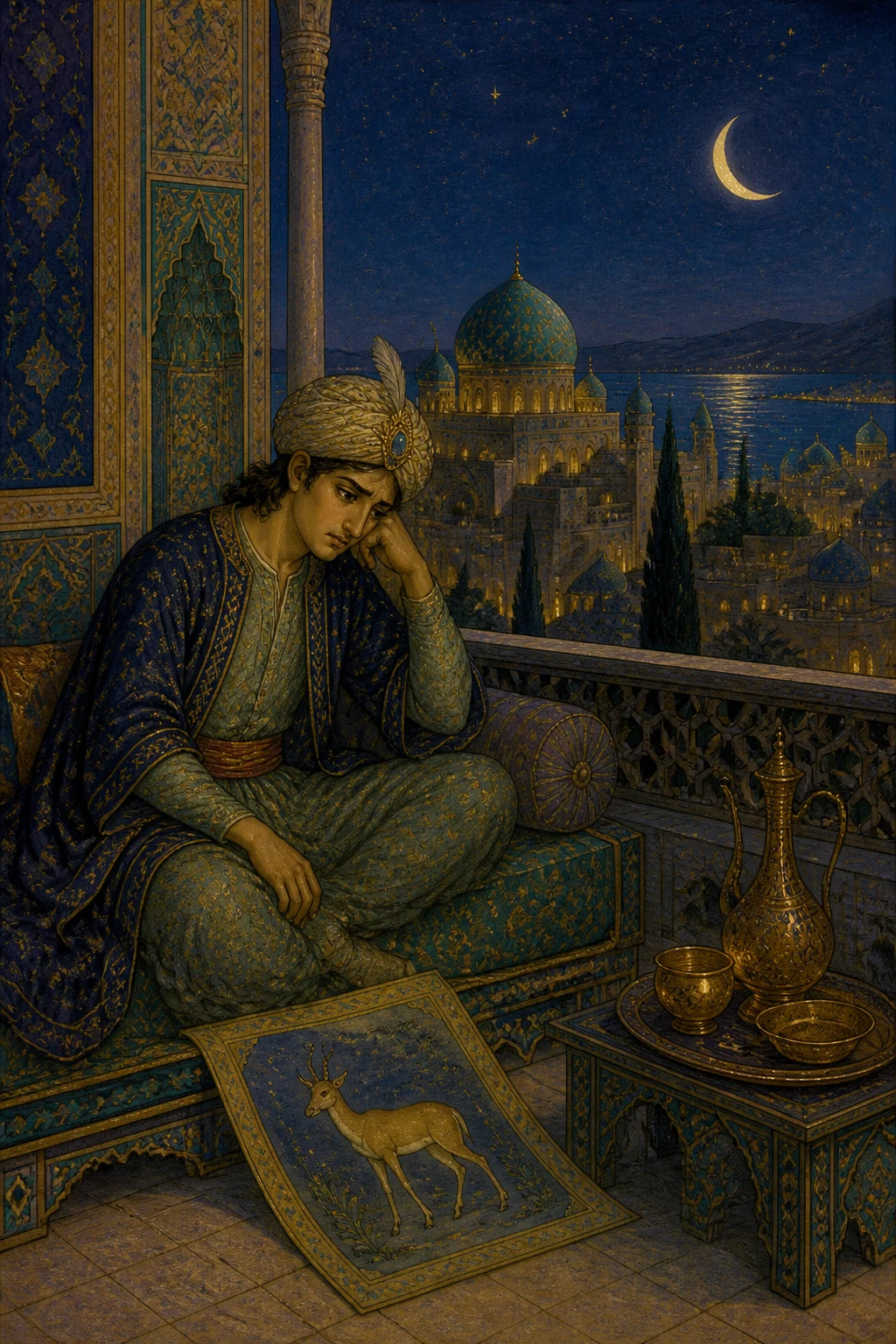
She said: It has reached me, O fortunate king, that when the prince turned the left-hand knob, the horse’s upward motion slackened and gave way to a descent, and it began to sink little by little toward the earth, while he took great care for his safety. When he saw this and understood how the horse worked, his heart filled with joy and gladness, and he thanked God Most High for His grace in delivering him from destruction. He continued descending all that day, for he had risen so high that the earth lay far beneath him. As the horse descended, he turned its head wherever he pleased: when he wished, he made it sink, and when he wished, he made it rise. Once he had mastered it to his satisfaction, he directed it toward the earth, looking down upon countries and cities unknown to him, which he had never seen in all his life. Among them he saw a city of the finest buildings, set in the midst of a lush green land of trees and rivers. He reflected, “I wonder what this city is called, and in which region it lies?” Then he circled it, studying it to right and left. The day was drawing to a close, and the sun was near setting, so he said to himself, “I can find no better place to spend the night than this city. I shall stay here tonight, and in the morning return to my family and my own kingdom. I shall tell my family and my father what has happened to me, and relate to him all that my eyes have seen.” He began searching for a place where he and his horse would be safe and no one would see him.
As he searched, he noticed in the heart of the city a palace soaring into the air, surrounded by a broad wall crowned with lofty battlements. “This is a fine place,” he thought. He began turning the knob that made the horse descend, and continued downward until he landed squarely on the palace roof. Dismounting, he praised God Most High, then walked around the horse, examining it. “By God,” he said, “the man who fashioned you in this form is a sage of great skill. If God Most High prolongs my life and brings me safely back to my country and my family, and reunites me with my father, I shall treat that sage with the greatest kindness and reward him most generously.” He remained on the palace roof until he was sure that everyone had gone to sleep. Hunger and thirst were tormenting him, for he had eaten nothing since leaving his father. “A palace such as this cannot be without provisions,” he thought. Leaving the horse where it stood, he went in search of something to eat. He found a staircase and descended into a courtyard paved with marble. He marveled at the place and the beauty of its construction, but throughout the palace he heard not the faintest sound and found no sign of a living soul. He stood bewildered, looking to right and left, not knowing which way to turn. At last he said to himself, “The best thing I can do is return to the place where my horse stands and spend the night beside it. When morning comes, I shall mount and depart.” But dawn overtook Shahrazad, and she fell silent, leaving her permitted tale untold.
When it was the three hundred and fifty-ninth night
She said: It has reached me, O fortunate king, that the prince said to himself, “The best thing I can do is spend the night beside my horse. When morning comes, I shall mount and depart.” As he stood there thinking these thoughts, he saw a light approaching the place where he was. Looking closely, he saw that it was borne by a company of maidens, among whom walked a radiant girl, her figure slender and straight as the letter alif, rivaling the shining full moon. As the poet said of her:
She came unbidden through the dark of dusk, as though she were the full moon in the dark horizon. Slender of waist, she had no equal among humankind in beauty’s splendor or in grace of form. When my eyes beheld her loveliness, I cried, “Glory to Him who made mankind from a clot!” I seek protection for her from all people’s eyes with the words, “I seek refuge in the Lord of humankind and of the daybreak.” This girl was the daughter of the king of that city. Her father loved her dearly, and out of his love had built this palace for her. Whenever her spirits grew heavy, she would come there with her maidens and stay a day or two, or longer, before returning to her own residence. As it happened, she had come that night for pleasure and diversion. She walked among her maidens, accompanied by a servant wearing a sword. When they entered the palace, they spread out the bedding, lit the incense burners, and began to amuse themselves and make merry. While they were thus engaged, the prince rushed at the servant and struck him such a blow that he fell flat. Taking the sword from his hand, he charged at the maidens attending the princess and scattered them to right and left. When the princess saw his beauty and comeliness, she said, “Perhaps you are the man who asked my father for my hand yesterday, whom he rejected, claiming you were ugly. By God, my father lied when he said that, for you are truly handsome.” Now the son of the king of India had asked her father for her hand, but he had refused him because of his hideous appearance, and she imagined that this was her rejected suitor. She went up to him, embraced and kissed him, and lay down beside him. Her maidens said, “My lady, this is not the man who asked your father for your hand. That one was ugly, and this one is handsome. The suitor your father rejected is not fit even to serve this man. But, my lady, this youth must be a person of great consequence.” Then the maidens went to the fallen servant and roused him. He sprang up in terror and searched for his sword, but could not find it in his hand. “The man who took your sword and knocked you down is sitting with the princess,” they told him. The king had appointed this servant to guard his daughter, fearing for her the calamities of time and the sudden blows of fortune. The servant rose, went to the curtain, and lifted it. He saw the princess sitting with the prince, the two of them deep in conversation. “My lord,” he asked the prince, “are you a man or a jinni?” “Woe to you, most ill-omened of slaves!” replied the prince. “How dare you reckon the sons of mighty sovereigns among the unbelieving devils?” Then he took the sword in his hand and said, “I am the king’s son-in-law. He has married his daughter to me and commanded me to come to her.”
When the servant heard this, he said, “My lord, if you are human, as you claim, then she is fit for none but you, and you have a better right to her than any other.” Then he went to the king, crying aloud, with his clothes torn and dust heaped upon his head. When the king heard his cries, he said, “What calamity has befallen you? You have set my heart trembling. Tell me quickly, and be brief.” “O king,” he replied, “come to your daughter’s rescue! A devil of the jinn has taken possession of her, disguised as a man and fashioned in the likeness of a prince. You must deal with him!” On hearing this, the king was on the point of killing him. “How could you neglect my daughter until such a thing befell her?” he demanded. Then he went to the palace where his daughter was staying. When he arrived, he found the maidens standing there and asked, “What has happened to my daughter?” They replied, “O king, while we were sitting with her, this youth suddenly burst upon us, fair as the full moon. Never have we seen a more handsome face. He held a drawn sword, and when we asked him who he was, he claimed that you had married your daughter to him. We know nothing beyond this, nor do we know whether he is a man or a jinni. But he is chaste and courteous, and attempts nothing improper.” Their words cooled the king’s anger. He raised the curtain little by little and looked inside. There he saw the prince sitting with his daughter in conversation, a youth of perfect beauty, his face like the shining moon. The king could not contain his jealous concern for his daughter. He flung up the curtain and entered with drawn sword, rushing upon them like a ghoul. When the prince saw him, he asked her, “Is this your father?” “Yes,” she replied. But dawn overtook Shahrazad, and she fell silent, leaving her permitted tale untold.
When it was the three hundred and sixtieth night
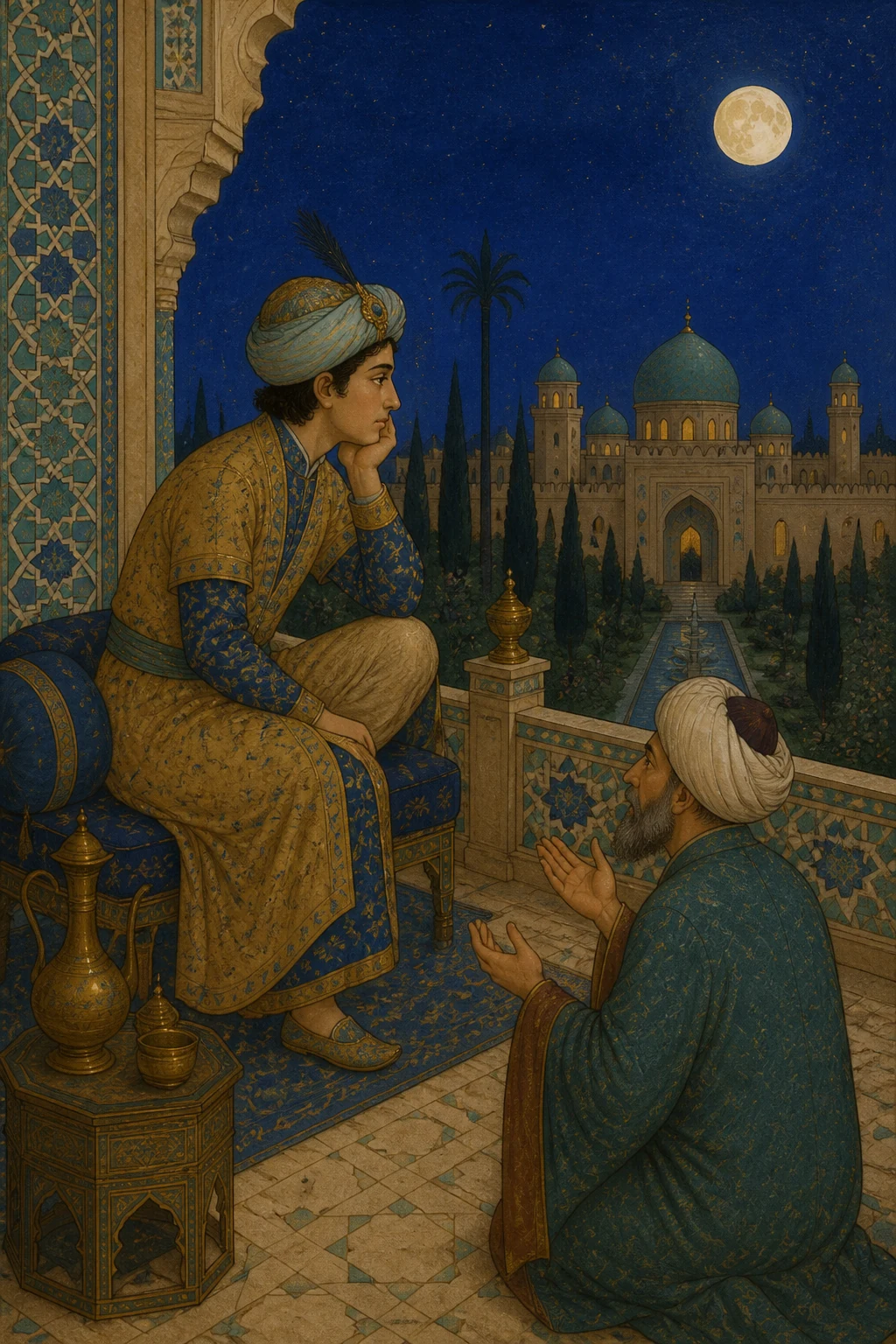
She said: It has reached me, O fortunate king, that when the prince saw the king rushing upon them like a ghoul, with a drawn sword in his hand, he asked the princess, “Is this your father?” “Yes,” she replied. At once he sprang to his feet, seized his sword in both hands, and gave such a terrible shout that the king was stunned. He was about to charge him with his sword when the king, realizing that the youth was more agile than himself, sheathed his own blade. He stood still until the prince reached him, then addressed him gently. “Young man, are you human or a jinni?” The prince replied, “Were it not for the regard I owe you and the honor of your daughter, I would shed your blood. How dare you number me among the devils, when I am the son of mighty sovereigns who, if they wished, could seize your kingdom, shake you from your glory and dominion, and strip you of everything in your lands?” On hearing these words, the king was awed and feared for his life. “If you are a king’s son, as you claim,” he said, “how did you enter my palace without my permission, violate the sanctity of my household, gain access to my daughter, and claim to be her husband, declaring that I had married her to you? I have put kings and princes to death when they sought her hand. Who will save you from my wrath? If I call my slaves and attendants and order them to kill you, they will kill you at once. Who will rescue you from my hands?” The prince answered, “I can only marvel at you and your lack of judgment. Do you hope to find your daughter a better husband than I? Have you ever seen anyone more steadfast of heart, more generous in rewarding others, or mightier in dominion, soldiers, and supporters?” “No, by God,” said the king. “But I wish, young man, that you had asked for her hand before witnesses, so that I might marry her to you. If I give her to you in secret, you will bring disgrace upon me through her.” “You have spoken well,” replied the prince. “But, O king, if your slaves, servants, and soldiers gather against me and kill me, as you say, you will disgrace yourself, and people will be divided between those who believe your account and those who do not. In my opinion, you should follow the course I propose.” “Tell me your proposal,” said the king. The prince replied, “Either you and I shall fight in single combat, and whoever kills the other shall have the better right to the kingdom; or you shall leave me here tonight, and in the morning go out to your army, your soldiers, and your attendants, and tell me their number.” “They number forty thousand horsemen,” said the king, “besides my slaves and their followers, who are as many again.” The prince said, “When day breaks, bring them out to face me, and tell them…” But dawn overtook Shahrazad, and she fell silent, leaving her permitted tale untold.
When it was the three hundred and sixty-first night
She said: It has reached me, O fortunate king, that the prince said to him, “When day breaks, bring them out to face me, and tell them, ‘This man has asked me for my daughter’s hand on condition that he fight you all. He claims that he will defeat and subdue you, and that you are powerless against him.’ Then leave me to fight them. If they kill me, your secret will be better concealed and your honor better preserved. But if I defeat and subdue them, then a man such as I is one whom a king should be eager to have as a son-in-law.” When the king heard this, he approved the plan and accepted it, though he thought the prince’s claims enormous and was appalled by his determination to fight the whole army he had described to him. Then they sat conversing. After a while, the king summoned the servant and ordered him to go that very moment to his vizier and command him to muster the troops, have them take up their weapons, and mount their horses. The servant went to the vizier and conveyed the king’s orders. At once the vizier summoned the army’s captains and the great officers of state, and ordered them to mount their horses and ride out equipped for war.
Such was their case. As for the king, he continued talking with the youth, delighted by his conversation, intelligence, and courtesy. While they spoke, morning dawned. The king rose and went to his throne, ordered his army to mount, and had a fine horse from among the best in his stables brought for the prince, commanding that it be fitted with handsome trappings. But the prince said, “O king, I shall not mount until I have looked out upon the army and seen them for myself.” “As you wish,” replied the king. Then the king set out, with the youth walking before him, until they reached the field. The youth looked at the army and its great numbers, and the king called out, “People, a young man has come to me seeking my daughter’s hand. Never have I seen anyone more handsome, more stouthearted, or more valiant. He claims that he will defeat and subdue you single-handed, and declares that even if you numbered a hundred thousand, he would think you few. When he comes out to fight you, receive him on your spearpoints and the edges of your swords, for he has undertaken a tremendous thing.” Then the king said to him, “My son, deal with them as you please.” “O king,” he replied, “you have not treated me fairly. How am I to fight them on foot while your men are mounted?” “I told you to mount, and you refused,” said the king. “Here are the horses: choose whichever you wish.” “None of your horses pleases me,” he answered. “I shall ride only the horse on which I came.” “Where is your horse?” asked the king. “On top of your palace.” “Where in my palace?” “On the palace roof.” When the king heard this, he said, “This is the first sign of your madness. Woe to you! How can a horse be on the roof? But now we shall discover whether you speak truth or falsehood.” Turning to one of his courtiers, he said, “Go to my palace and bring whatever you find on the roof.” The people marveled at the youth’s words, saying to one another, “How will this horse come down the stairs from the roof? We have never heard of such a thing.” The man whom the king had sent climbed to the top of the palace and saw the horse standing there. Never had he seen a finer one. He approached and examined it, and found that it was made of ebony and ivory. Some of the king’s courtiers had gone up with him, and when they saw the horse they burst out laughing. “Is it on a horse like this that the youth will do all he claims?” they said. “We can only suppose him mad. But soon we shall learn the truth about him.” But dawn overtook Shahrazad, and she fell silent, leaving her permitted tale untold.
When it was the three hundred and sixty-second night
She said: It has reached me, O fortunate king, that when the king’s courtiers saw the horse, they burst out laughing and said, “Is it on a horse like this that the youth will do all he claims? We can only suppose him mad. But soon we shall learn the truth about him. Perhaps there is something extraordinary about him.” Then they lifted the horse in their arms and carried it all the way to the king, setting it down before him. The people gathered around to gaze at it, marveling at the beauty of its workmanship and the elegance of its saddle and bridle. The king, too, admired it and was astonished beyond measure. “Young man,” he asked the prince, “is this your horse?” “Yes, O king, this is my horse, and you shall see wonders from it.” “Take your horse and mount,” said the king. “I shall not mount until the troops have drawn away from it,” he replied. The king ordered the soldiers around him to withdraw a bowshot’s distance. Then the prince said, “O king, I am now going to mount my horse and charge your army. I shall scatter them to right and left and strike terror into their hearts.” “Do as you please,” said the king, “and show them no mercy, for they will show you none.” The prince went to his horse and mounted, while the armies drew up in ranks before him. “When the youth comes between the ranks,” the soldiers said to one another, “we shall receive him with spearpoints and sword edges.” One of them said, “By God, this is a calamity! How can we kill this youth with his lovely face and graceful figure?” Another replied, “By God, you will not reach him without a mighty struggle. He would not have done all this unless he knew his own courage and skill.”
When the prince was settled on his horse, he turned the screw of ascent. All eyes strained toward him to see what he would do. His horse swayed and quivered, performing movements stranger than any living horse could make. Its belly filled with air, and then it rose and climbed into the sky. When the king saw him rising, he shouted to his army, “Woe to you! Seize him before he escapes you!” His viziers and deputies replied, “O king, can anyone catch a bird in flight? This can only be a mighty sorcerer from whom God has delivered you. Praise God Most High for saving you from his hands.” After witnessing what the prince had done, the king returned to his palace. He went to his daughter and told her what had happened between himself and the prince on the field, but found her grieving bitterly for the youth and their separation. She fell gravely ill and took to her bed. When her father saw her in this state, he clasped her to his breast, kissed her between the eyes, and said, “My daughter, praise God Most High and give Him thanks for delivering us from that cunning sorcerer.” Again and again he told her what he had seen the prince do and described how he had risen into the air, but she paid no heed to anything her father said. Her weeping and lamentation grew more intense, and she said to herself, “By God, I shall neither eat nor drink until God reunites me with him.” This filled her father the king with great anxiety. His daughter’s condition distressed him deeply, and his heart was heavy for her. Yet the more he tried to comfort her, the more passionately she longed for the prince. But dawn overtook Shahrazad, and she fell silent, leaving her permitted tale untold.
When it was the three hundred and sixty-third night
She said: It has reached me, O fortunate king, that the king’s heart was heavy for his daughter, and the more he tried to comfort her, the more passionately she longed for the prince. Such was the case of the king and his daughter. As for the prince, once he had risen into the sky and was alone, he recalled the girl’s beauty and loveliness. He had asked the king’s attendants the names of the city, its king, and his daughter; the city was Sanaa. He pressed onward until he came within sight of his father’s city, circled it, and then made for his father’s palace. He landed on the roof, left his horse there, and went down to his father. Entering his presence, he found him sad and dejected because of their separation. When his father saw him, he rose, embraced him, and clasped him to his breast, rejoicing beyond measure. Once they were reunited, the prince asked about the sage who had made the horse. “Father,” he said, “what has become of him?” His father replied, “May God grant no blessing to that sage, nor to the hour in which I saw him! He was the cause of our losing you. My son, he has been in prison since the day you disappeared.” The prince ordered that he be released from prison and brought before them. When the sage appeared before the king, the king bestowed upon him a robe of favor and treated him with the utmost generosity, but did not give him his daughter in marriage. At this the sage grew fiercely angry and regretted what he had done. He realized that the prince had discovered the horse’s secret and learned how to control it.
Then the king said to his son, “My advice is that you never go near this horse again, nor ride it after this day. You do not know its ways, and you are deceived in trusting it.” The prince had told his father what had happened between him and the daughter of the king of that city, and what had passed between himself and her father. His father said, “Had that king wished to kill you, he would have killed you. But your appointed hour has not yet come.” Then the prince’s longing for the daughter of the king of Sanaa flared up within him. He went to the horse, mounted it, and turned the screw of ascent. It flew into the air and bore him up into the heights of heaven. When morning came, his father looked for him and could not find him. Distraught, he climbed to the top of the palace and saw his son ascending into the sky. He grieved at their separation and bitterly regretted not having taken the horse and hidden it away. “By God,” he said to himself, “if my son returns to me, I shall no longer leave this horse at his disposal, so that my heart may be at peace concerning him.” Then he returned to his weeping and lamentation. But dawn overtook Shahrazad, and she fell silent, leaving her permitted tale untold.
When it was the three hundred and sixty-fourth night
She said: It has reached me, O fortunate king, that the king returned to his weeping and lamentation in his grief for his son. Such was his case. As for his son, he continued flying through the air until he came over the city of Sanaa. He landed in the same place as before and crept unseen to the princess’s quarters, but found neither her nor her maidens nor the servant appointed to guard her. This distressed him greatly. He went about the palace searching for her and at last found her in another chamber, not the one where they had first met. She lay in bed, surrounded by her maidens and nurses. He entered and greeted them. When the girl heard his voice, she rose, embraced him, and began kissing him between the eyes and clasping him to her breast. “My lady,” he said, “how I have missed you all this time!” “It is you who have left me desolate,” she replied. “Had you stayed away any longer, I should surely have died.” “My lady,” he said, “what did you think of my encounter with your father and the way he treated me? Had it not been for my love of you, O enchantress of the world, I would have killed him and made him a warning to all who saw him. But for your sake I love him.” “How could you stay away from me?” she asked. “Can life be sweet to me without you?” He said, “Will you obey me and listen to what I say?” “Say whatever you wish,” she replied. “I shall do whatever you ask and oppose you in nothing.” “Come with me to my country and my kingdom,” he said. “Gladly, and with all my heart,” she answered.
When the prince heard her reply, he rejoiced greatly. He took her hand, and they pledged themselves to this in the name of God Most High. Then he led her up to the palace roof, mounted his horse, and seated her behind him. He drew her close and bound her securely to him, then turned the screw of ascent on the horse’s shoulder, and it rose with them into the sky. The maidens cried out and alerted her father and mother, who hurried up to the palace roof. The king looked into the sky and saw the ebony horse flying away with them. He was overcome with mounting distress and cried, “Prince, I implore you by God, have mercy on me and my wife! Do not part us from our daughter!” But the prince made no answer. Then, thinking that the girl might regret leaving her mother and father, he asked her, “O enchantress of the age, would you like me to take you back to your parents?” “My lord,” she replied, “by God, that is not what I desire. I wish only to be with you wherever you may be, for my love of you has driven all else from my thoughts, even my father and mother.” Her words filled the prince with joy, and he made the horse carry them gently, so as not to alarm her. They continued until he saw a green meadow with a flowing spring. They landed there, ate and drank, and then the prince mounted his horse again, seated her behind him, and secured her with the bonds out of fear for her safety. He rode on with her through the air until they reached his father’s city, and his joy grew greater still. Wishing to show the girl the seat of his power and his father’s kingdom, and to let her see that his father’s dominion was greater than her own father’s, he brought her down in one of the gardens where his father took his pleasure. He led her into the pavilion reserved for his father and set the ebony horse at its door. Entrusting the horse to her care, he said, “Stay here until my messenger comes to you. I am going to my father to prepare a palace for you and show you my kingdom.” The girl was delighted to hear this and said, “Do as you please.” But dawn overtook Shahrazad, and she fell silent, leaving her permitted tale untold.
When it was the three hundred and sixty-fifth night
She said: It has reached me, O fortunate king, that the girl was delighted to hear the prince’s words and said, “Do as you please.” It occurred to her that she should enter the city only with the honor and ceremony befitting one of her rank. The prince left her, went into the city, and entered his father’s presence. When his father saw him, he rejoiced at his return, came forward to meet him, and welcomed him. Then the prince said, “Know, Father, that I have brought the king’s daughter of whom I told you. I have left her outside the city in one of the gardens, and have come to tell you so that you may prepare a procession and go out to meet her, displaying your sovereignty, your soldiers, and your attendants.” “Gladly, and with all my heart,” replied the king. At once he ordered the people to adorn the city with splendid decorations. Then he rode out in the greatest state and finest array, with all his troops, his chief officers, the dignitaries of his kingdom, and his servants. The prince brought from his palace jewels, robes, and the treasures that kings keep in store. He prepared for her a litter of green, red, and yellow brocade, with Indian, Greek, and Abyssinian maidens seated upon it, and displayed a wondrous abundance of treasures. Then he left the litter and its attendants and hurried ahead to the garden. He entered the pavilion where he had left the girl and searched for her, but could find neither her nor the horse. He struck his face, tore his clothes, and wandered about the garden in a daze. At last he recovered his senses and said to himself, “How could she have discovered the secret of this horse when I told her nothing of it? Perhaps the Persian sage who made it came upon her and took her in revenge for the way my father treated him.” He summoned the garden guards and questioned them about those who had passed their way. “Did you see anyone pass by and enter this garden?” he asked. They replied, “We saw no one enter except the Persian sage, who came to gather medicinal herbs.” When the prince heard their words, he knew for certain that it was the sage who had taken the girl. But dawn overtook Shahrazad, and she fell silent, leaving her permitted tale untold.
When it was the three hundred and sixty-sixth night
She said: It has reached me, O fortunate king, that when the prince heard their words, he knew for certain that it was the sage who had taken the girl. Now fate had ordained that when the prince left the girl in the garden pavilion and went to his father’s palace to make his preparations, the Persian sage should enter the garden to gather medicinal herbs. He caught the scent of musk and perfume that filled the place, a fragrance that came from the princess. He followed it until he reached the pavilion, where he saw the horse he had made with his own hands standing at the door. At the sight of it, his heart filled with joy and gladness, for he had bitterly regretted letting it pass out of his possession. He approached it and inspected every part, finding everything sound. He was about to mount and depart when he said to himself, “I must see what the prince has brought and left here with the horse.” Entering the pavilion, he found the girl sitting there like the radiant sun in a cloudless sky. At the sight of her, he knew that she was a maiden of high rank, whom the prince had brought on the horse and left in the pavilion while he went into the city to fetch a procession and bring her in with honor and ceremony. The sage went up to her and kissed the ground before her. She raised her eyes and looked at him, and found him exceedingly ugly and hideous in appearance. “Who are you?” she asked. “My lady,” he replied, “I am the prince’s messenger. He has sent me to you with orders to take you to another garden near the city.” When the girl heard this, she asked, “Where is the prince?” “He is in the city with his father,” he replied, “and will come to you this very hour with a magnificent procession.” “Tell me,” she said, “could the prince find no one but you to send to me?” The sage laughed at her words. “My lady,” he said, “do not be deceived by my ugly face and hideous looks. If you had gained from me what the prince has gained, you would praise my services. Indeed, he chose me as his messenger precisely because of my ugliness and fearsome appearance, out of his jealous concern and love for you. Otherwise, he has more mamluks, slaves, pages, servants, and attendants than can be counted.” When the girl heard his words, they seemed reasonable to her. She believed him and rose to go with him. But dawn overtook Shahrazad, and she fell silent, leaving her permitted tale untold.
When it was the three hundred and sixty-seventh night
She said: It has reached me, O fortunate king, that when the Persian sage told the girl these things about the prince, she believed his words and found them reasonable. She rose with him and placed her hand in his. Then she asked, “Father, what have you brought for me to ride?” “My lady,” he replied, “you shall ride the horse on which you came.” “I cannot ride it alone,” she said. When the sage heard this, he smiled, knowing that he had her in his power. “I shall ride with you myself,” he said. He mounted and seated the girl behind him, drew her close, and bound her securely, while she had no idea what he intended. Then he turned the screw of ascent. The horse’s belly filled with air; it stirred and swayed, then rose into the sky and flew on with them until the city vanished from sight. “You there,” the girl said, “what has become of what you told me about the prince, when you claimed that he had sent you to me?” The sage replied, “May God confound the prince! He is a wicked, contemptible fellow.” “Woe to you!” she cried. “How dare you disobey your master’s commands?” “He is not my master,” he replied. “Do you know who I am?” “I know only what you have told me about yourself,” she said. He answered, “What I told you was merely a trick to deceive you and the prince. I had been consumed with regret over this horse beneath you, for it is my own handiwork, and he had taken possession of it. Now I have recovered it and gained you as well. I have burned his heart as he burned mine, and never again shall he lay hands on it. So take heart and be content, for I shall serve you better than he.”
When the maiden heard his words, she struck her face and cried, “Alas for me! I have neither gained my beloved nor remained with my father and mother!” She wept bitterly over what had befallen her, while the sage journeyed on with her to the land of the Greeks. There he alighted in a green meadow with streams and trees, near a city ruled by a mighty king. As it happened, the king of that city had gone out that day to hunt and take his pleasure. Passing through the meadow, he saw the sage standing there, with the horse and the maiden beside him. Before the sage knew what was happening, the king’s slaves rushed upon him, seized him, the maiden, and the horse, and brought them all before the king. When the king saw the sage’s hideous, repulsive appearance and the maiden’s loveliness and beauty, he said to her, “My lady, how is this old man related to you?” The sage hastened to answer, “She is my wife and my cousin.” But when the maiden heard this, she contradicted him, saying, “O King, by God, I do not know him, nor is he my husband. He carried me off by deceit.” On hearing her words, the king ordered the sage beaten, and they beat him until he was near death. Then the king commanded that he be taken to the city and thrown into prison, and they did as he ordered. The king took the maiden and the horse from him, but he knew nothing of the horse’s secret or how it was made to move.
Such was the fate of the sage and the maiden. As for the prince, he put on his travelling clothes, took the money he would need, and set out in the deepest distress. He travelled swiftly, following their trail from country to country and city to city, asking about the ebony horse. Everyone who heard him speak of it marvelled and thought his tale extraordinary. He continued in this way for some time, but for all his inquiries and searching, he could find no news of them. At last he went to the city of the maiden’s father and asked after her there, but heard nothing of her and found her father grieving over her loss. So he turned back and made for the land of the Greeks, tracing their footsteps and asking after them. But dawn overtook Shahrazad, and she fell silent, leaving her tale untold.
When it was the three hundred and sixty-eighth night,
She said: It has reached me, O fortunate King, that the prince made for the land of the Greeks, following their trail and asking after them. He happened to lodge at an inn, where he saw a company of merchants sitting in conversation. He sat down near them and heard one of them say, “My friends, I have seen a wonder of wonders!” “What was it?” they asked. He replied, “I was travelling in a certain region, in such-and-such a city”—and he named the city where the maiden was—“when I heard its people telling a strange story. One day their king went out hunting with a company of his companions and the great men of his court. When they reached the open country, they passed through a green meadow and found a man standing there, with a woman seated beside him and a horse made of ebony. As for the man, he was hideously ugly and dreadful to behold. The woman, however, was a young maiden of exquisite beauty and loveliness, grace and perfection, with a shapely, well-proportioned figure. And the ebony horse was such a marvel that no eye had ever seen anything more beautiful or more finely wrought.” Those present asked him, “And what did the king do with them?” He answered, “The king seized the man and questioned him about the maiden. He claimed she was his wife and his cousin, but she denied his words. So the king took her from him and ordered him beaten and thrown into prison. As for the ebony horse, I know nothing of it.” When the prince heard the merchant’s words, he drew near and questioned him gently and courteously until he learned the name of the city and its king. Having learned these, he passed the night in gladness. In the morning he set out and travelled on until he reached that city. As he was about to enter, the gatekeepers seized him, intending to bring him before the king, who would question him about his circumstances, his reason for coming to the city, and the crafts in which he was skilled. For it was the king’s custom to question strangers about their affairs and occupations. But the prince had arrived in the evening, when it was not possible to gain an audience with the king or seek his instructions. So the gatekeepers took him to the prison to confine him there. When the jailers saw his beauty and handsome bearing, however, they could not bring themselves to shut him inside, but seated him with them outside the prison. When their food arrived, he ate his fill with them. After the meal they began to converse, then turned to the prince and asked, “What country are you from?” He answered, “I come from Persia, the land of the Chosroes.” When they heard this, they laughed, and one of them said, “O Persian, I have heard men’s tales and histories and seen much of their ways, but I have never seen or heard a greater liar than the Persian we have here in prison.” Another said, “Nor have I ever seen an uglier creature or a more repulsive face.” The prince asked them, “What lies have you discovered him telling?” They answered, “He claims to be a sage. The king came upon him on his way to the hunt, with a woman of wondrous beauty and loveliness, grace and perfection, and a shapely, well-proportioned figure. He also had a horse of black ebony, the like of which we had never seen for beauty. The maiden is now with the king, who loves her, but she is mad. If that man were a sage, as he claims, he would have cured her. The king is doing all he can to find a cure and longs to free her from her affliction. The ebony horse is in the king’s treasury, while the ugly man who was with her is here in our prison. When night falls, he weeps and wails over his misfortune and will not let us sleep.” But dawn overtook Shahrazad, and she fell silent, leaving her tale untold.
When it was the three hundred and sixty-ninth night,
She said: It has reached me, O fortunate King, that when the jailers told the prince about the Persian sage imprisoned in their charge, and of his weeping and wailing, he began to devise a plan by which he might gain his desire. When the gatekeepers wished to sleep, they put him inside the prison and locked the door upon him. There he heard the sage weeping and lamenting in Persian, saying amid his lamentations, “Woe to me for what I have brought upon myself and upon the prince, and for what I have done to the maiden! I neither left her alone nor gained my desire. All this comes of my own folly, for I sought what I did not deserve and what was not fitting for one like me. Whoever seeks what does not befit him will fall into the same plight as I.” When the prince heard the sage’s words, he spoke to him in Persian, saying, “How long will you go on weeping and wailing? Do you think you have suffered what no one else has suffered?” Hearing him speak, the sage took comfort in his company and complained to him of his plight and the hardships he endured. When morning came, the gatekeepers took the prince before their king and told him that he had reached the city the previous evening, too late to be admitted to the royal presence. The king questioned him, saying, “What country are you from? What is your name? What is your trade? And what has brought you to this city?” The prince answered, “My name in Persian is Harja, and my country is Persia. I am a man of learning, especially in the science of medicine, for I treat the sick and the mad. That is why I wander through countries and cities, adding to my knowledge. Whenever I see a sick person, I treat him. Such is my profession.”
When the king heard his words, he rejoiced greatly and said, “O worthy physician, you have come to us at the very moment we need you.” Then he told him about the maiden, saying, “If you treat her and cure her madness, you shall have whatever you ask of me.” On hearing this, the prince said, “May God exalt the King! Describe to me everything you have observed of her madness. Tell me how many days she has suffered from it, and how you came to take her, the horse, and the sage.” The king told him the story from beginning to end, then added, “The sage is in prison.” The prince asked, “O fortunate King, what have you done with the horse that was with them?” He answered, “It is still in my possession, safely kept in one of my private chambers.” The prince said to himself, “The wisest course is to inspect the horse before anything else. If it is sound and nothing has happened to it, all my wishes will be fulfilled. But if I find its movements disabled, I must devise some means of saving my life.” Then he turned to the king and said, “O King, I must examine this horse. Perhaps I shall find something to help me cure the maiden.” “With love and honour,” the king replied. He rose, took him by the hand, and led him to the horse. The prince walked around it, inspecting it and examining its condition, and found it sound and free of any damage. At this he rejoiced greatly and said, “May God exalt the King! I now wish to visit the maiden and observe her behaviour. I pray to God that, through the horse, her cure may be accomplished at my hands, if God Most High wills it.” Then he ordered that the horse be kept safe, and the king took him to the room where the maiden was. When the prince entered, he found her thrashing about and falling into fits, as was her custom. She was not mad at all, but behaved in this way so that no one would approach her. Seeing her in this state, the prince said, “No harm shall come to you, O Fitnat al-Alamin.” He began to soothe and caress her until he made himself known to her. When she recognized him, she gave a great cry and fainted from the intensity of her joy. The king supposed that this fit had come upon her from fear of the physician.
Then the prince put his mouth to her ear and said, “O Fitnat al-Alamin, save my life and your own. Be patient and steadfast, for we need patience here, and a carefully contrived plan, if we are to escape this tyrannical king. My plan is to go out to him and say, ‘Her illness is an affliction of madness, and I guarantee her cure.’ I shall make it a condition that he release you from your bonds, and your affliction will cease. When he comes in to you, speak pleasantly to him, so that he may see you have been cured at my hands. Then all our wishes will be fulfilled.” She replied, “I hear and obey.” He left her and went to the king, cheerful and smiling, saying, “O fortunate King, through your good fortune I have discovered her ailment and its remedy, and I have treated her for you. Rise now and go in to her. Speak gently to her, treat her kindly, and promise her things that will please her. Then you will obtain all you desire of her.” But dawn overtook Shahrazad, and she fell silent, leaving her tale untold.
When it was the three hundred and seventieth night,
She said: It has reached me, O fortunate King, that when the prince, posing as a physician, entered the maiden’s room and made himself known to her, he told her of the plan he was devising, and she replied, “I hear and obey.” Then he left her, went to the king, and said, “Rise and go in to her. Speak gently to her and promise her things that will please her. Then you will obtain all you desire of her.” The king rose and entered her room. When she saw him, she stood up, kissed the ground before him, and welcomed him. At this the king rejoiced greatly. He ordered the slave girls and servants to attend to her, take her to the bath, and prepare jewels for her. They went in and greeted her, and she returned their greeting in the sweetest tones and most gracious words. Then they dressed her in royal robes, placed a necklace of jewels about her neck, and led her to the bath, where they waited upon her. When they brought her out, she was like the full moon. Coming before the king, she greeted him and kissed the ground at his feet. He was overjoyed and said to the prince, “All this is through your blessing. May God grant us still more of your gifts!” The prince replied, “O King, to complete her cure and make her recovery perfect, you must go out with all your attendants and soldiers to the place where you found her, taking with you the ebony horse that was with her. There I shall bind the spirit that afflicts her, imprison it, and kill it, so that it may never return to her.” “With love and honour,” said the king. He had the ebony horse taken to the meadow where he had found it with the maiden and the Persian sage. Then he rode out with his army, taking the maiden with him, though none of them knew what the prince intended to do. When they reached the meadow, the prince, who was posing as a physician, ordered that the maiden and the horse be placed as far from the king and his soldiers as the eye could see. He said to the king, “With your leave, I wish to burn incense, recite the incantation, and imprison the spirit here, so that it may never return to her. After that I shall mount the ebony horse and seat the maiden behind me. When I have done so, the horse will stir and move until it comes to you. Then the cure will be complete, and you may do with her as you please.”
When the king heard his words, he rejoiced greatly. The prince mounted the horse and seated the maiden behind him, while the king and all his army watched. He drew her close and secured her firmly to him, then turned the screw that made the horse ascend. It rose with them into the air as the soldiers watched, until it vanished from their sight. The king waited half a day for him to return, but he did not come back. At last the king gave up hope, bitterly regretting what had happened and grieving over the loss of the maiden. Then he gathered his army and returned to his city.
Such was his fate. As for the prince, he set his course for his father’s city, full of joy and gladness, and journeyed on until he alighted upon his palace. He brought the maiden inside and saw that she was safe, then went to his father and mother, greeted them, and told them of her arrival. They rejoiced greatly at the news.
Such was the story of the prince, the horse, and the maiden. As for the king of the Greeks, when he returned to his city, he shut himself away in his palace, sorrowful and dejected. His viziers came to him and tried to console him, saying, “The man who took the maiden was a sorcerer. Praise be to God, who saved you from his sorcery and deceit!” They persisted until at last he was consoled for her loss. Meanwhile, the prince held magnificent feasts for the people of the city. But dawn overtook Shahrazad, and she fell silent, leaving her tale untold.
When it was the three hundred and seventy-first night,
She said: It has reached me, O fortunate King, that the prince held magnificent feasts for the people of the city, and their rejoicing continued for a full month. Then he went in to the maiden, and they delighted greatly in one another. Such was his story. As for his father, he broke the ebony horse and destroyed its mechanism. The prince then wrote a letter to the maiden’s father, telling him what had happened to her and informing him that he had married her and that she was living with him in the greatest happiness. He sent the letter by a messenger, together with gifts and precious rarities. When the messenger reached the city of the maiden’s father, which was Sana’a in Yemen, he delivered the letter and the gifts to the king. The king read the letter with great joy, accepted the gifts, and treated the messenger with honour. Then he prepared a gift for his son-in-law, the prince, and sent it back with the same messenger. The messenger returned with it to the prince and told him how delighted the maiden’s father had been to receive news of his daughter, at which the prince rejoiced greatly. Thereafter, each year the prince exchanged letters and gifts with his father-in-law. They continued thus until the prince’s father died and he succeeded him upon the throne. He ruled his subjects justly and conducted himself among them in a manner pleasing to all, so that the lands submitted to him and the people obeyed him. They lived on in the sweetest happiness and ease, in comfort and contentment, until there came to them the Destroyer of Delights and the Divider of Companies, the Ravager of Palaces and the Filler of Graves. Glory be to the Ever-Living who never dies, in whose hand are earthly kingship and heavenly dominion.