Prevod
It is also told that in the days of old, in ages long gone by, there lived a king of great renown, endowed with might and dominion. He had a vizier named Ibrahim, whose daughter was a marvel of beauty and grace, peerless in loveliness and perfection, possessed of a keen mind and exquisite manners. Yet she delighted in convivial company, wine, and handsome faces, in tender verses and rare tales whose delicate meanings beguiled the mind into love. As one who described her said:
I am enamored of her who enchants both Turk and Arab; she disputes with me on law, grammar, and letters. “I am the object,” she says, “so why have you lowered me? And this is the subject—why, then, does it stand erect?”
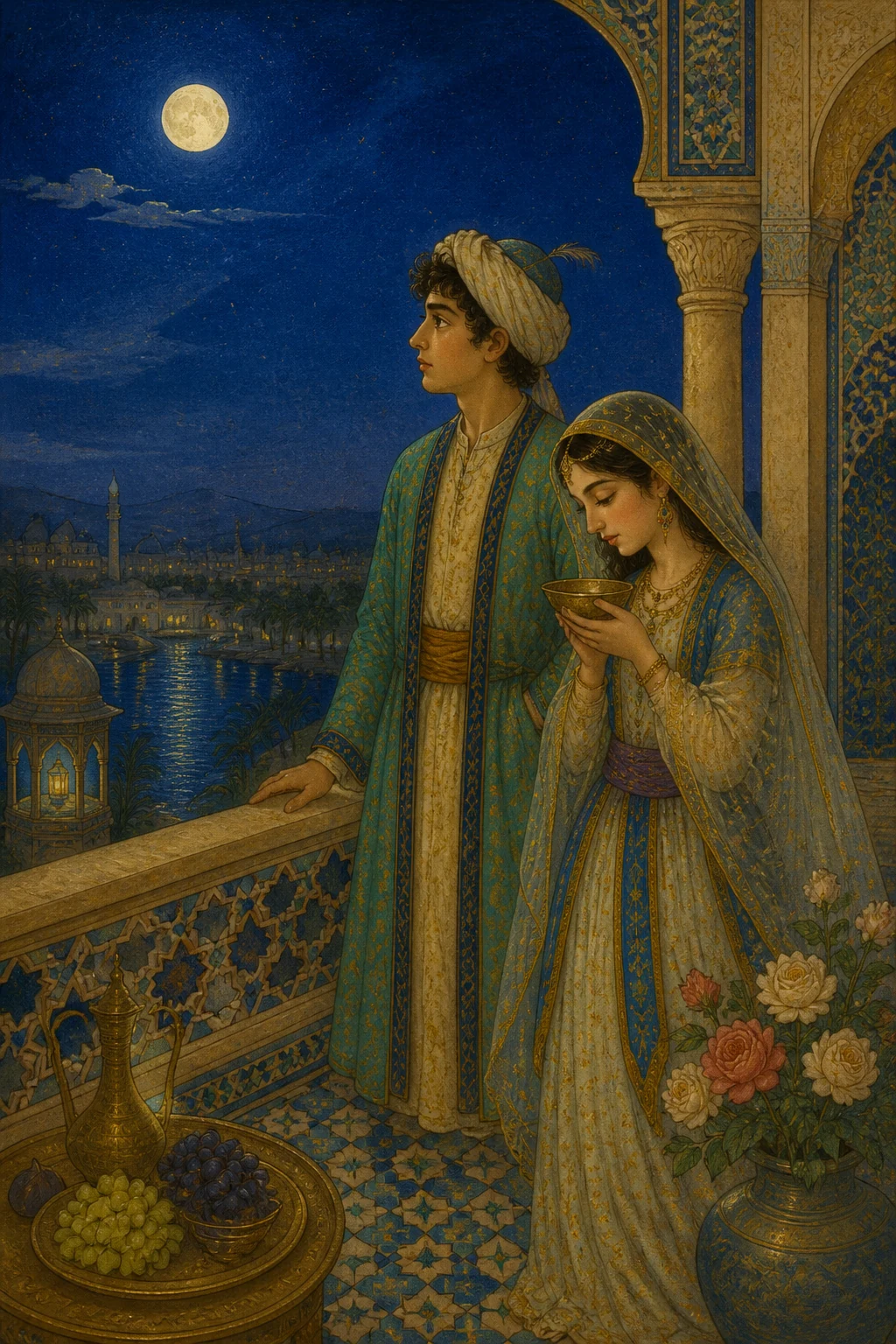
I answered, “May my life and soul be your ransom! Do you not know that the world has turned upside down? If ever you doubt its overturning, look here: the knot of the head is at the tail!” Her name was Rose-in-the-Bud, so called for her surpassing delicacy and perfect loveliness. The king delighted in her company because of her accomplished manners. Now it was his custom each year to assemble the notables of his kingdom and play polo. When the day came for the gathering and the game, the vizier’s daughter sat at the window to watch. While they were playing, she happened to glance aside and saw among the soldiers a young man more handsome and radiant than any other, with a shining face, a smiling mouth, long arms, and broad shoulders. Again and again she looked at him, yet could not feast her eyes enough. She said to her nurse, “What is the name of that handsome young man among the soldiers?” “My daughter,” replied the nurse, “they are all handsome. Which one do you mean?” “Wait,” she said, “until I point him out to you.” Then she took an apple and threw it at him. He raised his head and saw the vizier’s daughter at the window, like the full moon in the heavens; and before he could lower his eyes, his thoughts were consumed with love for her. He recited these verses:
Was it the archer who shot me, or your eyelids, striking the lover’s heart the moment he beheld you? Did that arrow, so swiftly loosed, come from an army, or did it come from a window? When the game was over, she asked her nurse, “What is the name of the young man I showed you?” “His name is Uns al-Wujud,” she replied. The maiden nodded, lay down upon her couch, and pondered deeply. Then she heaved a sigh and recited these verses:
He who named you Uns al-Wujud named you well, you who unite companionship and bounty! O rising full moon, whose countenance has illumined the universe and shone upon all existence! You stand alone among mankind, sovereign of beauty, and I have witnesses: your eyebrow is a finely drawn nun, your eye a sad fashioned by the Loving One. Your figure is a tender bough that yields its grace whenever called upon. You surpass the horsemen of the world in prowess, and surpass them too in charm and gracious presence. When she had finished her poem, she wrote it on a sheet of paper, wrapped it in a piece of silk embroidered with gold, and placed it beneath her pillow. One of her nurses had been watching her. She came over and kept her mistress in conversation until she fell asleep, then stole the paper from beneath the pillow and read it. Thus she learned that the maiden had fallen in love with Uns al-Wujud. Having read the paper, she put it back in its place. When her mistress Rose-in-the-Bud awoke, the nurse said, “My lady, I am devoted to your welfare and tenderly concerned for you. Know that love is powerful, and to conceal it would melt iron and bring sickness and disease. No blame attaches to those who confess their love.” Rose-in-the-Bud asked, “Nurse, what is the cure for love?” “Union,” she replied. “And how may union be attained?” “My lady, through letters and gentle words, and frequent greetings and salutations. These bring lovers together and make difficult matters easy. If you have any business of this kind, my mistress, none is better fitted than I to keep your secret, fulfill your need, and carry your message.” When Rose-in-the-Bud heard these words, she almost lost her wits for joy. Yet she held her tongue until she could see how matters would turn out, saying to herself, “No one has learned this secret from me. I shall not reveal it to this woman until I have put her to the test.” The woman continued, “My lady, I dreamed that a man came to me and said, ‘Your mistress and Uns al-Wujud love one another. Attend to their affairs, carry their letters, fulfill their needs, and conceal their love and their secrets, and great good will come to you.’ Now I have told you what I saw, and the matter rests with you.” When her nurse had told her the dream, Rose-in-the-Bud said to her… But morning overtook Shahrazad, and she fell silent, leaving her tale untold.
When it was the three hundred and seventy-second night,
She said: It has reached me, O fortunate King, that when her nurse had told her the dream she had seen, Rose-in-the-Bud asked, “Can you keep secrets, nurse?” “How could I not,” she answered, “when I am of the finest freeborn stock?” Then the maiden took out the paper on which she had written her verses and said, “Take this letter of mine to Uns al-Wujud and bring me his reply.” The nurse took it and went to Uns al-Wujud. On entering his presence, she kissed his hands, greeted him with the sweetest words, and gave him the paper. He read it, understood its meaning, and wrote these verses on the back:
I soothe my heart in love and hide my passion, yet my condition speaks of what I feel. If my tears overflow, I say, “My eye is wounded,” lest the censurer see my state and understand. Once I was carefree, knowing nothing of desire; now I am a lover, and my heart is love’s enslaved. I lay my story before you, pleading my passion and longing, that you may soften and show mercy. I have written it with the tears of my eyes, hoping it may tell you what I suffer on your account. May God preserve a face veiled in beauty, whose slave is the full moon, whose servants are the stars! Never have I seen the like of that lovely form; the branches learn their gentle swaying from its grace. I ask, if it cause you no hardship, that you visit me, for union is a precious thing. I have given you my soul: may you accept it! Union is my paradise, and rejection my hell. Then he folded the letter, kissed it, and handed it to the nurse, saying, “Nurse, incline your mistress’s heart toward me.” “I hear and obey,” she replied. Taking the letter, she returned to her mistress and gave her the paper. Rose-in-the-Bud kissed it and raised it above her head, then opened it, read it, and understood its meaning. Beneath it she wrote these verses:
O you whose heart is enthralled by our beauty, be patient: perhaps in love you may attain us. Since we have learned your love is true, and that your heart has suffered what ours has suffered, we would grant you union upon union, but those who guard us forbid our meeting. When night falls, the fires of passion blaze within our breasts. Our beds have banished sleep, and torment has laid waste our bodies. In the law of love, concealment is a duty: do not lift the curtains drawn about us. My heart is filled with longing for that gazelle—would that he had never vanished from our land! When she had finished her verses, she folded the paper and gave it to the nurse, who took it and left Rose-in-the-Bud, the vizier’s daughter. The chamberlain met her and asked, “Where are you going?” “To the bath,” she replied. His appearance so alarmed her that, as she passed through the doorway in her agitation, the paper fell from her.
Such was her case. As for the paper, one of the servants saw it lying in the passage and picked it up. Presently the vizier came out of the women’s quarters and seated himself upon his couch. The servant who had found the paper approached him with it in his hand and said, “My lord, I found this paper lying in the house and picked it up.” The vizier took it from him, still folded, and opened it. He saw the verses already related, read them, and understood their meaning. Then he examined the writing and recognized his daughter’s hand. He went in to her mother, weeping so bitterly that his beard was drenched. His wife asked, “What has made you weep, my lord?” He replied, “Take this paper and see what is in it.” She took it and read it, and found that it contained correspondence between her daughter Rose-in-the-Bud and Uns al-Wujud. Tears rose in her eyes, but she mastered herself and wiped them away. “My lord,” she said to the vizier, “weeping is of no use. The wise course is to consider how we may safeguard your honor and conceal your daughter’s affair.” She began to comfort him and ease his grief. He said, “I fear for my daughter because of this love. Do you not know how greatly the sultan favors Uns al-Wujud? I have two reasons to fear this affair: first, on my own account, because she is my daughter; and second, on the sultan’s account, because Uns al-Wujud is his favorite, and some grave trouble may arise from this. What do you advise?” But morning overtook Shahrazad, and she fell silent, leaving her tale untold.
When it was the three hundred and seventy-third night,
She said: It has reached me, O fortunate King, that when the vizier had told his wife of their daughter’s affair and asked, “What do you advise?” she replied, “Wait until I have prayed for guidance.” Then she performed the two customary rak‘ahs of the prayer for guidance. When she had finished, she said to her husband, “In the midst of the Sea of Treasures stands a mountain called the Mountain of the Bereaved Mother—the reason for its name will be told in due course. No one can reach that mountain without great difficulty. Make a dwelling for her there.” So the vizier agreed with his wife that he would build a fortified palace there and place their daughter in it, supply her with provisions year after year, and provide companions and servants to attend her. He assembled carpenters, builders, and architects and sent them to the mountain, where they built her a strong palace, the like of which no eye had seen. Then he prepared provisions and mounts, went to his daughter by night, and ordered her to depart. Her heart sensed the coming separation. When she went out and saw the preparations for a journey, she wept bitterly and wrote upon the door to tell Uns al-Wujud what had befallen her: a grief that made the skin shudder, melted solid stone, and set tears flowing. These were the verses she wrote:
By God, O house, if my beloved passes in the morning, greeting you with lovers’ secret signs, give him from me a pure and fragrant salutation, for he does not know where night has found us. Nor do I know where this journey carries us, as they hurry me away in stealth, beneath the wing of night, while the birds of the grove cling to the branches, weeping for us and mourning us. Their very state cries out, “Alas for the parting of lovers!” When I saw the cups of separation filled, and fate forced me to drink their unmixed bitterness, I mingled them with patient endurance, pleading my helplessness; yet now, far from you, patience is of no avail. When she had finished her verses, she mounted, and they set out with her across wilderness and desert, over level ground and rugged, until they reached the Sea of Treasures. They pitched their tents upon the shore, brought up a great vessel, and embarked her and her household. The vizier had ordered them, once they reached the mountain and lodged her and her household in the palace, to return in the vessel, disembark, and break it to pieces. They went and carried out all his commands, then returned, weeping over what had happened.
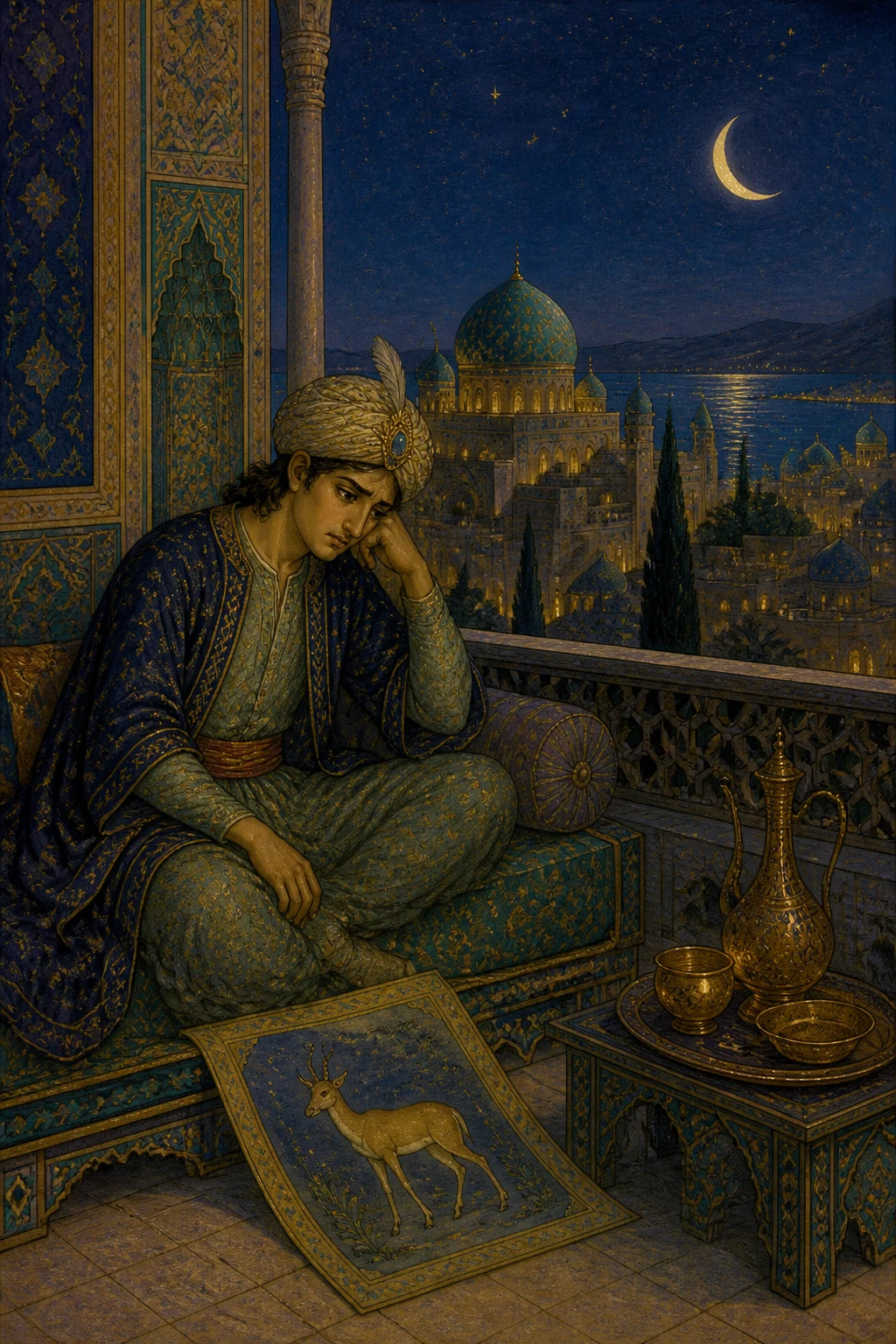
Such was their case. As for Uns al-Wujud, he awoke, performed the dawn prayer, then mounted and set out to attend the sultan. As was his custom, he passed the vizier’s door on the way, hoping to see one of the attendants he was accustomed to meeting there. He looked at the door and saw the verses already related written upon it. At the sight, he lost all awareness of himself, and fire blazed within his breast. He returned home, but could find neither rest nor patience. He remained in anguish and longing until night fell. Then, concealing his purpose, he disguised himself and went out in the dead of night, wandering without a path, not knowing where he was going. He traveled all that night and through the following day, until the sun’s heat grew fierce and the mountains blazed, and thirst tormented him. He spied a tree with a stream flowing beside it, made his way there, and sat in its shade by the water. He tried to drink, but the water had no savor in his mouth. His color had changed, his face had grown yellow, and his feet were swollen with walking and hardship. He wept bitterly, pouring forth his tears, and recited these verses:
The lover is drunk with love of his beloved: ask him a question, and he gives no answer. Lost in passion, lovesick and bewildered, he finds no sweetness in his food. How can life be pleasant to a lover parted from those he loves? That would be strange indeed! I have wasted away as my yearning for them blazed, and my tears have streamed in torrents down my cheeks. Shall I see them again, or see someone from their dwelling whose presence might heal this sorrowing heart? When he had finished his verses, he wept until he soaked the earth. Then he rose at once and left that place. As he journeyed through the wilderness and deserts, a lion appeared before him, its neck smothered in its mane, its head as large as a dome, its mouth wider than a doorway, and its fangs like an elephant’s tusks. At the sight, Uns al-Wujud was certain he would die. He faced the qibla, pronounced the profession of faith, and prepared for death. Yet he had read in books that a lion could be beguiled, for it was susceptible to kindly speech and stirred to noble conduct by praise. So he began to address it: “O lion of the forest, O lord of the open plain, O mighty lion, father of brave young warriors, O sovereign of wild beasts! I am a yearning lover, laid waste by passion and separation. Since I parted from my beloved, I have lost my reason. Hear my words, and pity my anguish and desire.” When the lion heard him, it drew back and sat upon its haunches, raised its head toward him, and began to play with its tail and forepaws. Seeing these movements, Uns al-Wujud recited these verses:
O lion of the wilderness, will you kill me before I meet the one who has enslaved my heart? I am no worthy quarry, nor have I any fat: the loss of my beloved has made me ill. Parting has wasted my very soul; I am like a figure wrapped in its shroud. O Abu al-Harith, lion of battle, do not let my censurers rejoice in my sorrow! I am a lover drowned in his own tears, made restless by separation from his beloved. Through the dark nights, my thoughts of her have carried me beyond all sense of self. When he had finished his verses, the lion rose and walked toward him. But morning overtook Shahrazad, and she fell silent, leaving her tale untold.
When it was the three hundred and seventy-fourth night,
She said: It has reached me, O fortunate King, that when Uns al-Wujud had finished his verses, the lion rose and walked gently toward him, its eyes brimming with tears. On reaching him, it licked him with its tongue, then walked ahead and signaled him to follow. Uns al-Wujud followed, and the lion led him onward for a time, up a mountain and down the other side. There he saw tracks across the wilderness and recognized them as the traces of the party who had taken Rose-in-the-Bud away. He began to follow the trail. When the lion saw that he had found and was following the tracks of those who had carried off his beloved, it went its own way. Uns al-Wujud continued along the trail for days and nights, until he came to a roaring sea of clashing waves. The tracks reached the shore and ended there. He knew that they had embarked and sailed away, and there his hope of finding them failed. He poured forth his tears and recited these verses:
The place of meeting is far away, and little patience remains to me: how shall I walk to them across the depths of the sea? How can I endure, when my heart is ruined by love of them, and I have exchanged sleep for wakefulness? Since the day they left their homeland and departed, my soul has burned in a raging blaze. My tears run like the Sayhun, the Jayhun, and the Euphrates, their flood surpassing deluge and rain. Their flowing has ulcerated my eyelids, and fire and sparks have scorched my heart. The armies of yearning and longing have charged, while the army of my patience retreats in defeat. I have hazarded my soul, freely offered in love, and counted my soul the least of things to risk. May God not punish an eye that gazed within their sanctuary upon beauty more radiant than the moon! I lie struck down by great dark eyes whose arrows pierced my heart without a bowstring. She beguiled me with the suppleness of her swaying form, as the branches of the willow bend upon the tree. I hoped for union with her to sustain me through the trials of love, through sorrow and distress. Now I remain downcast for her sake, and all that has befallen me arose from one enchanting glance. When he had finished his verses, he wept until he fell unconscious. He remained senseless for a long time, then recovered and looked to right and left, but saw no one in the wilderness. Fearing wild beasts, he climbed a high mountain. While he was there, he heard a human voice speaking in a cave and listened closely. It belonged to a hermit who had renounced the world and devoted himself to worship. Uns al-Wujud knocked three times at the cave, but the hermit neither answered nor came out. Then he heaved a sigh and recited these verses:
How may I attain my desire and leave behind grief, vexation, and weariness? Every terror I have faced has aged me, whitening heart and head while I am still young. I have found no helper in love, no friend to ease my longing and fatigue. How much anguish I endure in yearning, as though fortune itself has turned against me! Have pity on a restless, lovesick man who has drunk the cup of parting and estrangement. Fire has consumed his heart and inward parts, and the anguish of separation has robbed him of reason. How dreadful was the day I came to their dwelling and saw what had been written on the doors! I wept until my passion watered the earth, yet hid my secret from friends and strangers. O hermit secluded in your cave, it is as though you too had tasted love and been robbed of all! Yet after all this, if I attain my desire, neither grief nor weariness shall remain. When he had finished his verses, the cave door opened, and he heard a voice say, “Alas, the pity of it!” He entered and greeted the hermit, who returned his greeting and asked, “What is your name?” “My name is Uns al-Wujud.” “What has brought you to this place?” Then he told his story from beginning to end and related all that had happened to him. The hermit wept and said, “Uns al-Wujud, I have lived in this place for twenty years and have seen no one here until yesterday. Then I heard weeping and a great commotion. I looked toward the sound and saw many people, with tents pitched upon the seashore. They made ready a vessel, and some of them embarked and sailed away. Later, some who had gone aboard returned with the vessel, broke it to pieces, and went their way. I think those who sailed across the sea and did not return are the people you seek, Uns al-Wujud. If so, your grief is indeed great, and you have every cause for it. Yet no lover has ever been spared sorrow.” Then the hermit recited these verses:
Uns al-Wujud, you think my mind at ease, yet yearning and passion fold and unfold me. I have known desire and love since childhood, since I was an infant at the breast. Long have I practiced love, until I became known by it: if you would inquire about me, love knows me well. I drank the cup of anguish, of burning grief and wasting sickness, until my body grew so frail that I was all but blotted out. Once I was strong, but my endurance failed, and the swords of glances slew the army of my patience. Do not hope for union in love without estrangement: throughout all time, each thing is coupled with its opposite. Love has decreed for all lovers that forgetting is forbidden: such is the wisdom of those who understand. When the hermit had finished reciting his verses, he rose and embraced Uns al-Wujud. But morning overtook Shahrazad, and she fell silent, leaving her tale untold.
When it was the three hundred and seventy-fifth night,
She said: It has reached me, O fortunate King, that when the hermit had finished reciting his verses, he rose and embraced Uns al-Wujud. They wept together until the mountains echoed with their weeping, and continued until both fell unconscious. When they recovered, they pledged themselves brothers in Almighty God. Then the hermit said to Uns al-Wujud, “Tonight I shall pray and ask God to guide me to something you may do.” Uns al-Wujud replied, “I hear and obey.”
Such was the case of Uns al-Wujud. As for Rose-in-the-Bud, when they brought her to the mountain and lodged her in the palace, she looked upon it and its furnishings, wept, and said, “By God, you are a lovely place, but you lack the presence of my beloved.” She saw birds upon the island and ordered one of her attendants to set a trap and catch some for her, placing all he caught in cages within the palace. He did as she commanded. Then she sat at a palace window and remembered what had befallen her. Her passion, yearning, and bewilderment increased, and she poured forth her tears and recited these verses:
To whom shall I complain of the love within me, my sorrows, and my separation from my beloved? O flame that blazes between my ribs, I dare not reveal you for fear of my watcher! My body has grown as slender as a toothpick from distance, burning grief, and lamentation. Where are my beloved’s eyes, that he may see how I have become like one despoiled of all? They have wronged me, shutting me away in a place my beloved cannot reach. I ask the sun to carry a thousand greetings, at its rising and again at its setting, to a beloved whose beauty shamed the full moon when he appeared with his branchlike form. If a rose resembles his cheek, I say, “The radiance of that rose belongs to me.” Within his mouth flows a sweet spring that brings coolness in the fiercest blaze. How can I forget him, when he is my heart and soul, the cause of my sickness, my beloved, and my physician? When darkness fell about her, her passion grew fiercer, and she remembered what she had lost. She recited these verses:
Darkness has fallen, stirring the sickness of longing, and desire has awakened all my pain. The anguish of parting has lodged within me, and brooding has brought me to nothingness. Yearning has made me restless, longing has burned me, and tears have betrayed a secret deeply hidden. In my desire I no longer know myself, so frail is my body, so great my weakness and pain. The hell within my heart is kindled, and its fierce blaze torments my very core. On the day of parting, I could not even master myself to bid them farewell—alas for my helplessness and regret! Who will tell them what has befallen me? Let it suffice that I have endured what the pen of fate inscribed. By God, I shall never turn from loving them: this oath, sworn by the law of love, shall be faithfully kept. O night, greet my beloved and tell him my tale; bear witness, from your own knowledge, that I have not slept through you. Such was the case of Rose-in-the-Bud. As for Uns al-Wujud, the hermit said to him, “Go down into the valley and bring me some palm fiber.” He went down and brought it. The hermit took the fiber, twisted it, and fashioned a basket like those used for carrying straw. Then he said, “Uns al-Wujud, in the depths of the valley a kind of gourd grows and dries upon its roots. Go down, fill this basket with it, bind it fast, and cast it into the sea. Climb aboard and make your way out into the open water. Perhaps you will attain your desire, for he who will not risk his life will never reach his goal.” “I hear and obey,” he replied. The hermit prayed for him, and Uns al-Wujud bade him farewell and left to carry out his instructions. He made his way into the depths of the valley and did as the hermit had told him. When he reached the open sea in the basket, a wind sprang up and drove him onward until he vanished from the hermit’s sight. He continued to float upon the deep, one wave lifting him and another lowering him, while he beheld the marvels and terrors of the sea. After three days, destiny cast him upon the Mountain of the Bereaved Mother. He came ashore like a dazed fledgling, faint with hunger and thirst. There he found flowing streams, birds singing upon the branches, and fruit trees growing in clusters and singly. He ate of the fruit, drank from the streams, and set out walking. In the distance he saw something white and made toward it, until he reached a mighty, well-fortified palace. He went to its gate, found it locked, and sat beside it for three days. As he sat there, the gate opened and a eunuch came out. Seeing Uns al-Wujud seated there, he asked, “Where have you come from? Who brought you here?” “I am from Isfahan,” he replied. “I was traveling by sea with merchandise when my ship was wrecked, and the waves cast me upon this island.” The eunuch wept, embraced him, and said, “God greet you, O face that recalls my loved ones! Isfahan is my homeland. There I had a cousin, a girl whom I loved as a child and to whom I was deeply devoted. But a people stronger than we invaded us and carried me off among their spoils. I was young; they cut off my member and sold me as a eunuch, and here I remain in that condition.” But morning overtook Shahrazad, and she fell silent, leaving her tale untold.
When it was the three hundred and seventy-sixth night,
She said: It has reached me, O fortunate King, that the eunuch who came out of Rose-in-the-Bud’s palace told Uns al-Wujud all that had befallen him, saying, “The people who captured me cut off my member and sold me as a eunuch, and here I remain in that condition.” After greeting and welcoming him, he brought him into the palace courtyard. There Uns al-Wujud saw a great pool surrounded by trees and spreading boughs. Among them were birds in silver cages with golden doors, hanging from the branches. The birds sang and praised the Sovereign Judge. He approached the first cage and looked closely: it held a turtledove. At the sight of him, the bird raised its voice and cried, “O Bountiful One!” Uns al-Wujud fainted. When he recovered, he heaved a sigh and recited these verses:
O turtledove, are you, like me, distraught with love? Entreat the Lord and sing, “O Bountiful One!” Is this lament of yours a song of joy, or does love dwell within your heart? If you mourn in longing for loved ones gone away, I too am wasted for their sake, forever sick. Or have you, like me, lost your beloved? Estrangement awakens ancient yearning. May God preserve a faithful lover whom I shall not forget, though my bones crumble into dust! When he had finished his verses, he wept until he fell unconscious. On recovering, he walked to the second cage and found a ringdove within it. When the ringdove saw him, it sang, “O Eternal One, I thank You!” Uns al-Wujud heaved a sigh and recited these verses:
A ringdove said in its lament, “O Eternal One, I thank You for my affliction.” Perhaps God, in His bounty, will grant me union with my beloved upon this journey. Many a sweet-lipped beauty has visited me and added fresh passion to my desire. I spoke while fires were kindled in my heart until they burned my very soul, and tears like blood flowed freely down my cheeks: “No creature is without affliction, but I have patience for my trial.” If, by God’s power, some happy day brings me together with my beloved, I shall make my wealth a feast for lovers, for they are followers of my path. I shall release the birds from their prisons and cast off sorrow in my joy. When he had finished his verses, he walked to the third cage and found a nightingale. The nightingale cried out at the sight of him, and when he heard it, he recited these verses:
The nightingale’s sweet voice delights me, like the voice of a lover consumed by passion. Alas for lovers! How many nights have they passed in restless longing, desire, and distress! So great is their yearning, it is as though they were created to know neither morning nor sleep in their sorrow. When I went mad for my beloved, love bound me fast; when it returned, it bound me yet again. Tears streamed from my eyes, and I said, “The chains of tears have lengthened and put me in their bonds.” My longing has increased, separation has grown long, the treasures of my patience are spent, and boundless yearning has laid me waste. If fortune relents and brings me together with the one I love, beneath the shelter of God’s protection, I shall take off my robe before my beloved, that she may see how rejection, distance, and estrangement have wasted my body. When he had finished his verses, he walked to the fourth cage and saw a bulbul. At the sight of Uns al-Wujud, it lamented and sang. Hearing its song, he poured forth his tears and recited these verses:
The nightingale has a voice before dawn that draws the lover from the sweetness of the strings. In love it comforts sorrowing Uns al-Wujud, whom passion has all but effaced. How often have we heard melodies whose rapture melted solid iron and stone! The morning breeze brings us tidings of gardens lush with flowers, and we rejoice in song and fragrance, in the breeze and the birds before dawn. Then we remember an absent beloved, and our tears flow in torrents and rain. Within our breasts a fire blazes, glowing like embers alive with sparks. May God grant every ardent lover the sight and embrace of the beloved! Lovers have a clear excuse, though none but the discerning understand it. When he had finished his verses, he walked a little farther and saw a beautiful cage, finer than any there. Drawing near, he found in it a wood dove, that bird renowned among birds for lamenting its love. Around its neck hung an exquisitely strung necklace of jewels. He gazed at it and found it dazed and bewildered in its cage. At the sight of its plight, his tears flowed, and he recited these verses:
O dove of the grove, I greet you with peace, brother to lovers and all who suffer passion. I love a slender gazelle whose glance cuts deeper than the edge of a sword. Love has burned my heart and inward parts, and wasting sickness has overcome my body. I am denied the pleasure of food, as I am denied the sweetness of sleep. Patience and consolation have departed, while love and longing have made their home with me. How can life be sweet to me without my beloved, who is my soul, my purpose, and my desire? When Uns al-Wujud had finished his verses … Dawn overtook Shahrazad, and she fell silent, leaving her tale untold.
Then, when it was the three hundred and seventy-seventh night,
She said: It has reached me, O fortunate King, that when Uns al-Wujud finished his verses, the wood dove had awakened from its stupor and heard his song. It cried and lamented, pouring out such trills and mournful notes that it seemed almost to utter words in its singing. Its very plight spoke these verses on its behalf:
O lover, you have reminded me of days in which my youth was spent, and of a beloved whose form I adored, surpassingly fair and enchanting. Its voice among the branches on the sandy hills so ravished me that I turned away from the music of the flute. The hunter set a snare and caught it; I cried, “Would that he would leave me to the open sky!” I had hoped he might be merciful, or, seeing me a lover, take pity on me. May God strike him down, for in his cruelty he parted me from my beloved. My passion has only grown, and the fire of separation has consumed me. May God watch over a loving heart that has known love and suffered grief like mine, and that, seeing me lingering in my cage, will take pity and set me free to seek my beloved! Then Uns al-Wujud turned to his companion from Isfahan and asked, “What is this palace? What is in it, and who built it?” He answered, “The vizier of such-and-such a king built it for his daughter, fearing for her the misfortunes of time and the blows of fate. He lodged her here with her attendants, and it is opened only once a year, when their provisions arrive.” Uns al-Wujud said to himself, “I have found what I sought, but the wait is long.”
Such was the case with Uns al-Wujud. As for al-Ward fi’l-Akmam, neither food nor drink gave her pleasure, nor could she find comfort in sitting or in sleep. She rose, overcome by ever greater passion, longing, and distraction, and wandered through every corner of the palace, but could find no way out. She shed tears and recited these verses:
Cruelly they shut me away from my beloved, and in this prison made me taste my anguish. They burned my heart with the fires of love when they denied my eyes the sight of him. They confined me in lofty palaces on mountains rising from the deep. If they meant me to forget, they have only increased my torment in love. How can I forget, when all my suffering began with one glance at my beloved’s face? All my day is spent in sorrow, and I pass the night thinking of him. His memory is my companion in solitude whenever I feel the desolation of his absence. I wonder, after all this, will fate consent to grant my heart its wish? When she had finished her verses, she went up to the roof of the palace, took some lengths of Baalbek cloth, secured them about herself, and lowered herself until she reached the ground. She was wearing her finest clothes, with a necklace of jewels around her neck. She walked through the wild and barren country until she reached the seashore. There she saw a fisherman out fishing in his boat, whom the wind had driven toward the island. He turned and saw al-Ward fi’l-Akmam standing there. Frightened at the sight of her, he put out to sea to escape, but she called to him, beckoning repeatedly, and recited these verses:
O fisherman, fear no harm: I am a mortal woman, human like yourself. I ask you to answer my call and hear the true account I have to tell. Have pity—may God protect you—on the heat of my passion, if ever your eyes have seen a beloved flee. I love a handsome youth whose face outshines the sun and moon. When the gazelle beheld his eyes, it said, “I am his slave,” and humbly begged pardon. Beauty has written on his cheek a wondrous line, brief yet rich in meaning. Whoever sees the light of love finds guidance; whoever strays from it transgresses and denies the truth. May my beloved yet fulfill my hopes, for my heart has melted with longing and is broken. When the fisherman heard her words, he wept, moaned, and lamented, remembering the days of his youth, when love had mastered him, passion had grown fierce within him, longing and distraction had overwhelmed him, and the fires of desire had burned him. He recited these verses:
What clearer plea can there be for my passion than aching limbs and streaming tears? My eyes lie sleepless in the dark; who will succor a heart that strikes sparks like flint? We have known love since our earliest days, and learned to tell the paltry from the precious. We sold ourselves for love, in return for union with a distant beloved. We staked our very souls, hoping the bargain might bring us gain. For lovers hold that whoever purchases union with the beloved rises above all other gain. When he had finished his verses, he brought his boat ashore and said to her, “Get into the boat, and I will carry you wherever you wish.” She boarded, and he put out with her. They had gone only a little way from land when a wind sprang up behind the boat and drove it swiftly onward until the shore vanished from their sight and the fisherman no longer knew where to steer. The wind blew fiercely for three days; then, by the permission of God Most High, it subsided. The boat continued on its course until it reached a city on the seashore. Dawn overtook Shahrazad, and she fell silent, leaving her tale untold.
Then, when it was the three hundred and seventy-eighth night,
She said: It has reached me, O fortunate King, that when the boat brought the fisherman and al-Ward fi’l-Akmam to a city on the seashore, the fisherman made to moor there. The city was ruled by a mighty king named Dirbas, who at that moment was sitting with his son in the royal palace. As they looked from a palace window, they turned toward the sea and saw the boat. Looking closely, they beheld in it a maiden like the full moon in the vault of heaven, with earrings of precious balas rubies and a necklace of costly jewels. The king knew that she must be a daughter of nobles or kings. He went down from his palace and out through the pavilion gate, and found that the boat had reached the shore. The maiden was asleep, while the fisherman was busy securing the boat. The king woke her, and she awoke weeping. “Where are you from?” he asked. “Whose daughter are you, and what has brought you here?” Al-Ward fi’l-Akmam answered, “I am the daughter of Ibrahim, vizier to King Shamikh. What has brought me here is a strange and wondrous affair.” She told him her whole story from beginning to end, concealing nothing. Then she heaved deep sighs and recited these verses:
My tears have ulcerated my eyelids; strange indeed is the grief that made them overflow and fall. They flow for a beloved who dwells forever in my heart, though I have never gained the union I desire. His face is lovely, radiant, and fresh; in beauty he surpasses Turk and Arab alike. The sun and full moon bow before his countenance like lovers, observing reverence in their love for him. His eyes are lined with wondrous magic, and above them you see a bow drawn ready to loose its shaft. O you who know my plight, how often have I come pleading! Have pity on a lover whom the whims of passion have made their plaything. Love has cast me into your courtyard, weak in resolve, and from your nobility I hope for aid. When one seeking refuge comes to the noble, their protection exalts their honor. Shield the lovers’ exposed secrets, O my hope, and be the means of their reunion, my lord! When she had finished her verses, she told the king her story from beginning to end. Then her tears flowed, and she recited these verses:
We have lived to see wonders in love in every month, though the proverb says, “Live through Rajab, and you will see marvels.” Is it not a marvel that, on the morning they departed, I kindled a flame within my breast from the water of my tears? My eyelids rained silver, and the field of my cheeks brought forth gold. Against that saffron hue, the tears that burst forth seemed like Joseph’s shirt, which they stained with false blood. When the king heard her words, he understood the depth of her longing and passion. Pity moved him, and he said, “Have no fear or alarm. You have reached the place where your wish will be fulfilled. I shall surely secure what you desire and bring you what you seek. Listen to these words of mine.” Then he recited these verses:
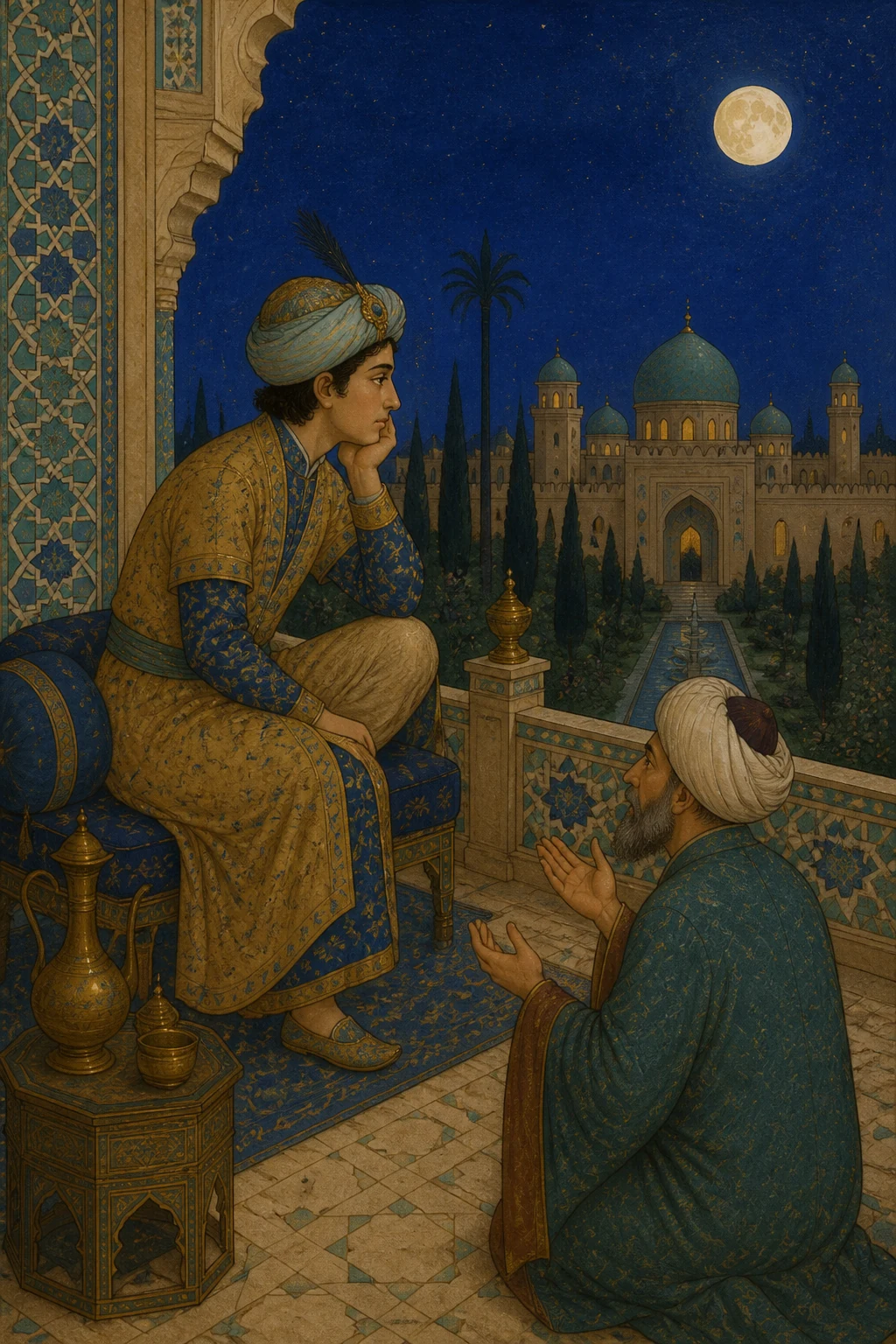
Daughter of the noble, you have attained your aim and desire. Glad tidings are yours; fear no hardship here. Today I shall gather treasures and send them to Shamikh, attended by horsemen and noble steeds. I shall send fragrant musk and brocade, white silver and gold. And my letter shall tell him that I wish to become his kinsman by marriage. Today I shall spare no effort to help you, until the one you love is near. Long ago I tasted love and learned its savor; today I pardon all who drink its cup. When he had finished his verses, he went out to his troops, summoned his vizier, and had an incalculable treasure packed for him. He ordered him to take it to King Shamikh, saying, “You must bring me a man in his service named Uns al-Wujud. Tell him, ‘He wishes to form a bond of marriage with you by marrying his daughter to Uns al-Wujud, your retainer. You must therefore send him with me, so that we may conclude his marriage to her in her father’s kingdom.’” Then King Dirbas wrote King Shamikh a letter to that effect and gave it to his vizier, charging him most emphatically to bring Uns al-Wujud. “If you do not bring him,” he said, “you will be dismissed from your office.” “I hear and obey,” answered the vizier. He set out with the gift for King Shamikh. On reaching him, he conveyed King Dirbas’s greetings and presented the letter and the gifts he had brought. When King Shamikh saw them, read the letter, and came upon the name of Uns al-Wujud, he wept bitterly and said to the envoy, “But where is Uns al-Wujud? He went away, and we do not know where he is. Bring him to me, and I will give you many times the value of the gifts you have brought.” Then he wept, moaned, and lamented, and, shedding tears, recited these verses:
Bring my beloved back to me: I have no need of wealth. I want no gifts of jewels and pearls. He was a full moon beside me, risen in the heavens of beauty. In body and spirit he surpassed all others; no gazelle could be compared with him. His figure was a willow bough whose fruits were graceful coquetry, yet no bough possesses that nature which steals men’s wits. I raised him from childhood upon the cushions of indulgence. Now I grieve for him, and my mind knows no rest. Then he turned to the vizier who had brought the gifts and the letter, and said, “Go to your master and tell him that Uns al-Wujud has been missing for a year. His lord does not know where he has gone and has no news of him.” The vizier replied, “My lord, my master told me, ‘If you do not bring him, you shall be dismissed from the vizierate, and you must not enter my city.’ How can I return to him without the man?” King Shamikh said to his vizier Ibrahim, “Go with him, taking a company of men, and search everywhere for Uns al-Wujud.” “I hear and obey,” he answered. He took a party of his retainers, joined King Dirbas’s vizier, and set out in search of Uns al-Wujud. Dawn overtook Shahrazad, and she fell silent, leaving her tale untold.
Then, when it was the three hundred and seventy-ninth night,
She said: It has reached me, O fortunate King, that Ibrahim, vizier to King Shamikh, took a party of his retainers and set out with King Dirbas’s vizier in search of Uns al-Wujud. Whenever they passed a band of Arabs or any other people, they asked about him, saying, “Has a man of such-and-such a name and such-and-such an appearance passed your way?” But the answer was, “We know nothing of him.” They went on asking in towns and villages, searching plains and rugged country, wildernesses and wastes, until they reached the seashore. There they found a boat, boarded it, and sailed until they approached the Mountain of the Bereaved Mother. King Dirbas’s vizier asked King Shamikh’s vizier, “Why is this mountain called by that name?” He answered, “Because long ago a jinniya came to dwell here. She belonged to the jinn of China, and she fell in love with a mortal man, who loved her in return. She feared her own people, and as her passion grew she searched the earth for a place where she could hide him from them. She found this mountain, cut off from humankind and jinn alike, with a path that no human or jinn could discover. She carried her beloved away and placed him here, going back to her people and returning to him in secret. She continued in this way for a long time and bore him several children on this mountain. Whenever merchants sailing by heard the children crying, their cries sounded like those of a woman bereaved of her children—that is, one who has lost them—and they would ask, ‘Is there a bereaved mother here?’” King Dirbas’s vizier marveled at this account. They continued on until they reached the palace and knocked at its door. It opened, and a servant came out, recognized Ibrahim, King Shamikh’s vizier, and kissed his hands. Ibrahim entered the palace and found a poor man among the servants in its courtyard: this was Uns al-Wujud. “Where has this man come from?” he asked. They answered, “He is a merchant whose goods were lost at sea. He escaped with his life, and he is one of those transported by divine ecstasy.” Ibrahim left him and went farther into the palace, but found no trace of his daughter. He questioned the maidservants there, and they said, “We do not know how she went away. She stayed with us only a short time.” He shed tears and recited these verses:
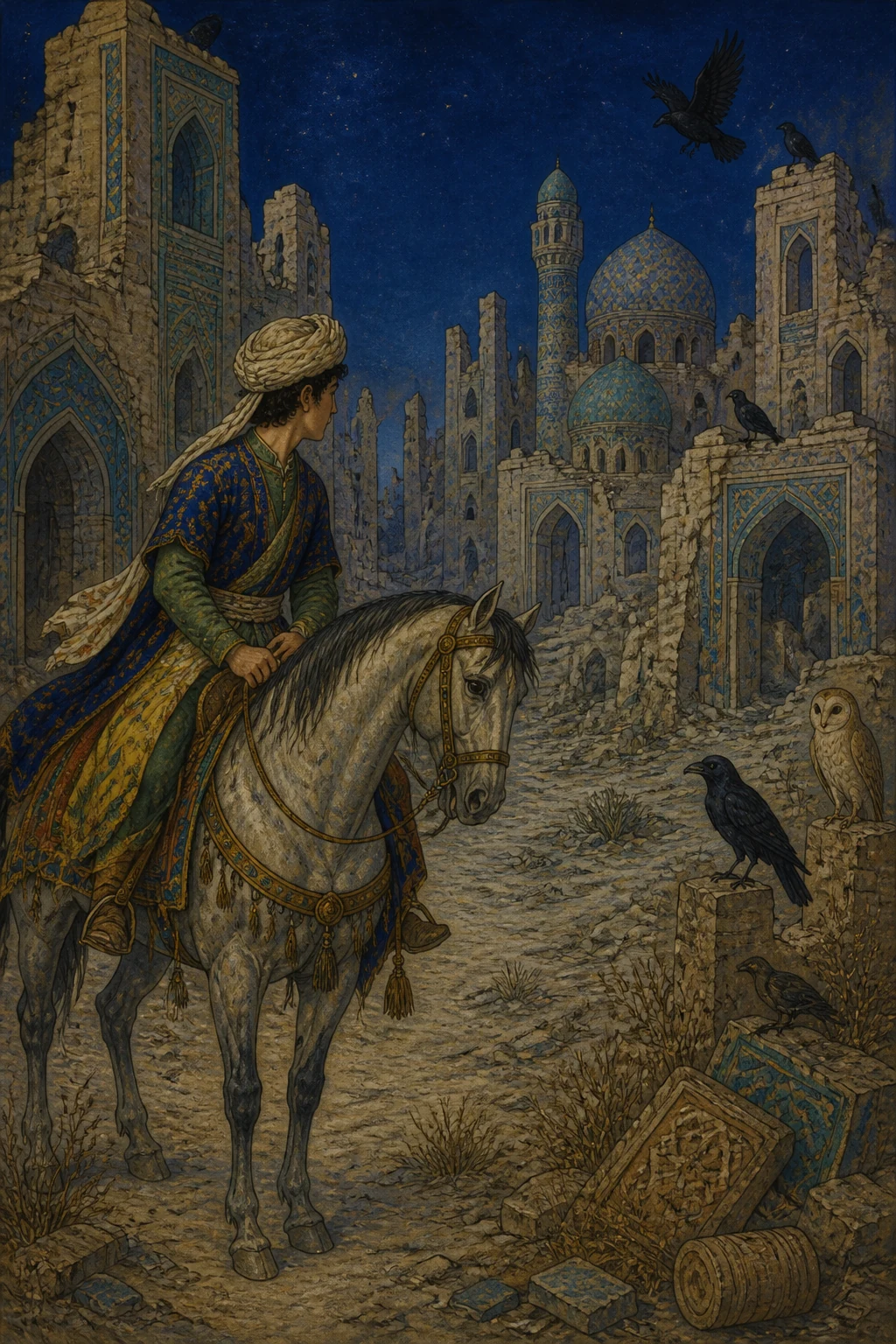
O dwelling where the birds once sang and the thresholds shone in splendor! How often a lover came here lamenting his longing and found its doors thrown open. Would that I knew where my heart’s darling has vanished, here in a house whose people have gone far away. Everything within it once was splendid; its chamberlains lived in comfort and held high rank. They clothed it in robes of fine silk. Where, I wonder, have its people gone? When he had finished his verses, he wept, moaned, and lamented, saying, “There is no remedy against God’s decree, nor any escape from what He has ordained.” Then he climbed to the palace roof and found the Baalbek cloth tied to the battlements and reaching to the ground. He knew that she had descended that way and wandered off like one distraught with love. Turning, he saw two birds there, a raven and an owl. He took them for an evil omen, heaved deep sighs, and recited these verses:
I came to the dwelling of my loved ones, hoping that their traces might quench my longing and anguish. But I found no loved ones there; I found only two ill-omened birds, a raven and an owl. And the very scene spoke: “You were unjust; you parted loving hearts. Now taste the pain of longing they have tasted, and live forever amid tears and burning grief.” Then he came down from the roof weeping. He had ordered the servants to go out onto the mountain and search for their mistress. They did so, but could not find her. Such was her case. As for Uns al-Wujud, when he learned for certain that al-Ward fi’l-Akmam had gone, he gave a mighty cry and fell unconscious. He remained in his swoon, and they supposed that a divine rapture had seized him and that he was lost in contemplation of the Almighty’s beauty. When they had despaired of finding Uns al-Wujud, and the vizier Ibrahim’s heart was consumed with the loss of his daughter al-Ward fi’l-Akmam, King Dirbas’s vizier decided to return to his own country, though his journey had failed to achieve its purpose. Ibrahim, the father of al-Ward fi’l-Akmam, began to take leave of him. King Dirbas’s vizier said, “I should like to take this poor man with me. Perhaps, through his blessing, God Most High will soften the king’s heart toward me, for he is a man transported by divine ecstasy. Afterward I shall send him to Isfahan, which is near our country.” “Do as you wish,” Ibrahim replied. Each then departed for his own land, and King Dirbas’s vizier took Uns al-Wujud with him. Dawn overtook Shahrazad, and she fell silent, leaving her tale untold.
Then, when it was the three hundred and eightieth night,
She said: It has reached me, O fortunate King, that King Dirbas’s vizier took Uns al-Wujud with him while he was still unconscious. For three days they traveled with him in that state, carrying him on mules, while he knew nothing of being carried. When he recovered, he asked, “Where am I?” They answered, “You are traveling with King Dirbas’s vizier.” Then they went to the vizier and told him that the man had awakened. He sent rosewater and sugar, which they gave him to drink, reviving him. They continued their journey until they drew near King Dirbas’s city. The king sent word to his vizier: “If Uns al-Wujud is not with you, never come into my presence.” When the vizier read the king’s command, he was greatly distressed. He did not know that al-Ward fi’l-Akmam was with the king, nor why the king had sent him to fetch Uns al-Wujud, nor why he wished to form a marriage alliance with him. Uns al-Wujud, for his part, did not know where they were taking him or that the vizier had been sent to search for him; and the vizier did not know that this man was Uns al-Wujud. Seeing that he had recovered, the vizier said to him, “The king sent me on an errand, but I have not accomplished it. When he learned that I was returning, he sent me a letter saying, ‘If the errand has not been accomplished, do not enter my city.’” “What is the king’s errand?” asked Uns al-Wujud. The vizier told him the whole story, and Uns al-Wujud said, “Have no fear. Go to the king and take me with you. I guarantee that Uns al-Wujud will come.” The vizier rejoiced. “Is what you say true?” he asked. “Yes,” he replied. The vizier mounted, took him along, and brought him to the king. When they arrived, the king asked, “Where is Uns al-Wujud?” Uns al-Wujud said, “O King, I know where Uns al-Wujud is.” The king drew him close and asked, “Where is he?” “Very near,” he answered. “But tell me what you want with him, and I will bring him before you.” “Gladly and with all honor,” said the king, “but this matter requires privacy.” He ordered everyone to withdraw and went with him into a private chamber, where he told him the story from beginning to end. Uns al-Wujud said, “Bring me fine clothes to put on, and I shall bring you Uns al-Wujud at once.” The king brought him a splendid suit of clothes. He put it on and said, “I am Uns al-Wujud, the torment of the envious.” Then, casting glances that pierced hearts, he recited these verses:
The memory of my beloved keeps me company in solitude and banishes the loneliness of separation. I have no aid but tears; when they flow from my eyes, they ease my sighing. My longing is fierce beyond compare, and strange is my condition in love and passion. I pass the night with sleepless eyes, and in love I journey between fire and paradise. Once I had gracious patience, but I have lost it; love grants me nothing save through suffering. The pain of absence has wasted my body, and longing has altered my looks and form. My eyelids are ulcerated with weeping, and I can no longer still my tears. My strength has dwindled, my heart is lost; how much anguish after anguish must I endure? My heart and head alike have grown hoary with grief for those sovereign in beauty, the fairest of all sovereigns. Against their will we were parted; they wished only to meet and be united with me. Will time, I wonder, after estrangement and separation, grant me the joy of union with those I love? Will it close the book of absence after opening it, and wipe away my suffering with the ease of reunion? Will my beloved remain beside me in our home, my companion, and my sorrow be exchanged for peace of heart? When he had finished his verses, the king said, “By God, you are two true lovers, two shining stars in the heavens of beauty! Wondrous is your story, and strange your affair.” Then he told him the whole tale of al-Ward fi’l-Akmam. “Where is she, O King of the Age?” Uns al-Wujud asked. “She is here with me,” he replied. The king summoned the judge and witnesses, had their marriage contract drawn up, and treated him with honor and generosity. Then King Dirbas sent to King Shamikh and told him all that had happened concerning Uns al-Wujud and al-Ward fi’l-Akmam. King Shamikh was overjoyed and sent a letter saying, “Since the marriage contract was concluded in your kingdom, the wedding festivities and the bridal night should take place in mine.” He made ready camels, horses, and men, and sent for the couple. When the message reached King Dirbas, he bestowed great wealth upon them and sent them off with a company of his troops. They traveled with them until they entered their own city. It was a memorable day, more splendid than any ever seen. King Shamikh gathered every kind of singer and musical entertainment, and held feasts for seven days. Each day he bestowed magnificent robes of honor upon the people and showered them with favors. Then Uns al-Wujud went in to al-Ward fi’l-Akmam and embraced her. They sat weeping from the fullness of their joy and delight, and al-Ward fi’l-Akmam recited these verses:
Joy has come, banishing care and sorrow. We are reunited, to the grief of those who envy us. The fragrant breeze of union has blown, reviving heart, inward parts, and body. The banners of companionship have appeared, and within our beating hearts the drums of glad tidings sound. Do not suppose that we weep from sorrow: we are happy, and our eyes overflow. How many terrors we have seen, now passed away! How patiently we bore all that stirred our grief! One hour of union has made us forget the dreadful hardships that turned our hair gray. When she had finished her verses, they embraced, and remained clasped in each other’s arms until they both fell unconscious. Dawn overtook Shahrazad, and she fell silent, leaving her tale untold.
Then, when it was the three hundred and eighty-first night,
She said: It has reached me, O fortunate King, that when Uns al-Wujud and al-Ward fi’l-Akmam were reunited, they embraced and remained in each other’s arms until the delight of reunion made them swoon. When they recovered, Uns al-Wujud recited these verses:
How sweet these little nights of faithfulness, now that my beloved deals kindly with me! Union follows union between us, and separation has departed altogether. Time comes hastening toward us after turning aside and forsaking us. Good fortune has raised its banners for us, and we have drunk from its pure cup. We met and told each other our sorrows and the nights we passed in estrangement. We have forgotten what is past, my lords, and the Merciful has pardoned what went before. How delightful life is, how sweet! Union has only deepened my love. When he had finished his verses, they embraced and lay down together in their privacy. They continued in intimate companionship, exchanging poems, charming tales, and stories, until they were immersed in the sea of love. Seven days passed without their knowing night from day, so great were their pleasure and delight, their serenity and joy. The seven days seemed a single day with no second to follow it, and they learned what day of the week it was only when the musicians arrived. Al-Ward fi’l-Akmam marveled greatly and recited these verses:
To the rage of the envious and the watchful, we have won all we wished from the beloved. Union has granted us embraces upon brocade and fresh silk, upon leather cushions stuffed with feathers of rare birds. We have no need of wine, for the beloved’s saliva is beyond compare. So sweet is our union that we cannot tell a distant hour from one close at hand. Seven nights have passed over us, and we never felt their passing—how wondrous! Congratulate me on our week, and say, “May God preserve your union with your beloved!” When she had finished her verses, Uns al-Wujud kissed her more than a hundred times, then recited these verses:
The day of joy has come with congratulations; my beloved has come and sheltered me from estrangement. The sweetness of her union has comforted me, and she has kept me company with subtle tenderness. She gave me the wine of intimacy until her draught made me forget existence. We rejoiced, our hearts expanded, we lay down together, and gave ourselves to drinking and song. So great is our happiness that we cannot tell the first day from the second. Happy the lover blessed with sweet union, whom joy visits as it has visited me! May he never taste the bitterness of rejection, and may my Lord favor him as He has favored me! When he had finished his verses, they rose and left their chamber. They bestowed money and robes of honor upon the people, giving freely and generously. Then al-Ward fi’l-Akmam ordered the bathhouse cleared for her, and said to Uns al-Wujud, “O delight of my eyes, I wish to see you in the bath, where we may be alone together with no one else beside us.” Her joy overflowed, and she recited these verses:
O you who took possession of me long ago, no new love could replace the old! O you whom I cannot do without, beside whom I desire no companion! Come to the bath, O light of my eyes, and let us behold paradise in the midst of hell. We shall perfume it with fragrant aloeswood until its scent spreads through the falling water. We shall forgive all time’s offenses and give thanks for the grace of our merciful Lord. And when I see you there, I shall sing, “May this bliss bring you joy, my beloved!” When she had finished her verses, they rose and went to the bathhouse, where they delighted in each other. Then they returned to their palace and dwelt there in the sweetest happiness until there came to them the Destroyer of Delights and the Disperser of Companies. Glory be to Him who neither changes nor passes away, and to whom all things return.